|
|

|
Source: Cleasby/Vigfusson, page b0605, entry 60 View original page image as: [TIFF] [PNG] [View previous entry] [View next entry] |
[Comment on this entry] [View comments] |
The following entry has been hand-corrected once. |
súsvort, f. the nightingale; einn fugl þann er heitir philomela á Látinu en á Norrænu heitir súsvort, sumir kalla ok niktigalu, Barl. 39: the word is obsolete in Icel., and the passage in Barl. stands alone in the old literature; not even does the Edda (Gl. in the list of birds) record this word; but it is preserved in provincial Norse sysvorta (sisvorta, svisvorta) = turdus torquatus, the ring ousel, Ivar Aasen: the etymology is quite uncertain.
|
Source: Cleasby/Vigfusson, page b0606, entry 23 View original page image as: [TIFF] [PNG] [View previous entry] [View next entry] |
[Comment on this entry] [View comments] |
The following entry has been hand-corrected once. |
SVANR, m., gen. svans, Pr. 478, pl. svanir; [A.S. swana; Germ. schwan; a common Teut. word, but in Icel. svanr is the poetical, álpt (q.v.) the common word] :-- a swan; svanir hvítir at lit, Stj. 90; fugls þess er s. heitir, Barl. 135; hjá söngvi svana, Edda 16 (in a verse): poët., svana beðr, fold, fjöll, dalr, strind, the swan's bed, land ..., i.e. the sea: as also svan-bekkr, svan-bingr, svan-fjöll, svan-flaug, svan-fold, svan-mjöll, svan-teigr, svan-vangr, svan-vengi, the bench, bed, fell, field, earth, snow ... of the swans, i.e. the sea, the waves, Lex. Poët. II. Svanr, as a pr. name, Landn., Hdl. COMPDS: svan-fjaðrar, f. swan's feathers, Vkv. svan-hvítr, adj., as a pr. name, Swan-white, Vkv. svan-mærr, adj. swan-bright, Ísl. ii. (in a verse). svana-söngr, m. a swan's song.
|
Source: Cleasby/Vigfusson, page b0606, entry 24 View original page image as: [TIFF] [PNG] [View previous entry] [View next entry] |
[Comment on this entry] [View comments] |
The following entry has been hand-corrected once. |
svar, n., pl. svör, a reply, answer, in ancient writers only in plur.; sagði Kári Eireki svör þeira, Nj. 137: the phrases, halda upp svörum fyrir e-n, to be one's spokesman, Fms. ii. 292, vi. 269; sitja fyrir svörum id., iv. 274, vi. 13, Band. 36 new Ed.; gjalda svör fyrir e-t, to give a reason, Barl. 91: in mod. usage also in sing.: compd, and-svör.
|
Source: Cleasby/Vigfusson, page b0609, entry 13 View original page image as: [TIFF] [PNG] [View previous entry] [View next entry] |
[Comment on this entry] [View comments] |
The following entry has been hand-corrected once. |
SVELGJA, svelg; pret. svalg, pl. sulgu; subj. sylgi; imperat. svelg; part. solginn; since it became weak, svelgðist, Bs. ii. (in a verse of the 14th century), and so in mod. usage; [A.S. swelgan; Engl. swallow, swill; Germ. schwelgen] :-- to swallow, with acc., Ýt. 4; hræ Ólafs hofgyldir svalg, 21; at jörðin sylgi hestinn, Nj. 163; mun hón solgit hafa yrmling, Fms. vi. 350; s. sinn föður-arf, Al. 114; eitt skógar-dýr svalg hann, Stj. 219; svelgja þik, Barl. 111: to swallow, svelg hrákann niðr, Pr.; svelgr hann allan Sigföðr, Ls. 58; Eljúðnir vann solginn Baldr, Mkv. 2. with dat.; ef hann svelgr niðr þeim bita, N.G.L. i. 343; þá svelgit mér sem fyrst, Barl. 54. 3. absol.; var honum bæði meint niðr at svelga, ok svá at drekka, en meinst at hósta, Bs. i. 347: to take a deep draught, hann tekr at drekka, ok svelgr allstórum, took a deep draught, Edda 32; þeir sulgu stórum, Grett. 43 new Ed.; svelgjandi eldr, Hom. 31. II. recipr. (weak); e-m svelgisk á, to go down the wrong way, Dan. faae i den vrange strube; honum svelgðist á. III. part. solginn, hungry, Hm. 32, Haustl.
|
Source: Cleasby/Vigfusson, page b0611, entry 26 View original page image as: [TIFF] [PNG] [View previous entry] [View next entry] |
[Comment on this entry] [View comments] |
The following entry has been hand-corrected once. |
SVIMMA, a defective and obsolete word, which has been superseded in Icel. by synda, q.v.; pres. svimm; pret. svamm, pl. summu; part. summit; the spelling with one m (svam, svimr) in Editions is erroneous; svimm rhymes with grimmu, Sd. (in a verse); þramma svimmi, Hallfred: 3rd pers. plur. symja, Sks. 177 B: a pret. svámu, Fms. viii. 38; subj. svæmi, Bret. 12: [A.S. swimman; Engl. swim; Germ. schwimmen; Dan. svömme] :-- to swim; svimma til lands, Fms. viii. 264; hann var því opt vanr at svim(m)a í brynju sinni, x. 314; þeir symja eigi á gráfu, heldr symja þeir opnir, Sks. 177 B; svimma hestar þeirra yfir stórar ár, Edda 8; svim(m)a í móðu marir, Fm. 15 (Bugge); svimma yfir vatnið, Al. 167; hann svim(m)r þá þangat á leið, Fbr. 104 new Ed.; svimm ek við ský, Sd. (in a verse); þess manns er í sjó svimmr, Sks. 28 new Ed. (svimar v.l.); svamm sjálfr konungr, svamm hann milli skipanna, Fms. x. 366; maðr svamm at skipinu, 367; svamm hann síðan ... er hann svamm, vii. 225; göltrinn svamm þar til er af gengu klaufirnar, Landn. 177; hann hljóp fyrir borð ok svamm til lands, Orkn. 150, Fms. viii. 291; hann svamm yfir ána með vápn sín, Bjarn. 50, Fms. vii. 123; eigi svamm ek skemra enn þú, 119; þeir summu frá landi (Cod. sumu), Eg. 593 A; svámu sumir yfir ána, Fms. viii. 380; sögðu at hann svæmi um hafit, Bret. 12; pres. subj. svimmi, Hallfred; hann mun hafa summit (for svimit, Ed.) í hólminn, Fbr. 104 new Ed.; svimmandi fiskar, Stj. 17, Barl. 22, v.l.; symjandi, v.l. 2. metaph., er áðr svimma í myrkrum, 625. 87; svimma í fullsælu, to swim in abundance, Fms. ix. 248. II. reflex., svimask í e-u, to swindle, Thom.
|
Source: Cleasby/Vigfusson, page b0614, entry 11 View original page image as: [TIFF] [PNG] [View previous entry] [View next entry] |
[Comment on this entry] [View comments] |
The following entry has been hand-corrected once. |
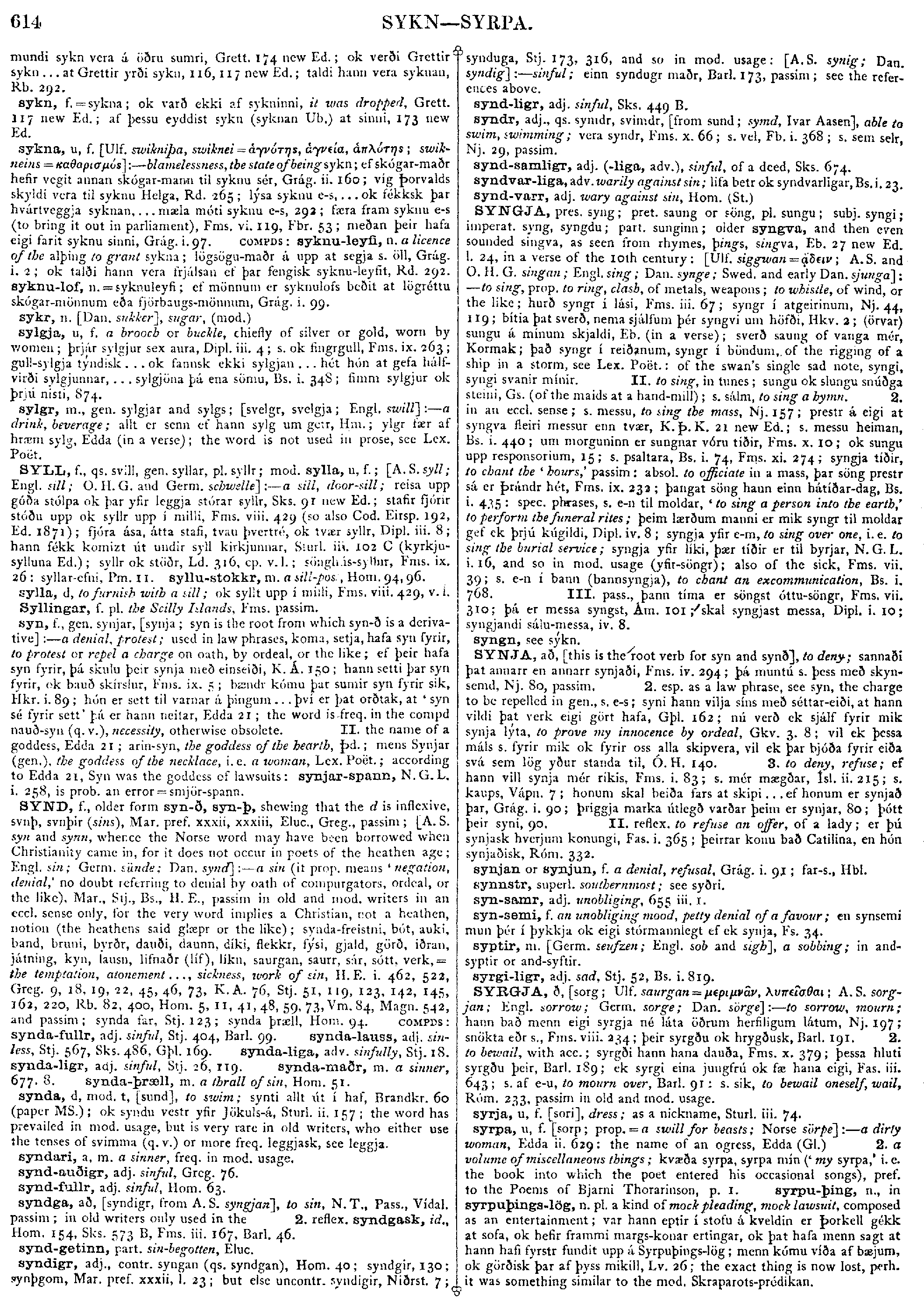
SYND, f., older form syn-ð, syn-þ, shewing that the d is inflexive, svnþ, svnþir (sins), Mar. pref. xxxii, xxxiii, Eluc., Greg., passim; [A.S. syn and synn, whence the Norse word may have been borrowed when Christianity came in, for it does not occur in poets of the heathen age; Engl. sin; Germ. sünde; Dan. synd] :-- a sin (it prop. means 'negation, denial,' no doubt referring to denial by oath of compurgators, ordeal, or the like). Mar., Stj., Bs., H.E., passim in old and mod. writers in an eccl. sense only, for the very word implies a Christian, not a heathen, notion (the heathens said glæpr or the like); synda-freistni, bót, auki, band, bruni, byrðr, dauði, daunn, díki, flekkr, fýsi, gjald, görð, iðran, játning, kyn, lausn, lifnaðr (líf), líkn, saurgan, saurr, sár, sótt, verk, = the temptation, atonement ..., sickness, work of sin, H.E. i. 462, 522, Greg. 9, 18, 19, 22, 45, 46, 73, K.Á. 76, Stj. 51, 119, 123, 142, 145, 162, 220, Rb. 82, 400, Hom. 5, 11, 41, 48, 59, 73, Vm. 84, Magn. 542, and passim; synda far, Stj. 123; synda þræll, Hom. 94. COMPDS: synda-fullr, adj. sinful, Stj. 404, Barl. 99. synda-lauss, adj. sinless, Stj. 567, Sks. 486, Gþl. 169. synda-liga, adv. sinfully, Stj. 18. synda-ligr, adj. sinful, Stj. 26, 119. synda-maðr, m. a sinner, 677. 8. synda-þræll, m. a thrall of sin, Hom. 51.
|
Source: Cleasby/Vigfusson, page b0614, entry 16 View original page image as: [TIFF] [PNG] [View previous entry] [View next entry] |
[Comment on this entry] [View comments] |
The following entry has been hand-corrected once. |
syndga, að, [syndigr, from A.S. syngjan], to sin, N.T., Pass., Vídal. passim; in old writers only used in the 2. reflex. syndgask, id., Hom. 154, Sks. 573 B, Fms. iii. 167, Barl. 46.
|
Source: Cleasby/Vigfusson, page b0614, entry 18 View original page image as: [TIFF] [PNG] [View previous entry] [View next entry] |
[Comment on this entry] [View comments] |
The following entry has been hand-corrected once. |
syndigr, adj., contr. syngan (qs. syndgan), Hom. 40; syndgir, 130; synþgom, Mar. pref. xxxii, l. 23; but else uncontr. syndigir, Niðrst. 7; synduga, Stj. 173, 316, and so in mod. usage: [A.S. synig; Dan. syndig] :-- sinful; einn syndugr maðr, Barl. 173, passim; see the references above.
|
Source: Cleasby/Vigfusson, page b0614, entry 33 View original page image as: [TIFF] [PNG] [View previous entry] [View next entry] |
[Comment on this entry] [View comments] |
The following entry has been hand-corrected once. |
SYRGJA, ð, [sorg; Ulf. saurgan = GREEK; A.S. sorgjan; Engl. sorrow; Germ. sorge; Dan. sörge] :-- to sorrow, mourn; hann bað menn eigi syrgja né láta öðrum herfiligum látum, Nj. 197; snökta eðr s., Fms. viii. 234; þeir syrgðu ok hrygðusk, Barl. 191. 2. to bewail, with acc.; syrgði hann hana dauða, Fms. x. 379; þessa hluti syrgðu þeir, Barl. 189; ek syrgi eina jungfrú ok fæ hana eigi, Fas. iii. 643; s. af e-u, to mourn over, Barl. 91: s. sik, to bewail oneself, wail, Róm. 233, passim in old and mod. usage.
|
Source: Cleasby/Vigfusson, page b0615, entry 7 View original page image as: [TIFF] [PNG] [View previous entry] [View next entry] |
[Comment on this entry] [View comments] |
The following entry has been hand-corrected once. |
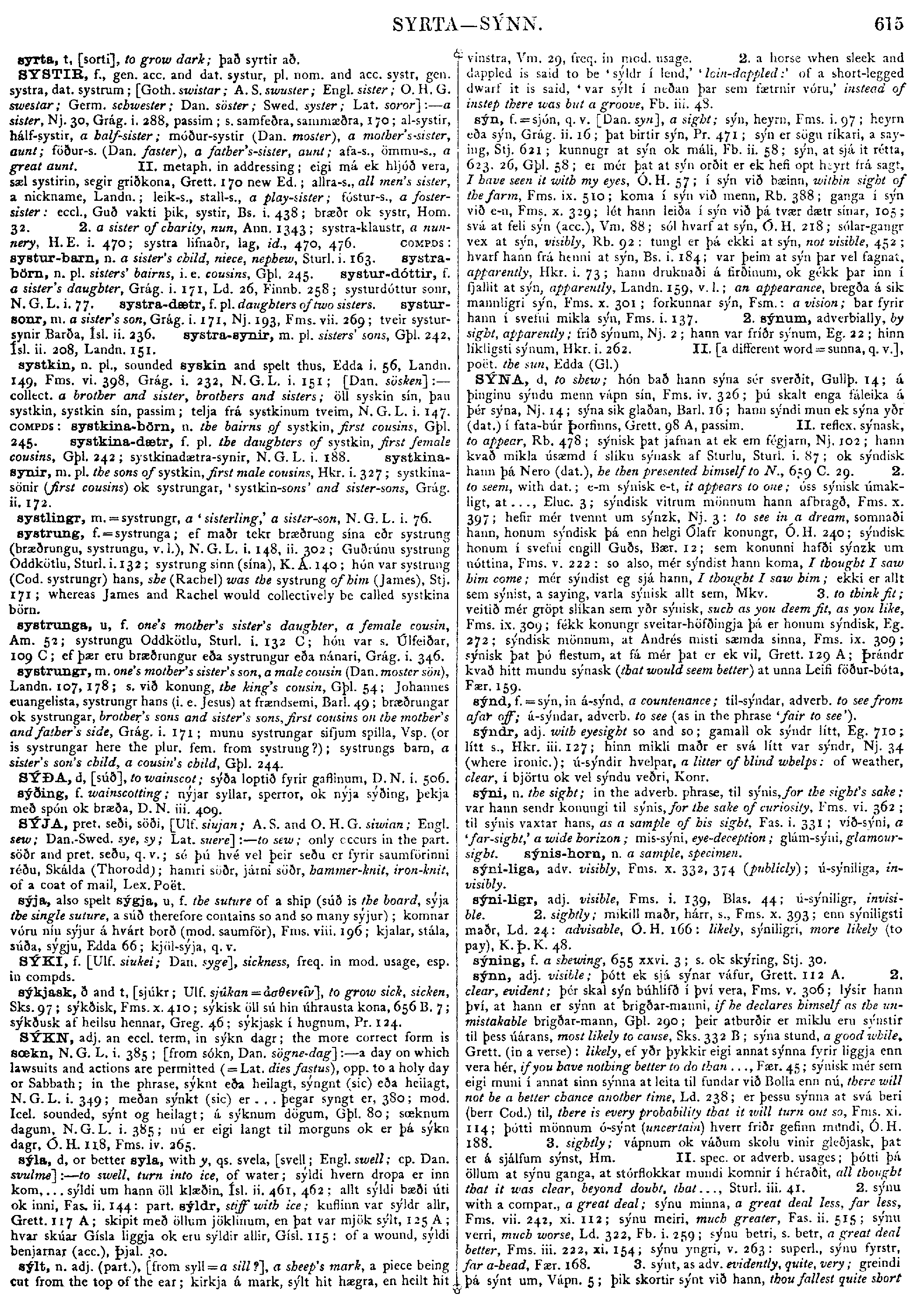
systrungr, m. one's mother's sister's son, a male cousin (Dan. moster sön), Landn. 107, 178; s. við konung, the king's cousin, Gþl. 54; Johannes euangelista, systrungr hans (i.e. Jesus) at frændsemi, Barl. 49; bræðrungar ok systrungar, brother's sons and sister's sons, first cousins on the mother's and father's side, Grág. i. 171; munu systrungar sifjum spilla, Vsp. (or is systrungar here the plur. fem, from systrung?); systrungs barn, a sister's son's child, a cousin's child, Gþl. 244.
| Result Page: |  |
Previous | 41 42 43 44 45 46 47 48 49 50 51 52 53 54 55 56 57 58 59 | Next |  |
Germanic Lexicon Project (main page)
This search system was written by
Sean Crist
Please consider
volunteering
to correct the data in these online dictionaries.
No rights reserved. Feel free to use these data in any way you please.