|
|

|
Source: Bosworth/Toller, page b0048, entry 17 View original page image as: [TIFF] [PNG] [View previous entry] [View next entry] |
[Comment on this entry] [View comments] |
The following entry has been hand-corrected once. |
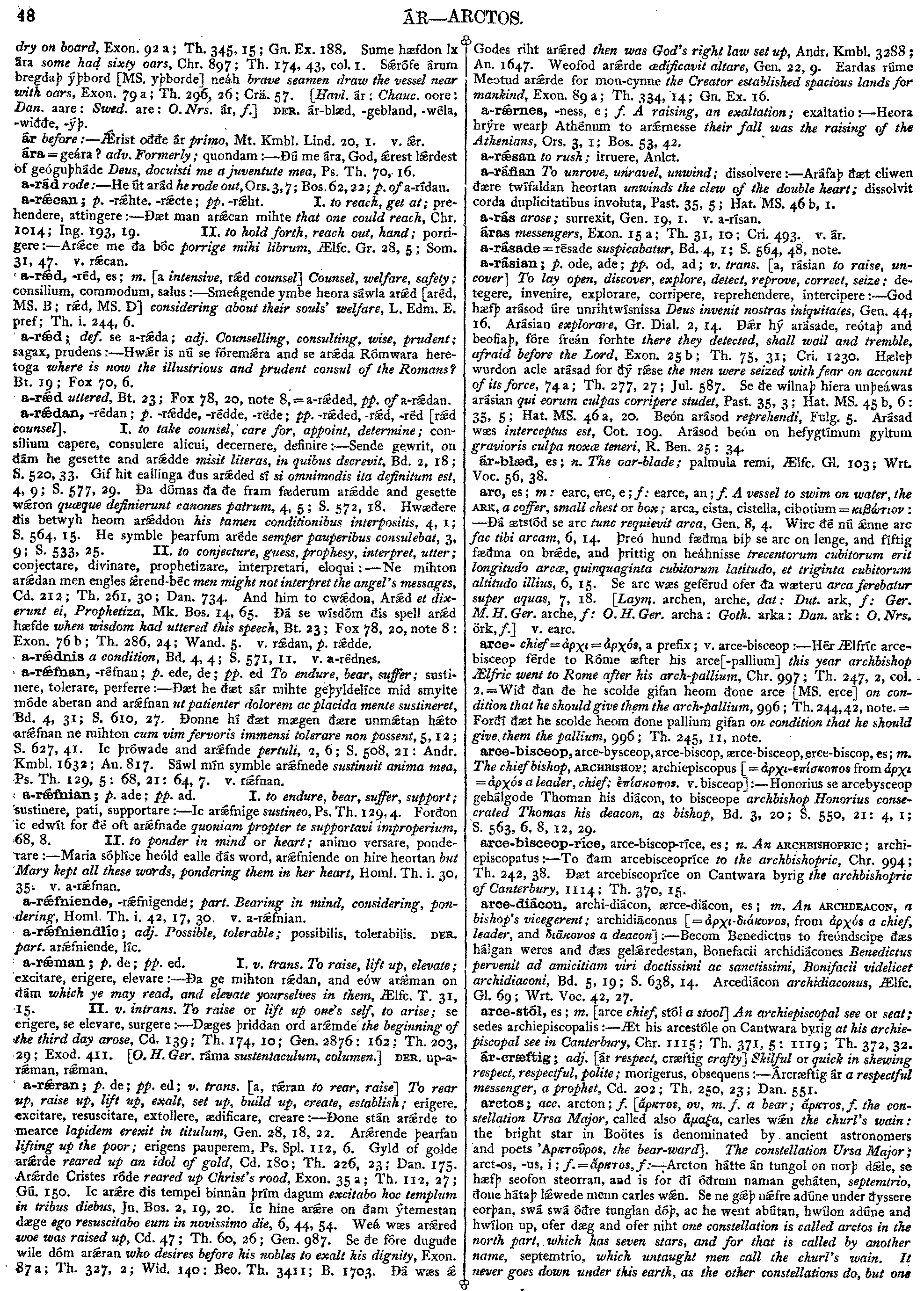
a-r rnes,
-ness,
e;
f.
A
raising,
an
exaltation;
exaltatio
:--
Heora
hrýre
wearþ
Athénum
to
arrnesse
their
fall
was
the
raising
of
the
Athenians,
Ors.
3,
1;
Bos.
53,
42.
rnes,
-ness,
e;
f.
A
raising,
an
exaltation;
exaltatio
:--
Heora
hrýre
wearþ
Athénum
to
arrnesse
their
fall
was
the
raising
of
the
Athenians,
Ors.
3,
1;
Bos.
53,
42.
|
Source: Bosworth/Toller, page b0164, entry 4 View original page image as: [TIFF] [PNG] [View previous entry] [View next entry] |
[Comment on this entry] [View comments (1)] |
The following entry has been hand-corrected once. |
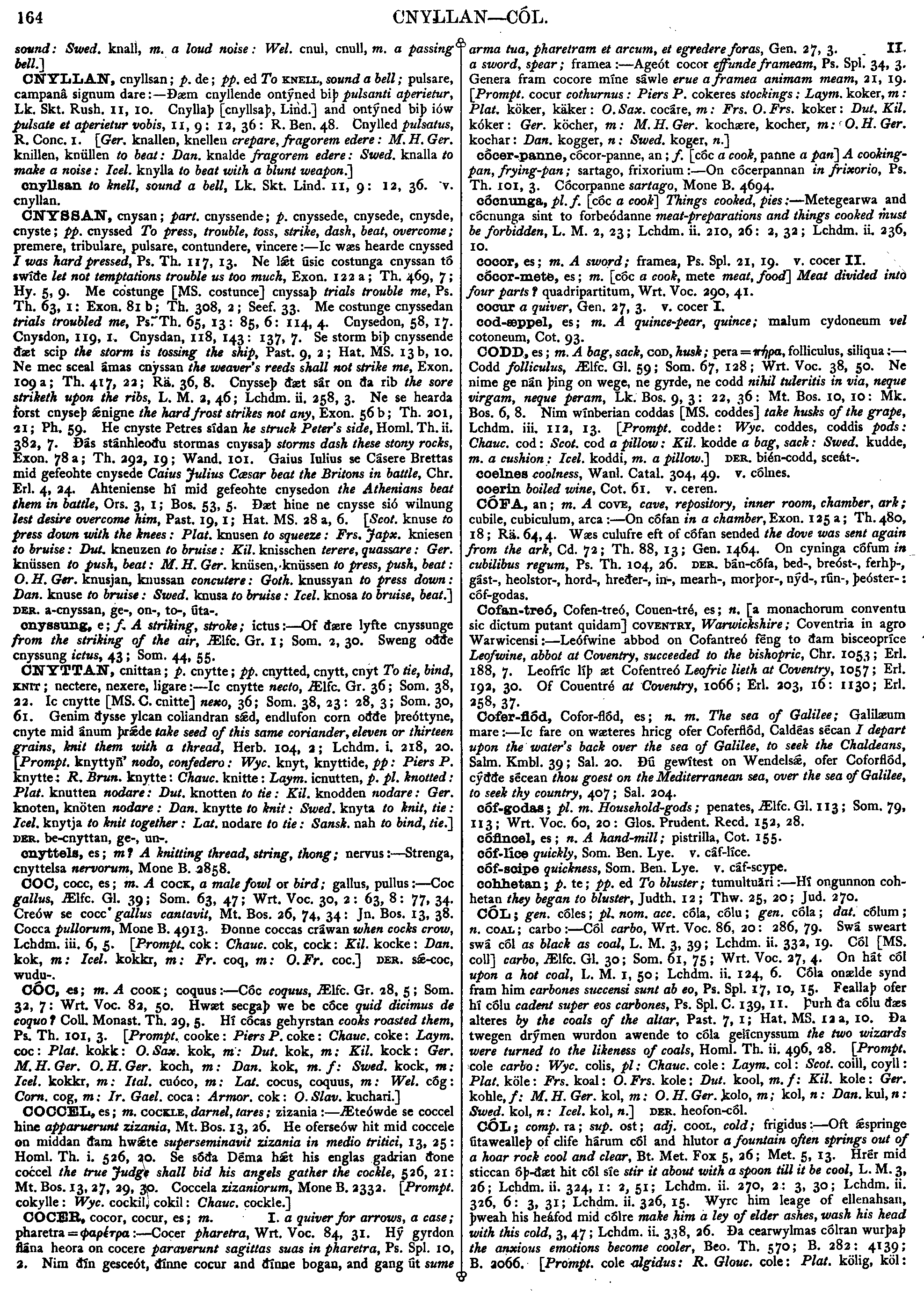
CNYSSAN,
cnysan;
part.
cnyssende;
p.
cnyssede,
cnysede,
cnysde,
cnyste;
pp.
cnyssed
To
press,
trouble,
toss,
strike,
dash,
beat,
overcome;
premere,
tribulare,
pulsare,
contundere,
vincere
:--
Ic
wæs
hearde
cnyssed
I
was
hard
pressed,
Ps.
Th.
117,
13.
Ne
lt
úsic
costunga
cnyssan
tó
swíðe
let
not
temptations
trouble
us
too
much,
Exon.
122a;
Th.
469,
7;
Hy.
5,
9.
Me
costunge
[MS.
costunce]
cnyssaþ
trials
trouble
me,
Ps.
Th.
63,
1:
Exon.
81b;
Th.
308,
2;
Seef.
33.
Me
costunge
cnyssedan
trials
troubled
me,
Ps.
Th.
65,
13:
85,
6:
114,
4.
Cnysedon,
58,
17.
Cnysdon,
119,
1.
Cnysdan,
118,
143:
137,
7.
Se
storm
biþ
cnyssende
ðæt
scip
the
storm
is
tossing
the
ship,
Past.
9,
2;
Hat.
MS.
13b,
10.
Ne
mec
sceal
ámas
cnyssan
the
weaver's
reeds
shall
not
strike
me,
Exon.
109a;
Th.
417,
22;
Rä.
36,
8.
Cnysseþ
ðæt
sár
on
ða
rib
the
sore
striketh
upon
the
ribs,
L.
M.
2,
46;
Lchdm.
ii.
258,
3.
Ne
se
hearda
forst
cnyseþ
nigne
the
hard
frost
strikes
not
any,
Exon.
56b;
Th.
201,
21;
Ph.
59.
He
cnyste
Petres
sídan
he
struck
Peter's
side,
Homl.
Th.
ii.
382,
7.
Ðás
stánhleoðu
stormas
cnyssaþ
storms
dash
these
stony
rocks,
Exon.
78a;
Th.
292,
19;
Wand.
101.
Gaius
Inlius
se
Cásere
Brettas
mid
gefeohte
cnysede
Caius
Julius
Ctesar
beat
the
Britons
in
battle,
Chr.
Erl.
4,
24.
Ahteniense
bí
mid
gefeohte
cnysedon
the
Athenians
beat
them
in
battle,
Ors.
3,
1;
Bos.
53,
5.
Ðæt
hine
ne
cnysse
sió
wilnung
lest
desire
overcome
him,
Past.
19,
1;
Hat.
MS.
28a,
6.
[Scot.
knuse
to
press
down
with
the
knees:
Plat.
knusen
to
squeeze:
Frs.
Japx.
kniesen
to
bruise:
Dut.
kneuzen
to
bruise:
Kil.
knisschen
terere,
quassare:
Ger.
knüssen
to
push,
beat:
M.
H.
Ger.
knüsen,
knüssen
to
press,
push,
beat:
O.
H.
Ger.
knusjan,
kimssan
concutere:
Goth.
knussyan
to
press
down:
Dan.
knuse
to
bruise:
Swed.
knusa
to
bruise:
Icel.
knosa
to
bruise,
beat.]
DER.
a-cnyssan,
ge-,
on-,
to-,
úta-.
|
Source: Bosworth/Toller, page d0055, entry 10 View original page image as: [TIFF] [PNG] [View previous entry] [View next entry] |
[Comment on this entry] [View comments] |
The following entry has been hand-corrected once. |
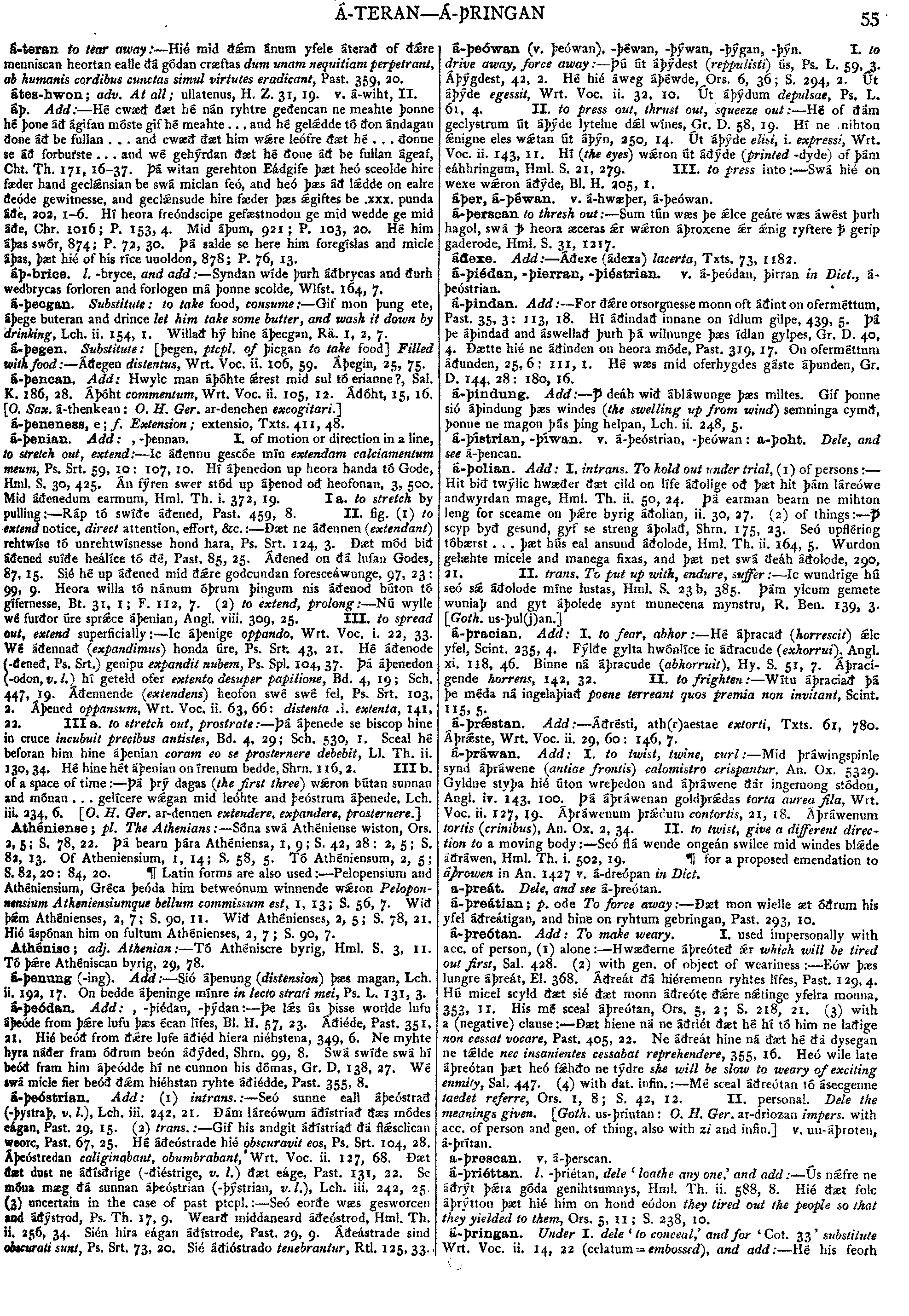
Athéniense
;
pl.
The
Athenians
:--Sóna
swá
Athgniense
wiston,
Ors.
2,
5
;
S.
78,
22.
Þá
bearn
þára
Athéniensa,
l,
9
;
S.
42,
28
:
2,
5
;
S.
82,
13.
Of
Atheniensium,
l,
14
;
S.
58,
5.
Tó
Athéniensum,
2,
5
;
S.
82,
20
:
84,
20.

Latin
forms
are
also
used
:--Pelopensium
and
Athéniensium,
Gréca
þeóda
him
betweónum
winnende
wron
Peloponnensium
Atheniensiumque
bellum
commissum
est,
l,
13
;
S.
56,
7.
Wið
þm
Athénienses,
2,
7
;
S.
90,
II.
Wið
Athénienses,
2,
5
;
S.
78,
21.
Hié
áspðnan
him
on
fultum
Athénienses,
2,
7
;
S.
90,
7.
|
Source: Cleasby/Vigfusson, page b0407, entry 7 View original page image as: [TIFF] [PNG] [View previous entry] [View next entry] |
[Comment on this entry] [View comments] |
The following entry has not been hand-corrected. However, the page is reserved and someone is correcting it. |
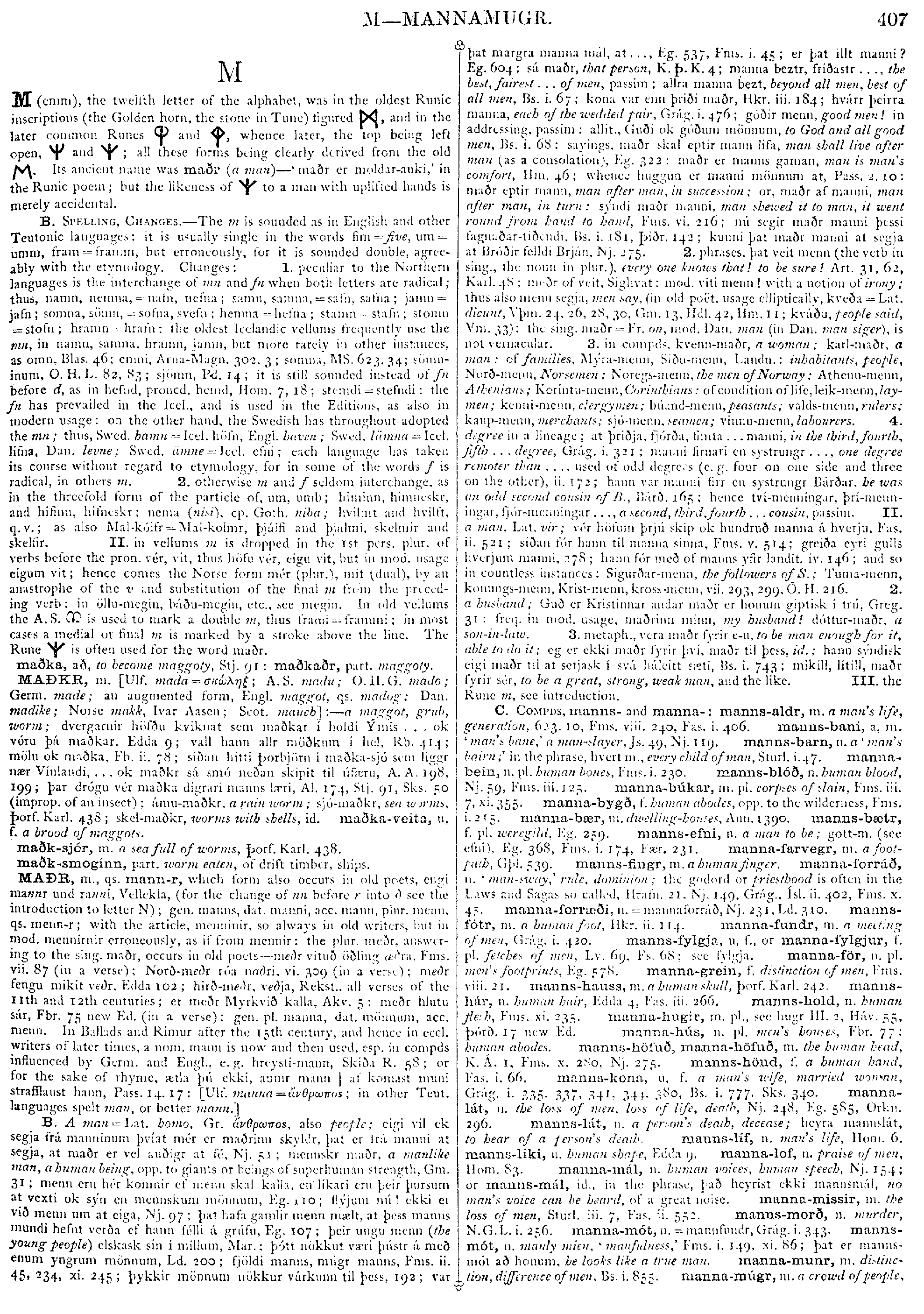
MAÐR, m., qs. mann-r, which form also occurs in old poets, cr. !'i mattnr und nrini, velltkla, (for the change of nn before r into ') see the introduction to letter N); gen. nianns, dat. maiuii, acc. maun, plur. menu, qs. menn-r; with the article, menninir, so always in old writers, but in mod. mennirnir erroneously, as if from niennir: the plur. meðr. answer- ing to the sing, maðr, occurs in old poets -- m e f)r vituð öðlin:; rfj-'Va, P'ms. vii. 87 (in a verse); Norð-m e()r róa nnf)ri. vi. 309 (in a verse); m?()r fengu mikit ve*)r, Edda 102; hirð-m e dr, v e dja, Rekst., all verses of the Ilth and 12th centuries; er ineîSr Myrkvið kalla, Akv. 5: meðr hlutu sár, Fbr. 75 new Ed. (in a verse): gen. pl. manna, dat. iiuiiinmn, acc. menu. In Ballads and Rimur after the 15th century, and hence in eccl. writers of later times, a noni. mann is now and then used, esp. in compels influenced by Germ, and Engl., e. g. hreysti-mann, Skiða R. 58; or for the sake of rhyme, ætla Ju'i ekki, aumr maim | af koinast muni strafflaust hann, Pass. 14. 17: [Ulf. manna = ('w6paiiros; in other Teut. languages spelt man, or better mann. '] B. A man -- Lat. bomo, Gr. avOpu-rros, also people; eigi vil ek segja frá manninum þvíat mér er niaðrinn skyKlr, þat er frá nianni at segja, at maðr er vel auðigr at K, Nj. s; j; n:cnnskr niaðr, a manlike man, ahnman being, opp. to giants or beings of superhuman strength. Gin. 31; menu eru her koinnir ef menu skal kalla, en líkari crn þeir þursum at vexti ok sy'n en mennskum monnum, Eg. ïio; flvjuin mi! ekki er við menn um at eiga, Nj. 97; bat hafa ganilir menn niælî, at þess maims mundi hefnt verôa cf hann fï'lli á gn'tfu, Eg. 107; þeir UUEJU menn (the young people) elskask sin í millum, Mar.; þótt nökkut væri þústr á með enum yngrum münnum, Ld. -200; fjöldi manns, múgr manns, Ems. ii. 45i 234, xi. 245; þykkir mönnum nükkur várkunn til þess, 192; var bat niargra manna nuii, at..., Eg. 537, Eniï. i. 45; er þat illt manni ? Eg. 604; sá maðr, that person, K. p. K. 4; manna beztr, fríðastr ..., the best, fairest... of men, passim; allra manna bezt, beyond all men, best of all men, Bs. i. 67; kona var enn þriði maðr, Hkr. iii. 184; hvárr þeirra manna, each ofthe wedded fair. Gray;, i. 476; góðir menu, good men ! in addressing, passim: allit., Guði ok gúðuni niönnum, to God and all good men, Bs. i. 68: sayings, maðr skal eptir mann lifa, man shall live after man (as a consolation), Eg. 322: maðr er maims gaman, man is man's comfort, 11111. 46; whence huggun er manni monnum at, Pass. 2. 10: maðr eptir mann, man after man, in succession; or, niaðr af manni, man after man, in turn: svndi maðr manni, man shewed it to man, it went round from band to hand, Ems. vi. 216; mi segir maðr manni þessi iagnaðar-tiðendi. Bs. i. 181, foiðr. 142; kunni þat inaðr manni at segja at Bróöir felldi Brjan, Nj. 275. 2. phrases, þat veil menu (the verb in sing., the noun in plur.), every one knows that! to be sure ! Art. 31, 62, Karl. 48; nicôr of veil, Sighvat: mod. viti menn ! with a notion of irony; thus also menu segja, men say, (in old pout, usage elliptically, kveða -- Lat. dicunt, Ybm. 24, 26, 28, 30. Gin. 13, lldl. 42, llni. í I; k'iib'J, people said, Ym. 33): the sing, maör -- Er. on, mod. Dan. man (in Dan. man siger), is not vernacular. 3. in compds. kvenn-maðr, a woman; karl-maðr, a man: (. ii families, Alyra-inenn, Síðu-nicnn, Landn.: inhabitants, people, Norð-menu, Norsemen; Noregs-ineni), / he men of Norway; Athenu-nienn, Athenians; Kcrintu-meim. Oj rin/ h iVi ns; of condition of life, leik-menn, lay- m ew; kenni-ineun, clergymen; biiand-rncnn, pea s ants; valds-rncnn, rulers; kaup-nienn, merchants; sjo-inenn, seamen; vinnu-inenn, labourers. 4. degree in a lineage: at þriðja, fjóröa, iînita ... manni, in the third, fourth, fifth ... degree, Gn'ig. i. 321; manni firnari en systrungr ..., one degree remoter than ... . used ot odd degrees (e. g. four on one side and three on the other), ii. 172; hann var manni firr en systrungr Bárðar, hewax an oild iccond cousin of 1!. . lîárð. 165; hence tvi-inenningar, þrí-incnn- ingar, fjor-menningar ..., a second, third, fourth ... cousin, passim. II. a man. Lat. vir; vi'-r liofum brjii skip ok hundruð manna á hverju. Eas. ii. 521; síðan tor hann til manna sinna, Fms. v. 514; grciða e)-ri gulls hverjum manni,, 178; hann for nicð of maims yfir landit, iv. 146; and so in countless instances: Sigurðar-menn, the followers ofS.; Tuina-ineiin, konungb-inenn, Krist-menn, kross-inenn, vii. 293, 299, 0. II. 216. 2. a husband; Guð er Kristinnar andar inaðr er honum giptisk í tru, Greg. 31: freq. in mod. usage, maðrinn minii, w y husband! dóttur-maðr, a son-in-law. 3. metaph., vera maðr fyrir e-u, to be man enough for it, able to do it; eg er ekki maðr f-rir því, inaðr til þess, id.; hann svndisk eigi maðr til at setja. sk í svá háíeitt sreti, Bs. i. 743; mikill, lítill, niaðr fyrir sur, to be a great, strong, weak man, and the like. III. the Rune m, see introduction. C. COMPDS, inarms- and manna-: manns-aldr, in. a man's life, generation. 6. ', 3. 10, Ems. viii. 240, Eas. i. 406. mauns-bani, a, in. ' man's bane, ' a man-slayer. Js. 49, Ni. 119. manns-barn, n. a ' man's bairn;' in the phrase, hvert in., every child of man, Stud. 1. 47. maniia- bein, n. pl. human bones, Fms. i. 230. manns-blóð, n. human blood, Nj. 59, Ems. iii. j 25. manna-bukar, m. pl. corpses of slain, Ems. iii. 7' x'- 355- manna-bygð, f. human abodes, opp. to the wilderness, Ems. i. 2 15. marma-bter, in. tlwclling-bo;i?ef, Ann. 1390. manns-bsotr, f. pl. weregrlil. Eg. 259. manns-efni, n. a;;; an to be; gott-m. (see efni Eg. 368, Ems. i. 174, Eær. 231. manna-farvegr, in. a foot- pa:h, ('îþi. 539. manns-fmgr, m. a human finger. nianna-forráð, n. ' man-sway ' rule, dominion; the g^dord or priesthood is often in the Laws and Sagas so called, Hrafn. 21, Nj. 149, Gn'ig., Ísl. ii. 402, Ems. x. 45. manna-forrœði. n. -- niannaforráð, Nj. 231, Ld. 3. 10. manns- fótr, m. a human foot, Hkr. ii. 114. inaiina-fundr, m. a meeting of men, (în'ig. i. 420. manns-fylgja, u, f., or manna-i'ylgjur, f. pl. fetches of men, I. v. 69, Es. 68; see íylgja. manna-för, n. pl. men's footprints, Eg. 578. manna-grein, f. distinction of men, Ems. viii. 21. inanns-hauss, m. a human skull, borf. Karl. 242. manns- liar, n. human hair, Edda 4, Eas. iii. 266. manns-hold, n. human Jie:h, Ems. xi. 235. manna-hugir, m. pl., see hugr III. 2, lláv. 55, Jjórð. 17 new Ed. manna-hús, n. pl. men's bonset, Fbr. 77: human abodes. manns-höíuð, manna-höfuð, m. (he human head, K. Á. i. Ems. x. 280, Nj. 275. manns-hönd, f. a human hand, Fas. i. 66. mo. nua-kona, u, f. a man's wife, married w)ii*nn, Gn'ig. i. 335. 337, 34r, 341, 380, Bs. i. 777, Sks. 340. manna- lát, n. the loss of men. loss af life, death, Nj. 248, Eg. 585, Orkn. 296. marms-lát, n. a person's death, decease; heyra inannslut, to bear of a person's ch-atb. raanns-lif, n. man's life, Honi. 6. manns-liki, n. human shape, Edda 9. manna-lof, n. praise of men, Hom. 83. manna-inal, n. human voices, human speech, Nj. 154; or manns-rnal, id., in the phrase, að heyrist ekki inanusmal, no man's voice can be heard, of a great noise. inanna-missir, in. the loss of men, Sturl. iii. 7, Eas. ii. 552. manns-morð, n. murder, N. G. L. i. 256. manna-mót, n. -- mar. nfuudr, (jrag. i. 343. manns- mót, n. manly mien, ' manfnlness, ' Ems. i. 149, xi. 86; þat er inanns- niót að honum, he looks like a true man. manna-munr, m. distinc- ^ /ion, difference of men. 13s. i. 85. 5. mauna-mxigr, m. a crcwd of people.
|
Source: Cleasby/Vigfusson, page b0470, entry 21 View original page image as: [TIFF] [PNG] [View previous entry] [View next entry] |
[Comment on this entry] [View comments] |
The following entry has been hand-corrected once. |
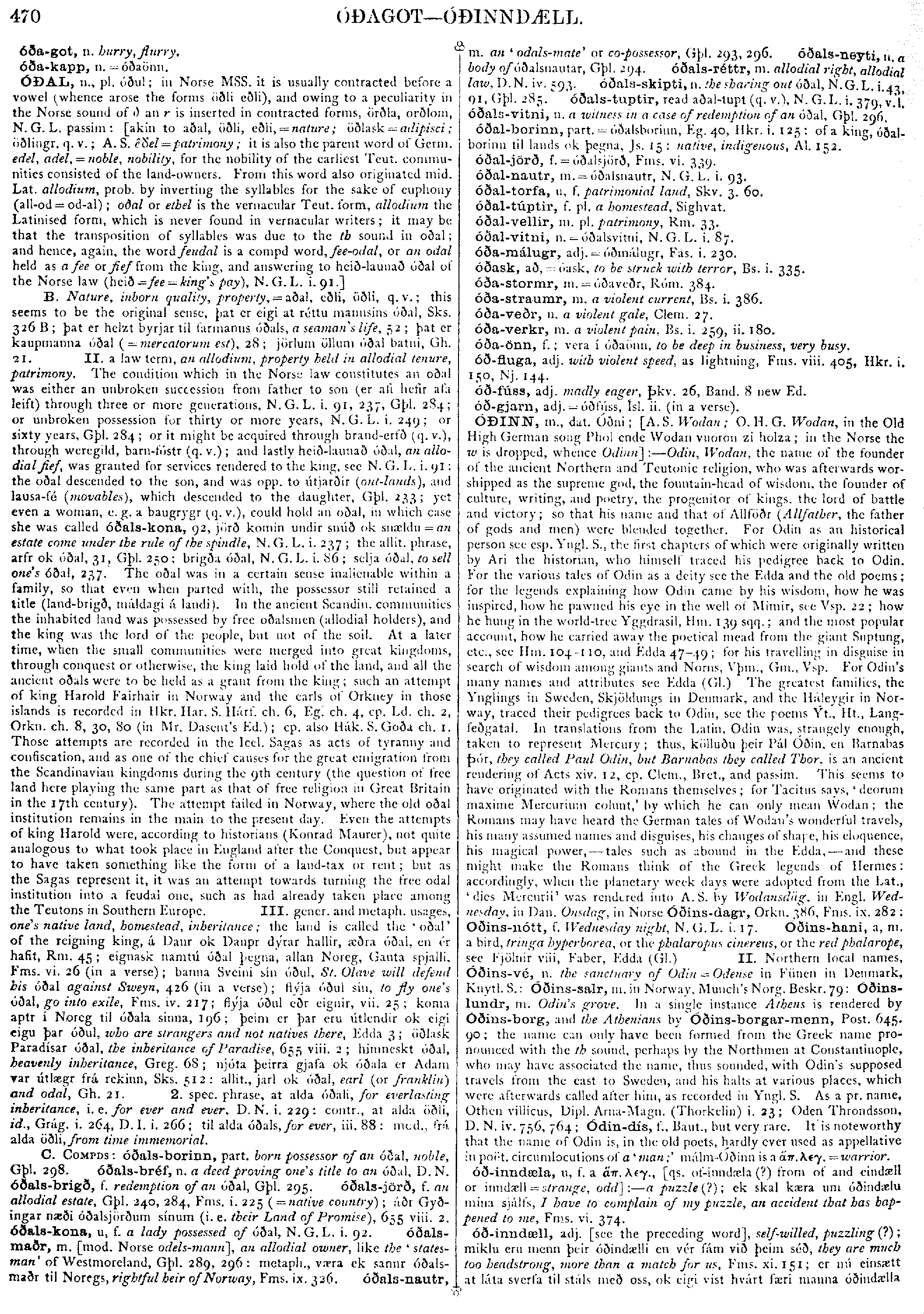
ÓÐINN, m., dat. Óðni; [A.S. Wodan; O.H.G. Wodan, in the Old High German song Phol ende Wodan vuoron zi holza; in the Norse the w is dropped, whence Odinn] :-- Odin, Wodan, the name of the founder of the ancient Northern and Teutonic religion, who was afterwards worshipped as the supreme god, the fountain-head of wisdom, the founder of culture, writing, and poetry, the progenitor of kings, the lord of battle and victory; so that his name and that of Allföðr (Allfather, the father of gods and men) were blended together. For Odin as an historical person see esp. Yngl. S., the first chapters of which were originally written by Ari the historian, who himself traced his pedigree back to Odin. For the various tales of Odin as a deity see the Edda and the old poems; for the legends explaining how Odin came by his wisdom, how he was inspired, how he pawned his eye in the well of Mimir, see Vsp. 22; how he hung in the world-tree Yggdrasil, Hm. 139 sqq.; and the most popular account, how he carried away the poetical mead from the giant Suptung, etc., see Hm. 104-110. and Edda 47-49; for his travelling in disguise in search of wisdom among giants and Norns, Vþm., Gm., Vsp. For Odin's many names and attributes see Edda (Gl.) The greatest families, the Ynglings in Sweden, Skjöldungs in Denmark, and the Háleygir in Norway, traced their pedigrees back to Odin, see the poems Ýt., Ht., Langfeðgatal. In translations from the Latin, Odin was, strangely enough, taken to represent Mercury; thus, kölluðu þeir Pál Óðin, en Barnabas Þór, they called Paul Odin, but Barnabas they called Thor, is an ancient rendering of Acts xiv. 12, cp. Clem., Bret., and passim. This seems to have originated with the Romans themselves; for Tacitus says, 'deorum maxime Mercurium colunt,' by which he can only mean Wodan; the Romans may have heard the German tales of Wodan's wonderful travels, his many assumed names and disguises, his changes of shape, his eloquence, his magical power, -- tales such as abound in the Edda, -- and these might make the Romans think of the Greek legends of Hermes: accordingly, when the planetary week days were adopted from the Lat., 'dies Mercurii' was rendered into A.S. by Wodansdäg, in Engl. Wednesday, in Dan. Onsdag, in Norse Óðins-dagr, Orkn. 386, Fms. ix. 282: Óðins-nótt, f. Wednesday night, N.G.L. i. 17. Óðins-hani, a, m. a bird, tringa hyperborea, or the phalaropus cinereus, or the red phalarope, see Fjölnir viii, Faber, Edda (Gl.) II. Northern local names, Óðins-vé, n. the sanctuary of Odin = Odense in Fünen in Denmark, Knytl. S.: Óðins-salr, m. in Norway. Munch's Norg. Beskr. 79: Óðins-lundr, m. Odin's grove. In a single instance Athens is rendered by Óðins-borg, and the Athenians by Óðins-borgar-menn, Post. 645. 90; the name can only have been formed from the Greek name pronounced with the th sound, perhaps by the Northmen at Constantinople, who may have associated the name, thus sounded, with Odin's supposed travels from the east to Sweden, and his halts at various places, which were afterwards called after him, as recorded in Yngl. S. As a pr. name, Othen villicus, Dipl. Arna-Magn. (Thorkelin) i. 23; Oden Throndsson, D.N. iv. 756, 764; Ódin-dís, f., Baut., but very rare. It is noteworthy that the name of Odin is, in the old poets, hardly ever used as appellative in poët. circumlocutions of a 'man;' málm-Óðinn is a GREEK = warrior.
Germanic Lexicon Project (main page)
This search system was written by
Sean Crist
Please consider
volunteering
to correct the data in these online dictionaries.
No rights reserved. Feel free to use these data in any way you please.