|
|

Tip: In the search results, you can click on any word or abbreviation for more information.
|
Source: Bosworth/Toller, page b0035, entry 27 View original page image as: [TIFF] [PNG] [View previous entry] [View next entry] |
[Comment on this entry] [View comments] |
The following entry has been hand-corrected once. |
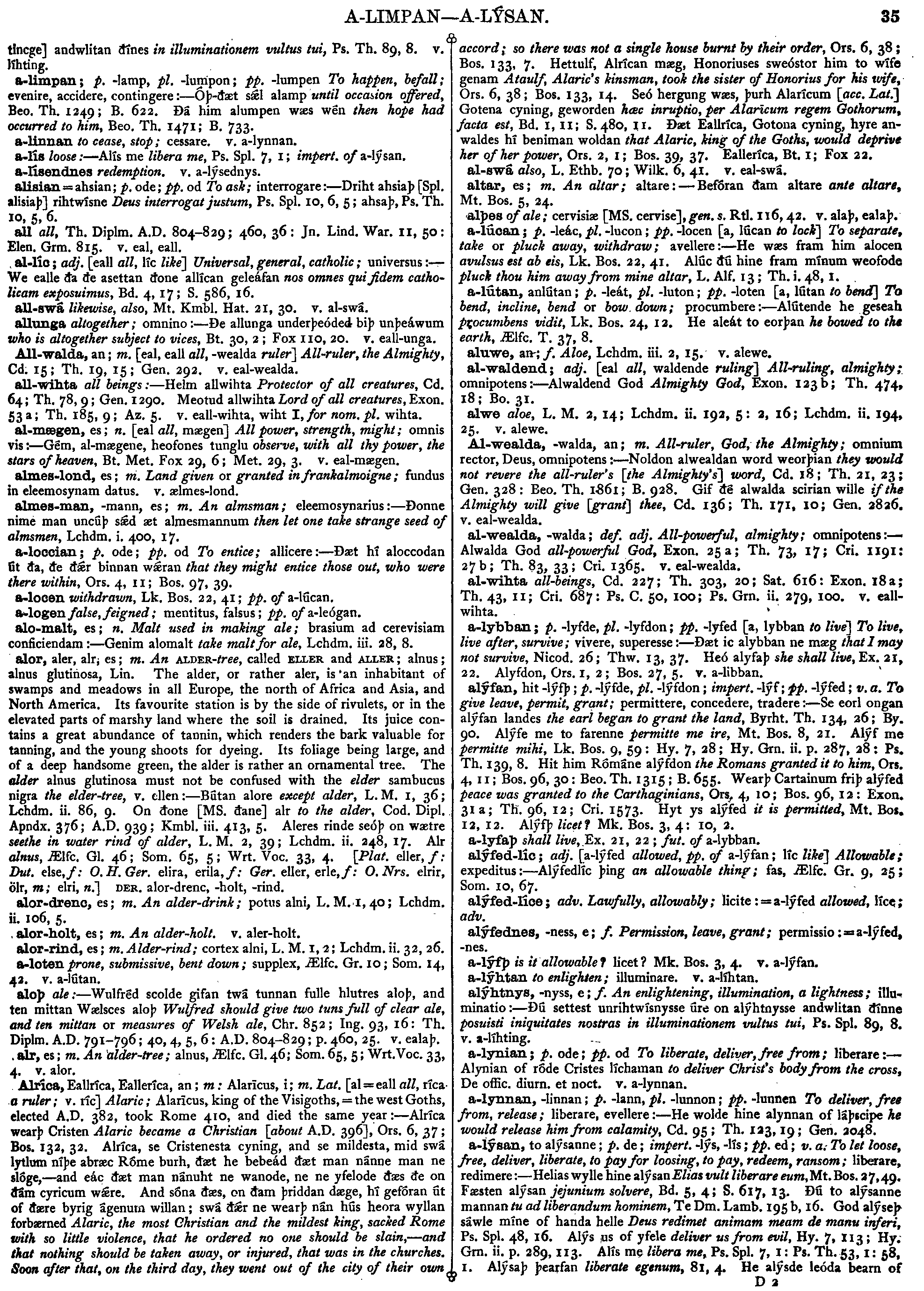
Alríca,
Eallríca,
Ealleríca,
an;
m:
Alarícus,
i;
m.
Lot.
[al=eall
all,
ríca
a
ruler;
v.
ríc]
Alaric;
Alarícus,
king
of
the
Visigoths,
=
the
west
Goths,
elected
A.D.
382,
took
Rome
410,
and
died
the
same
year
:--
Alríca
wearþ
Cristen
Alaric
became
a
Christian
[about
A.
D.
396],
Ors.
6,
37;
Bos.
132,
32.
Alrica,
se
Cristenesta
cyning,
and
se
mildesta,
mid
swá
lytlum
níþe
abræc
Róme
burh,
ðæt
he
bebeád
ðæt
man
nánne
man
ne
slóge,
--
and
eác
ðæt
man
nánuht
ne
wanode,
ne
ne
yfelode
ðæs
ðe
on
ðám
cyricum
w re.
And
sóna
ðæs,
on
ðam
þriddan
dæge,
hí
gefóran
út
of
ðære
byrig
ágenum
willan;
swá
ðr
ne
wearþ
nán
hús
heora
wyllan
forbærned
Alaric,
the
most
Christian
and
the
mildest
king,
sacked
Rome
with
so
little
violence,
that
he
ordered
no
one
should
be
slain,
--
and
that
nothing
should
be
taken
away,
or
injured,
that
was
in
the
churches.
Soon
after
that,
on
the
third
day,
they
went
out
of
the
city
of
their
own
accord;
so
there
was
not
a
single
house
burnt
by
their
order.
Ors.
6,
38;
Bos.
133,
7.
Hettulf,
Alrícan
mæg,
Honoriuses
sweóstor
him
to
wífe
genam
Ataulf,
Alaric's
kinsman,
took
the
sister
of
Honorius
for
his
wife,
Ors.
6,
38;
Bos.
133,
14.
Seó
hergung
wæs,
þurh
Alarícum
[acc.
Lat.]
Gotena
cyning,
geworden
hæc
inruptio,
per
Alarícum
regem
Gothorum,
facta
est,
Bd.
1,
11;
S.
480,
11.
Ðæt
Eallríca,
Gotona
cyning,
hyre
an-waldes
hí
beniman
woldan
that
Alaric,
king
of
the
Goths,
would
deprive
her
of
her
power,
Ors.
2,
1;
Bos.
39,
37.
Ealleríca,
Bt.
1;
Fox
22.
re.
And
sóna
ðæs,
on
ðam
þriddan
dæge,
hí
gefóran
út
of
ðære
byrig
ágenum
willan;
swá
ðr
ne
wearþ
nán
hús
heora
wyllan
forbærned
Alaric,
the
most
Christian
and
the
mildest
king,
sacked
Rome
with
so
little
violence,
that
he
ordered
no
one
should
be
slain,
--
and
that
nothing
should
be
taken
away,
or
injured,
that
was
in
the
churches.
Soon
after
that,
on
the
third
day,
they
went
out
of
the
city
of
their
own
accord;
so
there
was
not
a
single
house
burnt
by
their
order.
Ors.
6,
38;
Bos.
133,
7.
Hettulf,
Alrícan
mæg,
Honoriuses
sweóstor
him
to
wífe
genam
Ataulf,
Alaric's
kinsman,
took
the
sister
of
Honorius
for
his
wife,
Ors.
6,
38;
Bos.
133,
14.
Seó
hergung
wæs,
þurh
Alarícum
[acc.
Lat.]
Gotena
cyning,
geworden
hæc
inruptio,
per
Alarícum
regem
Gothorum,
facta
est,
Bd.
1,
11;
S.
480,
11.
Ðæt
Eallríca,
Gotona
cyning,
hyre
an-waldes
hí
beniman
woldan
that
Alaric,
king
of
the
Goths,
would
deprive
her
of
her
power,
Ors.
2,
1;
Bos.
39,
37.
Ealleríca,
Bt.
1;
Fox
22.
|
Source: Bosworth/Toller, page b0455, entry 28 View original page image as: [TIFF] [PNG] [View previous entry] [View next entry] |
[Comment on this entry] [View comments] |
The following entry has been hand-corrected once. |
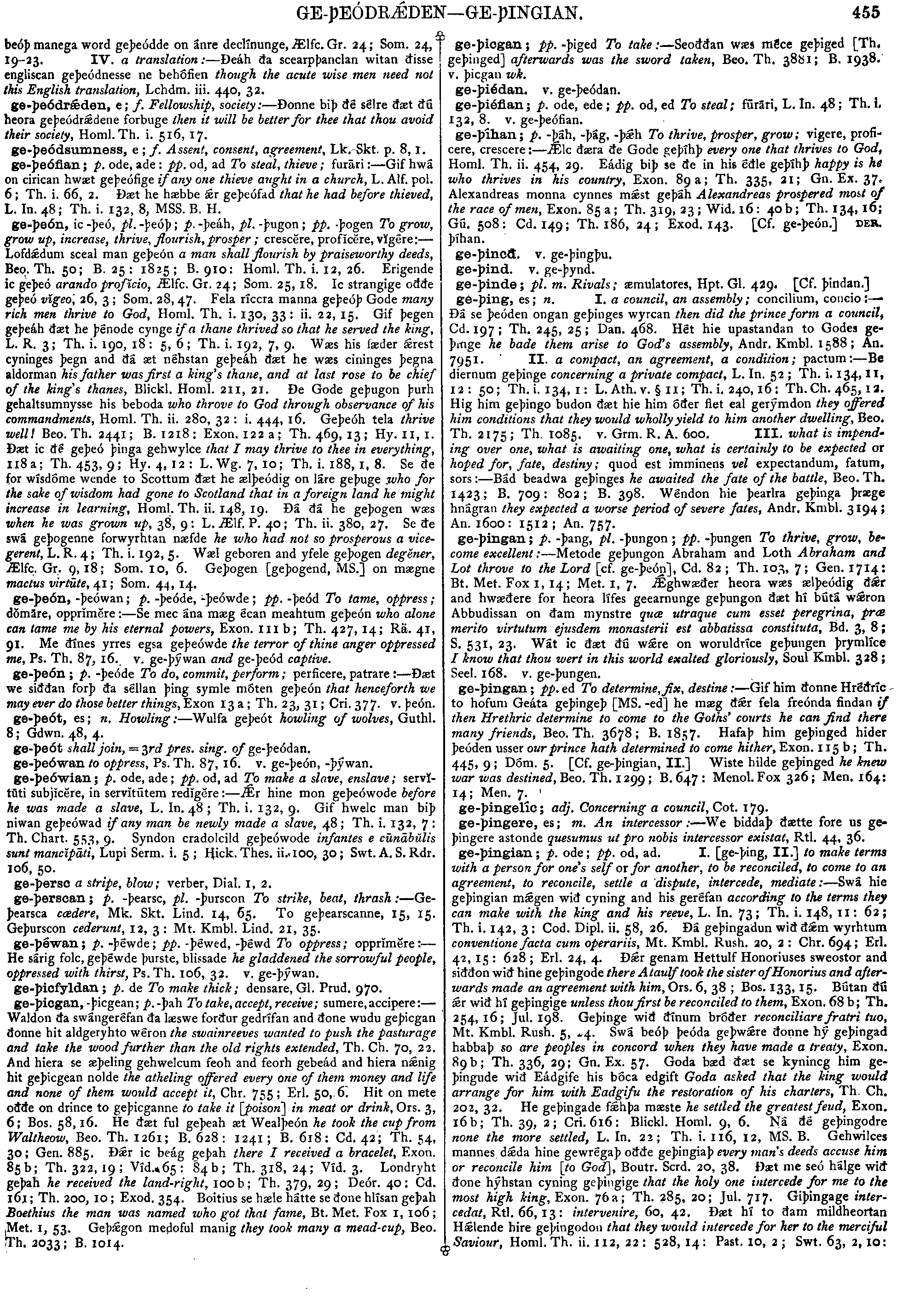
ge-þingian;
p.
ode;
pp.
od,
ad.
I.
[ge-þing,
II.]
to
make
terms
with
a
person
for
one's
self
or
for
another,
to
be
reconciled,
to
come
to
an
agreement,
to
reconcile,
settle
a
dispute,
intercede,
mediate
:--
Swá
hie
geþingian
mgen
wið
cyning
and
his
geréfan
according
to
the
terms
they
can
make
with
the
king
and
his
reeve,
L.
In.
73;
Th.
i.
148,
11:
62;
Th.
i.
142,
3:
Cod.
Dipl.
ii.
58,
26.
Ðá
geþingadun
wið
ðm
wyrhtum
conventione
facta
cum
operariis,
Mt.
Kmbl.
Rush.
20,
2:
Chr.
694;
Erl.
42,
15:
628;
Erl.
24,
4.
Ðr
genam
Hettulf
Honoriuses
sweostor
and
siððon
wið
hine
geþingode
there
Ataulf
took
the
sister
of
Honorius
and
afterwards
made
an
agreement
with
him,
Ors.
6,
38;
Bos.
133,
15.
Bútan
ðú
r
wið
hí
geþingige
unless
thou
first
be
reconciled
to
them,
Exon.
68
b;
Th.
254,
16;
Jul.
198.
Geþinge
wið
ðínum
bróðer
reconciliare
fratri
tuo,
Mt.
Kmbl.
Rush.
5,
24.
Swá
beóþ
þeóda
geþwre
ðonne
hý
geþingad
habbaþ
so
are
peoples
in
concord
when
they
have
made
a
treaty,
Exon.
89
b;
Th.
336,
29;
Gn.
Ex.
57.
Goda
bæd
ðæt
se
kynincg
him
geþingude
wið
Eádgife
his
bóca
edgift
Goda
asked
that
the
king
would
arrange
for
him
with
Eadgifu
the
restoration
of
his
charters,
Th.
Ch.
202,
32.
He
geþingade
fhþa
mæste
he
settled
the
greatest
feud,
Exon.
16
b;
Th.
39,
2;
Cri.
616:
Blickl.
Homl.
9,
6.
Ná
ðé
geþingodre
none
the
more
settled,
L.
In.
22;
Th.
i.
116,
12,
MS.
B.
Gehwilces
manes,
dda
hine
gewrégaþ
oððe
geþingiaþ
every
man's
deeds
accuse
him
or
reconcile
him
[to
God],
Boutr.
Scrd.
20,
38.
Ðæt
me
seó
hálge
wið
ðone
hýhstan
cyning
geþingige
that
the
holy
one
intercede
for
me
to
the
most
high
king,
Exon.
76
a;
Th.
285,
20;
Jul.
717.
Giþingage
intercedat,
Rtl.
66,
13:
intervenire,
60,
42.
Ðæt
hí
to
ðam
mildheortan
Hlende
hire
geþingodon
that
they
would
intercede
for
her
to
the
merciful
Saviour,
Homl.
Th.
ii.
112,
22:
528,
14:
Past.
10,
2;
Swt.
63,
2,
10:
Hat.
MS.
Geþinga
us
intercede
for
us,
Exon.
12
b;
Th.
21,
29;
Cri.
342.
II.
to
determine
:--
Hafaþ
nú
geþingod
to
us
þeóden
mra
the
great
prince
hath
determined
[to
come]
to
us,
Cd.
226
;
Th.
302,
12;
Sat.
598.
[Cf.
ge-þingan.]
Germanic Lexicon Project (main page)
This search system was written by
Sean Crist
Please consider
volunteering
to correct the data in these online dictionaries.
No rights reserved. Feel free to use these data in any way you please.