|
|

Search for Art again, using less strict matching (495 results)
|
Source: Bosworth/Toller, page b0210, entry 18 View original page image as: [TIFF] [PNG] [View previous entry] [View next entry] |
[Comment on this entry] [View comments] |
The following entry has been hand-corrected once. |
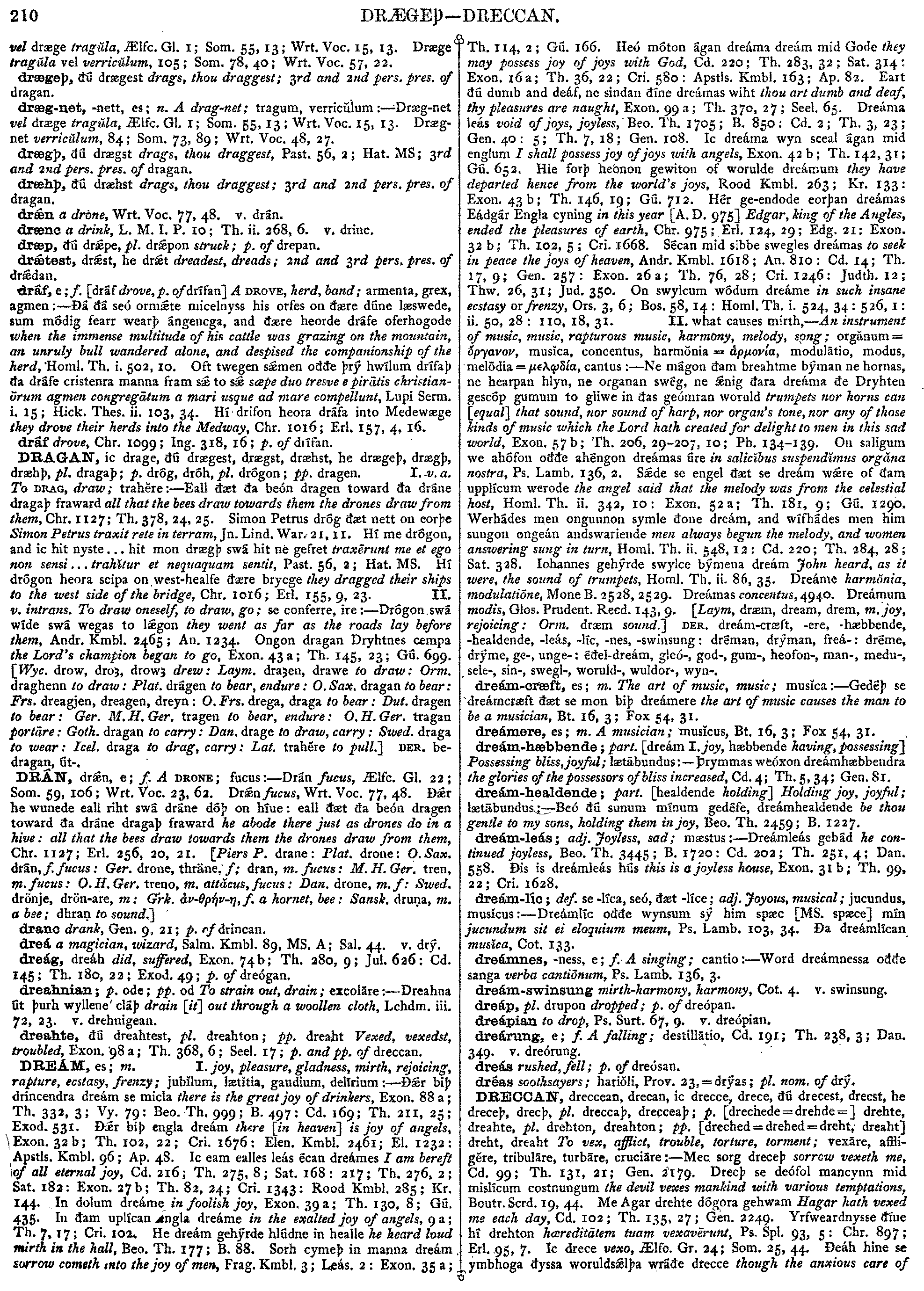
DREÁM,
es;
m.
I.
joy,
pleasure,
gladness,
mirth,
rejoicing,
rapture,
ecstasy,
frenzy;
jub lum,
lættia,
gaudium,
del
lum,
lættia,
gaudium,
del rium
:--
Ð
rium
:--
Ð r
biþ
drincendra
dreám
se
micla
there
is
the
great
joy
of
drinkers,
Exon.
88
a;
Th.
332,
3;
Vy.
79:
Beo.
Th.
999;
B.
497:
Cd.
169;
Th.
211,
25;
Exod.
531.
Ðr
biþ
engla
dreám
there
[in
heaven]
is
joy
of
angels,
Exon.
32
b;
Th.
102,
22;
Cri.
1676:
Elen.
Kmbl.
2461;
El.
1232:
Apstls.
Kmbl.
96;
Ap.
48.
Ic
eam
ealles
leás
écan
dreámes
I
am
bereft
of
all
eternal
joy,
Cd.
216;
Th.
275,
8;
Sat.
168:
217;
Th.
276,
2;
Sat.
182:
Exon.
27
b;
Th.
82,
24;
Cri.
1343:
Rood
Kmbl.
285;
Kr.
144.
In
dolum
dreáme
in
foolish
joy,
Exon.
39
a;
Th.
130,
8;
Gú.
435.
In
ðam
uplícan
engla
dreáme
in
the
exalted
joy
of
angels,
9
a;
Th.
7,
17;
Cri.
102.
He
dreám
gehýrde
hlúdne
in
healle
he
heard
loud
mirth
in
the
hall,
Beo.
Th.
177;
B.
88.
Sorh
cymeþ
in
manna
dreám
sorrow
cometh
into
the
joy
of
men,
Frag.
Kmbl.
3;
Leás.
2:
Exon.
35
a;
Th.
114,
2;
Gú.
166.
Heó
móton
ágan
dreáma
dreám
mid
Gode
they
may
possess
joy
of
joys
with
God,
Cd.
220;
Th.
283,
32;
Sat.
314:
Exon.
16
a;
Th.
36,
22;
Cri.
580:
Apstls.
Kmbl.
163;
Ap.
82.
Eart
ðú
dumb
and
deáf,
ne
sindan
ðíne
dreámas
wiht
thou
art
dumb
and
deaf,
thy
pleasures
are
naught,
Exon.
99
a;
Th.
370,
27;
Seel.
65.
Dreáma
leás
void
of
joys,
joyless,
Beo.
Th.
1705;
B.
850;
Cd.
2;
Th.
3,
23;
Gen.
40:
5;
Th.
7,
18;
Gen.
108.
Ic
dreáma
wyn
sceal
ágan
mid
englum
I
shall
possess
joy
of
joys
with
angels,
Exon.
42
b;
Th.
142,
31;
Gú.
652.
Hie
forþ
heónon
gewiton
of
worulde
dreámum
they
have
departed
hence
from
the
world's
joys,
Rood
Kmbl.
263;
Kr.
133
Exon.
43
b;
Th.
146,
19;
Gú.
712.
Hér
ge-endode
eorþan
dreámas
Eádgár
Engla
cyning
in
this
year
[A.
D.
975]
Edgar,
king
of
the
Angles,
ended
the
pleasures
of
earth,
Chr.
975;
Erl.
124,
29;
Edg.
21:
Exon.
32
b;
Th.
102,
5;
Cri.
1668.
Sécan
mid
sibbe
swegles
dreámas
to
seek
in
peace
the
joys
of
heaven,
Andr.
Kmbl.
1618;
An.
810:
Cd.
14;
Th.
17,
9;
Gen.
257:
Exon.
26
a;
Th.
76,
28;
Cri.
1246:
Judth.
12;
Thw.
26,
31;
Jud.
350.
On
swylcum
wódum
dreáme
in
such
insane
ecstasy
or
frenzy,
Ors.
3,
6;
Bos.
58,
14:
Homl.
Th.
i.
524,
34:
526.
1:
ii.
50,
28:
110,
18,
31.
II.
what
causes
mirth,-An
instrument
of
music,
music,
rapturous
music,
harmony,
melody,
song;
org
r
biþ
drincendra
dreám
se
micla
there
is
the
great
joy
of
drinkers,
Exon.
88
a;
Th.
332,
3;
Vy.
79:
Beo.
Th.
999;
B.
497:
Cd.
169;
Th.
211,
25;
Exod.
531.
Ðr
biþ
engla
dreám
there
[in
heaven]
is
joy
of
angels,
Exon.
32
b;
Th.
102,
22;
Cri.
1676:
Elen.
Kmbl.
2461;
El.
1232:
Apstls.
Kmbl.
96;
Ap.
48.
Ic
eam
ealles
leás
écan
dreámes
I
am
bereft
of
all
eternal
joy,
Cd.
216;
Th.
275,
8;
Sat.
168:
217;
Th.
276,
2;
Sat.
182:
Exon.
27
b;
Th.
82,
24;
Cri.
1343:
Rood
Kmbl.
285;
Kr.
144.
In
dolum
dreáme
in
foolish
joy,
Exon.
39
a;
Th.
130,
8;
Gú.
435.
In
ðam
uplícan
engla
dreáme
in
the
exalted
joy
of
angels,
9
a;
Th.
7,
17;
Cri.
102.
He
dreám
gehýrde
hlúdne
in
healle
he
heard
loud
mirth
in
the
hall,
Beo.
Th.
177;
B.
88.
Sorh
cymeþ
in
manna
dreám
sorrow
cometh
into
the
joy
of
men,
Frag.
Kmbl.
3;
Leás.
2:
Exon.
35
a;
Th.
114,
2;
Gú.
166.
Heó
móton
ágan
dreáma
dreám
mid
Gode
they
may
possess
joy
of
joys
with
God,
Cd.
220;
Th.
283,
32;
Sat.
314:
Exon.
16
a;
Th.
36,
22;
Cri.
580:
Apstls.
Kmbl.
163;
Ap.
82.
Eart
ðú
dumb
and
deáf,
ne
sindan
ðíne
dreámas
wiht
thou
art
dumb
and
deaf,
thy
pleasures
are
naught,
Exon.
99
a;
Th.
370,
27;
Seel.
65.
Dreáma
leás
void
of
joys,
joyless,
Beo.
Th.
1705;
B.
850;
Cd.
2;
Th.
3,
23;
Gen.
40:
5;
Th.
7,
18;
Gen.
108.
Ic
dreáma
wyn
sceal
ágan
mid
englum
I
shall
possess
joy
of
joys
with
angels,
Exon.
42
b;
Th.
142,
31;
Gú.
652.
Hie
forþ
heónon
gewiton
of
worulde
dreámum
they
have
departed
hence
from
the
world's
joys,
Rood
Kmbl.
263;
Kr.
133
Exon.
43
b;
Th.
146,
19;
Gú.
712.
Hér
ge-endode
eorþan
dreámas
Eádgár
Engla
cyning
in
this
year
[A.
D.
975]
Edgar,
king
of
the
Angles,
ended
the
pleasures
of
earth,
Chr.
975;
Erl.
124,
29;
Edg.
21:
Exon.
32
b;
Th.
102,
5;
Cri.
1668.
Sécan
mid
sibbe
swegles
dreámas
to
seek
in
peace
the
joys
of
heaven,
Andr.
Kmbl.
1618;
An.
810:
Cd.
14;
Th.
17,
9;
Gen.
257:
Exon.
26
a;
Th.
76,
28;
Cri.
1246:
Judth.
12;
Thw.
26,
31;
Jud.
350.
On
swylcum
wódum
dreáme
in
such
insane
ecstasy
or
frenzy,
Ors.
3,
6;
Bos.
58,
14:
Homl.
Th.
i.
524,
34:
526.
1:
ii.
50,
28:
110,
18,
31.
II.
what
causes
mirth,-An
instrument
of
music,
music,
rapturous
music,
harmony,
melody,
song;
org num
=
&omicron-tonos;
num
=
&omicron-tonos;


 o,
musca,
concentus,
harm
o,
musca,
concentus,
harm nia
=
&alpha-tonos;
nia
=
&alpha-tonos; o&iota-tonos;,
modul
o&iota-tonos;,
modul tio,
modus,
mel
tio,
modus,
mel dia
=
dia
=


 &iota-tonos;,
cantus
:--
Ne
mágon
ðam
breahtme
býman
ne
hornas,
ne
hearpan
hlyn,
ne
organan
swég,
ne
nig
ðara
dreáma
ðe
Dryhten
gescóp
gumum
to
gliwe
in
ðas
geómran
woruld
trumpets
nor
horns
can
[equal]
that
sound,
nor
sound
of
harp,
nor
organ's
tone,
nor
any
of
those
kinds
of
music
which
the
Lord
hath
created
for
delight
to
men
in
this
sad
world,
Exon.
57
b;
Th.
206,
29-207,
10;
Ph.
134-139.
On
saligum
we
ahófon
oððe
ahéngon
dreámas
úre
in
salicbus
suspendmus
orgna
nostra,
Ps.
Lamb.
136,
2.
Sde
se
engel
ðæt
se
dreám
wre
of
ðam
upplícum
werode
the
angel
said
that
the
melody
was
from
the
celestial
host,
Homl.
Th.
ii.
342,
10:
Exon.
52
a;
Th.
181,
9;
Gú.
1290.
Werhádes
men
ongunnon
symle
ðone
dreám,
and
wífhádes
men
him
sungon
ongeán
andswariende
men
always
begun
the
melody,
and
women
answering
sung
in
turn,
Homl.
Th.
ii.
548,
12:
Cd.
220;
Th.
284,
28;
Sat.
328.
Iohannes
gehýrde
swylce
býmena
dreám
John
heard,
as
it
were,
the
sound
of
trumpets,
Homl.
Th.
ii.
86,
35.
Dreáme
harmnia,
modulatine,
Mone
B.
2528,
2529.
Dreámas
concentus,
4940.
Dreámum
modis,
Glos.
Prudent.
Recd.
143,
9.
[Laym,
dræm,
dream,
drem,
m.
joy,
rejoicing:
Orm.
dræm
sound.]
DER.
dreám-cræft,
-ere,
-hæbbende,
-healdende,
-leás,
-líc,
-nes,
-swinsung:
dréman,
drýman,
freá-:
dréme,
drýme,
ge-,
unge-:
éðel-dreám,
gleó-,
god-,
gum-,
heofon-,
man-,
medu-,
sele-,
sin-,
swegl-,
woruld-,
wuldor-,
wyn-.
&iota-tonos;,
cantus
:--
Ne
mágon
ðam
breahtme
býman
ne
hornas,
ne
hearpan
hlyn,
ne
organan
swég,
ne
nig
ðara
dreáma
ðe
Dryhten
gescóp
gumum
to
gliwe
in
ðas
geómran
woruld
trumpets
nor
horns
can
[equal]
that
sound,
nor
sound
of
harp,
nor
organ's
tone,
nor
any
of
those
kinds
of
music
which
the
Lord
hath
created
for
delight
to
men
in
this
sad
world,
Exon.
57
b;
Th.
206,
29-207,
10;
Ph.
134-139.
On
saligum
we
ahófon
oððe
ahéngon
dreámas
úre
in
salicbus
suspendmus
orgna
nostra,
Ps.
Lamb.
136,
2.
Sde
se
engel
ðæt
se
dreám
wre
of
ðam
upplícum
werode
the
angel
said
that
the
melody
was
from
the
celestial
host,
Homl.
Th.
ii.
342,
10:
Exon.
52
a;
Th.
181,
9;
Gú.
1290.
Werhádes
men
ongunnon
symle
ðone
dreám,
and
wífhádes
men
him
sungon
ongeán
andswariende
men
always
begun
the
melody,
and
women
answering
sung
in
turn,
Homl.
Th.
ii.
548,
12:
Cd.
220;
Th.
284,
28;
Sat.
328.
Iohannes
gehýrde
swylce
býmena
dreám
John
heard,
as
it
were,
the
sound
of
trumpets,
Homl.
Th.
ii.
86,
35.
Dreáme
harmnia,
modulatine,
Mone
B.
2528,
2529.
Dreámas
concentus,
4940.
Dreámum
modis,
Glos.
Prudent.
Recd.
143,
9.
[Laym,
dræm,
dream,
drem,
m.
joy,
rejoicing:
Orm.
dræm
sound.]
DER.
dreám-cræft,
-ere,
-hæbbende,
-healdende,
-leás,
-líc,
-nes,
-swinsung:
dréman,
drýman,
freá-:
dréme,
drýme,
ge-,
unge-:
éðel-dreám,
gleó-,
god-,
gum-,
heofon-,
man-,
medu-,
sele-,
sin-,
swegl-,
woruld-,
wuldor-,
wyn-.
|
Source: Bosworth/Toller, page b0210, entry 19 View original page image as: [TIFF] [PNG] [View previous entry] [View next entry] |
[Comment on this entry] [View comments] |
The following entry has been hand-corrected once. |
dreám-cræft,
es,
m.
The
art
of
music,
music;
musca
:--
Gedéþ
se
dreámcræft
ðæt
se
mon
biþ
dreámere
the
art
of
music
causes
the
man
to
be
a
musician,
Bt.
16,
3;
Fox
54,
31.
|
Source: Bosworth/Toller, page b0211, entry 23 View original page image as: [TIFF] [PNG] [View previous entry] [View next entry] |
[Comment on this entry] [View comments] |
The following entry has been hand-corrected once. |
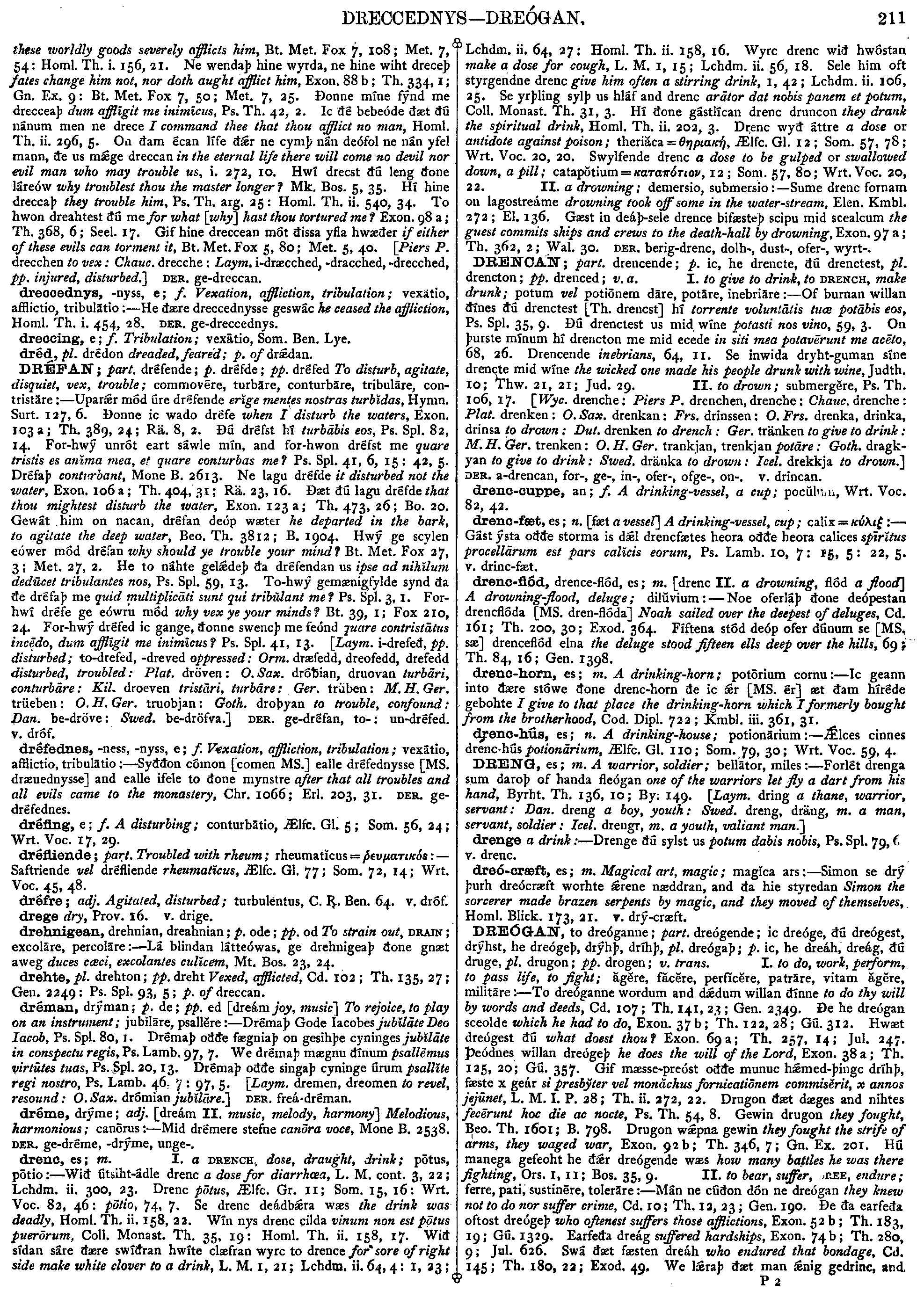
dreó-cræft,
es;
m.
Magical
art,
magic;
magca
ars
:--
Simon
se
drý
þurh
dreócræft
worhte
rene
næddran,
and
ða
hie
styredan
Simon
the
sorcerer
made
brazen
serpents
by
magic,
and
they
moved
of
themselves,
Homl.
Blick.
173,
21.
v.
drý-cræft.
|
Source: Bosworth/Toller, page b0216, entry 1 View original page image as: [TIFF] [PNG] [View previous entry] [View next entry] |
[Comment on this entry] [View comments] |
The following entry has been hand-corrected once. |
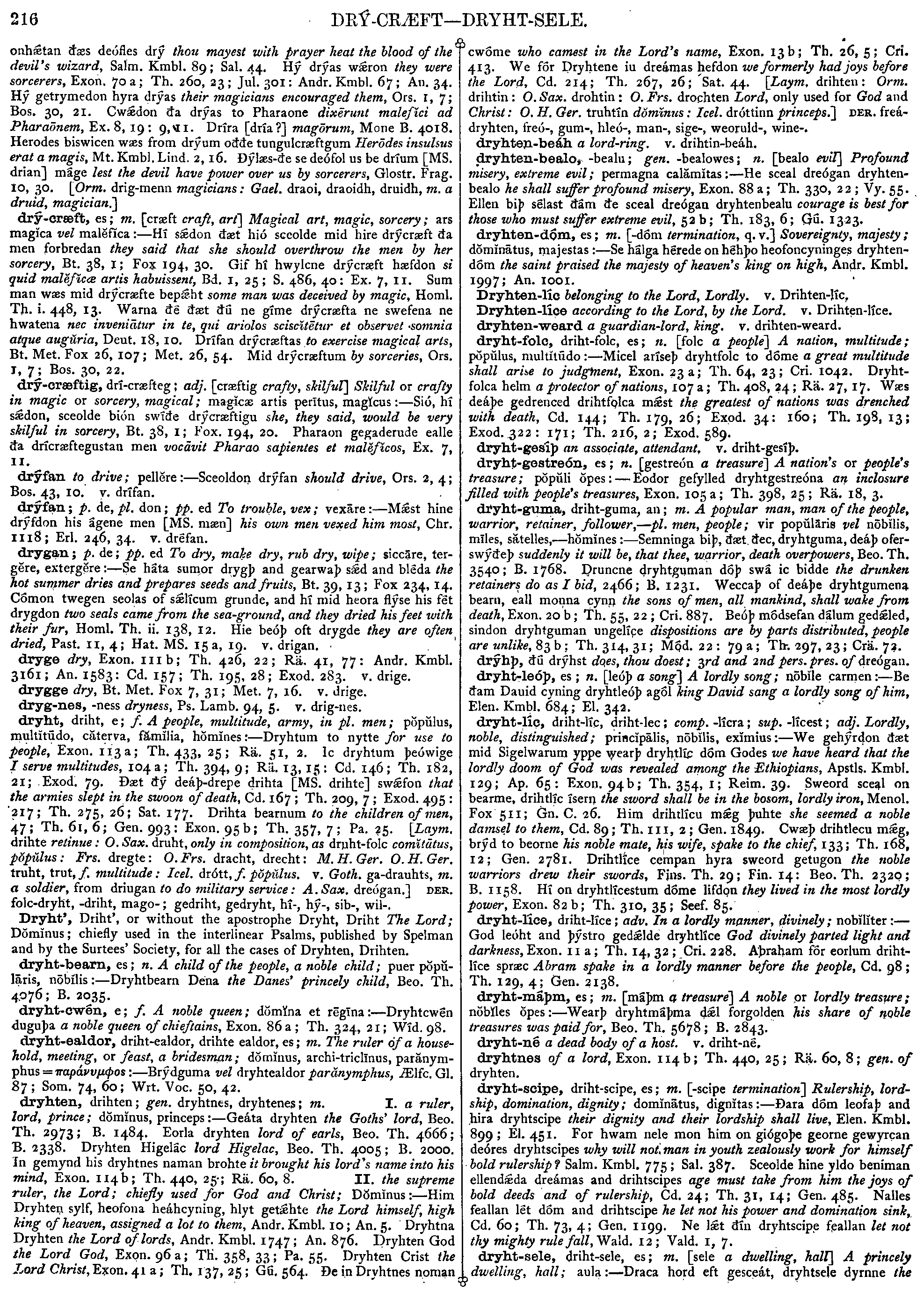
drý-cræft,
es;
m.
[cræft
craft,
art]
Magical
art,
magic,
sorcery;
ars
magca
vel
mal fca
:--
Hí
sdon
ðæt
hió
sceolde
mid
hire
drýcræft
ða
men
forbredan
they
said
that
she
should
overthrow
the
men
by
her
sorcery,
Bt.
38,
1;
Fox
194,
30.
Gif
hí
hwylcne
drýcræft
hæfdon
si
quid
malfcæ
artis
habuissent,
Bd.
1,
25;
S.
486,
40
:
Ex.
7,
11.
Sum
man
wæs
mid
drýcræfte
bepht
some
man
was
deceived
by
magic,
Homl.
Th.
i.
448,
13.
Warna
ðé
ðæt
ðú
ne
gíme
drýcræfta
ne
swefena
ne
hwatena
nec
invenitur
in
te,
qui
ariolos
scisct
fca
:--
Hí
sdon
ðæt
hió
sceolde
mid
hire
drýcræft
ða
men
forbredan
they
said
that
she
should
overthrow
the
men
by
her
sorcery,
Bt.
38,
1;
Fox
194,
30.
Gif
hí
hwylcne
drýcræft
hæfdon
si
quid
malfcæ
artis
habuissent,
Bd.
1,
25;
S.
486,
40
:
Ex.
7,
11.
Sum
man
wæs
mid
drýcræfte
bepht
some
man
was
deceived
by
magic,
Homl.
Th.
i.
448,
13.
Warna
ðé
ðæt
ðú
ne
gíme
drýcræfta
ne
swefena
ne
hwatena
nec
invenitur
in
te,
qui
ariolos
scisct tur
et
observet
somnia
atque
aug
tur
et
observet
somnia
atque
aug ria,
Deut.
18,
10.
Drífan
drýcræftas
to
exercise
magical
arts,
Bt.
Met.
Fox
26,
107;
Met.
26,
54.
Mid
drýcræftum
by
sorceries,
Ors.
1,
7;
Bos.
30,
22.
ria,
Deut.
18,
10.
Drífan
drýcræftas
to
exercise
magical
arts,
Bt.
Met.
Fox
26,
107;
Met.
26,
54.
Mid
drýcræftum
by
sorceries,
Ors.
1,
7;
Bos.
30,
22.
|
Source: Bosworth/Toller, page b0218, entry 7 View original page image as: [TIFF] [PNG] [View previous entry] [View next entry] |
[Comment on this entry] [View comments] |
The following entry has been hand-corrected once. |
DUMB;
def.
se
dumba,
seó,
ðæt
dumbe;
adj.
DUMB,
speechless,
mute;
m tus,
e-linguis
:--
Eart
ðú
dumb
and
deáf
thou
art
dumb
and
deaf,
Exon.
99
a;
Th.
370,
26;
Seel.
65:
l08
b;
Th.
414,
7;
Rä.
32,
16.
Beó
ðú
dumb
óþ-ðæt
ðæt
cild
beó
acenned
be
thou
dumb
until
the
child
shall
be
born,
Homl.
Th.
i.
202,
7:
L.
Alf.
pol.
14;
Th.
i.
70,
14.
Dumb
mtus,
Wrt.
Voc.
75.
36:
Mt.
Bos.
12,
22:
Lk.
Bus.
l1,
14.
Se
dumba
fæder
the
dumb
father,
Homl.
Th.
i.
354,
27:
Salm.
Kmbl.
457;
Sal.
229.
Se
dumba
spræc
lctus
est
mtus,
Mt.
Bos.
9.
33:
Lk.
Bos,
11,
14.
Dumbes
elinguis,
Glos.
Prudent.
Recd.
143,
1.
Híg
brohton
him
dumbne
man
obtlrunt
ei
hmnem
mtum,
Mt.
Bos.
9,
32:
Mk.
Bos.
9,
17:
Ex.
4,
11.
Geségun
ða
dumban
gesceaft
they
saw
the
dumb
creation,
Exon.
24
b;
Th.
69,
30;
Cri:
1128:
113
a;
Th.
433,
3;
Rä.
50,
2.
Ða
óðre
nigon
consonantes
synd
gecwedene
mtæ,
ðæt
synd
dumbe
the
other
nine
consonants
are
called
mtæ,
which
are
dumb,
Ælfc.
Gr.
2;
Som.
3,
1,
2.
He
dyde
ðæt
deáfe
gehýrdon,
and
dumbe
sprcon
surdos
fcit
audre,
et
mtos
lqui,
Mk.
Bos.
7,
37:
Mt.
Bos.
15,
31.
Ic
sceal
dda
fremman
swá
ða
dumban
neát
I
shall
do
deeds
such
as
the
dumb
cattle,
Andr.
Kmbl.
134;
An.
67.
Dumbra
of
the
dumb,
Salm.
Kmbl.
158;
Sal.
78.
Be
dumbera
manna
ddum
of
dumb
men's
deeds,
L.
Alf.
pol:
14;
Th.
i.
70,
13.
Hí
forgeáfon
dumbum
spræce
they
gave
speech
to
the
dumb,
Homl.
Th.
i.
544,
33:
424,
10:
Andr.
Kmbl.
1153;
An.
577:
Exon.
68
a;
Th.
251,
24;
Jul.
150.
[Piers
P.
dombe:
Wyc.
doumbe:
Chauc.
dombe:
Laym.
dumbe:
Orm.
dumb:
O.
Sax.
dump
stultus:
Frs.
domme,
dom:
O.
Frs.
dumbe,
dome
stultus,
mtus:
Dut.
dom
stupid:
Ger.
dumm
stupid
:
M.
H.
Ger.
tump
stupid:
O.
H.
Ger.
tumb
mtus,
stultus:
Goth.
dumbs
mute:
Dan.
dum
stupid:
Swed.
dum
stupid;
dumb
mute:
Icel.
dumbr
mute.]
DER.
dum-nys:
a-dumbian.
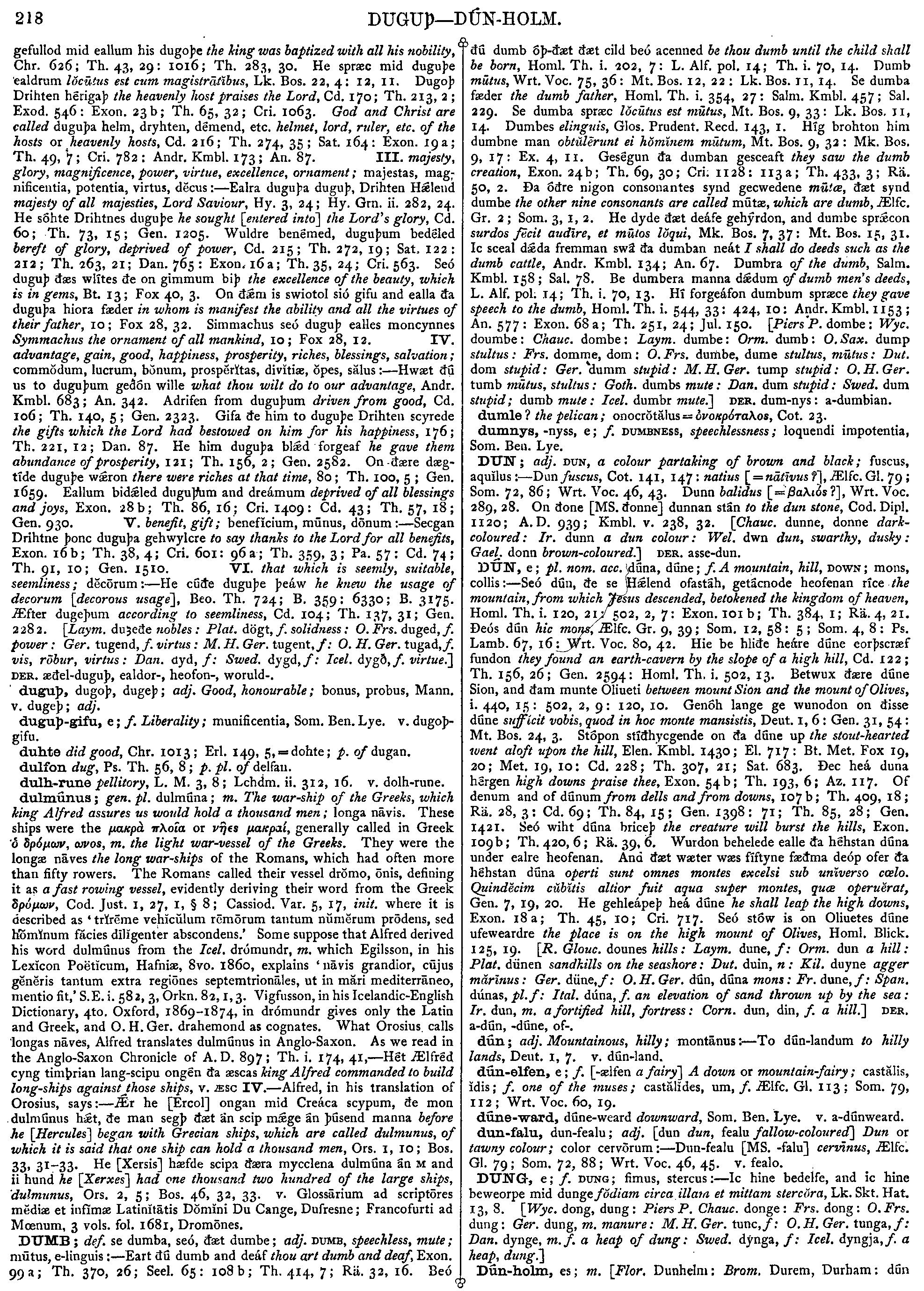
tus,
e-linguis
:--
Eart
ðú
dumb
and
deáf
thou
art
dumb
and
deaf,
Exon.
99
a;
Th.
370,
26;
Seel.
65:
l08
b;
Th.
414,
7;
Rä.
32,
16.
Beó
ðú
dumb
óþ-ðæt
ðæt
cild
beó
acenned
be
thou
dumb
until
the
child
shall
be
born,
Homl.
Th.
i.
202,
7:
L.
Alf.
pol.
14;
Th.
i.
70,
14.
Dumb
mtus,
Wrt.
Voc.
75.
36:
Mt.
Bos.
12,
22:
Lk.
Bus.
l1,
14.
Se
dumba
fæder
the
dumb
father,
Homl.
Th.
i.
354,
27:
Salm.
Kmbl.
457;
Sal.
229.
Se
dumba
spræc
lctus
est
mtus,
Mt.
Bos.
9.
33:
Lk.
Bos,
11,
14.
Dumbes
elinguis,
Glos.
Prudent.
Recd.
143,
1.
Híg
brohton
him
dumbne
man
obtlrunt
ei
hmnem
mtum,
Mt.
Bos.
9,
32:
Mk.
Bos.
9,
17:
Ex.
4,
11.
Geségun
ða
dumban
gesceaft
they
saw
the
dumb
creation,
Exon.
24
b;
Th.
69,
30;
Cri:
1128:
113
a;
Th.
433,
3;
Rä.
50,
2.
Ða
óðre
nigon
consonantes
synd
gecwedene
mtæ,
ðæt
synd
dumbe
the
other
nine
consonants
are
called
mtæ,
which
are
dumb,
Ælfc.
Gr.
2;
Som.
3,
1,
2.
He
dyde
ðæt
deáfe
gehýrdon,
and
dumbe
sprcon
surdos
fcit
audre,
et
mtos
lqui,
Mk.
Bos.
7,
37:
Mt.
Bos.
15,
31.
Ic
sceal
dda
fremman
swá
ða
dumban
neát
I
shall
do
deeds
such
as
the
dumb
cattle,
Andr.
Kmbl.
134;
An.
67.
Dumbra
of
the
dumb,
Salm.
Kmbl.
158;
Sal.
78.
Be
dumbera
manna
ddum
of
dumb
men's
deeds,
L.
Alf.
pol:
14;
Th.
i.
70,
13.
Hí
forgeáfon
dumbum
spræce
they
gave
speech
to
the
dumb,
Homl.
Th.
i.
544,
33:
424,
10:
Andr.
Kmbl.
1153;
An.
577:
Exon.
68
a;
Th.
251,
24;
Jul.
150.
[Piers
P.
dombe:
Wyc.
doumbe:
Chauc.
dombe:
Laym.
dumbe:
Orm.
dumb:
O.
Sax.
dump
stultus:
Frs.
domme,
dom:
O.
Frs.
dumbe,
dome
stultus,
mtus:
Dut.
dom
stupid:
Ger.
dumm
stupid
:
M.
H.
Ger.
tump
stupid:
O.
H.
Ger.
tumb
mtus,
stultus:
Goth.
dumbs
mute:
Dan.
dum
stupid:
Swed.
dum
stupid;
dumb
mute:
Icel.
dumbr
mute.]
DER.
dum-nys:
a-dumbian.
|
Source: Bosworth/Toller, page b0222, entry 10 View original page image as: [TIFF] [PNG] [View previous entry] [View next entry] |
[Comment on this entry] [View comments] |
The following entry has been hand-corrected once. |
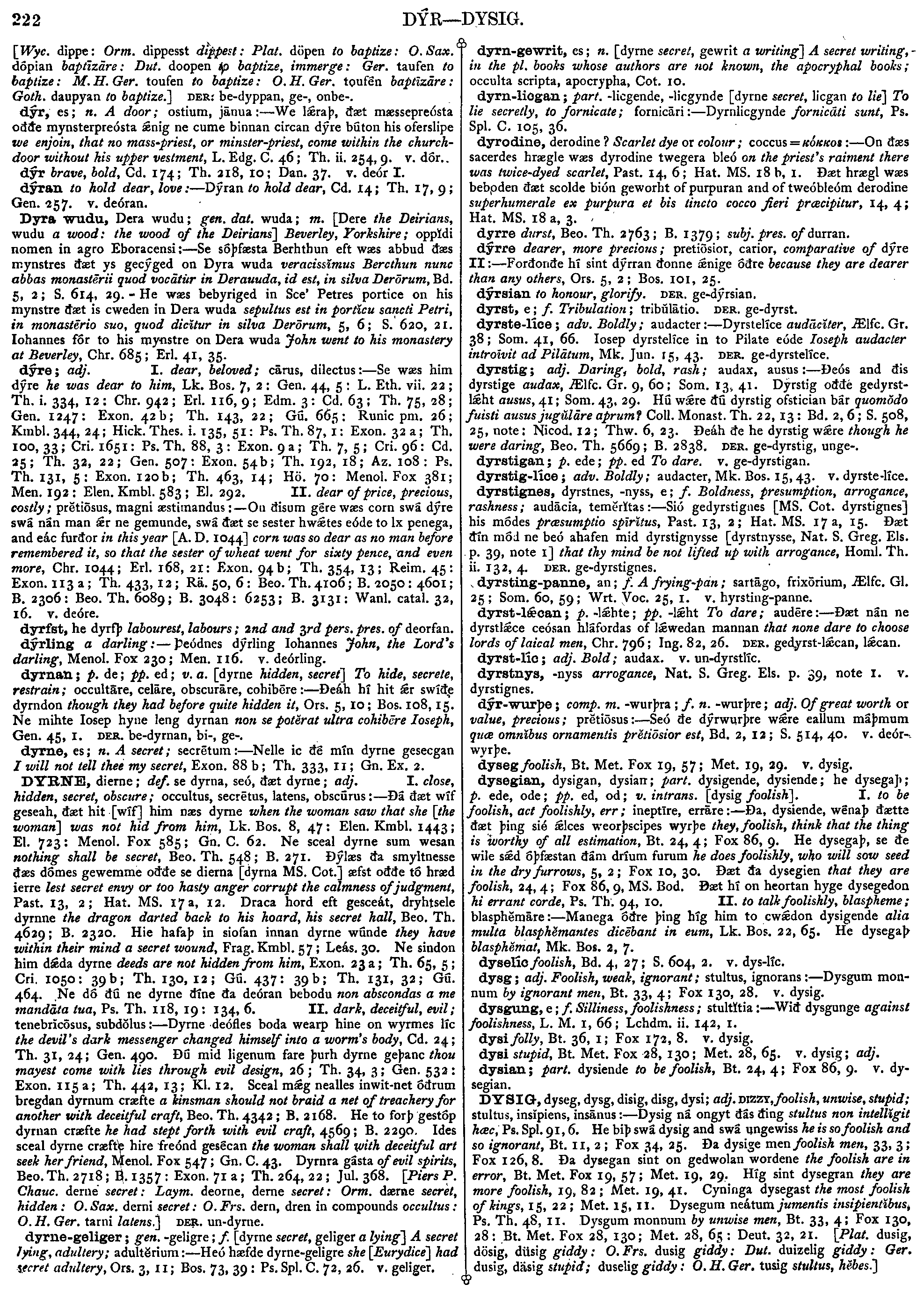
DYRNE,
dierne;
def.
se
dyrna,
seó,
ðæt
dyrne;
adj.
I.
close,
hidden,
secret,
obscure;
occultus,
secrtus,
latens,
obscrus
:--
Ðá
ðæt
wíf
geseah,
ðæt
hit
[wíf]
him
næs
dyrn
when
the
woman
saw
that
she
[the
woman]
was
not
hid
from
him,
Lk.
Bos.
8,
47:
Elen.
Kmbl.
1443;
El.
723:
Menol.
Fox
585;
Gn.
C.
62.
Ne
sceal
dyrne
sum
wesan
nothing
shall
be
secret,
Beo.
Th.
548;
B.
271.
Ðýlæs
ða
smyltnesse
ðæs
dómes
gewemme
oððe
se
dierna
[dyrna
MS.
Cot.]
æfst
oððe
tó
hræd
ierre
lest
secret
envy
or
too
hasty
anger
corrupt
the
calmness
of
judgment,
Past.
13,
2;
Hat.
MS.
17
a,
12.
Draca
hord
eft
gesceát,
dryhtsele
dyrnne
the
dragon
darted
back
to
his
hoard,
his
secret
hall,
Beo.
Th.
4629;
B.
2320.
Hie
hafaþ
in
siofan
innan
dyrne
wúnde
they
have
within
their
mind
a
secret
wound,
Frag.
Kmbl.
57;
Leás.
30.
Ne
sindon
him
dda
dyrne
deeds
are
not
hidden
from
him,
Exon.
23
a;
Th.
65,
5;
Cri.
1050:
39
b;
Th.
130,
12;
Gú.
437:
39
b;
Th.
131,
32;
Gú.
464.
Ne
dó
ðú
ne
dyrne
ðíne
ða
deóran
bebodu
non
abscondas
a
me
mandta
tua,
Ps.
Th.
118,
19:
134,
6.
II.
dark,
deceitful,
evil;
tenebrcsus,
subdlus
:--
Dyrne
deófles
boda
wearp
hine
on
wyrmes
líc
the
devil's
dark
messenger
changed
himself
into
a
worm's
body,
Cd.
24;
Th.
31,
24;
Gen.
490.
Ðú
mid
ligenum
fare
þurh
dyrne
geþanc
thou
mayest
come
with
lies
through
evil
design,
26;
Th.
34,
3;
Gen.
532:
Exon.
115
a;
Th.
442,
13;
Kl.
12.
Sceal
mg
nealles
inwit-net
óðrum
bregdan
dyrnum
cræfte
a
kinsman
should
not
braid
a
net
of
treachery
for
another
with
deceitful
craft,
Beo.
Th.
4342;
B.
2168.
He
to
forþ
gestóp
dyrnan
cræfte
he
had
stept
forth
with
evil
craft,
4569;
B.
2290.
Ides
sceal
dyrne
cræfte
hire
freónd
gesécan
the
woman
shall
with
deceitful
art
seek
her
friend,
Menol.
Fox
547;
Gn.
C.
43.
Dyrnra
gásta
of
evil
spirits,
Beo.
Th.
2718;
1357:
Exon.
71
a;
Th.
264,
22;
Jul,
368.
[Piers
P.
Chauc.
derne
secret:
Laym.
deorne,
derne
secret:
Orm.
dærne
secret,
hidden:
O.
Sax.
derni
secret:
O.
Frs.
dern,
dren
in
compounds
occultus:
O.
H.
Ger.
tarni
latens.]
DER.
un-dyrne.
|
Source: Bosworth/Toller, page b0230, entry 23 View original page image as: [TIFF] [PNG] [View previous entry] [View next entry] |
[Comment on this entry] [View comments] |
The following entry has been hand-corrected once. |
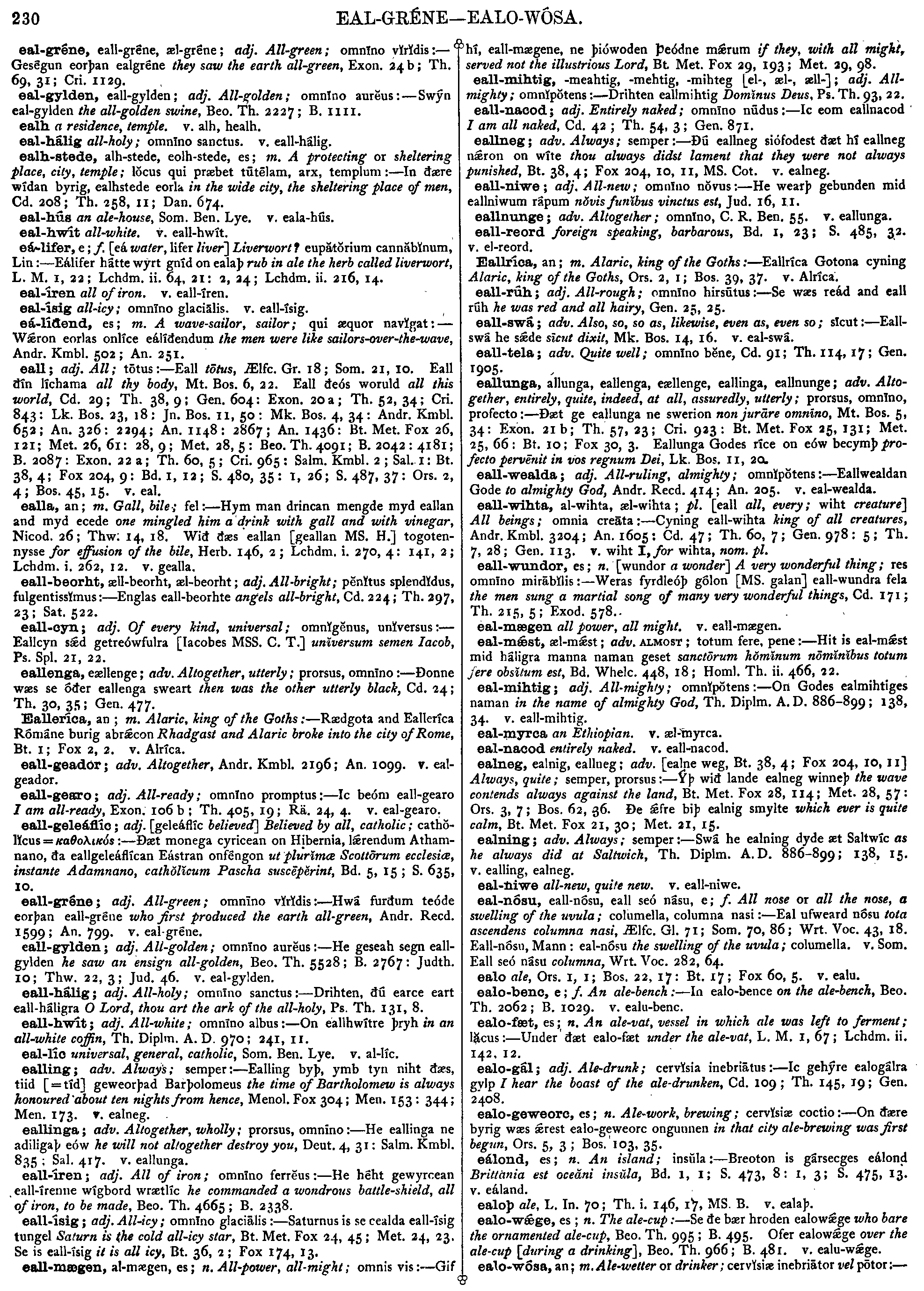
eall-hálig;
adj.
All-holy;
omnno
sanctus
:--
Drihten,
ðú
earce
eart
eall-háligra
O
Lord,
thou
art
the
ark
of
the
all-holy,
Ps.
Th.
131,
8.
|
Source: Bosworth/Toller, page b0232, entry 1 View original page image as: [TIFF] [PNG] [View previous entry] [View next entry] |
[Comment on this entry] [View comments] |
The following entry has been hand-corrected once. |
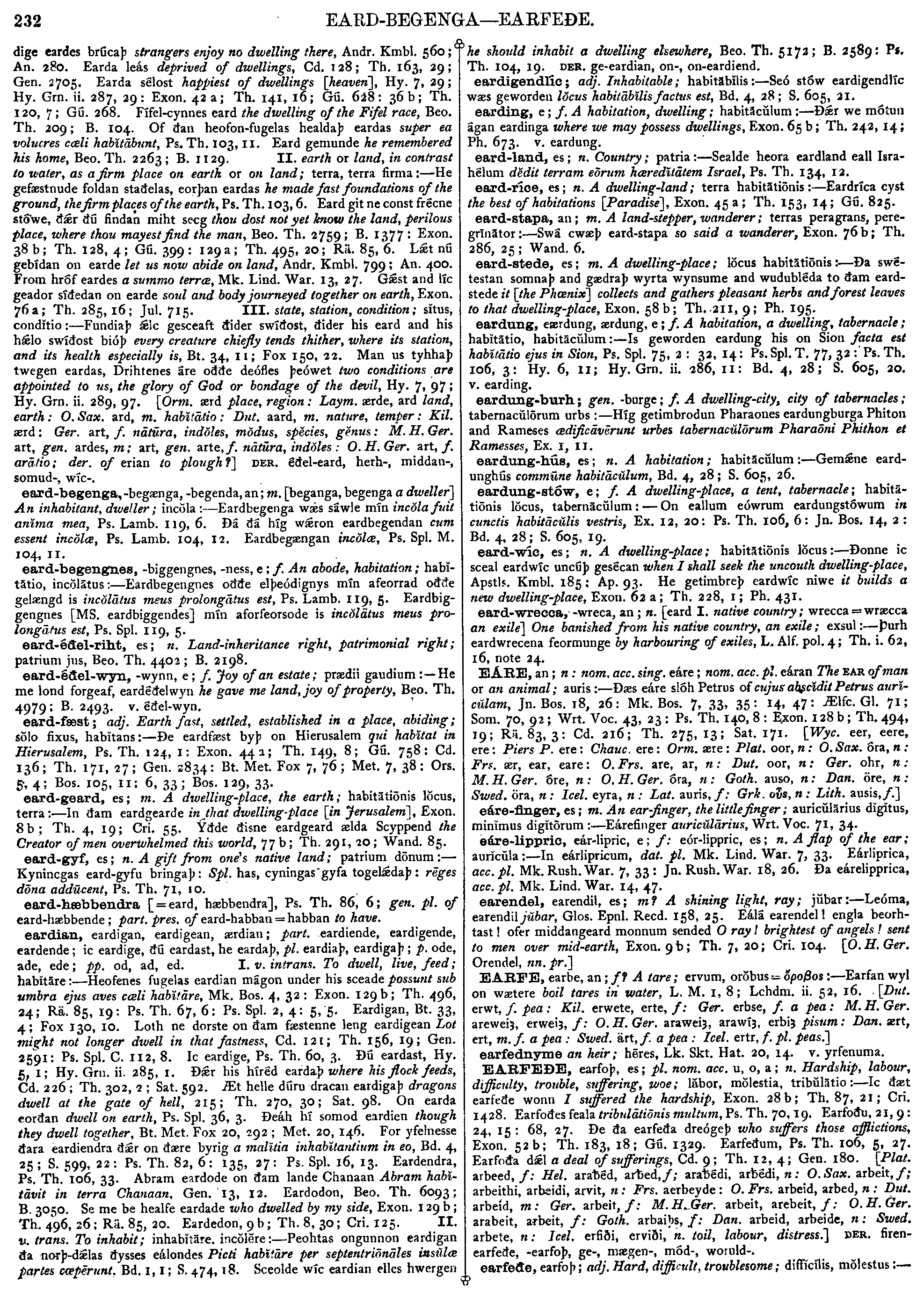
dige
eardes
brúcaþ
strangers
enjoy
no
dwelling
there,
Andr.
Kmbl.
560;
An.
280.
Earda
leás
deprived
of
dwellings,
Cd.
128;
Th.
163,
29;
Gen.
2705.
Earda
sélost
happiest
of
dwellings
[heaven],
Hy.
7,
29;
Hy.
Grn.
ii.
287,
29:
Exon.
42
a;
Th.
141,
16;
Gú.
628:
36
b;
Th.
120,
7;
Gú.
268.
Fífel-cynnes
eard
the
dwelling
of
the
Fifel
race,
Beo.
Th.
209;
B.
104.
Of
ðan
heofon-fugelas
healdaþ
eardas
super
ea
volucres
cœli
habtbunt,
Ps.
Th.
103,
11.
Eard
gemunde
he
remembered
his
home,
Beo.
Th.
2263;
B.
1129.
II.
earth
or
land,
in
contrast
to
water,
as
a
firm
place
on
earth
or
on
land;
terra,
terra
firma:--He
gefæstnude
foldan
staðelas,
eorþan
eardas
he
made
fast
foundations
of
the
ground,
the
firm
places
of
the
earth,
Ps.
Th.
103,
6.
Eard
git
ne
const
frécne
stówe,
ðr
ðú
findan
miht
secg
thou
dost
not
yet
know
the
land,
perilous
place,
where
thou
mayest
find
the
man,
Beo.
Th.
2759;
B.
1377:
Exon.
38
b;
Th.
128,
4;
Gú.
399:
129
a;
Th.
495,
20;
Rä.
85,
6.
Lt
nú
gebídan
on
earde
let
us
now
abide
on
land,
Andr.
Kmbl.
799;
An.
400.
From
hróf
eardes
a
summo
teræ.
Mk.
Lind.
War.
13,
27.
Gst
and
líc
geador
síðedan
on
earde
soul
and
body
journeyed
together
on
earth,
Exon.
76
a;
Th.
285,
16;
Jul.
715.
III.
state,
station,
condition;
stus,
condtio:--Fundiaþ
lc
gesceaft
ðider
swíðost,
ðider
his
eard
and
his
hlo
swíðost
bióþ
every
creature
chiefly
tends
thither,
where
its
station,
and
its
health
especially
is,
Bt.
34,
11;
Fox
150,
22.
Man
us
tyhhaþ
twegen
eardas,
Drihtenes
áre
oððe
deófles
þeówet
two
conditions
are
appointed
to
us,
the
glory
of
God
or
bondage
of
the
devil,
Hy.
7,
97;
Hy.
Grn.
ii.
289,
97.
[Orm.
ærd
place,
region:
Laym.
ærde,
ard
land,
earth:
O.
Sax.
ard,
m.
habttio:
Dut.
aard,
m.
nature,
temper:
Kil.
ærd:
Ger.
art,
f.
ntira,
indles,
mdus,
spcies,
gnus:
M.
H.
Ger.
art,
gen.
ardes,
m;
art,
gen.
arte,
f.
ntra,
indles:
O.
H.
Ger.
art,
f.
artio;
der.
of
erian
to
plough?]
DER.
éðel-eard,
herh-,
middan-,
somud-,
wíc-.
|
Source: Bosworth/Toller, page b0234, entry 2 View original page image as: [TIFF] [PNG] [View previous entry] [View next entry] |
[Comment on this entry] [View comments] |
The following entry has been hand-corrected once. |
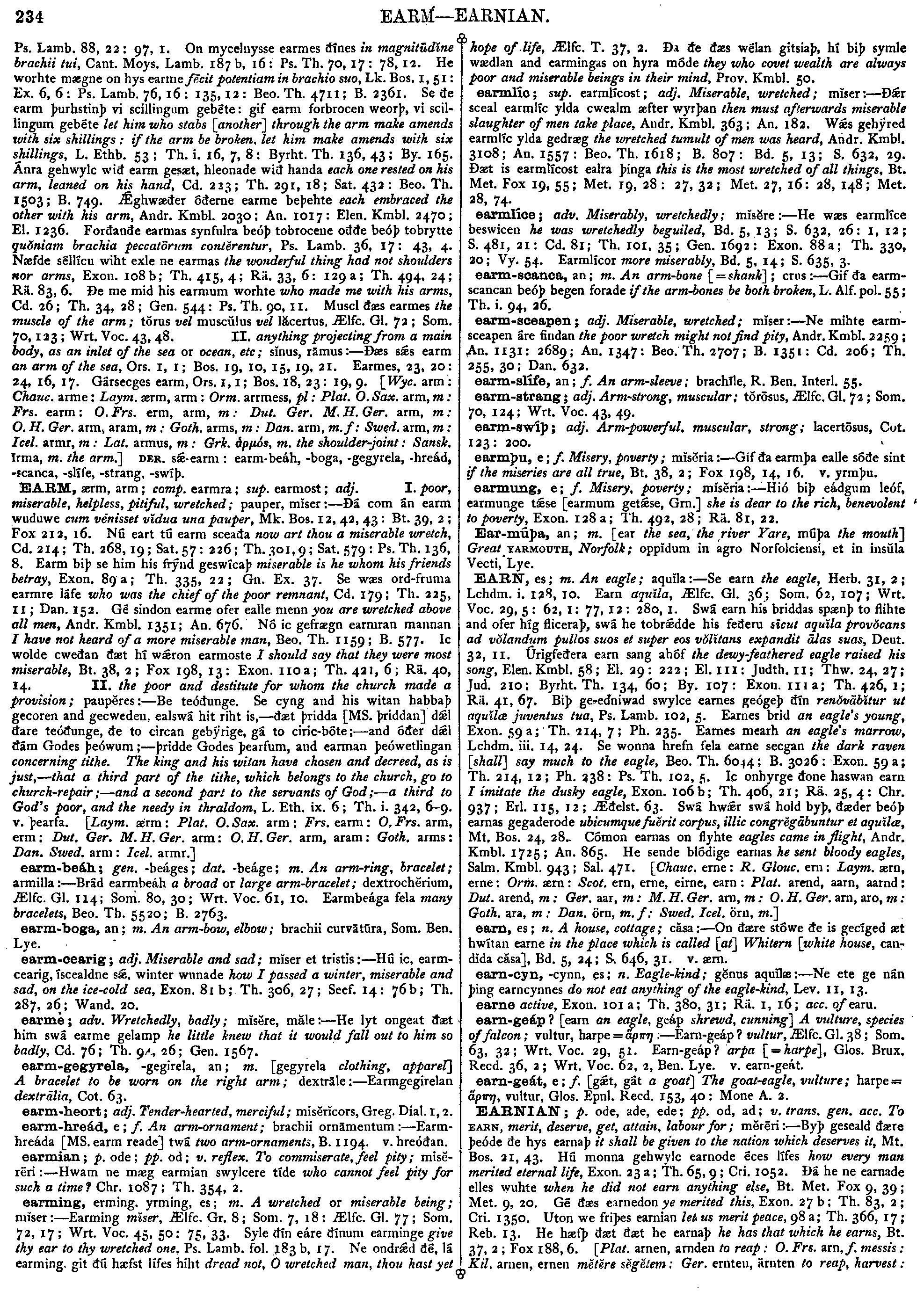
EARM,
ærm,
arm;
comp.
earmra;
sup.
earmost;
adj.
I.
poor,
miserable,
helpless,
pitiful,
wretched;
pauper,
mser
:--
Ðá
com
án
earm
wuduwe
cum
vnisset
vdua
una
pauper,
Mk.
Bos.
12,
42,
43:
Bt.
39,
2;
Fox
212,
16.
Nú
eart
tú
earm
sceaða
now
art
thou
a
miserable
wretch,
Cd.
214;
Th.
268,
19;
Sat.
57:
226;
Th.
301,
9;
Sat.
579:
Ps.
Th.
136,
8.
Earm
biþ
se
him
his
frýnd
geswícaþ
miserable
is
he
whom
his
friends
betray,
Exon.
89
a;
Th.
335,
22;
Gn.
Ex.
37.
Se
wæs
ord-fruma
earmre
láfe
who
was
the
chief
of
the
poor
remnant,
Cd.
179;
Th.
225,
11;
Dan.
152.
Gé
sindon
earme
ofer
ealle
menn
you
are
wretched
above
all
men,
Andr.
Kmbl.
1351;
An.
676.
Nó
ic
gefrægn
earmran
mannan
I
have
not
heard
of
a
more
miserable
man,
Beo.
Th.
1159;
B.
577.
Ic
wolde
cweðan
ðæt
hi
wron
earmoste
I
should
say
that
they
were
most
miserable,
Bt.
38,
2;
Fox
198,
13:
Exon.
110
a;
Th.
421,
6;
Rä.
40,
14.
II.
the
poor
and
destitute
for
whom
the
church
made
a
provision;
paupres
:--
Be
teóðunge.
Se
cyng
and
his
witan
habbaþ
gecoren
and
gecweden,
ealswá
hit
riht
is,--ðæt
þridda
[MS.
þriddan]
ðl
ðare
teóðunge,
ðe
to
circan
gebýrige,
gá
to
ciric-bóte;--and
óðer
dl
ðám
Godes
þeówum;--þridde
Godes
þearfum,
and
earman
þeówetlingan
concerning
tithe.
The
king
and
his
witan
have
chosen
and
decreed,
as
is
just,--that
a
third
part
of
the
tithe,
which
belongs
to
the
church,
go
to
church-repair;--and
a
second
part
to
the
servants
of
God;--a
third
to
God's
poor,
and
the
needy
in
thraldom,
L.
Eth.
ix.
6;
Th.
i.
342,
6-9.
v.
þearfa.
[Laym,
ærm:
Plat.
O.
Sax.
arm:
Frs.
earm:
O.
Frs.
arm,
erm:
Dut.
Ger.
M.
H.
Ger.
arm:
O.
H.
Ger.
arm,
aram:
Goth.
arms:
Dan.
Swed.
arm:
Icel.
armr.]
|
Source: Bosworth/Toller, page b0235, entry 22 View original page image as: [TIFF] [PNG] [View previous entry] [View next entry] |
[Comment on this entry] [View comments] |
The following entry has been hand-corrected once. |
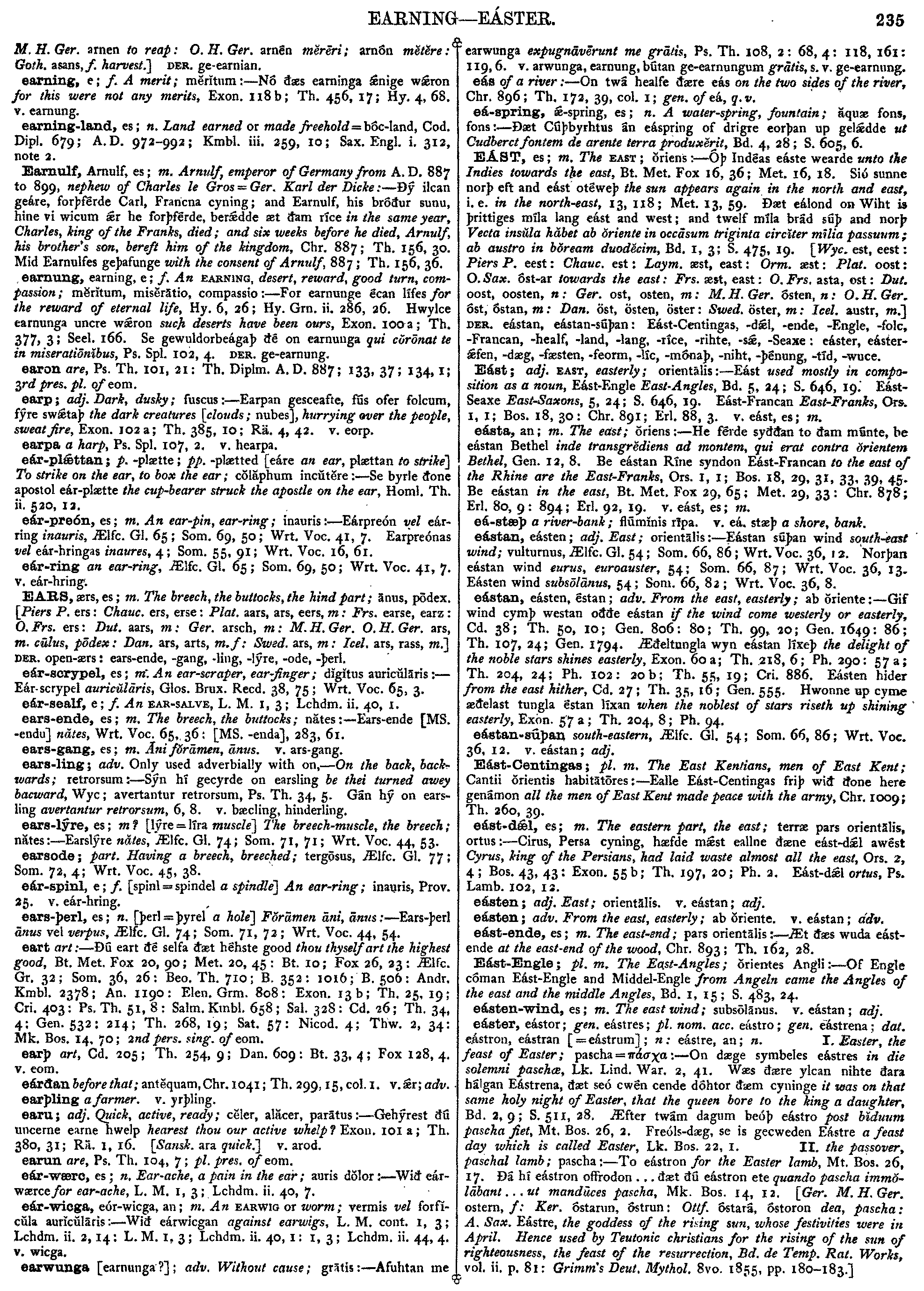
eart art:-- Ðú eart ðé selfa ðæt héhste good thou thyself art the highest good, Bt. Met. Fox 20, 90; Met. 20, 45: Bt. 10; Fox 26, 23: Ælfc. Gr. 32; Som. 36, 26: Beo. Th. 710; B. 352: 1016; B. 506: Andr. Kmbl. 2378; An. 1190: Elen. Grm. 808: Exon. 13 b; Th. 25, 19; Cri. 403: Ps. Th. 51, 8: Salm. Kmbl. 658; Sal. 328: Cd. 26; Th. 34, 4; Gen. 532: 214; Th. 268, 19; Sat. 57: Nicod. 4; Thw. 2, 34: Mk. Bos. 14, 70; 2nd pers. sing, of eom.
| Result Page: |  |
Previous | 1 2 3 4 5 6 7 8 9 10 11 12 13 14 15 16 17 18 19 | Next |  |
Germanic Lexicon Project (main page)
This search system was written by
Sean Crist
Please consider
volunteering
to correct the data in these online dictionaries.
No rights reserved. Feel free to use these data in any way you please.