|
|

|
Source: Bosworth/Toller, page b0455, entry 23 View original page image as: [TIFF] [PNG] [View previous entry] [View next entry] |
[Comment on this entry] [View comments] |
The following entry has been hand-corrected once. |
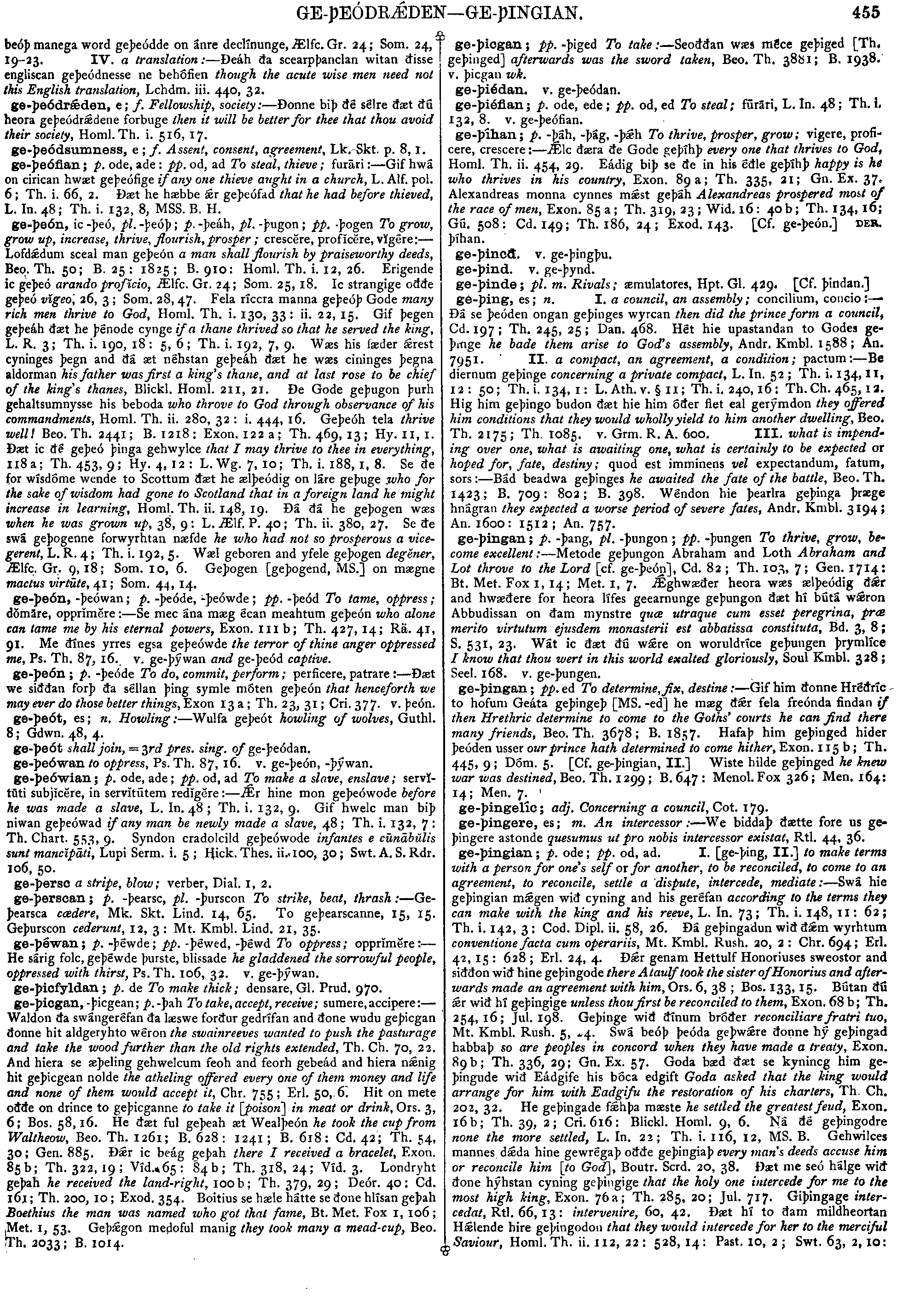
ge-þing, es; n. I. a council, an assembly; concilium, counio :-- Ðá se þeóden ongan geþinges wyrcan then did the prince form a council, Cd. 197; Th. 245, 25; Dan. 468. Hét hie upastandan to Godes geþinge he bade them arise to God's assembly, Andr, Kmbl. 1588; An. 7951. II. a compact, an agreement, a condition; pactum :-- Be diernum geþinge concerning a private compact, L. In. 52; Th. i. 134, 11, 12: 50; Th. i. 134, 1: L. Ath. v. § 11; Th. i. 240, 16: Th. Ch. 465, 12. Hig him geþingo budon ðæt hie him óðer flet eal gerýmdon they offered him conditions that they would wholly yield to him another dwelling, Beo. Th. 2175; Th, 1085. v. Grm. R. A. 600. III. what is impending over one, what is awaiting one, what is certainly to be expected or hoped for, fate, destiny; quod est imminens vel expectandum, fatum, sors :-- Bád beadwa geþinges he awaited the fate of the battle, Beo. Th. 1423; B, 709: 802; B. 398. Wéndon hie þearlra geþinga þræge hnágran they expected a worse period of severe fates, Andr. Kmbl. 3194; An. 1600: 1512; An. 757.
|
Source: Bosworth/Toller, page b0456, entry 14 View original page image as: [TIFF] [PNG] [View previous entry] [View next entry] |
[Comment on this entry] [View comments] |
The following entry has been hand-corrected once. |
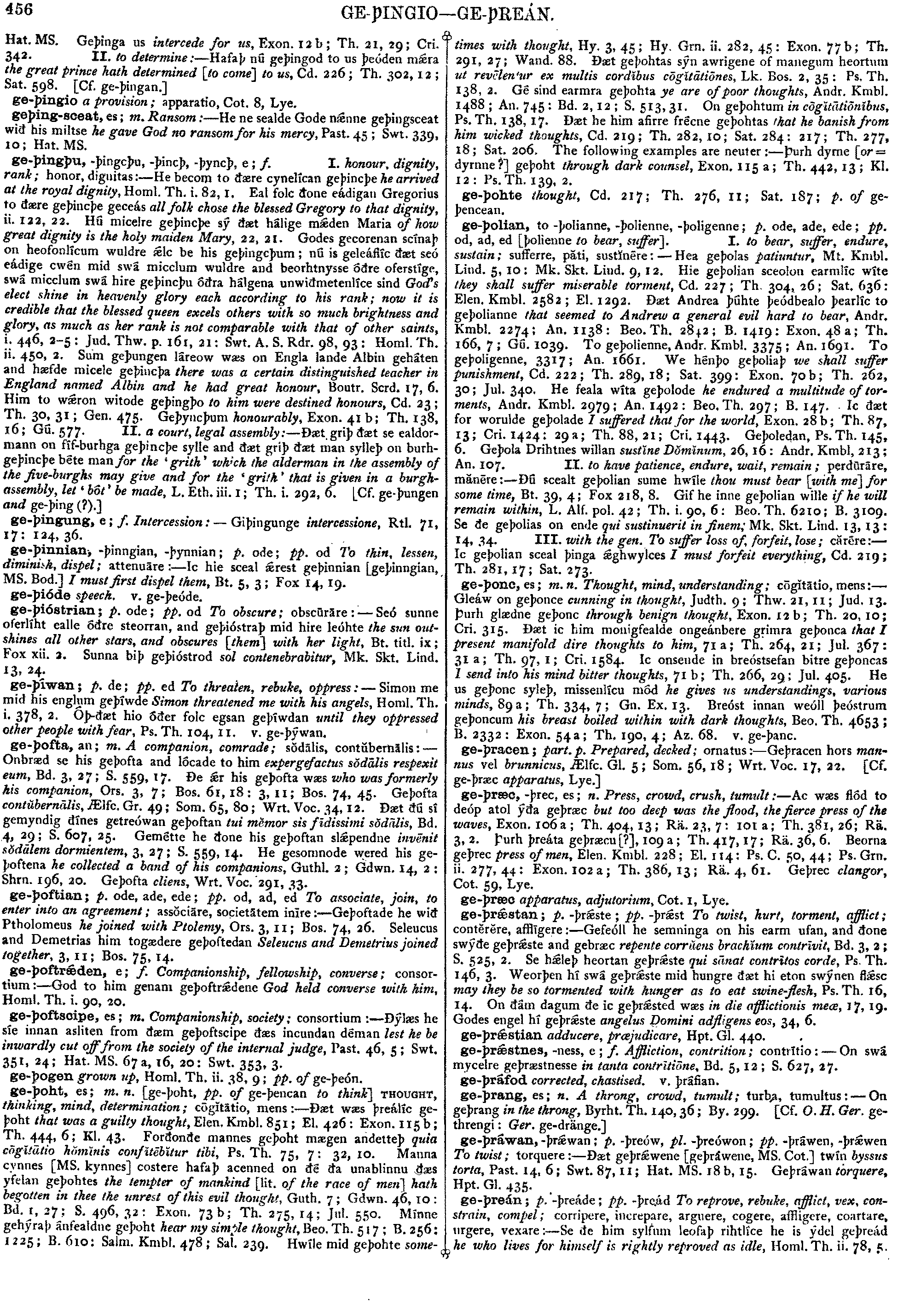
ge-þoht,
es;
m.
n.
[ge-þoht,
pp.
of
ge-þencan
to
think]
THOUGHT,
thinking,
mind,
determination;
c g
g t
t tio,
mens
:--
Ðæt
wæs
þreálíc
ge-þoht
that
was
a
guilty
thought,
Elen.
Kmbl.
851;
El.
426:
Exon.
115
b;
Th.
444,
6;
Kl.
43.
Forðonðe
mannes
geþoht
mægen
andetteþ
quia
cgttio
h
tio,
mens
:--
Ðæt
wæs
þreálíc
ge-þoht
that
was
a
guilty
thought,
Elen.
Kmbl.
851;
El.
426:
Exon.
115
b;
Th.
444,
6;
Kl.
43.
Forðonðe
mannes
geþoht
mægen
andetteþ
quia
cgttio
h mnis
conft
mnis
conft btur
tibi,
Ps.
Th.
75,
7:
32,
10.
Manna
cynnes
[MS.
kynnes]
costere
hafaþ
acenned
on
ðé
ða
unablinnu
ðæs
yfelan
geþohtes
the
tempter
of
mankind
[lit.
of
the
race
of
men]
hath
begotten
in
thee
the
unrest
of
this
evil
thought,
Guth.
7;
Gdwn.
46,
10:
Bd.
1,
27:
S.
496,
32:
Exon.
73
b;
Th.
275,
14;
Jul.
550.
Mínne
gehýraþ
ánfealdne
geþoht
hear
my
simple
thought,
Beo.
Th.
517;
B.
256:
1225;
B.
610:
Salm.
Kmbl.
478;
Sal.
239.
Hwíle
mid
geþohte
sometimes
with
thought,
Hy.
3,
45;
Hy.
Grn.
ii.
282,
45:
Exon.
77
b;
Th.
291,
27;
Wand.
88.
Ðæt
geþohtas
sýn
awrigene
of
manegum
heortum
ut
revlentur
ex
meltis
cordbus
cgttines,
Lk.
Bos.
2,
35:
Ps.
Th.
138,
2.
Gé
sind
earmra
geþohta
ye
are
of
poor
thoughts,
Andr.
Kmbl.
1488;
An.
745:
Bd.
2,
12;
S.
513,
31.
On
geþohtum
in
cgttinbus,
Ps.
Th.
138,
17.
Ðæt
he
him
afirre
frécne
geþohtas
that
he
banish
from
him
wicked
thoughts,
Cd.
219;
Th.
282,
10;
Sat.
284:
217;
Th.
277,
18;
Sat.
206.
The
following
examples
are
neuter
:--
Þurh
dyrne
[or
=
dyrnne?]
geþoht
through
dark
counsel,
Exon.
115
a;
Th.
442,
13;
Kl.
12:
Ps.
Th.
139,
2.
btur
tibi,
Ps.
Th.
75,
7:
32,
10.
Manna
cynnes
[MS.
kynnes]
costere
hafaþ
acenned
on
ðé
ða
unablinnu
ðæs
yfelan
geþohtes
the
tempter
of
mankind
[lit.
of
the
race
of
men]
hath
begotten
in
thee
the
unrest
of
this
evil
thought,
Guth.
7;
Gdwn.
46,
10:
Bd.
1,
27:
S.
496,
32:
Exon.
73
b;
Th.
275,
14;
Jul.
550.
Mínne
gehýraþ
ánfealdne
geþoht
hear
my
simple
thought,
Beo.
Th.
517;
B.
256:
1225;
B.
610:
Salm.
Kmbl.
478;
Sal.
239.
Hwíle
mid
geþohte
sometimes
with
thought,
Hy.
3,
45;
Hy.
Grn.
ii.
282,
45:
Exon.
77
b;
Th.
291,
27;
Wand.
88.
Ðæt
geþohtas
sýn
awrigene
of
manegum
heortum
ut
revlentur
ex
meltis
cordbus
cgttines,
Lk.
Bos.
2,
35:
Ps.
Th.
138,
2.
Gé
sind
earmra
geþohta
ye
are
of
poor
thoughts,
Andr.
Kmbl.
1488;
An.
745:
Bd.
2,
12;
S.
513,
31.
On
geþohtum
in
cgttinbus,
Ps.
Th.
138,
17.
Ðæt
he
him
afirre
frécne
geþohtas
that
he
banish
from
him
wicked
thoughts,
Cd.
219;
Th.
282,
10;
Sat.
284:
217;
Th.
277,
18;
Sat.
206.
The
following
examples
are
neuter
:--
Þurh
dyrne
[or
=
dyrnne?]
geþoht
through
dark
counsel,
Exon.
115
a;
Th.
442,
13;
Kl.
12:
Ps.
Th.
139,
2.
|
Source: Bosworth/Toller, page b0456, entry 16 View original page image as: [TIFF] [PNG] [View previous entry] [View next entry] |
[Comment on this entry] [View comments] |
The following entry has been hand-corrected once. |
ge-þolian,
to
-þolianne,
-þolienne,
-þoligenne;
p.
ode,
ade,
ede;
pp.
od,
ad,
ed
[þolienne
to
bear,
suffer].
I.
to
bear,
suffer,
endure,
sustain;
sufferre,
p ti,
sustnre
:--
Hea
geþolas
patiuntur,
Mt.
Kmbl.
Lind.
5,
10:
Mk.
Skt.
Lind.
9,
12.
Hie
geþolian
sceolon
earmlíc
wíte
they
shall
suffer
miserable
torment,
Cd.
227;
Th.
304,
26;
Sat.
636:
Elen.
Kmbl.
2582;
El.
1292.
Ðæt
Andrea
þúhte
þeódbealo
þearlíc
to
geþolianne
that
seemed
to
Andrew
a
general
evil
hard
to
bear,
Andr.
Kmbl.
2274;
An.
1138:
Beo.Th.
2842;
B.
1419:
Exon.
48
a;
Th.
166,
7;
Gú.
1039.
To
geþolienne,
Andr.
Kmbl.
3375;
An.
1691.
To
geþoligenne,
3317;
An.
1661.
We
hénþo
geþoliaþ
we
shall
suffer
punishment,
Cd.
222;
Th.
289,
18;
Sat.
399:
Exon.
70
b;
Th.
262,
30;
Jul.
340.
He
feala
wíta
geþolode
he
endured
a
multitude
of
torments,
Andr.
Kmbl.
2979;
An.
1492:
Beo.
Th.
297;
B.
147.
Ic
ðæt
for
worulde
geþolade
I
suffered
that
for
the
world,
Exon.
28
b;
Th.
87,
13;
Cri.
1424:
29
a;
Th.
88,
21;
Cri.
1443.
Geþoledan,
Ps.
Th.
145,
6.
Geþola
Drihtnes
willan
sustne
Dmnum,
26,
16:
Andr.
Kmbl,
213;
An.
107.
II.
to
have
patience,
endure,
wait,
remain;
perd
ti,
sustnre
:--
Hea
geþolas
patiuntur,
Mt.
Kmbl.
Lind.
5,
10:
Mk.
Skt.
Lind.
9,
12.
Hie
geþolian
sceolon
earmlíc
wíte
they
shall
suffer
miserable
torment,
Cd.
227;
Th.
304,
26;
Sat.
636:
Elen.
Kmbl.
2582;
El.
1292.
Ðæt
Andrea
þúhte
þeódbealo
þearlíc
to
geþolianne
that
seemed
to
Andrew
a
general
evil
hard
to
bear,
Andr.
Kmbl.
2274;
An.
1138:
Beo.Th.
2842;
B.
1419:
Exon.
48
a;
Th.
166,
7;
Gú.
1039.
To
geþolienne,
Andr.
Kmbl.
3375;
An.
1691.
To
geþoligenne,
3317;
An.
1661.
We
hénþo
geþoliaþ
we
shall
suffer
punishment,
Cd.
222;
Th.
289,
18;
Sat.
399:
Exon.
70
b;
Th.
262,
30;
Jul.
340.
He
feala
wíta
geþolode
he
endured
a
multitude
of
torments,
Andr.
Kmbl.
2979;
An.
1492:
Beo.
Th.
297;
B.
147.
Ic
ðæt
for
worulde
geþolade
I
suffered
that
for
the
world,
Exon.
28
b;
Th.
87,
13;
Cri.
1424:
29
a;
Th.
88,
21;
Cri.
1443.
Geþoledan,
Ps.
Th.
145,
6.
Geþola
Drihtnes
willan
sustne
Dmnum,
26,
16:
Andr.
Kmbl,
213;
An.
107.
II.
to
have
patience,
endure,
wait,
remain;
perd rre,
mnre
:--
Ðú
scealt
geþolian
sume
hwíle
thou
must
bear
[with
me]
for
some
time,
Bt.
39,
4;
Fox
218,
8.
Gif
he
inne
geþolian
wille
if
he
will
remain
within,
L.
Alf.
pol.
42;
Th.
i.
90,
6:
Beo.
Th.
6210;
B.
3109.
Se
ðe
geþolias
on
ende
qui
sustinuerit
in
finem;
Mk.
Skt.
Lind.
13,
13:
14,
34.
III.
with
the
gen.
To
suffer
loss
of,
forfeit,
lose;
crre
:--
Ic
geþolian
sceal
þinga
rre,
mnre
:--
Ðú
scealt
geþolian
sume
hwíle
thou
must
bear
[with
me]
for
some
time,
Bt.
39,
4;
Fox
218,
8.
Gif
he
inne
geþolian
wille
if
he
will
remain
within,
L.
Alf.
pol.
42;
Th.
i.
90,
6:
Beo.
Th.
6210;
B.
3109.
Se
ðe
geþolias
on
ende
qui
sustinuerit
in
finem;
Mk.
Skt.
Lind.
13,
13:
14,
34.
III.
with
the
gen.
To
suffer
loss
of,
forfeit,
lose;
crre
:--
Ic
geþolian
sceal
þinga
 ghwylces
I
must
forfeit
everything,
Cd.
219;
Th.
281,
17;
Sat.
273.
ghwylces
I
must
forfeit
everything,
Cd.
219;
Th.
281,
17;
Sat.
273.
|
Source: Bosworth/Toller, page b0456, entry 27 View original page image as: [TIFF] [PNG] [View previous entry] [View next entry] |
[Comment on this entry] [View comments] |
The following entry has been hand-corrected once. |
ge-þreán; p. þreáde; pp. -þreád To reprove, rebuke, afflict, vex, constrain, compel; corripere, increpare, arguere, cogere, affligere, coartare, urgere, vexare :-- Se ðe him sylfum leofaþ rihtlíce he is ýdel geþreád he who lives for himself is rightly reproved as idle, Homl. Th. ii. 78, 5. Huelc from iúh geþreáþ mec quis ex vobis arguit me? Jn. Skt. Lind. 8, 46: 16, 18. He geþreáde ðæt wind ille increpavit ventum, Lk. Skt. Lind. 8, 24: 9, 55. Geþreá hine increpa illum, 17, 3. Ne geþreá me neque corripias me, Ps. Surt. 37, 2. From giþreándum ab increpantibus, Rtl. 19, 15. Hú beó ic geþreád quomodo coarctor, Lk. 12, 50. Ic wæs geþreád ðæt ic ðé sóhte I was compelled to seek thee, Exon, 70 b; Th. 263, 3; Jul. 344. Egsan geþreád afflicted with terror, 30 b; Th. 95, 28; Cri. 1564: 33 b; Th. 106, 22; Gú. 45: Cd. 90; Th. 112, 4; Gen. 1865: 126; Th. 161, 21; Gen. 2668: Andr. Kmbl. 781; An. 391. He náhte his líchoman geweald ac he wæs mid godcundum mægene geþreád he had no power over his body, but was afflicted by the divine might, Blickl. Homl. 223, 12.
|
Source: Bosworth/Toller, page b0457, entry 1 View original page image as: [TIFF] [PNG] [View previous entry] [View next entry] |
[Comment on this entry] [View comments] |
The following entry has been hand-corrected once. |
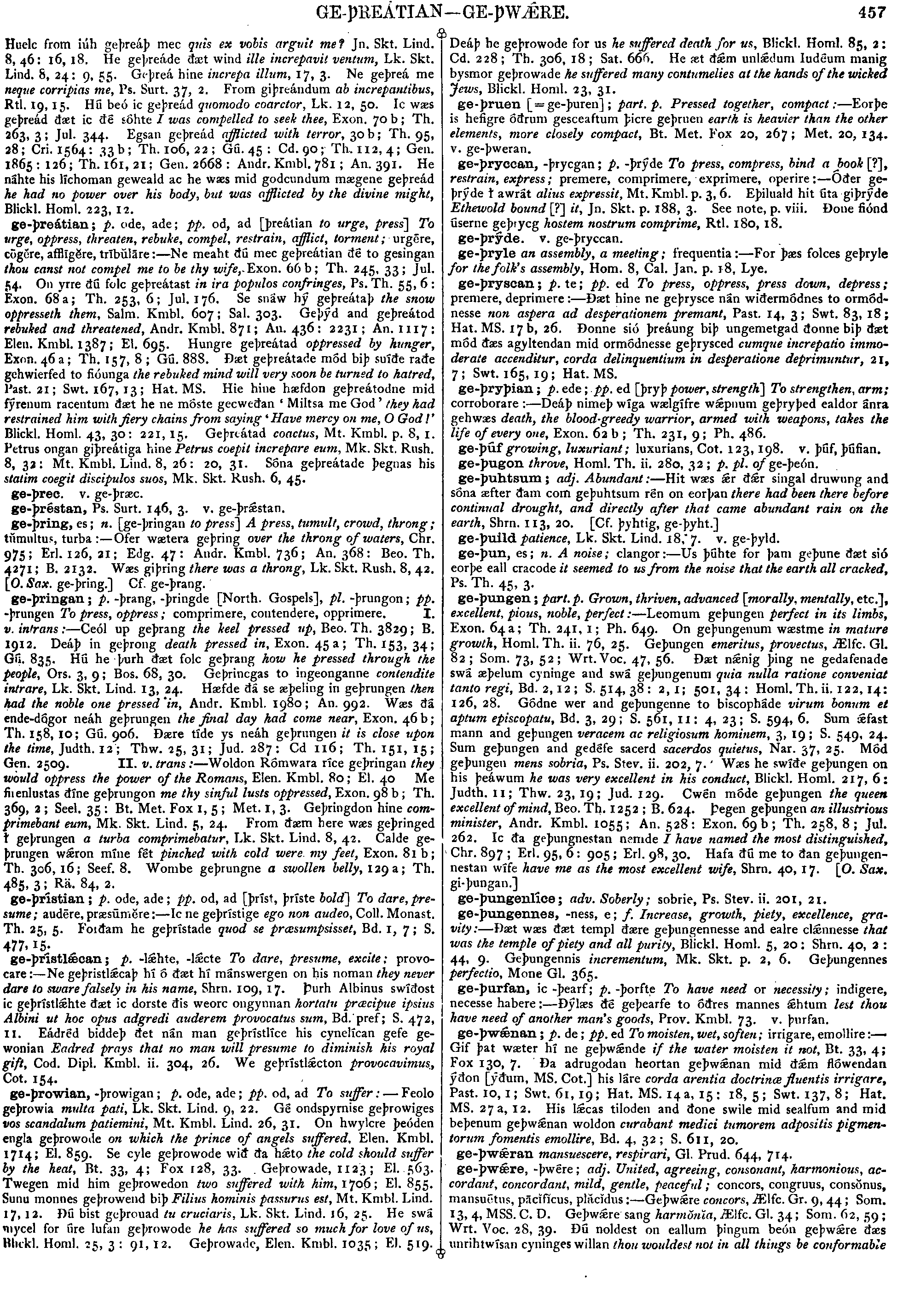
ge-þreátian;
p.
ode,
ade;
pp.
od,
ad
[þreátian
to
urge,
press]
To
urge,
oppress,
threaten,
rebuke,
compel,
restrain,
afflict,
torment;
urgre,
cg re,
affl
re,
affl gre,
trb
gre,
trb lre
:--
Ne
meaht
ðú
mec
geþreátian
ðé
to
gesingan
thou
canst
not
compel
me
to
be
thy
wife,
Exon.
66
b;
Th.
245,
33;
Jul.
54.
On
yrre
ðú
folc
geþreátast
in
ira
populos
confringes,
Ps.
Th.
55,
6:
Exon.
68
a;
Th.
253,
6;
Jul.
176.
Se
snáw
hý
geþreátaþ
the
snow
oppresseth
them,
Salm.
Kmbl.
607;
Sal.
303.
Geþýd
and
geþreátod
rebuked
and
threatened,
Andr.
Kmbl.
871;
An.
436:
2231;
An.
1117:
Elen.
Kmbl.
1387;
El.
695.
Hungre
geþreátad
oppressed
by
hunger,
Exon.
46
a;
Th.
157,
8;
Gú.
888.
Ðæt
geþreátade
mód
biþ
suíðe
raðe
gehwierfed
to
fióunga
the
rebuked
mind
will
very
soon
be
turned
to
hatred,
Past.
21;
Swt.
167,
13;
Hat.
MS.
Hie
hine
hæfdon
geþreátodne
mid
fýrenum
racentum
ðæt
he
ne
móste
gecweðan
'Miltsa
me
God'
they
had
restrained
him
with
fiery
chains
from
saying
'Have
mercy
on
me,
O
God!'
Blickl.
Homl.
43,
30:
221,
15.
Geþreátad
coactus,
Mt.
Kmbl.
p.
8,
1.
Petrus
ongan
giþreátiga
hine
Petrus
coepit
increpare
eum,
Mk.
Skt.
Rush.
8,
32:
Mt.
Kmbl.
Lind.
8,
26:
20,
31.
Sóna
geþreátade
þegnas
his
statim
coegit
discipulos
suos,
Mk.
Skt.
Rush.
6,
45.
lre
:--
Ne
meaht
ðú
mec
geþreátian
ðé
to
gesingan
thou
canst
not
compel
me
to
be
thy
wife,
Exon.
66
b;
Th.
245,
33;
Jul.
54.
On
yrre
ðú
folc
geþreátast
in
ira
populos
confringes,
Ps.
Th.
55,
6:
Exon.
68
a;
Th.
253,
6;
Jul.
176.
Se
snáw
hý
geþreátaþ
the
snow
oppresseth
them,
Salm.
Kmbl.
607;
Sal.
303.
Geþýd
and
geþreátod
rebuked
and
threatened,
Andr.
Kmbl.
871;
An.
436:
2231;
An.
1117:
Elen.
Kmbl.
1387;
El.
695.
Hungre
geþreátad
oppressed
by
hunger,
Exon.
46
a;
Th.
157,
8;
Gú.
888.
Ðæt
geþreátade
mód
biþ
suíðe
raðe
gehwierfed
to
fióunga
the
rebuked
mind
will
very
soon
be
turned
to
hatred,
Past.
21;
Swt.
167,
13;
Hat.
MS.
Hie
hine
hæfdon
geþreátodne
mid
fýrenum
racentum
ðæt
he
ne
móste
gecweðan
'Miltsa
me
God'
they
had
restrained
him
with
fiery
chains
from
saying
'Have
mercy
on
me,
O
God!'
Blickl.
Homl.
43,
30:
221,
15.
Geþreátad
coactus,
Mt.
Kmbl.
p.
8,
1.
Petrus
ongan
giþreátiga
hine
Petrus
coepit
increpare
eum,
Mk.
Skt.
Rush.
8,
32:
Mt.
Kmbl.
Lind.
8,
26:
20,
31.
Sóna
geþreátade
þegnas
his
statim
coegit
discipulos
suos,
Mk.
Skt.
Rush.
6,
45.
|
Source: Bosworth/Toller, page b0457, entry 4 View original page image as: [TIFF] [PNG] [View previous entry] [View next entry] |
[Comment on this entry] [View comments] |
The following entry has been hand-corrected once. |
ge-þring,
es;
n.
[ge-þringan
to
press]
A
press,
tumult,
crowd,
throng;
tmultus,
turba
:--
Ofer
wætera
geþring
over
the
throng
of
waters,
Chr.
975;
Erl.
126,
21;
Edg.
47:
Andr.
Kmbl.
736;
An.
368:
Beo.
Th.
4271;
B.
2132.
Wæs
giþring
there
was
a
throng,
Lk.
Skt.
Rush.
8,
42.[O.
Sax.
ge-þring.]
Cf.
ge-þrang.
|
Source: Bosworth/Toller, page b0457, entry 5 View original page image as: [TIFF] [PNG] [View previous entry] [View next entry] |
[Comment on this entry] [View comments] |
The following entry has been hand-corrected once. |
ge-þringan;
p.
-þrang,
-þringde
[North.
Gospels],
pl.
-þrungon;
pp.
-þrungen
To
press,
oppress;
comprimere,
contendere,
opprimere.
I.
v.
intrans
:--
Ceól
up
geþrang
the
keel
pressed
up,
Beo.
Th.
3829;
B.
1912.
Deáþ
in
geþrong
death
pressed
in,
Exon.
45
a;
Th.
153,
34;
Gú.
835.
Hú
he
þurh
ðæt
folc
geþrang
how
he
pressed
through
the
people,
Ors.
3,
9;
Bos.
68,
30.
Geþrincgas
to
ingeonganne
contendite
intrare,
Lk.
Skt.
Lind.
13,
24.
Hæfde
ðá
se
æþeling
in
geþrungen
then
had
the
noble
one
pressed
in,
Andr.
Kmbl.
1980;
An.
992.
Wæs
ðá
ende-dógor
neáh
geþrungen
the
final
day
had
come
near,
Exon.
46
b;
Th.
158,
10;
Gú.
906.
Ðære
tíde
ys
neáh
geþrungen
it
is
close
upon
the
time,
Judth.
12;
Thw.
25,
31;
Jud.
287:
Cd
116;
Th.
151,
15;
Gen.
2509.
II.
v.
trans
:--
Woldon
Rómwara
ríce
geþringan
they
would
oppress
the
power
of
the
Romans,
Elen.
Kmbl.
80;
El.
40
Me
firenlustas
ðíne
geþrungon
me
thy
sinful
lusts
oppressed,
Exon.
98
b;
Th.
369,
2;
Seel.
35:
Bt.
Met.
Fox
1,
5;
Met.
1,
3.
Geþringdon
hine
comprimebant
eum,
Mk.
Skt.
Lind.
5,
24.
From
ðæm
here
wæs
geþrunged
 geþrungen
a
turba
comprimebatur,
Lk.
Skt.
Lind.
8,
42.
Calde
geþrungen
wron
míne
fét
pinched
with
cold
were
my
feet,
Exon.
81
b;
Th.
306,
16;
Seef.
8.
Wombe
geþrungne
a
swollen
belly,
129
a;
Th.
485,
3;
Rä.
84,
2.
geþrungen
a
turba
comprimebatur,
Lk.
Skt.
Lind.
8,
42.
Calde
geþrungen
wron
míne
fét
pinched
with
cold
were
my
feet,
Exon.
81
b;
Th.
306,
16;
Seef.
8.
Wombe
geþrungne
a
swollen
belly,
129
a;
Th.
485,
3;
Rä.
84,
2.
|
Source: Bosworth/Toller, page b0457, entry 20 View original page image as: [TIFF] [PNG] [View previous entry] [View next entry] |
[Comment on this entry] [View comments] |
The following entry has been hand-corrected once. |
ge-þungen;
part.
p.
Grown,
thriven,
advanced
[morally,
mentally,
etc.],
excellent,
pious,
noble,
perfect
:--
Leomum
geþungen
perfect
in
its
limbs,
Exon.
64
a;
Th.
241,
1;
Ph.
649.
On
geþungenum
wæstme
in
mature
growth,
Homl.
Th.
ii.
76,
25.
Geþungen
emeritus,
provectus,
Ælfc.
Gl.
82;
Som.
73,
52;
Wrt.
Voc.
47,
56.
Ðæt
nnig
þing
ne
gedafenade
swá
æþelum
cyninge
and
swá
geþungenum
quia
nulla
ratione
conveniat
tanto
regi,
Bd.
2,
12;
S.
514,
38:
2,
1;
501,
34:
Homl.
Th.
ii.
122,
14:
126,
28.
Gódne
wer
and
geþungenne
to
biscopháde
virum
bonum
el
aptum
episcopatu,
Bd.
3,
29;
S.
561,
11:
4,
23;
S.
594,
6.
Sum
fast
mann
and
geþungen
veracem
ac
religiosum
hominem,
3,
19;
S.
549,
24.
Sum
geþungen
and
gedéfe
sacerd
sacerdos
quietus,
Nar.
37,
25.
Mód
geþungen
mens
sobria,
Ps.
Stev.
ii.
202,
7.
Wæs
he
swíðe
geþungen
on
his
þeáwum
he
was
very
excellent
in
his
conduct,
Blickl.
Homl.
217,
6:
Judth.
11;
Thw.
23,
19;
Jud.
129.
Cwén
móde
geþungen
the
queen
excellent
of
mind,
Beo.
Th.
1252;
B.
624.
Þegen
geþungen
an
illustrious
minister,
Andr.
Kmbl.
1055;
An.
528:
Exon.
69
b;
Th.
258,
8;
Jul.
262.
Ic
ða
geþungnestan
nemde
I
have
named
the
most
distinguished,
Chr.
897;
Erl.
95,
6:
905;
Erl.
98,
30.
Hafa
ðú
me
to
ðan
geþungennestan
wífe
have
me
as
the
most
excellent
wife,
Shrn.
40,
17.
[O.
Sax.
gi-þungan.]
|
Source: Bosworth/Toller, page b0459, entry 4 View original page image as: [TIFF] [PNG] [View previous entry] [View next entry] |
[Comment on this entry] [View comments] |
The following entry has been hand-corrected once. |
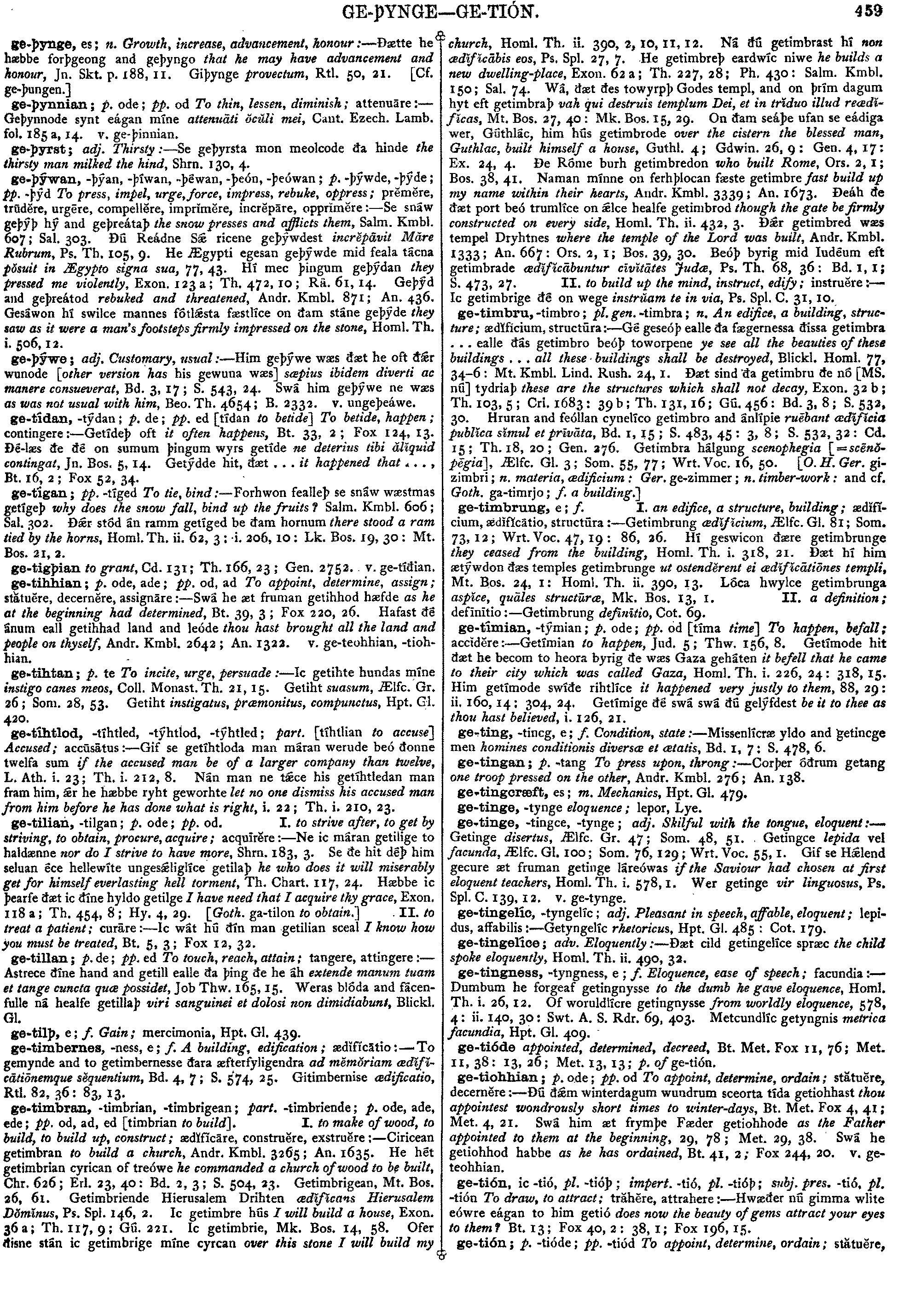
ge-þýwan,
-þýan,
-þíwan,
-þéwan,
-þeón,
-þeówan;
p.
-þýwde,
-þýde;
pp.
-þýd
To
press,
impel,
urge,
force,
impress,
rebuke,
oppress;
prmre,
trdre,
urgre,
compellre,
imprmre,
incrpre,
opprmre
:--
Se
snáw
geþýþ
hý
and
geþreátaþ
the
snow
presses
and
afflicts
them,
Salm.
Kmbl.
607;
Sal.
303.
Ðú
Reádne
S
ricene
geþýwdest
incrpvit
Mre
Rubrum,
Ps.
Th.
105,
9.
He
Ægypti
egesan
geþýwde
mid
feala
tácna
psuit
in
Ægypto
signa
sua,
77,
43.
Hí
mec
þingum
geþýdan
they
pressed
me
violently,
Exon.
123
a;
Th.
472,
10;
Rä.
61,
14.
Geþýd
and
geþreátod
rebuked
and
threatened,
Andr.
Kmbl.
871;
An.
436.
Gesáwon
hí
swilce
mannes
fótlsta
fæstlíce
on
ðam
stáne
geþýde
they
saw
as
it
were
a
man's
footsteps
firmly
impressed
on
the
stone,
Homl.
Th.
i.
506,
12.
|
Source: Bosworth/Toller, page b0459, entry 9 View original page image as: [TIFF] [PNG] [View previous entry] [View next entry] |
[Comment on this entry] [View comments] |
The following entry has been hand-corrected once. |
ge-tihhian;
p.
ode,
ade;
pp.
od,
ad
To
appoint,
determine,
assign;
stture,
decernre,
assignre
:--
Swá
he
æt
fruman
getihhod
hæfde
as
he
at
the
beginning
had
determined,
Bt.
39,
3;
Fox
220,
26.
Hafast
ðé
ánum
eall
getihhad
land
and
leóde
thou
hast
brought
all
the
land
and
people
on
thyself,
Andr.
Kmbl.
2642;
An.
1322.
v.
ge-teohhian,
-tiohhian.
| Result Page: |  |
Previous | 69 70 71 72 73 74 75 76 77 78 79 80 81 82 83 84 85 86 87 | Next |  |
Germanic Lexicon Project (main page)
This search system was written by
Sean Crist
Please consider
volunteering
to correct the data in these online dictionaries.
No rights reserved. Feel free to use these data in any way you please.