|
|

Tip: In the search results, you can click on any word or abbreviation for more information.
|
Source: Bosworth/Toller, page b0079, entry 10 View original page image as: [TIFF] [PNG] [View previous entry] [View next entry] |
[Comment on this entry] [View comments] |
The following entry has been hand-corrected once. |
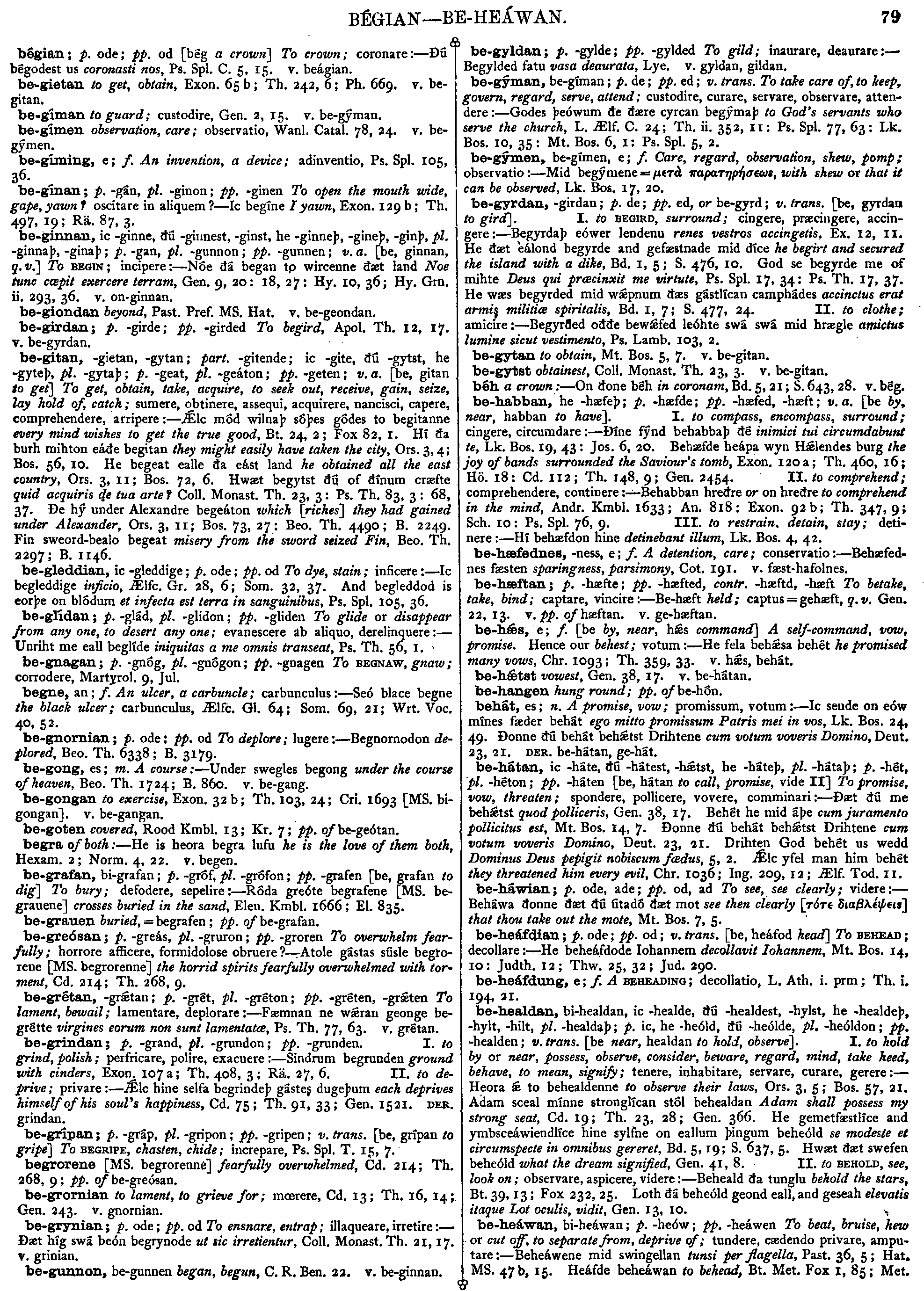
be-gitan, -gietan, -gytan; part. -gitende; ic -gite, ðú -gytst, he -gyteþ, pl. -gytaþ ; p. -geat, pl. -geáton; pp. -geten ; v. a. [be, gitan to get] To get, obtain, take, acquire, to seek out, receive, gain, seize, lay hold of, catch; sumere, obtinere, assequi, acquirere, nancisci, capere, comprehendere, arripere :-- Æ-acute;lc mód wilnaþ sóþes gódes to begitanne every mind wishes to get the true good, Bt. 24, 2 ; Fox 82, 1. Hí ða burh mihton eáðe begitan they might easily have taken the city, Ors. 3, 4; Bos. 56, 10. He begeat ealle ða eást land he obtained all the east country, Ors. 3, 11; Bos. 72, 6. Hwæt begytst ðú of ðínum cræfte quid acquiris de tua arte? Coll. Monast. Th. 23, 3 : Ps. Th. 83, 3 : 68, 37. Ðe hý under Alexandre begeáton which [riches] they had gained under Alexander, Ors. 3, 11; Bos. 73, 27 : Beo. Th. 4490; B. 2249.
|
Source: Bosworth/Toller, page b0390, entry 31 View original page image as: [TIFF] [PNG] [View previous entry] [View next entry] |
[Comment on this entry] [View comments] |
The following entry has been hand-corrected once. |
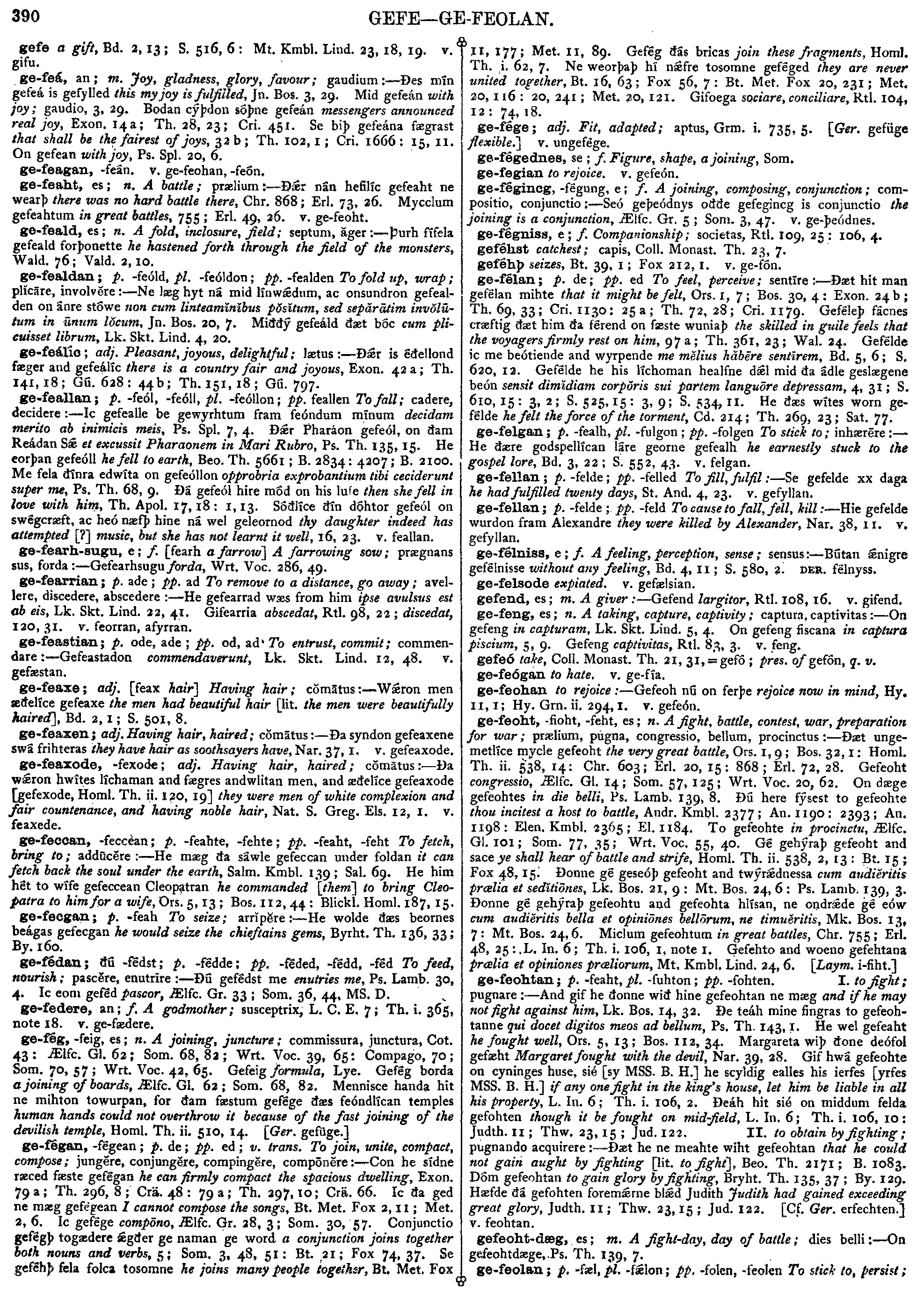
ge-fellan; p. -felde; pp. -feld To cause to fall, fell, kill :-- Hie gefelde wurdon fram Alexandre they were killed by Alexander, Nar. 38, 11. v. gefyllan.
|
Source: Bosworth/Toller, page b0406, entry 23 View original page image as: [TIFF] [PNG] [View previous entry] [View next entry] |
[Comment on this entry] [View comments] |
The following entry has been hand-corrected once. |
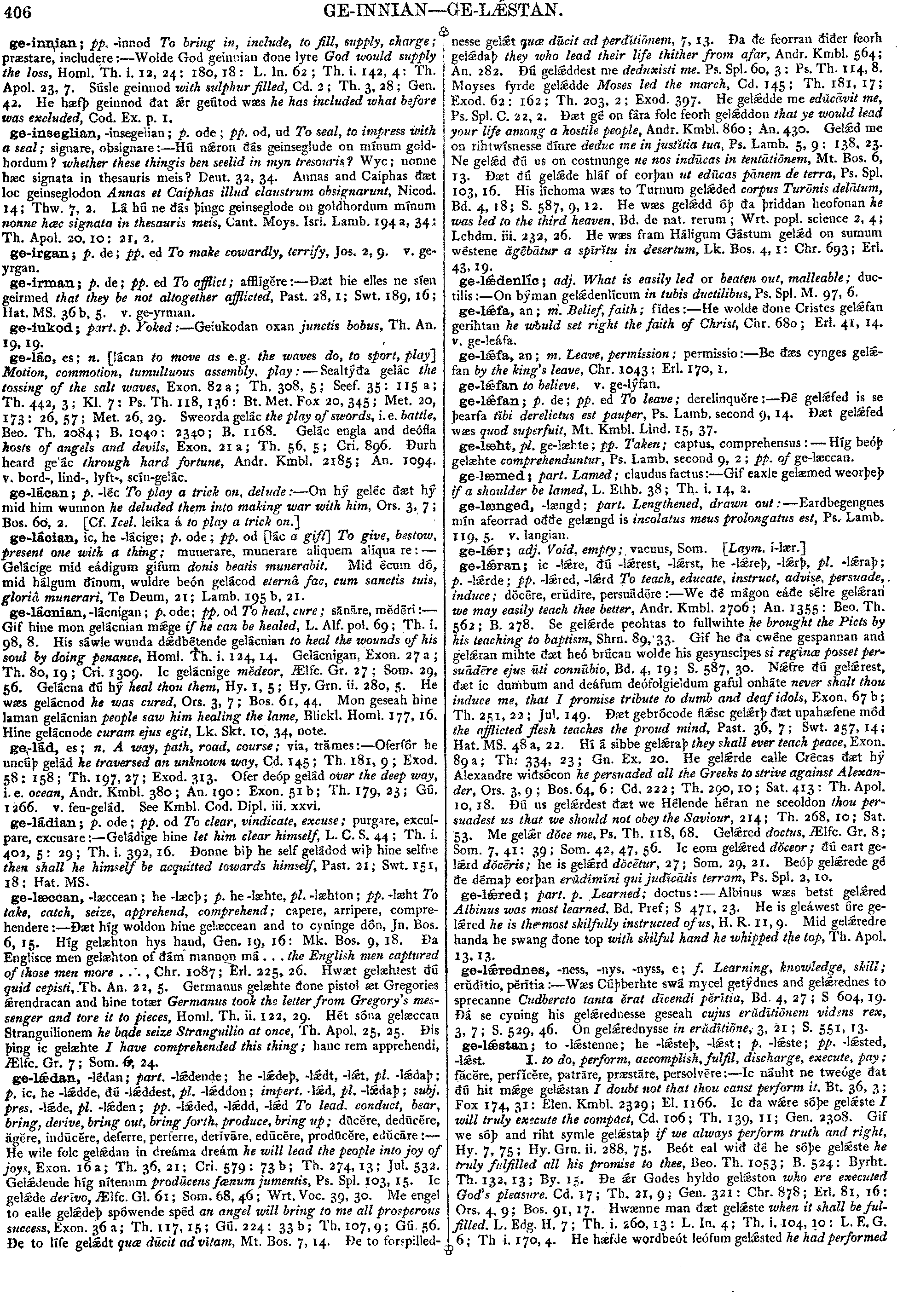
ge-l ran;
ic
-lre,
ðú
-lrest,
-lrst,
he
-lreþ,
-lrþ,
pl.
-lraþ;
p.
-lrde;
pp.
-lred,
-lrd
To
teach,
educate,
instruct,
advise,
persuade,
induce;
d
ran;
ic
-lre,
ðú
-lrest,
-lrst,
he
-lreþ,
-lrþ,
pl.
-lraþ;
p.
-lrde;
pp.
-lred,
-lrd
To
teach,
educate,
instruct,
advise,
persuade,
induce;
d c
c re,
er
re,
er d
d re,
persu
re,
persu dre
:--
We
ðé
mágon
eáðe
sélre
gelran
we
may
easily
teach
thee
better,
Andr.
Kmbl.
2706;
An.
1355
:
Beo.
Th.
562;
B.
278.
Se
gelrde
peohtas
to
fullwihte
he
brought
the
Picts
by
his
teaching
to
baptism,
Shrn.
89,
33.
Gif
he
ða
cwéne
gespannan
and
gelran
mihte
ðæt
heó
brúcan
wolde
his
gesynscipes
si
regnæ
posset
persudre
ejus
dre
:--
We
ðé
mágon
eáðe
sélre
gelran
we
may
easily
teach
thee
better,
Andr.
Kmbl.
2706;
An.
1355
:
Beo.
Th.
562;
B.
278.
Se
gelrde
peohtas
to
fullwihte
he
brought
the
Picts
by
his
teaching
to
baptism,
Shrn.
89,
33.
Gif
he
ða
cwéne
gespannan
and
gelran
mihte
ðæt
heó
brúcan
wolde
his
gesynscipes
si
regnæ
posset
persudre
ejus
 ti
connbio,
Bd.
4,
19;
S.
587,
30.
Nfre
ðú
gelrest,
ðæt
ic
dumbum
and
deáfum
deófolgieldum
gaful
onháte
never
shalt
thou
induce
me,
that
I
promise
tribute
to
dumb
and
deaf
idols,
Exon.
67
b;
Th.
251,
22;
Jul.
149.
Ðæt
gebrócode
flsc
gelrþ
ðæt
upahæfene
mód
the
afflicted
flesh
teaches
the
proud
mind,
Past.
36,
7;
Swt.
257,
14;
Hat.
MS.
48
a,
22.
Hi
á
sibbe
gelraþ
they
shall
ever
teach
peace,
Exon.
89
a;
Th.
334,
23;
Gn.
Ex.
20.
He
gelrde
ealle
Crécas
ðæt
hý
Alexandre
wiðsócon
he
persuaded
all
the
Greeks
to
strive
against
Alexander,
Ors.
3,
9;
Bos.
64,
6
:
Cd.
222;
Th.
290,
10;
Sat.
413
:
Th.
Apol.
10,
18.
Ðú
us
gelrdest
ðæt
we
Hélende
héran
ne
sceoldon
thou
persuadest
us
that
we
should
not
obey
the
Saviour,
214;
Th.
268,
10;
Sat.
53.
Me
gelr
dce
me,
Ps.
Th.
118,
68.
Gelred
doctus,
Ælfc.
Gr.
8;
Som.
7,
41
:
39;
Som.
42,
47,
56.
Ic
eom
gelred
dceor;
ðú
eart
gelrd
dcris;
he
is
gelrd
dctur,
27;
Som.
29,
21.
Beóþ
gelrede
gé
ðe
démaþ
eorþan
erdm
ti
connbio,
Bd.
4,
19;
S.
587,
30.
Nfre
ðú
gelrest,
ðæt
ic
dumbum
and
deáfum
deófolgieldum
gaful
onháte
never
shalt
thou
induce
me,
that
I
promise
tribute
to
dumb
and
deaf
idols,
Exon.
67
b;
Th.
251,
22;
Jul.
149.
Ðæt
gebrócode
flsc
gelrþ
ðæt
upahæfene
mód
the
afflicted
flesh
teaches
the
proud
mind,
Past.
36,
7;
Swt.
257,
14;
Hat.
MS.
48
a,
22.
Hi
á
sibbe
gelraþ
they
shall
ever
teach
peace,
Exon.
89
a;
Th.
334,
23;
Gn.
Ex.
20.
He
gelrde
ealle
Crécas
ðæt
hý
Alexandre
wiðsócon
he
persuaded
all
the
Greeks
to
strive
against
Alexander,
Ors.
3,
9;
Bos.
64,
6
:
Cd.
222;
Th.
290,
10;
Sat.
413
:
Th.
Apol.
10,
18.
Ðú
us
gelrdest
ðæt
we
Hélende
héran
ne
sceoldon
thou
persuadest
us
that
we
should
not
obey
the
Saviour,
214;
Th.
268,
10;
Sat.
53.
Me
gelr
dce
me,
Ps.
Th.
118,
68.
Gelred
doctus,
Ælfc.
Gr.
8;
Som.
7,
41
:
39;
Som.
42,
47,
56.
Ic
eom
gelred
dceor;
ðú
eart
gelrd
dcris;
he
is
gelrd
dctur,
27;
Som.
29,
21.
Beóþ
gelrede
gé
ðe
démaþ
eorþan
erdm ni
qui
judctis
terram,
Ps.
Spl.
2,
10.
ni
qui
judctis
terram,
Ps.
Spl.
2,
10.
|
Source: Bosworth/Toller, page b1096, entry 12 View original page image as: [TIFF] [PNG] [View previous entry] [View next entry] |
[Comment on this entry] [View comments] |
The following entry has been hand-corrected once. |
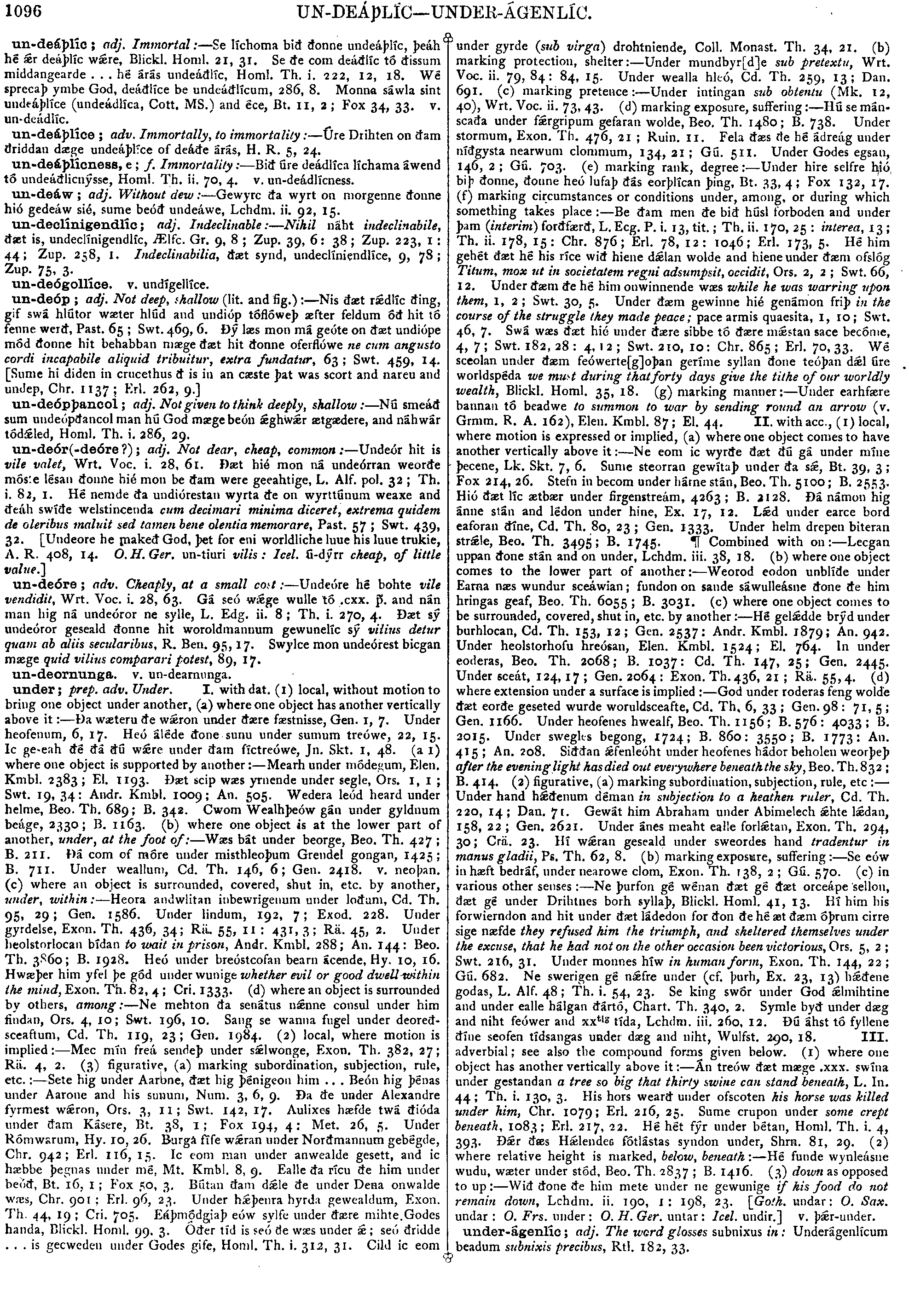
under;
prep.
adv.
Under.
I.
with
dat.
(1)
local,
without
motion
to
bring
one
object
under
another,
(a)
where
one
object
has
another
vertically
above
it
:--
Ða
wæteru
ðe
wron
under
ðære
fæstnisse,
Gen.
1,
7.
Under
heofenum,
6,
17.
Heó
áléde
ðone
sunu
under
sumum
treówe,
22,
15.
Ic
ge-eah
ðé
ðá
ðú
wre
under
ðam
fíctreówe,
Jn.
Skt.
1,
48.
(a
1)
where
one
object
is
supported
by
another
:--
Mearh
under
módegum,
Elen.
Kmbl.
2383;
El.
1193.
Ðæt
scip
wæs
yrnende
under
segle,
Ors.
1,
1;
Swt.
19,
34:
Andr.
Kmbl.
1009;
An.
505.
Wedera
leód
heard
under
helme,
Beo.
Th.
689;
B.
342.
Cwom
Wealhþeów
gán
under
gyldnum
beáge,
2330;
B.
1163.
(b)
where
one
object
is
at
the
lower
part
of
another,
under,
at
the
foot
of
:--
Wæs
bát
under
beorge,
Beo.
Th.
427;
B.
211.
Ðá
com
of
móre
under
misthleoþum
Grendel
gongan,
1425;
B.
711.
Under
weallum,
Cd.
Th.
146,
6;
Gen.
2418.
v.
neoþan.
(c)
where
an
object
is
surrounded,
covered,
shut
in,
etc.
by
another,
under,
within
:--
Heora
andwlitan
inbewrigenum
under
loðum,
Cd.
Th.
95,
29;
Gen.
1586.
Under
lindun,
192,
7;
Exod.
228.
Under
gyrdelse,
Exon.
Th.
436,
34;
Rä.
55,
11:
431,
3;
Rä.
45,
2.
Under
heolstorlocan
bídan
to
wait
in
prison,
Andr.
Kmbl.
288;
An.
144:
Beo.
Th.
3860;
B.
1928.
Heó
under
breóstcofan
bearn
ácende,
Hy.
10,
16.
Hwæþer
him
yfel
þe
gód
under
wunige
whether
evil
or
good
dwell-within
the
mind,
Exon.
Th.
82,
4;
Cri.
1333.
(d)
where
an
object
is
surrounded
by
others,
among
:--
Ne
mehton
ða
senátus
nnne
consul
under
him
findan,
Ors.
4,
10;
Swt.
196,
10.
Sang
se
wanna
fugel
under
deoreð-sceaftum,
Cd.
Th.
119,
23;
Gen.
1984.
(2)
local,
where
motion
is
implied
:--
Mec
mín
freá
sendeþ
under
slwonge,
Exon.
Th.
382,
27;
Rä.
4,
2.
(3)
figurative,
(a)
marking
subordination,
subjection,
rule,
etc.
:--
Sete
hig
under
Aarone,
ðæt
hig
þénigeon
him
...
Beón
hig
þénas
under
Aarone
and
his
sunum,
Num.
3,
6,
9.
Ða
ðe
under
Alexandre
fyrmest
wron,
Ors.
3,
11;
Swt.
142,
17.
Aulixes
hæfde
twá
ðióda
under
ðam
Kásere,
Bt.
38,
1;
Fox
194,
4:
Met.
26,
5.
Under
Rómwarum,
Hy.
10,
26.
Burga
fífe
wran
under
Norðmannum
gebégde,
Chr.
942;
Erl.
116,
15.
Ic
eom
man
under
anwealde
gesett,
and
ic
hæbbe
þegnas
under
mé,
Mt.
Kmbl.
8,
9.
Ealle
ða
rícu
ðe
him
under
beóð,
Bt.
16,
1;
Fox
50,
3.
Bútan
ðam
dle
ðe
under
Dena
onwalde
wæs,
Chr.
901;
Erl.
96,
23.
Under
hþenra
hyrda
gewealdum,
Exon.
Th.
44,
19;
Cri.
705.
Eáþmódgiaþ
eów
sylfe
under
ðære
mihte
Godes
handa,
Blickl.
Homl.
99,
3.
Óðer
ti
is
seó
ðe
wæs
under
;
seó
ðridde
...
is
gecweden
under
Godes
gife,
Homl.
Th.
i.
312,
31.
Cild
ic
eom
under
gyrde
(sub
virga)
drohtniende,
Coll.
Monast.
Th.
34,
21.
(b)
marking
protection,
shelter
:--
Under
mundbyr[d]e
sub
pretextu,
Wrt.
Voc.
ii.
79,
84:
84,
15.
Under
wealla
hleó,
Cd.
Th.
259,
13;
Dan.
691.
(c)
marking
pretence
:--
Under
intingan
sub
obtentu
(Mk.
12,
40),
Wrt.
Voc.
ii.
73,
43.
(d)
marking
exposure,
suffering
:--
Hú
se
mánscaða
under
frgripum
gefaran
wolde,
Beo.
Th.
1480;
B.
738.
Under
stormum,
Exon.
Th.
476,
21;
Ruin.
11.
Fela
ðæs
ðe
hé
ádreág
under
níðgysta
nearwum
clommum,
134,
21;
Gú.
511.
Under
Godes
egsan,
146,
2;
Gú.
703.
(e)
marking
rank,
degree
:--
Under
hire
selfre
hió,
bíþ
ðonne,
ðonne
heó
lufaþ
ðás
eorþlícan
þing,
Bt.
33,
4;
Fox
132,
17.
(f)
marking
circumstances
or
conditions
under,
among,
or
during
which
something
takes
place
:--
Be
ðam
mere
ðe
bið
húsl
forboden
and
under
þam
(interim)
forðfærð,
L.
Ecg.
P.
i.
13,
tit.;
Th.
ii.
170,
25:
interea,
13;
Th.
ii.
178,
15:
Chr.
876;
Erl.
78,
12:
1046;
Erl.
173,
5.
Hé
him
gehét
ðæt
hé
his
ríce
wið
hiene
dlan
wolde
and
hiene
under
ðæm
ofslóg
Titum,
mox
ut
in
societatem
regni
adsumpsit,
occidit,
Ors.
2,
2;
Swt.
66,
12.
Under
ðæm
ðe
hé
him
onwinnende
wæs
while
he
was
warring
upon
them,
1,
2;
Swt.
30,
5.
Under
ðæm
gewinne
hié
genámon
friþ
in
the
course
of
the
struggle
they
made
peace;
pace
armis
quaesita,
1,
10;
Sat.
46,
7.
Swá
wæs
ðæt
hié
under
ðære
sibbe
tó
ðære
mstan
sace
becóme,
4,
7;
Swt.
182,
28:
4,
12;
Swt.
210,
10:
Chr.
865;
Erl.
70,
33.
Wé
sceolan
under
ðæm
feówerte[g]oþan
geríme
syllan
ðone
teóþan
dl
úre
worldspéda
we
must
during
that
forty
days
give
the
tithe
of
our
worldly
wealth,
Blickl.
Homl.
35,
18.
(g)
marking
manner
:--
Under
earhfære
bannan
tó
beadwe
to
summon
to
war
by
sending
round
an
arrow
(v.
Grmm.
R.
A.
162),
Elen.
Kmbl.
87;
El.
44.
II.
with
acc.,
(1)
local,
where
motion
is
expressed
or
implied,
(a)
where
one
object
comes
to
have
another
vertically
above
it
:--
Ne
eom
ic
wyrðe
ðæt
ðú
gá
under
míne
þecene,
Lk.
Skt.
7,
6.
Sume
steorran
gewítaþ
under
ða
s,
Bt.
39,
3;
Fox
214,
26.
Stefn
in
becom
under
hárne
stán,
Beo.
Th.
5100;
B.
2553.
Hió
ðæt
líc
ætbær
under
firgenstreám,
4263;
B.
2128.
Ðá
námon
hig
ánne
stán
and
lédon
under
hine,
Ex.
17,
12.
Ld
under
earce
bond
eaforan
ðíne,
Cd.
Th.
80,
23;
Gen.
1333.
Under
helm
drepen
biteran
strle,
Beo.
Th.
3495;
B.
1745.

Combined
with
on
:--
Lecgan
uppan
ðone
stán
and
on
under,
Lchdm.
iii.
38,
18.
(b)
where
one
object
comes
to
the
lower
part
of
another
:--
Weorod
eodon
unblíðe
under
Earna
næs
wundur
sceáwian;
fundon
on
sande
sáwulleásne
ðone
ðe
him
hringas
geaf,
Beo.
Th.
6055;
B.
3031.
(c)
where
one
object
comes
to
be
surrounded,
covered,
shut
in,
etc.
by
another
:--
Hé
geldde
brýd
under
burhlocan,
Cd.
Th.
153,
12;
Gen.
2537:
Andr.
Kmbl.
1879;
An.
942.
Under
heolstorhofu
hreósan,
Elen.
Kmbl.
1524;
El.
764.
In
under
eoderas,
Beo.
Th.
2068;
B.
1037:
Cd.
Th.
147,
25;
Gen.
2445.
Under
sceát,
124,
17;
Gen.
2064:
Exon.
Th.
436,
21;
Rä.
55,
4.
(d)
where
extension
under
a
surface
is
implied
:--
God
under
roderas
feng
wolde
ðæt
eorðe
geseted
wurde
woruldsceafte,
Cd.
Th,
6,
33;
Gen.
98:
71,
5;
Gen.
1166.
Under
heofenes
hwealf,
Beo.
Th.
1156;
B.
576:
4033;
B.
|
Source: Bosworth/Toller, page d0019, entry 2 View original page image as: [TIFF] [PNG] [View previous entry] [View next entry] |
[Comment on this entry] [View comments] |
The following entry has been hand-corrected once. |
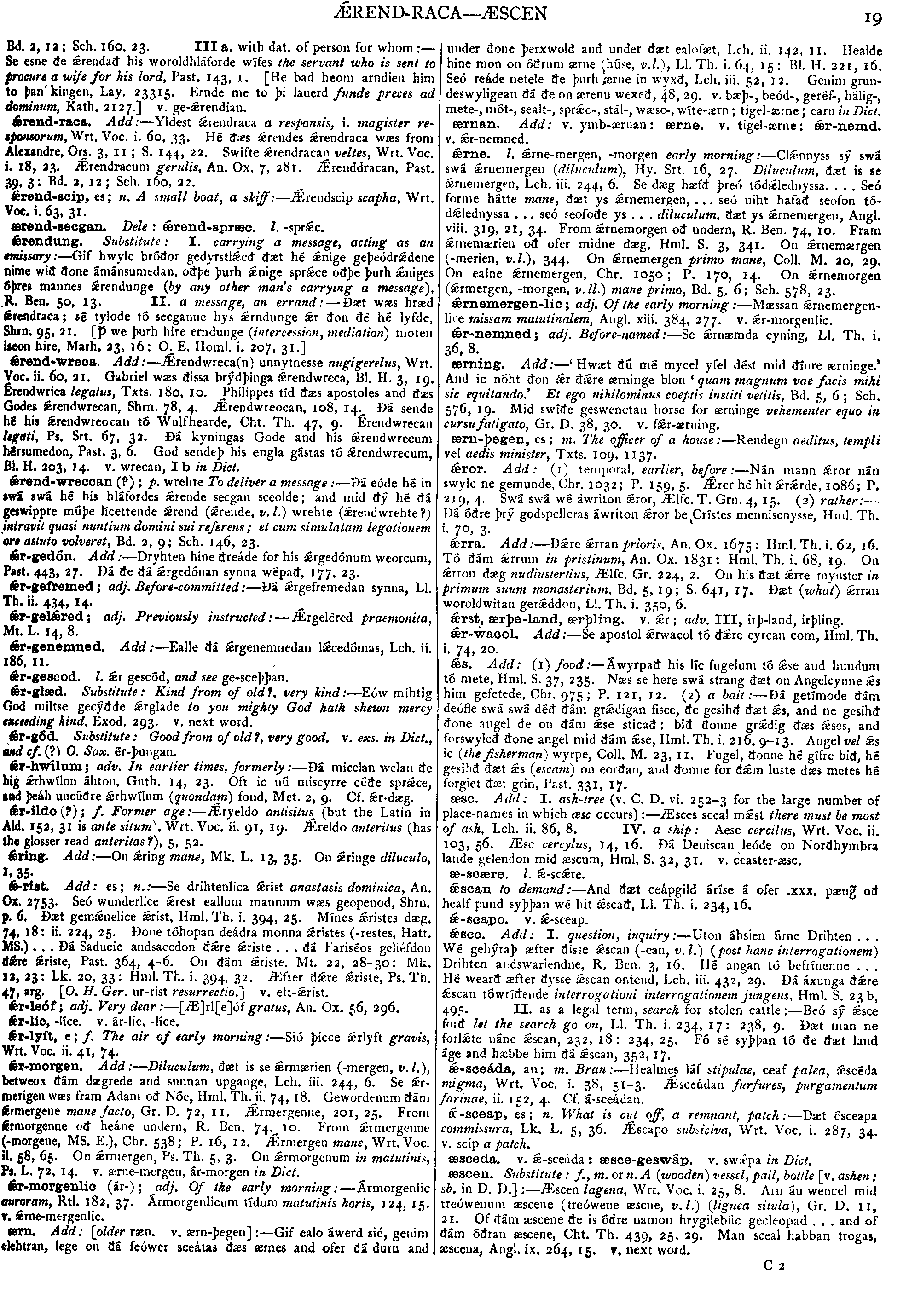
rend-raca.
Add:--Yldest
rendraca
a
responsis,
i.
magister
responsorum,
Wrt.
Voc.
i.
60,
33.
Hé
ðæs
rendes
rendraca
wæs
from
Alexandre,
Ors.
3,
11;
S.
144,
22.
Swifte
rendracan
veltes,
Wrt.
Voc.
i.
18,
23.
Æ-acute;rendracum
gerulis,
An.
Ox.
7,
281.
Æ-acute;renddracan,
Past.
39,
3:
Bd.
2,
12;
Sch.
160,
22.
|
Source: Bosworth/Toller, page d0277, entry 4 View original page image as: [TIFF] [PNG] [View previous entry] [View next entry] |
[Comment on this entry] [View comments] |
The following entry has been hand-corrected once. |
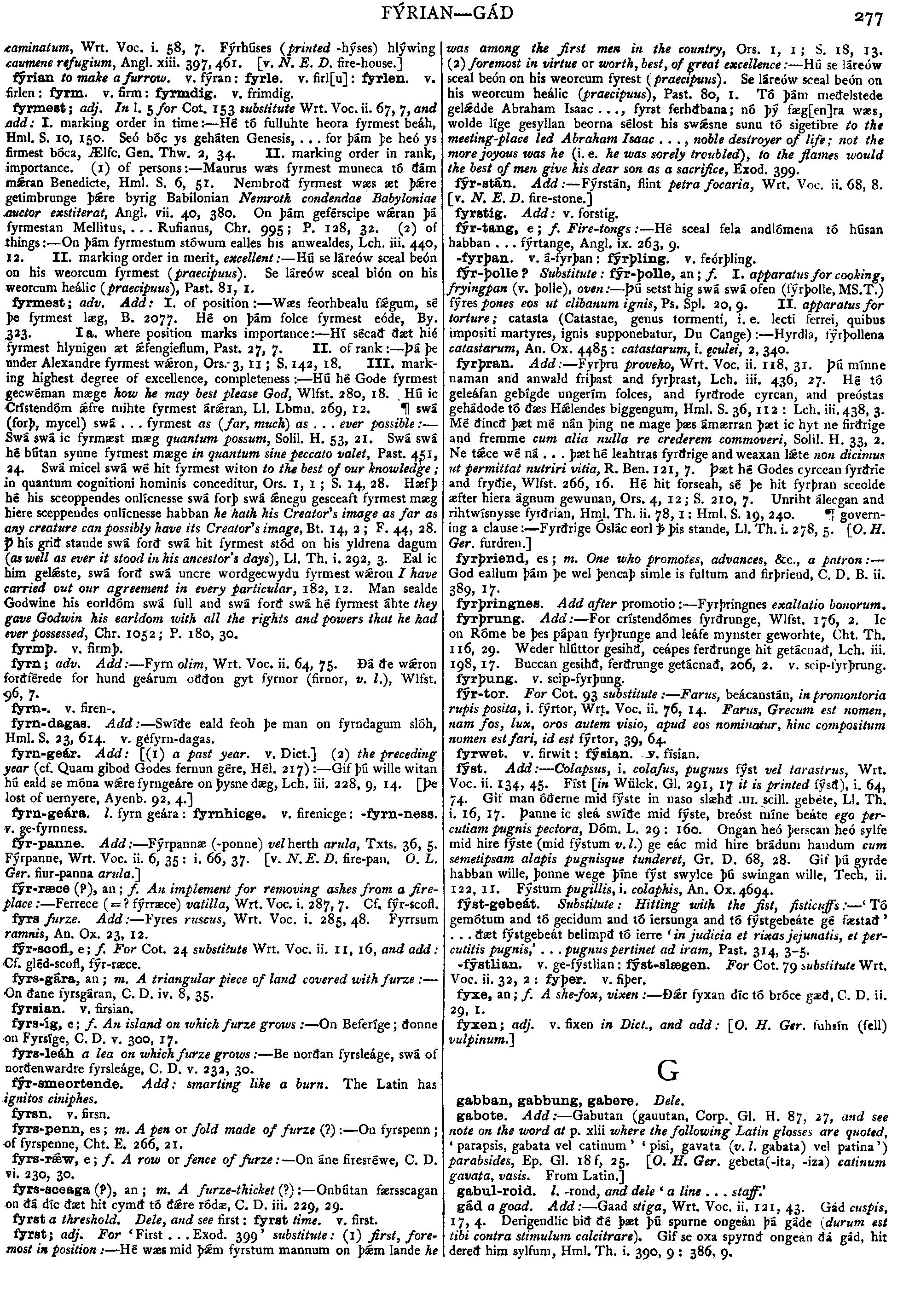
fyrmest;
adv.
Add:
I.
of
position:--Wæs
feorhbealu
fgum,
sé
þe
fyrmest
læg,
B.
2077.
Hé
on
þám
folce
fyrmest
eóde,
By.
323.
I
a.
where
position
marks
importance:--Hí
sécað
ðæt
hié
fyrmest
hlynigen
æt
fengieflum,
Past.
27,
7.
II.
of
rank:--Þá
þe
under
Alexandre
fyrmest
wron,
Ors.
3,
11;
S.
142,
18.
III.
marking
highest
degree
of
excellence,
completeness:--Hú
hé
Gode
fyrmest
gecwéman
mæge
how
he
may
best
please
God,
Wlfst.
280,
18.
Hú
ic
Crístendóm
fre
mihte
fyrmest
árran,
Ll.
Lbmn.
269,
12.

swá
(forþ,
mycel)
swá
.
.
.
fyrmest
as
(far,
much)
as
.
.
.
ever
possible:--Swá
swá
ic
fyrmæst
mæg
quantum
possum,
Solil.
H.
53,
21.
Swá
swá
hé
bútan
synne
fyrmest
mæge
in
quantum
sine
peccato
valet,
Past.
451,
24.
Swá
micel
swá
wé
hit
fyrmest
witon
to
the
best
of
our
knowledge;
in
quantum
cognitioni
hominis
conceditur,
Ors.
1,
1;
S.
14,
28.
Hæfþ
hé
his
sceoppendes
onlícnesse
swá
forþ
swá
negu
gesceaft
fyrmest
mæg
hiere
sceppendes
onlícnesse
habban
he
hath
his
Creator's
image
as
far
as
any
creature
can
possibly
have
its
Creator's
image,
Bt.
14,
2;
F.
44,
28.
Þ-bar;
his
grið
stande
swá
forð
swá
hit
fyrmest
stód
on
his
yldrena
dagum
(as
well
as
ever
it
stood
in
his
ancestor's
days),
Ll.
Th.
i.
292,
3.
Eal
ic
him
gelste,
swá
forð
swá
uncre
wordgecwydu
fyrmest
wron
I
have
carried
out
our
agreement
in
every
particular,
182,
12.
Man
sealde
Godwine
his
eorldóm
swá
full
and
swá
forð
swá
hé
fyrmest
áhte
they
gave
Godwin
his
earldom
with
all
the
rights
and
powers
that
he
had
ever
possessed,
Chr.
1052;
P.
180,
30.
|
Source: Bosworth/Toller, page d0537, entry 1 View original page image as: [TIFF] [PNG] [View previous entry] [View next entry] |
[Comment on this entry] [View comments] |
The following entry has been hand-corrected once. |
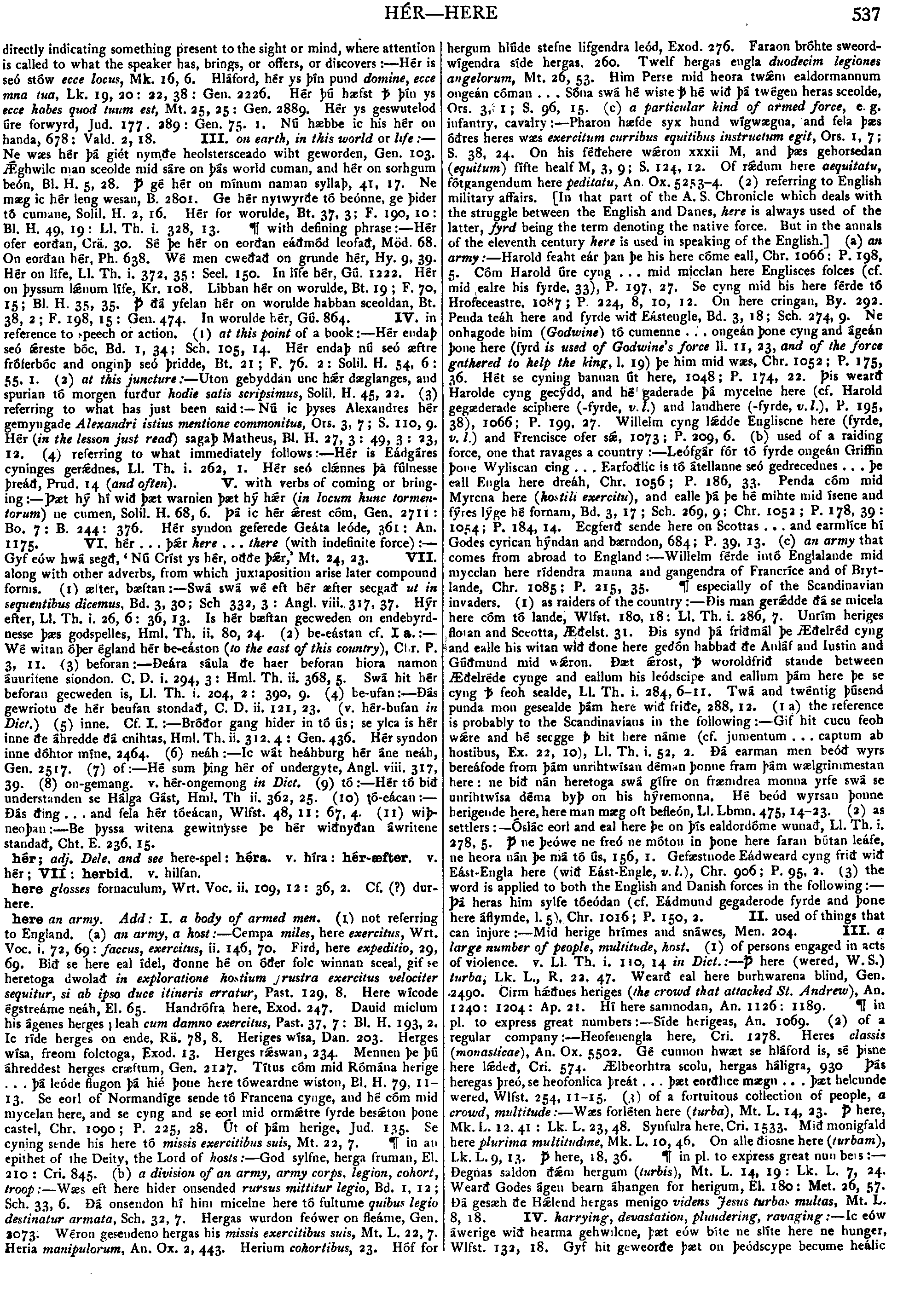
directly
indicating
something
present
to
the
sight
or
mind,
where
attention
is
called
to
what
the
speaker
has,
brings,
or
offers,
or
discovers
:--
Hér
is
seó
stów
ecce
locus,
Mk.
16,
6.
Hláford,
hér
ys
þín
pund
domine,
ecce
mna
tua,
Lk.
19,
20:
22,
38:
Gen.
2226.
Hér
þú
hæfst
 þín
ys
ecce
habes
quod
tuum
est,
Mt.
25,
25:
Gen.
2889.
Hér
ys
geswutelod
úre
forwyrd,
Jud.
177.
289:
Gen.
75.
l.
Nú
hæbbe
ic
his
hér
on
handa,
678
:
Vald.
2,
18.
III.
on
earth,
in
this
world
or
life
:--
Ne
wæs
hér
þá
giét
nymðe
heolstersceado
wiht
geworden,
Gen.
103.
Æ-acute;ghwilc
man
sceolde
mid
sáre
on
þás
world
cuman,
and
hér
on
sorhgum
beón,
Bl.
H.
5,
28.
Þ
UNCERTAIN
gé
hér
on
mínum
naman
syllaþ,
41,
17.
Ne
mæg
ic
hér
leng
wesan,
B.
2801.
Ge
hér
nytwyrde
tó
beónne,
ge
þider
tó
cumane,
Solil.
H.
2,
16.
Hér
for
worulde,
Bt.
37,
3;
F.
190,
10:
Bl.
H.
49,
19:
Ll.
Th.
i.
328,
13.

with
defining
phrase
:--
Hér
ofer
eorðan,
Crä.
30.
Sé
þe
hér
on
eorðan
eáðmód
leotað,
Möd.
68.
On
eorðan
hér,
Ph.
638.
Wé
men
cweðað
on
grunde
hér,
Hy.
9,
39.
Hér
on
lífe,
Ll.
Th.
i.
372,
35
:
Seel.
150.
In
lífe
hér,
Gú.
1222.
Hér
on
þyssum
lnum
lífe,
Kr.
108.
Libban
hér
on
worulde.
Bt.
19
;
F.
70,
15;
Bl.
H.
35,
35.
Þ
UNCERTAIN
ðá
yfelan
hér
on
worulde
habban
sceoldan,
Bt.
38,
2;
F.
198,
15
:
Gen.
474.
In
worulde
hér,
GO.
864.
IV.
in
reference
to
speech
or
action,
(l)
at
this
point
of
a
book
:--
Hér
endaþ
seó
reste
bóc,
Bd.
I.
34;
Sch.
105,
14.
Hér
endaþ
nú
seó
æftre
fróferbóc
and
onginþ
seó
þridde,
Bt.
21
;
F.
76.
2:
Solil.
H.
54,
6:
55,
1.
(2)
at
this
juncture
:--
Uton
gebyddan
unc
hr
dæglanges,
and
spurian
tó
morgen
furður
hodie
satis
scripsimus,
Solil.
H.
45,
22.
(3)
referring
to
what
has
just
been
said
:--
Nú
ic
þyses
Alexandre
s
hér
gemyngade
Alexandri
istius
mentione
commonitus,
Ors.
3,
7;
S.
no,
9.
Hér
(in
the
lesson
just
read)
sagaþ
Matheus,
Bl.
H.
27,
3
:
49,
3
:
23,
12.
(4)
referring
to
what
immediately
follows
:--
Hér
is
Eádgáres
cyninges
gerdnes,
Ll.
Th.
i.
262,
I.
Hér
seó
clnnes
þá
fúlnesse
þreáð,
Prud.
14
(and
often).
V.
with
verbs
of
coming
or
bringing
:--
Þæt
hý
hí
wið
þæt
warnien
bæt
hý
hr
(in
locum
hunc
tormenforum)
ne
cumen,
Solil.
H.
68,
6.
Þá
ic
héer
rest
cóm,
Gen.
2711
:
Bo.
7:
B.
244:
376.
Hér
syndon
geferede
Geáta
leóde,
361:
An.
1175.
VI.
hér
.
.
.
þr
here
.
.
.
there
(with
indefinite
force)
:--
Gyf
eów
hwá
segð,
'Nú
Críst
ys
hér,
oððe
þr,'
Mt.
24,
23.
VII.
along
with
other
adverbs,
from
which
juxtaposition
arise
later
compound
forms.
(l)
æfter,
bæftan
:--
Swá
swá
wé
eft
hér
æfter
secgað
ut
in
sequentibus
dicemus,
Bd.
3,
30;
Sch
332,
3
:
Angl.
viii.
,
317,
37.
Hýr
efter.
Ll.
Th.
i.
26,
6:
36,
13.
Is
hér
bæftan
gecweden
on
endebyrdnesse
þæs
godspelles,
Hml.
Th.
ii.
80,
24.
(2)
be-eástan
cf.
I
a.
:--
Wé
witan
óþer
égland
hér
be-eáston
(to
the
east
of
this
country),
Cl.
r.
P.
3,
II.
(3)
beforan
:--
Ðeára
sáula
ðe
haer
beforan
hiora
namon
áuurifene
siondon.
C.
D.
i.
294,
3:
Hml.
Th.
ii.
368,
5.
Swá
hit
hér
beforan
gecweden
is,
Ll.
Th.
i.
204,
2
:
390,
9.
(4)
be-ufan
:--
Ðás
gewriotu
ðe
hér
beufan
stondað,
C.
D.
ii.
121,
23.
(v.
hér-bufan
in
Dict.)
(5)
inne.
Cf.
I.
:--
Bróðor
gang
hider
in
tó
ús;
se
ylca
is
hér
inne
ðe
áhredde
ðá
cnihtas,
Hml.
Th.
ii.
312.
4
:
Gen.
436.
Hér
syndon
inne
dóhtor
míne,
2464.
(6)
neáh
:--
Ic
wát
heáhburg
hér
áne
neáh,
Gen.
2517.
(7)
of
:--
Hé
sum
þing
hér
of
undergyte,
Angl.
viii.
317,
39.
(8)
on-gemang.
v.
hér-ongemong
in
Dict.
(9)
tó
:--
Hér
tó
bið
understanden
se
Hálga
Gást,
Hml.
Th
ii.
362,
25.
(10)
tó-eácan
:--
Ðás
ðing
.
.
.
and
fela
hér
tóeácan,
Wlfst.
48,
ll:
67,
4.
(n)
wiþ-neoþan
:--
Be
þyssa
witena
gewitnysie
þe
hér
wiðnyðan
áwritene
standað,
Cht.
E.
236,
15.
þín
ys
ecce
habes
quod
tuum
est,
Mt.
25,
25:
Gen.
2889.
Hér
ys
geswutelod
úre
forwyrd,
Jud.
177.
289:
Gen.
75.
l.
Nú
hæbbe
ic
his
hér
on
handa,
678
:
Vald.
2,
18.
III.
on
earth,
in
this
world
or
life
:--
Ne
wæs
hér
þá
giét
nymðe
heolstersceado
wiht
geworden,
Gen.
103.
Æ-acute;ghwilc
man
sceolde
mid
sáre
on
þás
world
cuman,
and
hér
on
sorhgum
beón,
Bl.
H.
5,
28.
Þ
UNCERTAIN
gé
hér
on
mínum
naman
syllaþ,
41,
17.
Ne
mæg
ic
hér
leng
wesan,
B.
2801.
Ge
hér
nytwyrde
tó
beónne,
ge
þider
tó
cumane,
Solil.
H.
2,
16.
Hér
for
worulde,
Bt.
37,
3;
F.
190,
10:
Bl.
H.
49,
19:
Ll.
Th.
i.
328,
13.

with
defining
phrase
:--
Hér
ofer
eorðan,
Crä.
30.
Sé
þe
hér
on
eorðan
eáðmód
leotað,
Möd.
68.
On
eorðan
hér,
Ph.
638.
Wé
men
cweðað
on
grunde
hér,
Hy.
9,
39.
Hér
on
lífe,
Ll.
Th.
i.
372,
35
:
Seel.
150.
In
lífe
hér,
Gú.
1222.
Hér
on
þyssum
lnum
lífe,
Kr.
108.
Libban
hér
on
worulde.
Bt.
19
;
F.
70,
15;
Bl.
H.
35,
35.
Þ
UNCERTAIN
ðá
yfelan
hér
on
worulde
habban
sceoldan,
Bt.
38,
2;
F.
198,
15
:
Gen.
474.
In
worulde
hér,
GO.
864.
IV.
in
reference
to
speech
or
action,
(l)
at
this
point
of
a
book
:--
Hér
endaþ
seó
reste
bóc,
Bd.
I.
34;
Sch.
105,
14.
Hér
endaþ
nú
seó
æftre
fróferbóc
and
onginþ
seó
þridde,
Bt.
21
;
F.
76.
2:
Solil.
H.
54,
6:
55,
1.
(2)
at
this
juncture
:--
Uton
gebyddan
unc
hr
dæglanges,
and
spurian
tó
morgen
furður
hodie
satis
scripsimus,
Solil.
H.
45,
22.
(3)
referring
to
what
has
just
been
said
:--
Nú
ic
þyses
Alexandre
s
hér
gemyngade
Alexandri
istius
mentione
commonitus,
Ors.
3,
7;
S.
no,
9.
Hér
(in
the
lesson
just
read)
sagaþ
Matheus,
Bl.
H.
27,
3
:
49,
3
:
23,
12.
(4)
referring
to
what
immediately
follows
:--
Hér
is
Eádgáres
cyninges
gerdnes,
Ll.
Th.
i.
262,
I.
Hér
seó
clnnes
þá
fúlnesse
þreáð,
Prud.
14
(and
often).
V.
with
verbs
of
coming
or
bringing
:--
Þæt
hý
hí
wið
þæt
warnien
bæt
hý
hr
(in
locum
hunc
tormenforum)
ne
cumen,
Solil.
H.
68,
6.
Þá
ic
héer
rest
cóm,
Gen.
2711
:
Bo.
7:
B.
244:
376.
Hér
syndon
geferede
Geáta
leóde,
361:
An.
1175.
VI.
hér
.
.
.
þr
here
.
.
.
there
(with
indefinite
force)
:--
Gyf
eów
hwá
segð,
'Nú
Críst
ys
hér,
oððe
þr,'
Mt.
24,
23.
VII.
along
with
other
adverbs,
from
which
juxtaposition
arise
later
compound
forms.
(l)
æfter,
bæftan
:--
Swá
swá
wé
eft
hér
æfter
secgað
ut
in
sequentibus
dicemus,
Bd.
3,
30;
Sch
332,
3
:
Angl.
viii.
,
317,
37.
Hýr
efter.
Ll.
Th.
i.
26,
6:
36,
13.
Is
hér
bæftan
gecweden
on
endebyrdnesse
þæs
godspelles,
Hml.
Th.
ii.
80,
24.
(2)
be-eástan
cf.
I
a.
:--
Wé
witan
óþer
égland
hér
be-eáston
(to
the
east
of
this
country),
Cl.
r.
P.
3,
II.
(3)
beforan
:--
Ðeára
sáula
ðe
haer
beforan
hiora
namon
áuurifene
siondon.
C.
D.
i.
294,
3:
Hml.
Th.
ii.
368,
5.
Swá
hit
hér
beforan
gecweden
is,
Ll.
Th.
i.
204,
2
:
390,
9.
(4)
be-ufan
:--
Ðás
gewriotu
ðe
hér
beufan
stondað,
C.
D.
ii.
121,
23.
(v.
hér-bufan
in
Dict.)
(5)
inne.
Cf.
I.
:--
Bróðor
gang
hider
in
tó
ús;
se
ylca
is
hér
inne
ðe
áhredde
ðá
cnihtas,
Hml.
Th.
ii.
312.
4
:
Gen.
436.
Hér
syndon
inne
dóhtor
míne,
2464.
(6)
neáh
:--
Ic
wát
heáhburg
hér
áne
neáh,
Gen.
2517.
(7)
of
:--
Hé
sum
þing
hér
of
undergyte,
Angl.
viii.
317,
39.
(8)
on-gemang.
v.
hér-ongemong
in
Dict.
(9)
tó
:--
Hér
tó
bið
understanden
se
Hálga
Gást,
Hml.
Th
ii.
362,
25.
(10)
tó-eácan
:--
Ðás
ðing
.
.
.
and
fela
hér
tóeácan,
Wlfst.
48,
ll:
67,
4.
(n)
wiþ-neoþan
:--
Be
þyssa
witena
gewitnysie
þe
hér
wiðnyðan
áwritene
standað,
Cht.
E.
236,
15.
|
Source: Bosworth/Toller, page d0678, entry 9 View original page image as: [TIFF] [PNG] [View previous entry] [View next entry] |
[Comment on this entry] [View comments] |
The following entry has been hand-corrected once. |
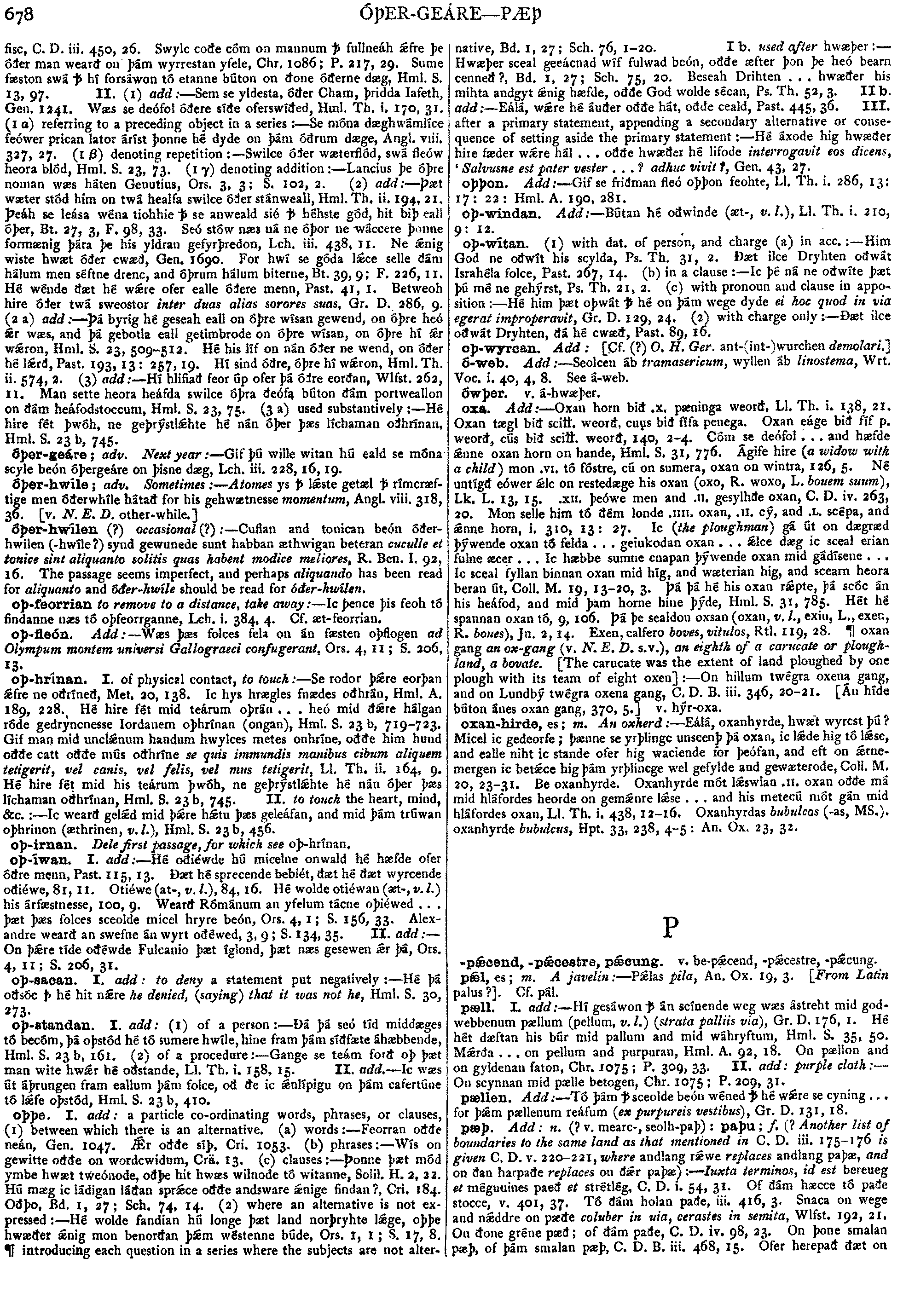
oþ-íwan.
I.
add
:--
Hé
oðiéwde
hú
micelne
onwald
hé
hæfde
ofer
óðre
menn,
Past.
115,
13.
Ðæt
hé
sprecende
bebiét,
ðæt
hé
ðæt
wyrcende
oðiéwe,
81,
11.
Otiéwe
(at-,
v.
l.),
84,
16.
Hé
wolde
otiéwan
(æt-,
v.
l.)
his
árfæstnesse,
100,
9.
Wearð
Rómánum
an
yfelum
tácne
oþiéwed
.
.
.
þæt
þæs
folces
sceolde
micel
hryre
beón,
Ors.
4,
1;
S.
156,
33.
Alexandre
wearð
an
swefne
án
wyrt
oðéwed,
3,
9;
S.
134,
35.
II.
add
:--
On
þre
tíde
oðéwde
Fulcanio
þæt
íglond,
þæt
næs
gesewen
r
þá,
Ors.
4,
11;
S.
206,
31.
Germanic Lexicon Project (main page)
This search system was written by
Sean Crist
Please consider
volunteering
to correct the data in these online dictionaries.
No rights reserved. Feel free to use these data in any way you please.