|
|

Search for Air again, using less strict matching (174 results)
|
Source: Bosworth/Toller, page b1144, entry 14 View original page image as: [TIFF] [PNG] [View previous entry] [View next entry] |
[Comment on this entry] [View comments] |
The following entry has been hand-corrected once. |
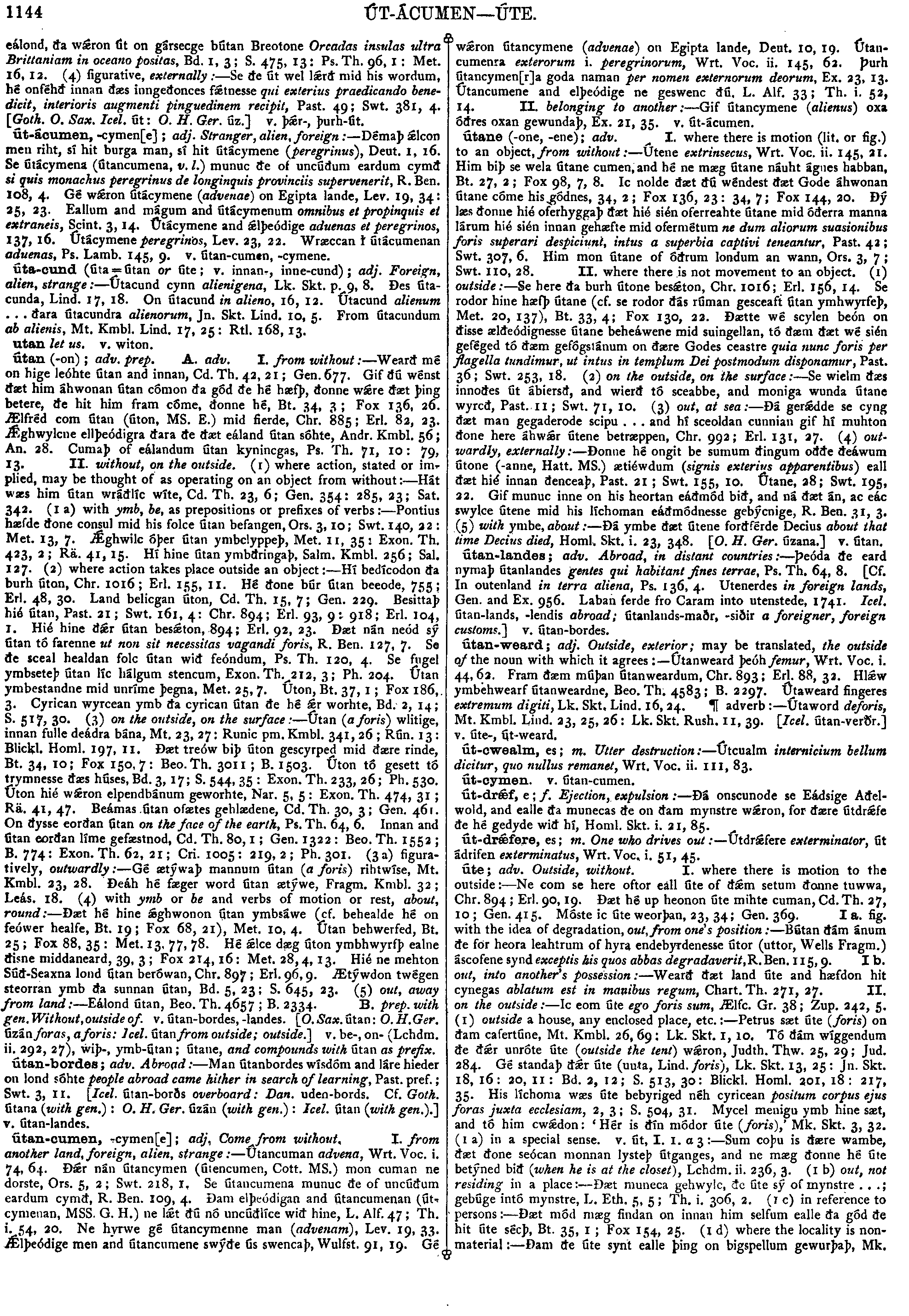
úte;
adv.
Outside,
without.
I.
where
there
is
motion
to
the
outside
:--
Ne
com
se
here
oftor
eall
úte
of
ð m
setum
ðonne
tuwwa,
Chr.
894;
Erl.
90,
19.
Ðæt
hé
up
heonon
úte
mihte
cuman,
Cd.
Th.
27,
10;
Gen.
415.
Móste
ic
úte
weorþan,
23,
34;
Gen.
369.
I
a.
fig.
with
the
idea
of
degradation,
out,
from
one's
position
:--
Bútan
ðám
ánum
ðe
for
heora
leahtrum
of
hyra
endebyrdenesse
útor
(uttor,
Wells
Fragm.)
áscofene
synd
exceptis
his
quos
abbas
degradaverit,
R.
Ben.
115,
9.
I
b.
out,
into
another's
possession
:--
Wearð
ðæt
land
úte
and
hæfdon
hit
cynegas
ablatum
est
in
manibus
regum,
Chart.
Th.
271,
27.
II.
on
the
outside
:--
Ic
eom
úte
ego
foris
sum,
Ælfc.
Gr.
38;
Zup.
242,
5.
(1)
outside
a
house,
any
enclosed
place,
etc.
:--
Petrus
sæt
úte
(foris)
on
ðam
cafertúne,
Mt.
Kmbl.
26,
69:
Lk.
Skt.
1,
10.
Tó
ðá
wíggendum
ðe
ðr
unróte
úte
(outside
the
tent)
wron,
Judth.
Thw.
25,
29;
Jud.
284.
Gé
standaþ
ðr
úte
(uuta,
Lind.
foris),
Lk.
Skt.
13,
25:
Jn.
Skt.
18,
16:
20,
11:
Bd.
2,
12;
S.
513,
30:
Blickl.
Homl.
201,
18:
217,
35.
His
líchoma
wæs
úte
bebyriged
néh
cyricean
positum
corpus
ejus
foras
juxta
ecclesiam,
2,
3;
S.
504,
31.
Mycel
menigu
ymb
hine
sæt,
and
tó
him
cwdon:
'Hér
is
ðín
módor
úte
(foris),'
Mk.
Skt.
3,
32.
(1
a)
in
a
special
sense.
v.
út,
I.
1.
a
3
:--
Sum
coþu
is
ðære
wambe,
ðæt
ðone
seócan
monnan
lystep
útganges,
and
ne
mæg
ðonne
hé
úte
betýned
bið
(when
he
is
at
the
closet),
Lchdm.
ii.
236,
3.
(1
b)
out,
not
residing
in
a
place
:--
Ðæt
muneca
gehwylc,
ðe
úte
sý
of
mynstre...;
gebúge
intó
mynstre,
L.
Eth.
5,
5;
Th.
i.
306,
2.
(1
c)
in
reference
to
persons
:--
Ðæt
mód
mæg
findan
on
innan
him
selfum
ealle
ða
gód
ðe
hit
úte
sécþ,
Bt.
35,
1;
Fox
154,
25.
(1
d)
where
the
locality
is
non-material
:--
Ðam
ðe
úte
synt
ealle
þing
on
bigspellum
gewurþaþ,
Mk.
Skt.
4,
11.
Nú
sind
wé
úte
belocene
fram
ðam
heofenlícan
leóhte,
Homl.
Th.
i.
184,
13.
Ðr
wæs
Evan
wóp
úte
betýned,
Blickl.
Homl.
7,
14
(2)
outside,
on
the
outer
side
:--
Gé
ðæt
úte
is
calices
geclnsiaþ,
Lk.
Skt.
11,
39.
(3)
out,
out
of
doors,
in
the
open
air
:--
Se
cyng
hét
him
úte
setl
gewyrcean
rex,
residens
sub
divo,
Bd.
1,
25;
S.
486,
38.
Hí
slépon
úte
on
triówa
sceadum,
Bt.
15;
Fox
48,
12:
Met.
8,
27.
Gnættas
cómon
ofer
eall
ðæt
land,
ge
inne
ge
úte,
Ors.
1,
7;
Swt.
36,
30.
Ic
seah
wyhte
twá
úte
plegan,
Exon.
Th.
429,
10;
Rä.
43,
2.
(4)
out,
away,
at
a
distance
:--
Úttor
exterius,
Ælfc.
Gr.
38;
Zup.
240,
7:
Exon.
Th.
426,
35;
Rä.
41,
84.
(4
a)
out,
away
from
habitations,
in
open
country
:--
Hé
ne
mihte
on
ða
ceastre
gán,
ac
beón
úte
(foris)
on
wéstum
stówum,
Mk.
Skt.
1,
45.
On
burgum
beóþ
blóstmum
fægere,
swá
on
eorðan
hég
úte
on
lande,
Ps.
Th.
71,
16.
Hé
genam
hine
æt
eówde
úte
be
sceápum,
77,
69.
(4
b)
out,
from
home
on
service
:--
Hié
wron
simle
healfe
æt
hám,
healfe
úte,
Chr.
894;
Erl.
90,
18.
Hí
lágon
úre
ealne
ðone
herfest
on
fyrdinge,
1006;
Erl.
140,
9.
(4
c)
out,
not
in
one's
own
country,
abroad
:--
Him
leófre
wæs
ðæt
hé
úte
wunne
ðonne
hé
æt
hám
wre,
Ors.
3,
7;
Swt.
110,
30.
(4
d)
out,
away
from
land
:--
Án
ígland
ðæt
is
úte
on
ðære
s,
Chr.
895;
Erl.
93,
24.
Ðá
ston
hié
úte
on
ðam
íglande,
918;
Erl.
104,
11.
Gefeaht
Scipia
wið
Hannibal
úte
on
s,
Ors.
4,
11;
Swt.
204,
36.
(5)
marking
degree
or
extent
:--
Hí
nánwuht
ne
magon
ufor
ne
útor
(beyond)
findan,
Bt.
34,
12;
Fox
154,
16.
Ðám
ðe
him
ðás
woruld
úttor
ltan,
ðonne
ðæt
éce
líf
Exon.
Th.
109,
28;
Gú.
97.
[O.
Sax.
O.
Frs.
úta:
Icel.
úti.]
v.
þr-úte;
út,
útan.
m
setum
ðonne
tuwwa,
Chr.
894;
Erl.
90,
19.
Ðæt
hé
up
heonon
úte
mihte
cuman,
Cd.
Th.
27,
10;
Gen.
415.
Móste
ic
úte
weorþan,
23,
34;
Gen.
369.
I
a.
fig.
with
the
idea
of
degradation,
out,
from
one's
position
:--
Bútan
ðám
ánum
ðe
for
heora
leahtrum
of
hyra
endebyrdenesse
útor
(uttor,
Wells
Fragm.)
áscofene
synd
exceptis
his
quos
abbas
degradaverit,
R.
Ben.
115,
9.
I
b.
out,
into
another's
possession
:--
Wearð
ðæt
land
úte
and
hæfdon
hit
cynegas
ablatum
est
in
manibus
regum,
Chart.
Th.
271,
27.
II.
on
the
outside
:--
Ic
eom
úte
ego
foris
sum,
Ælfc.
Gr.
38;
Zup.
242,
5.
(1)
outside
a
house,
any
enclosed
place,
etc.
:--
Petrus
sæt
úte
(foris)
on
ðam
cafertúne,
Mt.
Kmbl.
26,
69:
Lk.
Skt.
1,
10.
Tó
ðá
wíggendum
ðe
ðr
unróte
úte
(outside
the
tent)
wron,
Judth.
Thw.
25,
29;
Jud.
284.
Gé
standaþ
ðr
úte
(uuta,
Lind.
foris),
Lk.
Skt.
13,
25:
Jn.
Skt.
18,
16:
20,
11:
Bd.
2,
12;
S.
513,
30:
Blickl.
Homl.
201,
18:
217,
35.
His
líchoma
wæs
úte
bebyriged
néh
cyricean
positum
corpus
ejus
foras
juxta
ecclesiam,
2,
3;
S.
504,
31.
Mycel
menigu
ymb
hine
sæt,
and
tó
him
cwdon:
'Hér
is
ðín
módor
úte
(foris),'
Mk.
Skt.
3,
32.
(1
a)
in
a
special
sense.
v.
út,
I.
1.
a
3
:--
Sum
coþu
is
ðære
wambe,
ðæt
ðone
seócan
monnan
lystep
útganges,
and
ne
mæg
ðonne
hé
úte
betýned
bið
(when
he
is
at
the
closet),
Lchdm.
ii.
236,
3.
(1
b)
out,
not
residing
in
a
place
:--
Ðæt
muneca
gehwylc,
ðe
úte
sý
of
mynstre...;
gebúge
intó
mynstre,
L.
Eth.
5,
5;
Th.
i.
306,
2.
(1
c)
in
reference
to
persons
:--
Ðæt
mód
mæg
findan
on
innan
him
selfum
ealle
ða
gód
ðe
hit
úte
sécþ,
Bt.
35,
1;
Fox
154,
25.
(1
d)
where
the
locality
is
non-material
:--
Ðam
ðe
úte
synt
ealle
þing
on
bigspellum
gewurþaþ,
Mk.
Skt.
4,
11.
Nú
sind
wé
úte
belocene
fram
ðam
heofenlícan
leóhte,
Homl.
Th.
i.
184,
13.
Ðr
wæs
Evan
wóp
úte
betýned,
Blickl.
Homl.
7,
14
(2)
outside,
on
the
outer
side
:--
Gé
ðæt
úte
is
calices
geclnsiaþ,
Lk.
Skt.
11,
39.
(3)
out,
out
of
doors,
in
the
open
air
:--
Se
cyng
hét
him
úte
setl
gewyrcean
rex,
residens
sub
divo,
Bd.
1,
25;
S.
486,
38.
Hí
slépon
úte
on
triówa
sceadum,
Bt.
15;
Fox
48,
12:
Met.
8,
27.
Gnættas
cómon
ofer
eall
ðæt
land,
ge
inne
ge
úte,
Ors.
1,
7;
Swt.
36,
30.
Ic
seah
wyhte
twá
úte
plegan,
Exon.
Th.
429,
10;
Rä.
43,
2.
(4)
out,
away,
at
a
distance
:--
Úttor
exterius,
Ælfc.
Gr.
38;
Zup.
240,
7:
Exon.
Th.
426,
35;
Rä.
41,
84.
(4
a)
out,
away
from
habitations,
in
open
country
:--
Hé
ne
mihte
on
ða
ceastre
gán,
ac
beón
úte
(foris)
on
wéstum
stówum,
Mk.
Skt.
1,
45.
On
burgum
beóþ
blóstmum
fægere,
swá
on
eorðan
hég
úte
on
lande,
Ps.
Th.
71,
16.
Hé
genam
hine
æt
eówde
úte
be
sceápum,
77,
69.
(4
b)
out,
from
home
on
service
:--
Hié
wron
simle
healfe
æt
hám,
healfe
úte,
Chr.
894;
Erl.
90,
18.
Hí
lágon
úre
ealne
ðone
herfest
on
fyrdinge,
1006;
Erl.
140,
9.
(4
c)
out,
not
in
one's
own
country,
abroad
:--
Him
leófre
wæs
ðæt
hé
úte
wunne
ðonne
hé
æt
hám
wre,
Ors.
3,
7;
Swt.
110,
30.
(4
d)
out,
away
from
land
:--
Án
ígland
ðæt
is
úte
on
ðære
s,
Chr.
895;
Erl.
93,
24.
Ðá
ston
hié
úte
on
ðam
íglande,
918;
Erl.
104,
11.
Gefeaht
Scipia
wið
Hannibal
úte
on
s,
Ors.
4,
11;
Swt.
204,
36.
(5)
marking
degree
or
extent
:--
Hí
nánwuht
ne
magon
ufor
ne
útor
(beyond)
findan,
Bt.
34,
12;
Fox
154,
16.
Ðám
ðe
him
ðás
woruld
úttor
ltan,
ðonne
ðæt
éce
líf
Exon.
Th.
109,
28;
Gú.
97.
[O.
Sax.
O.
Frs.
úta:
Icel.
úti.]
v.
þr-úte;
út,
útan.
|
Source: Bosworth/Toller, page b1182, entry 2 View original page image as: [TIFF] [PNG] [View previous entry] [View next entry] |
[Comment on this entry] [View comments] |
The following entry has been hand-corrected once. |
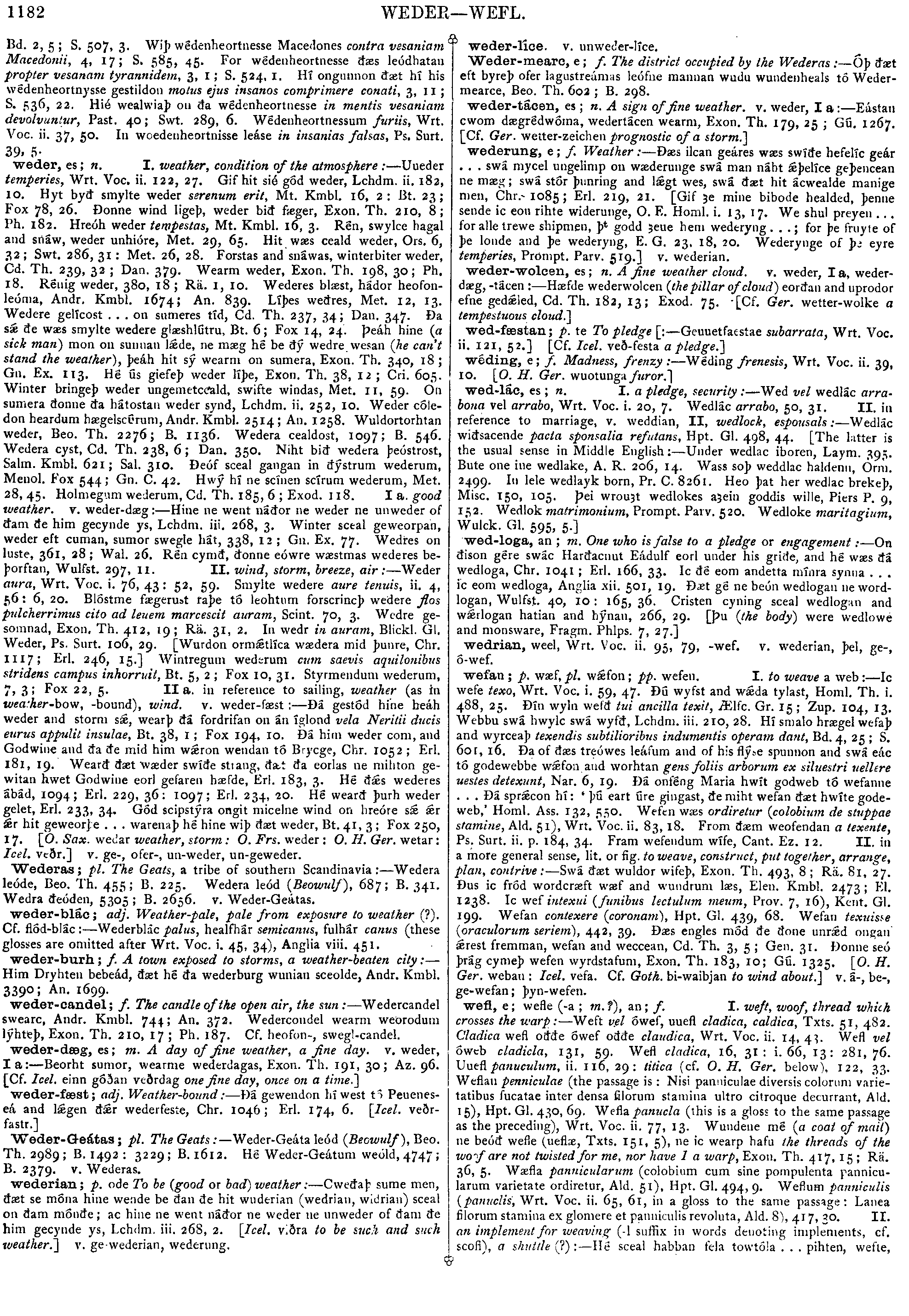
weder,
es;
n.
I.
weather,
condition
of
the
atmosphere
:--
Uueder
temperies,
Wrt.
Voc.
ii.
122,
27.
Gif
hit
sié
gód
weder,
Lchdm.
ii.
182,
10.
Hyt
byð
smylte
weder
serenum
erit,
Mt.
Kmbl.
16,
2:
Bt.
23;
Fox
78,
26.
Ðonne
wind
ligeþ,
weder
bið
fæger,
Exon.
Th.
210,
8;
Ph.
182.
Hreóh
weder
tempestas,
Mt.
Kmbl.
16,
3.
Rén,
swylce
hagal
and
snáw,
weder
unhióre,
Met.
29,
65.
Hit
wæs
ceald
weder,
Ors.
6,
32;
Swt.
286,
31:
Met.
26,
28.
Forstas
and
snáwas,
winterbiter
weder,
Cd.
Th.
239,
32;
Dan.
379.
Wearm
weder.
Exon.
Th.
198,
30;
Ph.
18.
Réuig
weder,
380,
18
;
Rä.
1,
10.
Wederes
blæst,
hádor
heofon leóma.
Andr.
Kmbl.
1674;
An.
839.
Líþes
weðres,
Met.
12,
13.
Wedere
gelícost
.
.
.
on
sumeres
tíd,
Cd.
Th.
237,
34;
Dan.
347.
Ða
s
ðe
wæs
smylte
wedere
glæshlútru,
Bt.
6;
Fox
14,
24.
Þeah
nine
(a
sick
man)
mon
on
sunnan
lde,
ne
mæg
hé
be
ðý
wedre
wesan
(he
can't
stand
the
weather),
þeáh
hit
sý
wearm
on
sumera,
Exon.
Th.
340,
18
;
Gn.
Ex.
113.
Hé
ús
giefeþ
weder
líþe,
Exon.
Th.
38,
12;
Cri.
605.
Winter
bringeþ
weder
ungemetceald,
swifte
windas,
Met.
11.
59.
On
sumera
ðonne
ða
hátostan
weder
synd,
Lchdm.
ii.
252,
10.
Weder
cóledon
heardum
hægelscúrum,
Andr.
Kmbl.
2514
;
An.
1258.
Wuldortorhtan
weder,
Beo.
Th.
2276;
B.
1136.
Wedera
cealdost,
1097;
B.
546.
Wedera
cyst,
Cd.
Th.
238,
6
;
Dan.
350.
Niht
bið
wedera
þeóstrost,
Salm.
Kmbl.
621;
Sal.
310.
Ðeóf
sceal
gangan
in
ðýstrum
wederum,
Menol.
Fox
544;
Gn.
C.
42.
Hwý
hí
ne
scínen
scírum
wederum,
Met.
28,
45.
Holmegum
wederum,
Cd.
Th.
185,
6
;
Exod.
118.
Ia.
good
weather.
v.
weder-dæg
:--
Hine
ne
went
náðor
ne
weder
ne
unweder
of
ðam
ðe
him
gecynde
ys,
Lchdm.
iii.
268,
3.
Winter
sceal
geweorpan,
weder
eft
cuman,
sumor
swegle
hát,
338,
12
;
Gn.
Ex.
77.
Wedres
on
luste,
361,
28
;
Wa
leóma.
Andr.
Kmbl.
1674;
An.
839.
Líþes
weðres,
Met.
12,
13.
Wedere
gelícost
.
.
.
on
sumeres
tíd,
Cd.
Th.
237,
34;
Dan.
347.
Ða
s
ðe
wæs
smylte
wedere
glæshlútru,
Bt.
6;
Fox
14,
24.
Þeah
nine
(a
sick
man)
mon
on
sunnan
lde,
ne
mæg
hé
be
ðý
wedre
wesan
(he
can't
stand
the
weather),
þeáh
hit
sý
wearm
on
sumera,
Exon.
Th.
340,
18
;
Gn.
Ex.
113.
Hé
ús
giefeþ
weder
líþe,
Exon.
Th.
38,
12;
Cri.
605.
Winter
bringeþ
weder
ungemetceald,
swifte
windas,
Met.
11.
59.
On
sumera
ðonne
ða
hátostan
weder
synd,
Lchdm.
ii.
252,
10.
Weder
cóledon
heardum
hægelscúrum,
Andr.
Kmbl.
2514
;
An.
1258.
Wuldortorhtan
weder,
Beo.
Th.
2276;
B.
1136.
Wedera
cealdost,
1097;
B.
546.
Wedera
cyst,
Cd.
Th.
238,
6
;
Dan.
350.
Niht
bið
wedera
þeóstrost,
Salm.
Kmbl.
621;
Sal.
310.
Ðeóf
sceal
gangan
in
ðýstrum
wederum,
Menol.
Fox
544;
Gn.
C.
42.
Hwý
hí
ne
scínen
scírum
wederum,
Met.
28,
45.
Holmegum
wederum,
Cd.
Th.
185,
6
;
Exod.
118.
Ia.
good
weather.
v.
weder-dæg
:--
Hine
ne
went
náðor
ne
weder
ne
unweder
of
ðam
ðe
him
gecynde
ys,
Lchdm.
iii.
268,
3.
Winter
sceal
geweorpan,
weder
eft
cuman,
sumor
swegle
hát,
338,
12
;
Gn.
Ex.
77.
Wedres
on
luste,
361,
28
;
Wa .
26.
Rén
cymð,
ðonne
eówre
wæstmas
wederes
beþorftan,
Wulfst.
297,
11.
II.
wind,
storm,
breeze,
air
:--
Weder
aura,
Wrt.
Voc.
i.
76,
43:
52,
59.
Smylte
wedere
aure
tenuis,
ii.
4,
56:
6,
20.
Blóstme
fægerust
raþe
tó
leohtnm
forscrincþ
wedere
flos
pulcherrimus
cito
ad
leuem
marcescit
auram,
Scint.
70,
3.
Wedre
gesomnad,
Exon.
Th.
412,
19;
Rä.
31,
2.
In
wedr
in
auram,
Blickl.
Gl.
Weder,
Ps.
Surt.
106,
29.
[Wurdon
ormtlíca
wædera
mid
þunre,
Chr.
1117;
Erl.
246,
15.]
Wintregum
wederum
cum
saevis
aquilonibus
stridens
campus
inhorruit,
Bt.
5,
2
;
Fox
10,
31.
Styrmendum
wederum,
7,
3;
Fox
22,
5.
IIa.
in
reference
to
sailing,
weather
(as
in
weather-bow,
-bound),
wind.
v.
weder-fæst
:--
Ðá
gestód
hine
beáh
weder
and
storm
s,
wearþ
ðá
fordrifan
on
án
íglond
vela
Neritii
ducis
eurus
appulit
insulae,
Bt.
38,
1;
Fox
194,
10.
Ðá
him
weder
com,
and
Godwine
and
ða
ðe
mid
him
wron
wendan
tó
Brycge,
Chr.
1052
;
Erl.
181,
19.
Wearð
ðæt
wæder
swíðe
strang,
ðæt
ða
eorlas
ne
mihton
gewitan
hwet
Godwine
eorl
gefaren
hæfde,
Erl.
183,
3.
Hé
ðs
wederes
ábád,
1094;
Erl.
229,
36:
1097;
Erl.
234,
20.
Hé
wearð
þurh
weder
gelet,
Erl.
233,
34.
Gód
scipstýra
ongit
micelne
wind
on
hreóre
s
r
r
hit
geweorþe
.
.
.
warenaþ
hé
hine
wiþ
ðæt
weder,
Bt.
41,
3;
Fox
250,
17.
[O.Sax.
wedar
weather,
storm:
O.
Frs.
weder
:
O.
H.
Ger.
wetar:
Icel.
veðr.]
v.
ge-,
ofer-,
un-weder,
un-geweder.
.
26.
Rén
cymð,
ðonne
eówre
wæstmas
wederes
beþorftan,
Wulfst.
297,
11.
II.
wind,
storm,
breeze,
air
:--
Weder
aura,
Wrt.
Voc.
i.
76,
43:
52,
59.
Smylte
wedere
aure
tenuis,
ii.
4,
56:
6,
20.
Blóstme
fægerust
raþe
tó
leohtnm
forscrincþ
wedere
flos
pulcherrimus
cito
ad
leuem
marcescit
auram,
Scint.
70,
3.
Wedre
gesomnad,
Exon.
Th.
412,
19;
Rä.
31,
2.
In
wedr
in
auram,
Blickl.
Gl.
Weder,
Ps.
Surt.
106,
29.
[Wurdon
ormtlíca
wædera
mid
þunre,
Chr.
1117;
Erl.
246,
15.]
Wintregum
wederum
cum
saevis
aquilonibus
stridens
campus
inhorruit,
Bt.
5,
2
;
Fox
10,
31.
Styrmendum
wederum,
7,
3;
Fox
22,
5.
IIa.
in
reference
to
sailing,
weather
(as
in
weather-bow,
-bound),
wind.
v.
weder-fæst
:--
Ðá
gestód
hine
beáh
weder
and
storm
s,
wearþ
ðá
fordrifan
on
án
íglond
vela
Neritii
ducis
eurus
appulit
insulae,
Bt.
38,
1;
Fox
194,
10.
Ðá
him
weder
com,
and
Godwine
and
ða
ðe
mid
him
wron
wendan
tó
Brycge,
Chr.
1052
;
Erl.
181,
19.
Wearð
ðæt
wæder
swíðe
strang,
ðæt
ða
eorlas
ne
mihton
gewitan
hwet
Godwine
eorl
gefaren
hæfde,
Erl.
183,
3.
Hé
ðs
wederes
ábád,
1094;
Erl.
229,
36:
1097;
Erl.
234,
20.
Hé
wearð
þurh
weder
gelet,
Erl.
233,
34.
Gód
scipstýra
ongit
micelne
wind
on
hreóre
s
r
r
hit
geweorþe
.
.
.
warenaþ
hé
hine
wiþ
ðæt
weder,
Bt.
41,
3;
Fox
250,
17.
[O.Sax.
wedar
weather,
storm:
O.
Frs.
weder
:
O.
H.
Ger.
wetar:
Icel.
veðr.]
v.
ge-,
ofer-,
un-weder,
un-geweder.
|
Source: Bosworth/Toller, page b1182, entry 6 View original page image as: [TIFF] [PNG] [View previous entry] [View next entry] |
[Comment on this entry] [View comments] |
The following entry has been hand-corrected once. |
weder-candel; f. The candle of the open air, the sun :-- Wedercandel swearc, Andr. Kmbl. 744; An. 372. Wedercondel wearm weorodum lýhteþ, Exon. Th. 210, 17; Ph. 187. Cf. heofon-, swegl-candel.
|
Source: Bosworth/Toller, page b1209, entry 17 View original page image as: [TIFF] [PNG] [View previous entry] [View next entry] |
[Comment on this entry] [View comments] |
The following entry has been hand-corrected once. |
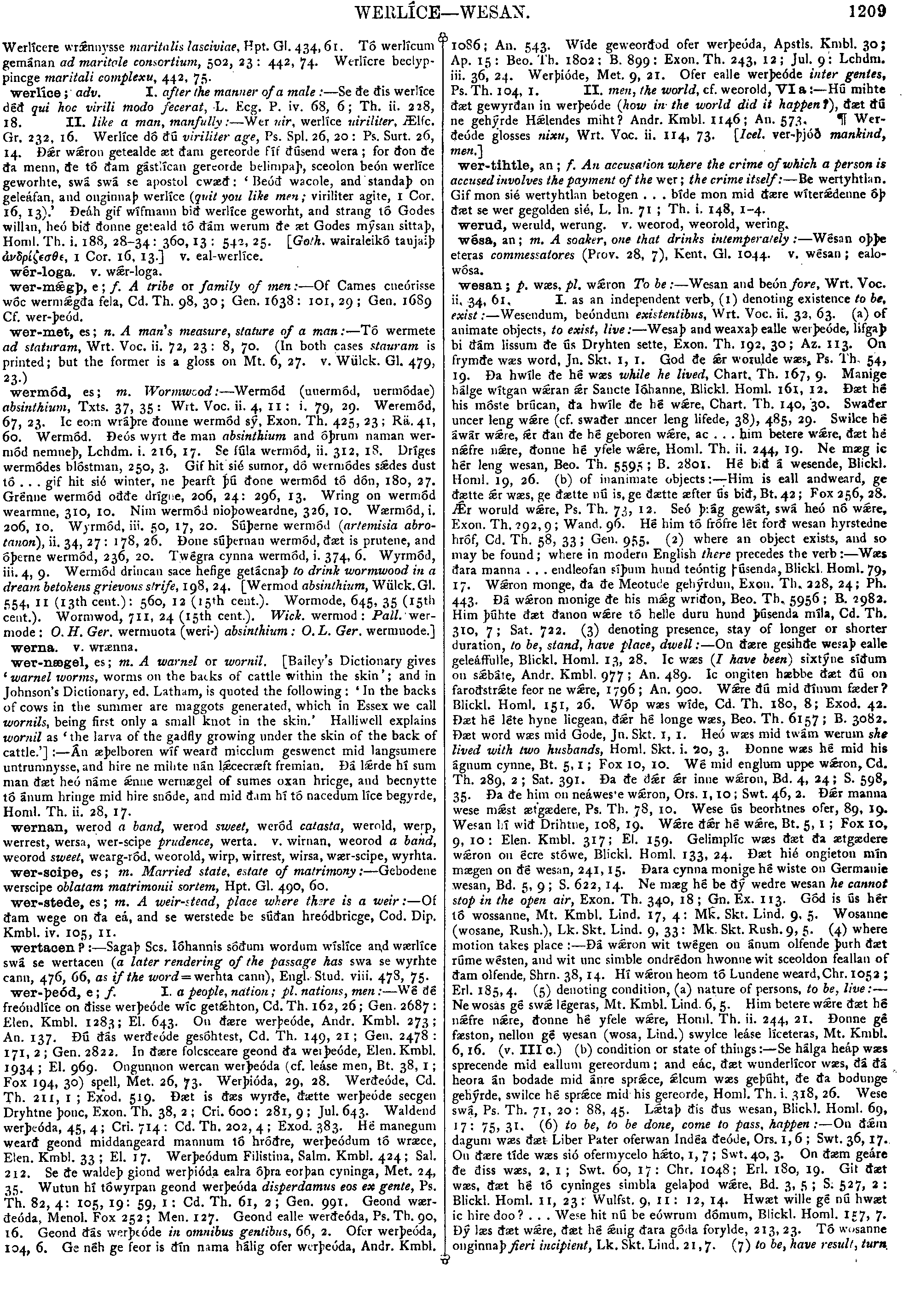
wesan;
p.
wæs,
pl.
wron
To
be:--Wesan
and
beón
fore,
Wrt.
Voc.
ii.
34,
61.
I.
as
an
independent
verb,
(1)
denoting
existence
to
be,
exist:--Wesendum,
beóndum
existentibus,
Wrt.
Voc.
ii.
32,
63.
(a)
of
animate
objects,
to
exist,
live:--Wesaþ
and
weaxaþ
ealle
werþeóde,
lifgaþ
bi
ðám
lissum
ðe
ús
Dryhten
sette,
Exon.
Th.
192,
30;
Az.
113.
On
frymðe
wæs
word,
Jn.
Skt.
1,
1.
God
ðe
r
worulde
wæs,
Ps.
Th.
54,
19.
Ða
hwíle
ðe
hé
wæs
while
he
lived,
Chart.
Th.
167,
9.
Manige
hálge
wítgan
wran
r
Sancte
Ióhanne,
Blickl.
Homl.
161,
12.
Ðæt
hé
his
móste
brúcan,
ða
hwíle
ðe
hé
wre,
Chart.
Th.
140,
30.
Swaðer
uncer
leng
wre
(cf.
swaðer
uncer
leng
lifede,
38),
485,
29.
Swilce
hé
áwár
wre,
r
ðan
ðe
hé
geboren
wre,
ac
.
.
.
him
betere
wre,
ðæt
hé
nfre
nre,
ðonne
hé
yfele
wre,
Homl.
Th.
ii.
244,
19.
Ne
mæg
ic
hér
leng
wesan,
Beo.
Th.
5595;
B.
2801.
Hé
bið
á
wesende,
Blickl.
Homl.
19,
26.
(b)
of
inanimate
objects:--Him
is
eall
andweard,
ge
ðætte
r
wæs,
ge
ðætte
nú
is,
ge
ðætte
æfter
ús
bið,
Bt.
42;
Fox
256,
28.
Æ-acute;r
woruld
wre,
Ps.
Th.
73,
12.
Seó
þrág
gewát,
swá
heó
nó
wre,
Exon.
Th.
292,
9;
Wand.
96.
Hé
him
tó
frófre
lét
forð
wesan
hyrstedne
hróf,
Cd.
Th.
58,
33;
Gen.
955.
(2)
where
an
object
exists,
and
so
may
be
found;
where
in
modern
English
there
precedes
the
verb:--Wæs
ðara
manna
.
.
.
endleofan
síþum
hund
teóntig
þúsenda,
Blickl.
Homl.
79,
17.
Wron
monge,
ða
ðe
Meotude
gehýrdun,
Exon.
Th.
228,
24;
Ph.
443.
Ðá
wron
monige
ðe
his
mg
wriðon,
Beo.
Th.
5956;
B.
2982.
Him
þúhte
ðæt
ðanon
wre
tó
helle
duru
hund
þúsenda
míla,
Cd.
Th.
310,
7;
Sat.
722.
(3)
denoting
presence,
stay
of
longer
or
shorter
duration,
to
be,
stand,
have
place,
dwell:--On
ðære
gesihðe
wesaþ
ealle
geleáffulle,
Blickl.
Homl.
13,
28.
Ic
wæs
(I
have
been)
sixtýne
síðum
on
sbáte,
Andr.
Kmbl.
977;
An.
489.
Ic
ongiten
hæbbe
ðæt
ðú
on
faroðstrte
feor
ne
wre,
1796;
An.
900.
Wre
ðú
mid
ðínum
fæder?
Blickl.
Homl.
151,
26.
Wóp
wæs
wíde,
Cd.
Th.
180,
8;
Exod.
42.
Ðæt
hé
léte
hyne
licgean,
ðr
hé
longe
wæs,
Beo.
Th.
6157;
B.
3082.
Ðæt
word
wæs
mid
Gode,
Jn.
Skt.
1,
1.
Heó
wæs
mid
twám
werum
she
lived
with
two
husbands,
Homl.
Skt.
i.
20,
3.
Ðonne
wæs
hé
mid
his
ágnum
cynne,
Bt.
5,
1;
Fox
10,
10.
Wé
mid
englum
uppe
wron,
Cd.
Th.
289,
2;
Sat.
391.
Ða
ðe
ðr
r
inne
wron,
Bd.
4,
24;
S.
598,
35.
Ða
ðe
him
on
neáweste
wron,
Ors.
1,
10;
Swt.
46,
2.
Ðr
manna
wese
mst
ætgædere,
Ps.
Th.
78,
10.
Wese
ús
beorhtnes
ofer,
89,
19.
Wesan
hí
wið
Drihtne,
108,
19.
Wre
ðr
hé
wre,
Bt.
5,
1;
Fox
10,
9,
10:
Elen.
Kmbl.
317;
El.
159.
Gelimplíc
wæs
ðæt
ða
ætgædere
wron
on
écre
stówe,
Blickl.
Homl.
133,
24.
Ðæt
hié
ongieton
mín
mægen
on
ðé
wesan,
241,
15.
Ðara
cynna
monige
hé
wiste
on
Germanie
wesan,
Bd.
5,
9;
S.
622,
14.
Ne
mæg
hé
be
ðý
wedre
wesan
he
cannot
stop
in
the
open
air,
Exon.
Th.
340,
18;
Gn.
Ex.
113.
Gód
is
ús
hér
tó
wossanne,
Mt.
Kmbl.
Lind.
17,
4:
Mk.
Skt.
Lind.
9,
5.
Wosanne
(wosane,
Rush.),
Lk.
Skt.
Lind.
9,
33:
Mk.
Skt.
Rush.
9,
5.
(4)
where
motion
takes
place:--Ðá
wron
wit
twégen
on
ánum
olfende
þurh
ðæt
rúme
wésten,
and
wit
unc
simble
ondrédon
hwonne
wit
sceoldon
feallan
of
ðam
olfende,
Shrn.
38,
14.
Hí
wron
heom
tó
Lundene
weard,
Chr.
1052;
Erl.
185,
4.
(5)
denoting
condition,
(a)
nature
of
persons,
to
be,
live:--Ne
wosas
gé
sw
légeras,
Mt.
Kmbl.
Lind.
6,
5.
Him
betere
wre
ðæt
hé
nfre
nre,
ðonne
hé
yfele
wre,
Homl.
Th.
ii.
244,
21.
Ðonne
gé
fæston,
nellon
gé
wesan
(wosa,
Lind.)
swylce
leáse
líceteras,
Mt.
Kmbl.
6,
16.
(v.
III
c.)
(b)
condition
or
state
of
things:--Se
hálga
heáp
wæs
sprecende
mid
eallum
gereordum;
and
eác,
ðæt
wunderlícor
wæs,
ðá
ðá
heora
án
bodade
mid
ánre
sprce,
lcum
wæs
geþúht,
ðe
ða
bodunge
gehýrde,
swilce
hé
sprce
mid
his
gereorde,
Homl.
Th.
i.
318,
26.
Wese
swá,
Ps.
Th.
71,
20:
88,
45.
Ltaþ
ðis
ðus
wesan,
Blickl.
Homl.
69,
17:
75,
31.
(6)
to
be,
to
be
done,
come
to
pass,
happen:--On
ðm
dagum
wæs
ðæt
Liber
Pater
oferwan
Indéa
ðeóde,
Ors.
1,
6;
Swt.
36,
17.
On
ðære
tíde
wæs
sió
ofermycelo
hto,
1,
7;
Swt.
40,
3.
On
ðæm
geáre
ðe
ðiss
wæs,
2,
1;
Swt.
60,
17:
Chr.
1048;
Erl.
180,
19.
Git
ðæt
wæs,
ðæt
hé
tó
cyninges
simbla
gelaþod
wre,
Bd.
3,
5;
S.
527,
2:
Blickl.
Homl.
11,
23:
Wulfst.
9,
11:
12,
14.
Hwæt
wille
gé
nú
hwæt
ic
hire
doo?
.
.
.
Wese
hit
nú
be
eówrum
dómum,
Blickl.
Homl.
157,
7.
Ðý
læs
ðæt
wre,
ðæt
hé
nig
ðara
góda
forylde,
213,
23.
Tó
wosanne
onginnaþ
fieri
incipient,
Lk.
Skt.
Lind.
21,
7.
(7)
to
be,
have
result,
turn
|
Source: Bosworth/Toller, page b1231, entry 18 View original page image as: [TIFF] [PNG] [View previous entry] [View next entry] |
[Comment on this entry] [View comments (1)] |
The following entry has been hand-corrected once. |
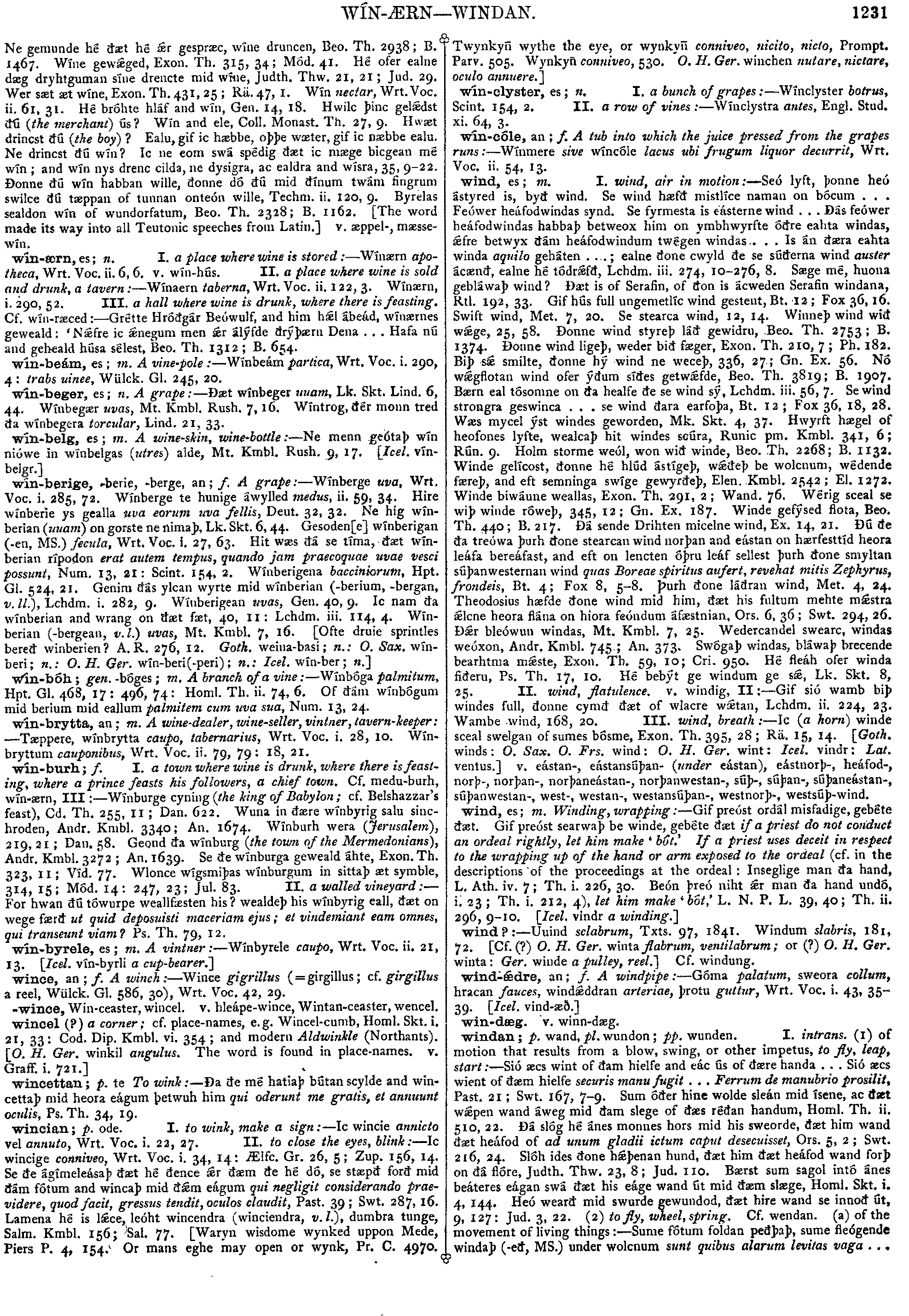
wind,
es;
m.
I.
wind,
air
in
motion
:--Seó
lyft,
þonne
heó
ástyred
is,
byð
wind.
Se
wind
hæfð
mistlíce
naman
on
bocum
...
Feówer
heáfodwindas
synd.
Se
fyrmesta
is
eásterne
wind
...
Ðás
feówer
heáfodwindas
habbaþ
betweox
him
on
ymbhwyrfte
óðre
eahta
windas,
fre
betwyx
ðám
heáfodwindum
twégen
windas
...
Is
án
ðæra
eahta
winda
aquilo
geháten
...;
ealne
ðone
cwyld
ðe
se
súðerna
wind
auster
ácænð,
ealne
hé
tódrfð,
Lchdm.
iii.
274,
10-276,
8.
Sæge
mé,
huona
gebláwaþ
wind?
Ðæt
is
of
Serafin,
of
ðon
is
ácweden
Serafin
windana,
Rtl.
192,
33.
Gif
hús
full
ungemetlíc
wind
gesteut,
Bt.
12;
Fox
36,
16.
Swift
wind.
Met.
7,
20.
Se
stearca
wind,
12,
14.
Winneþ
wind
wið
wge,
25,
58.
Ðonne
wind
styreþ
láð
gewidru,
Beo.
Th.
2753;
B.
1374.
Ðonne
wind
ligeþ,
weder
bið
fæger,
Exon.
Th.
210,
7;
Ph.
182.
Biþ
ssmilte,
ðonne
hý
wind
ne
weceþ,
336,
27;
Gn.
Ex.
56.
Nó
wgflotan
wind
ofer
ýðum
síðes
getwfde,
Beo.
Th.
3819;
B.
1907.
Bærn
eal
tósomne
on
ða
healfe
ðe
se
wind
sý.
Lchdm.
iii.
56,
7.
Se
wind
strongra
geswinca
...
se
wind
ðara
earfoþa,
Bt.
12;
Fox
36,
18,
28.
Wæs
mycel
ýst
windes
geworden,
Mk.
Skt.
4,
37.
Hwyrft
hægel
of
heofones
lyfte,
wealcaþ
hit
windes
scúra,
Runic
pm.
Kmbl.
341,
6;
Run.
9.
Holm
storme
weól,
won
wið
winde,
Beo.
Th.
2268;
B.
1132.
Winde
gelícost,
ðonne
hé
hlúd
ástígeþ,
wðeþ
be
wolcnum,
wédende
færeþ,
and
eft
semninga
swíge
gewyrðeþ,
Elen.
Kmbl.
2542;
El.
1272.
Winde
biwáune
weallas,
Exon.
Th.
291,
2;
Wand.
76.
Wérig
sceal
se
wiþ
winde
róweþ,
345,
12;
Gn.
Ex.
187.
Winde
gefýsed
flota,
Beo.
Th.
440;
B.
217.
Ðá
sende
Drihten
micelne
wind.
Ex.
14,
21.
Ðú
ðe
ða
treówa
þurh
ðone
stearcan
wind
norþan
and
eástan
on
hærfesttíd
heora
leáfa
bereáfast,
and
eft
on
lencten
óþru
leaf
sellest
þurh
ðone
smyltan
súþanwesternan
wind
quas
Boreae
spiritus
aufert,
revehat
mitis
Zephyrus,
frondeis,
Bt.
4;
Fox
8,
5-8.
Þurh
ðone
láðran
wind.
Met.
4,
24.
Theodosius
hæfde
ðone
wind
mid
him,
ðæt
his
fultum
mehte
mstra
lcne
heora
flána
on
hiora
feóndum
áfæstnian,
Ors.
6,
36;
Swt.
294,
26.
Ðr
bleówun
windas,
Mt.
Kmbl.
7,
25.
Wedercandel
swearc,
windas
weóxon,
Andr.
Kmbl.
745;
An.
373.
Swógaþ
windas,
bláwaþ
brecende
bearhtma
mste,
Exon.
Th.
59,
10;
Cri.
950.
Hé
fleáh
ofer
winda
fiðeru.
Ps.
Th.
17,
10.
Hé
bebýt
ge
windum
ge
s.
Lk.
Skt.
8,
25.
II.
wind,
flatulence,
v.
windig,
II
:--Gif
sió
wamb
biþ
windes
full,
ðonne
cymð
ðæt
of
wlacre
wtan,
Lchdm.
ii.
224,
23.
Wambe
wind,
168,
20.
III.
wind,
breath
:--Ic
(a
horn)
winde
sceal
swelgan
of
sumes
bósme,
Exon.
Th.
395,
28;
Ru.
15,
14.
[Goth.
winds:
O.
Sax.
O.
Frs.
wind:
O.
H.
Ger.
wint:
Icel.
vindr:
Lat.
ventus.]
v.
eástan-,
eástansúþan-
(under
eástan),
eástnorþ-,
heáfod-,
norþ-,
norþan-,
norþaneástan-,
norþanwestan-,
súþ-,
súþan-,
súþaneástan-,
súþanwestan-,
west-,
westan-,
westansúþan-,
westnorþ-,
westsúþ-wind.
|
Source: Bosworth/Toller, page d0019, entry 21 View original page image as: [TIFF] [PNG] [View previous entry] [View next entry] |
[Comment on this entry] [View comments] |
The following entry has been hand-corrected once. |
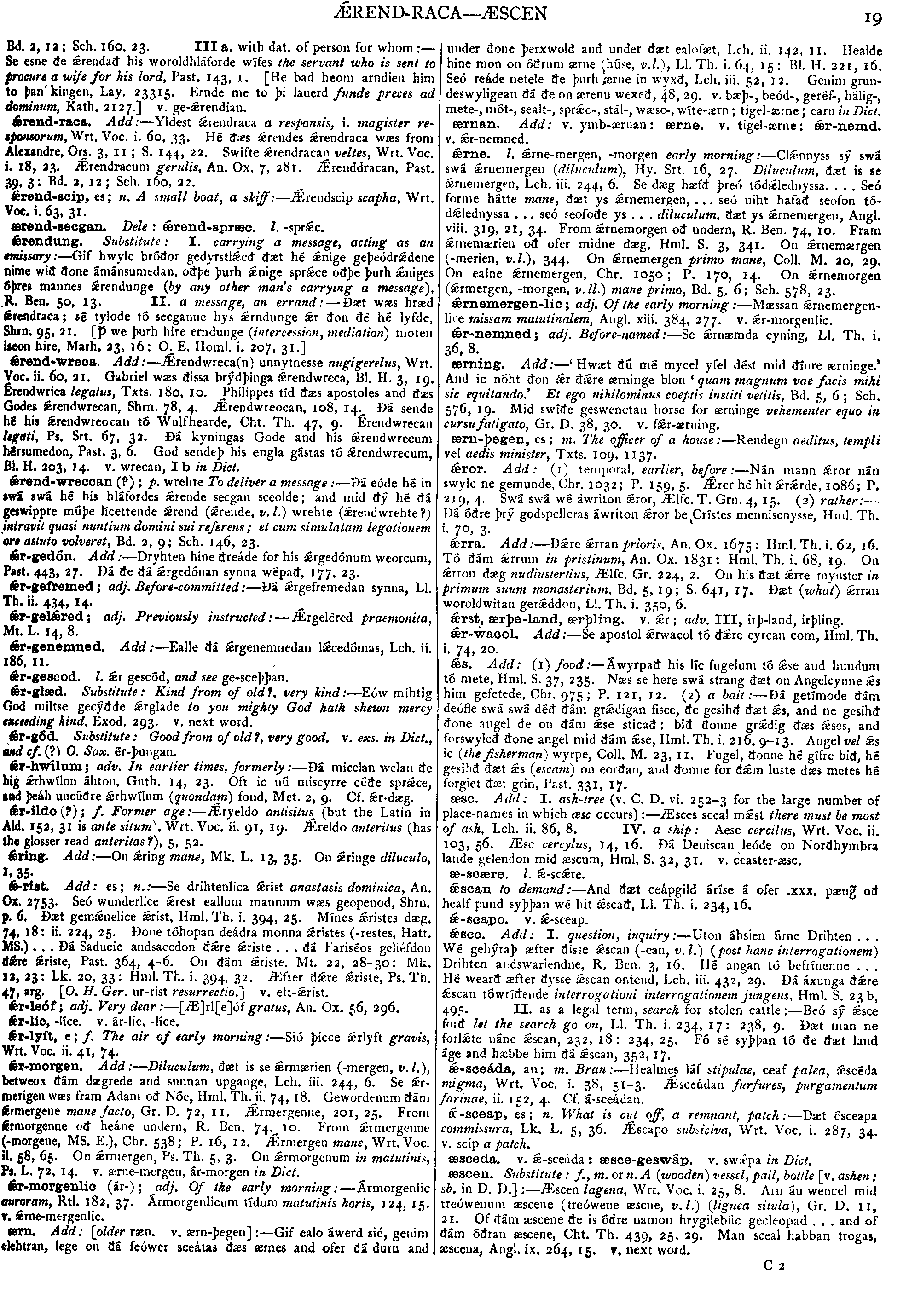
r-lyft,
e;
f.
The
air
of
early
morning:--Sió
þicce
rlyft
gravis,
Wrt.
Voc.
ii.
41,
74.
|
Source: Bosworth/Toller, page d0096, entry 33 View original page image as: [TIFF] [PNG] [View previous entry] [View next entry] |
[Comment on this entry] [View comments] |
The following entry has been hand-corrected once. |
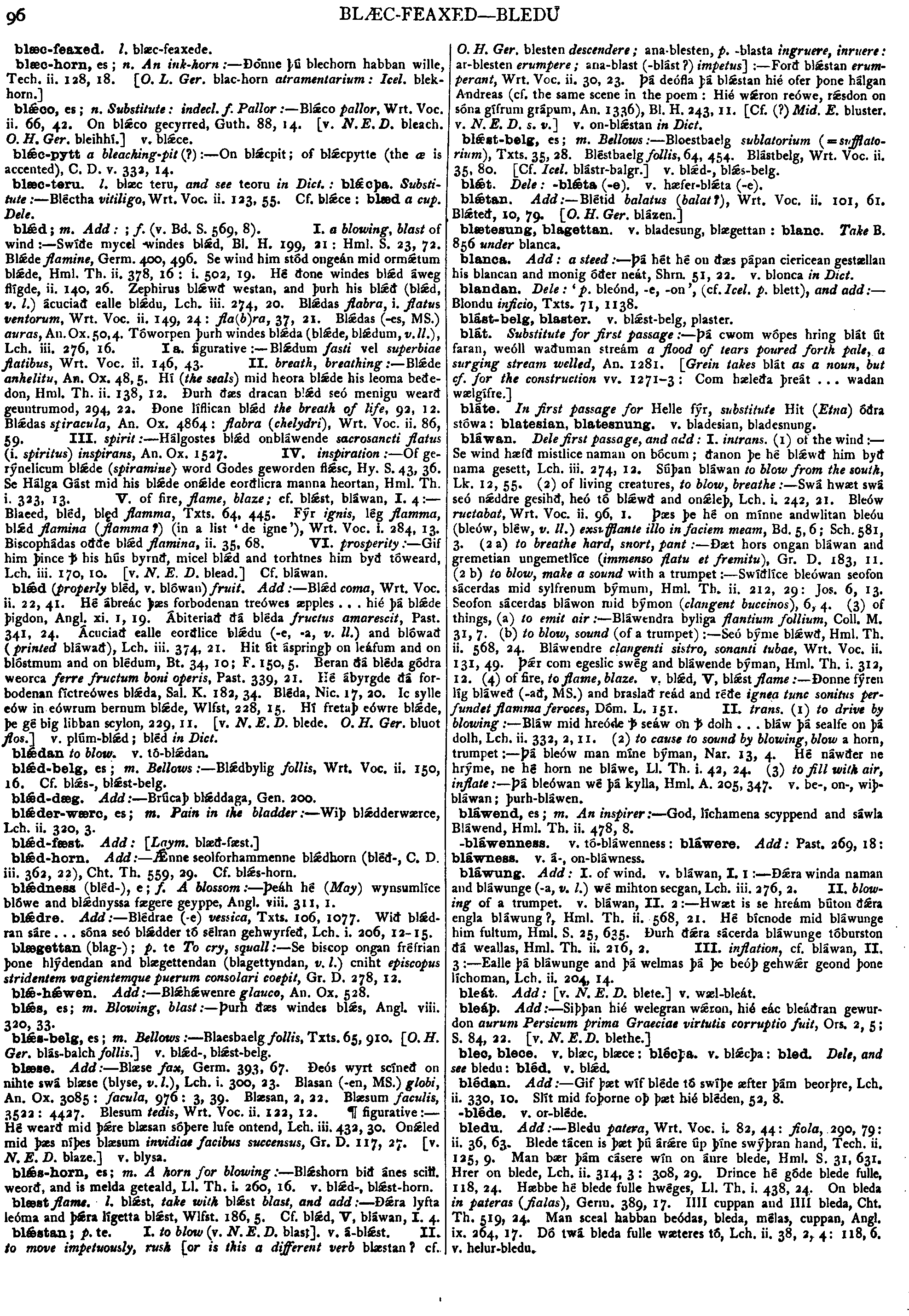
bláwan.
Dele
first
passage,
and
add
:
I.
intrans.
(1)
of
the
wind
:--
Se
wind
hæfð
mistlice
naman
on
bócum;
ðanon
þe
hé
blwð
him
byð
nama
gesett,
Lch.
iii.
274,
12.
Súþan
bláwan
to
blow
from
the
south,
Lk.
12,
55.
(2)
of
living
creatures,
to
blow,
breathe
:--
Swá
hwæt
swá
seó
nddre
gesihð,
heó
tó
blwð
and
onleþ,
Lch.
i.
242,
21.
Bleów
ructabat,
Wrt.
Voc.
ii.
96,
1.
Þæs
þe
hé
on
mínne
andwlitan
bleóu
(bleów,
bléw,
v.
ll.)
exsufflante
illo
in
faciem
meam,
Bd.
5,
6;
Sch.
581,
3.
(2
a)
to
breathe
hard,
snort,
pant
:--
Ðæt
hors
ongan
bláwan
and
gremetian
ungemetlíce
(immenso
flatu
et
fremitu),
Gr.
D.
183,
11.
(2
b)
to
blow,
make
a
sound
with
a
trumpet
:--
Swíðlíce
bleówan
seofon
sácerdas
mid
sylfrenum
býmum,
Hml.
Th.
ii.
212,
29:
Jos.
6,
13.
Seofon
sácerdas
bláwon
mid
býmon
(clangent
buccinos),
6,
4.
(3)
of
things,
(a)
to
emit
air
:--
Bláwendra
byliga
flantium
follium,
Coll.
M.
31,
7.
(b)
to
blow,
sound
(of
a
trumpet)
:--
Seó
býme
blwð,
Hml.
Th.
ii.
568,
24.
Bláwendre
clangenti
sistro,
sonanti
tubae,
Wrt.
Voc.
ii.
131,
49.
Þr
com
egeslic
swég
and
bláwende
býman,
Hml.
Th.
i.
312,
12.
(4)
of
fire,
to
flame,
blaze.
v.
bld.
V.
blst
flame
:--
Ðonne
fýren
líg
bláweð
(-að,
MS.)
and
braslað
reád
and
réðe
ignea
tanc
sonitus
perfundet
flamma
feroces,
Dóm.
L.
151.
II.
trans.
(1)
to
drive
by
blowing
:--
Bláw
mid
hreóde
 seáw
on
dolh
.
.
.
bláw
þá
sealfe
on
þá
dolh,
Lch.
ii.
332,
2,
11.
(2)
to
cause
to
sound
by
blowing,
blow
a
horn,
trumpet
:--
Þá
bleów
man
míne
býman,
Nar.
13,
4.
Hé
náwðer
ne
hrýme,
ne
hé
horn
ne
bláwe,
Ll.
Th.
i.
42,
24.
(3)
to
flll
with
air,
inflate
:--
Þá
bleówan
wé
þá
kylla,
Hml.
A.
205,
347.
v.
be-,
on-,
wiþ-bláwan;
þurh-bláwen.
seáw
on
dolh
.
.
.
bláw
þá
sealfe
on
þá
dolh,
Lch.
ii.
332,
2,
11.
(2)
to
cause
to
sound
by
blowing,
blow
a
horn,
trumpet
:--
Þá
bleów
man
míne
býman,
Nar.
13,
4.
Hé
náwðer
ne
hrýme,
ne
hé
horn
ne
bláwe,
Ll.
Th.
i.
42,
24.
(3)
to
flll
with
air,
inflate
:--
Þá
bleówan
wé
þá
kylla,
Hml.
A.
205,
347.
v.
be-,
on-,
wiþ-bláwan;
þurh-bláwen.
|
Source: Bosworth/Toller, page d0103, entry 45 View original page image as: [TIFF] [PNG] [View previous entry] [View next entry] |
[Comment on this entry] [View comments] |
The following entry has been hand-corrected once. |
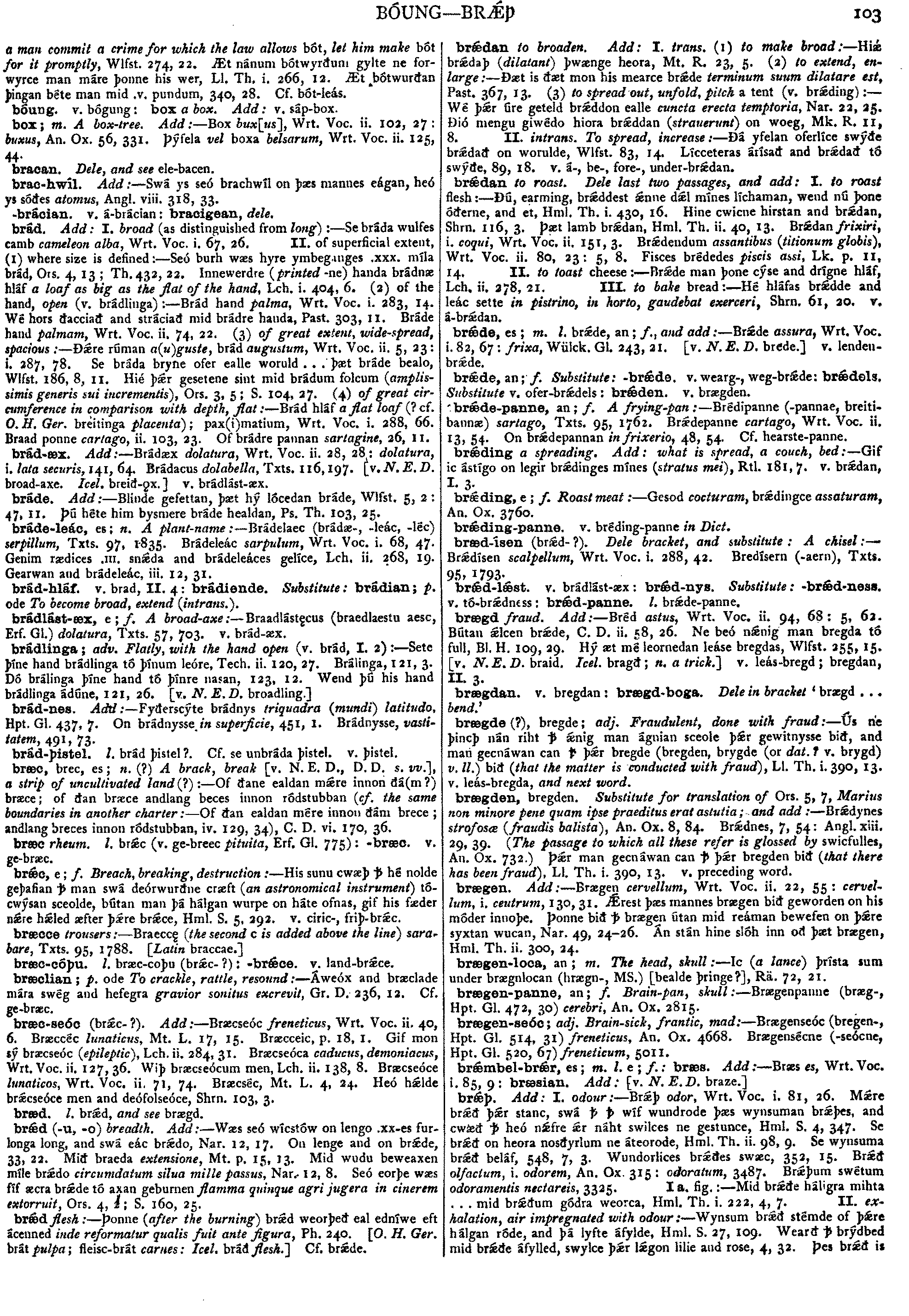
brþ.
Add:
I.
odour:
--
-Brþ
odor,
Wrt.
Voc.
i.
81,
26.
Mre
brð
þr
stanc,
swá
wíf
wundrode
þæs
wynsuman
brþes,
and
cwæð
heó
nfre
r
náht
swilces
ne
gestunce.
Hml.
S.
4,
347.
Se
brð
on
heora
nosðyrlum
ne
áteorode,
Hml.
Th.
ii.
98,
9.
Se
wynsuma
brð
beláf,
548,
7,
3.
Wundorlices
brðes
swæc,
352,
15.
Brd
olfactum,
i.
odorem,
An.
Ox.
315
:
odoratum,
3487.
Brþum
swétum
odoramentis
nectareis,
3325.
I
a.
fig.
:--
Mid
brðe
háligra
mihta
.
.
.
mid
brðum
gódra
weorca,
Hml.
Th.
i.
222,
4,
7.
II.
exhalation,
air
impregnated
with
odour
:--
Wynsum
brð
stémde
of
þre
hálgan
róde,
and
þá
lyfte
áfylde,
Hml.
S.
27,
109.
Wearð
brýdbed
mid
brðe
áfylled,
swylce
þr
lgon
lilie
and
rose,
4,
32.
Þes
brð
is
|
Source: Bosworth/Toller, page d0159, entry 17 View original page image as: [TIFF] [PNG] [View previous entry] [View next entry] |
[Comment on this entry] [View comments] |
The following entry has been hand-corrected once. |
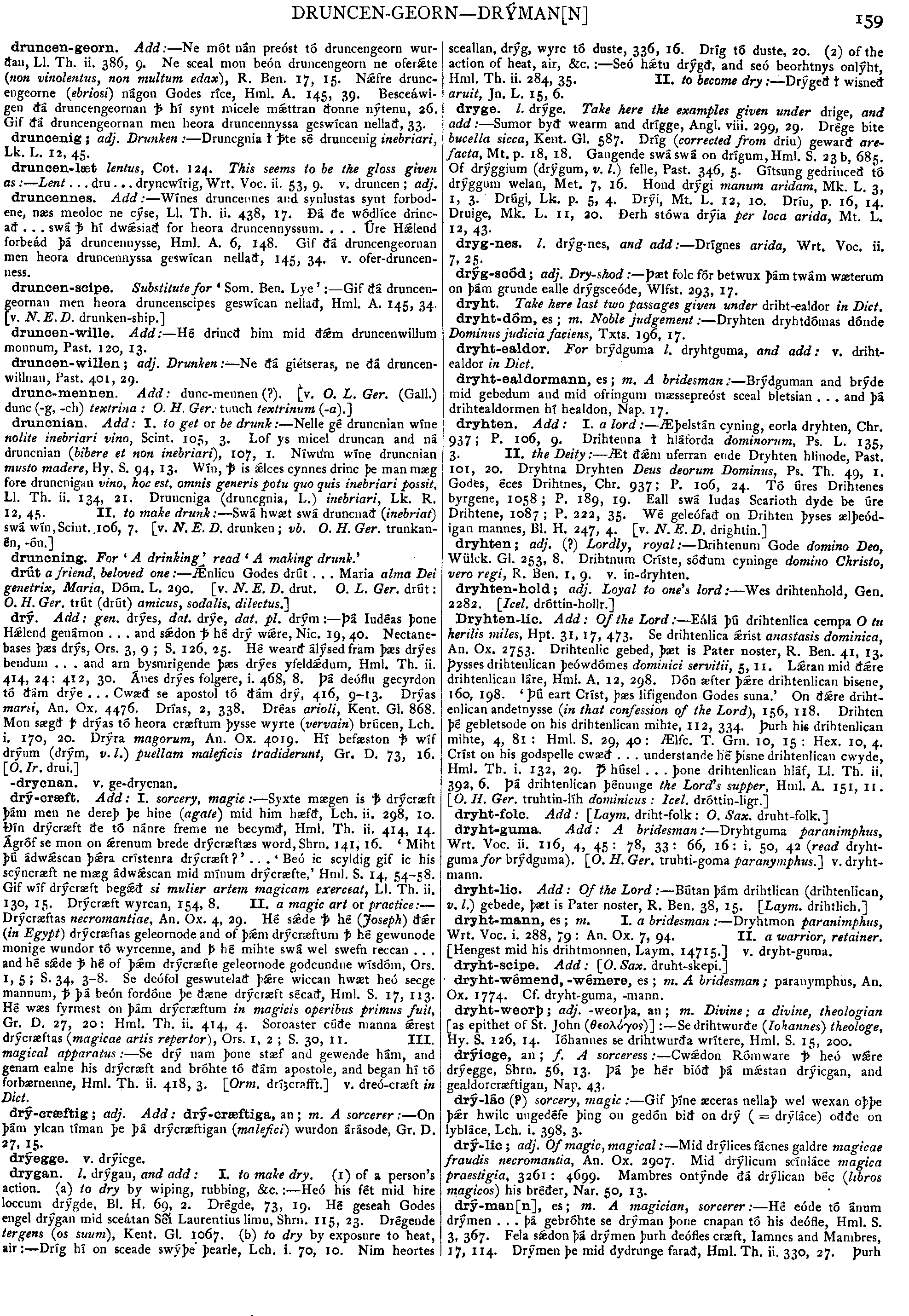
drygan.
l.
drýgan,
and
add:
I.
to
make
dry.
(1)
of
a
person's
action,
(a)
to
dry
by
wiping,
rubbing,
&c.
:--
Heó
his
fét
mid
hire
loccum
drýgde,
Bl.
H.
69,
2.
Drégde,
73,
19.
Hé
geseah
Godes
engel
drýgan
mid
sceátan
S i
Laurentius
limu,
Shrn.
115,
23.
Drégende
tergens
(os
suum),
Kent.
Gl.
1067.
(b)
to
dry
by
exposure
to
heat,
air
:--
Dríg
hí
on
sceade
swýþe
þearle,
Lch.
i.
70,
10.
Nim
heortes
sceallan,
drýg,
wyrc
tó
duste,
336,
16.
Dríg
tó
duste,
20.
(2)
of
the
action
of
heat,
air,
&c.
:--
Seó
htu
drýgð,
and
seó
beorhtnys
onlýht,
Hml.
Th.
ii.
284,
35.
II.
to
become
dry
:--
Drýgeð
wisneð
aruit,
Jn.
L.
15,
6.
i
Laurentius
limu,
Shrn.
115,
23.
Drégende
tergens
(os
suum),
Kent.
Gl.
1067.
(b)
to
dry
by
exposure
to
heat,
air
:--
Dríg
hí
on
sceade
swýþe
þearle,
Lch.
i.
70,
10.
Nim
heortes
sceallan,
drýg,
wyrc
tó
duste,
336,
16.
Dríg
tó
duste,
20.
(2)
of
the
action
of
heat,
air,
&c.
:--
Seó
htu
drýgð,
and
seó
beorhtnys
onlýht,
Hml.
Th.
ii.
284,
35.
II.
to
become
dry
:--
Drýgeð
wisneð
aruit,
Jn.
L.
15,
6.
|
Source: Bosworth/Toller, page d0218, entry 7 View original page image as: [TIFF] [PNG] [View previous entry] [View next entry] |
[Comment on this entry] [View comments] |
The following entry has been hand-corrected once. |
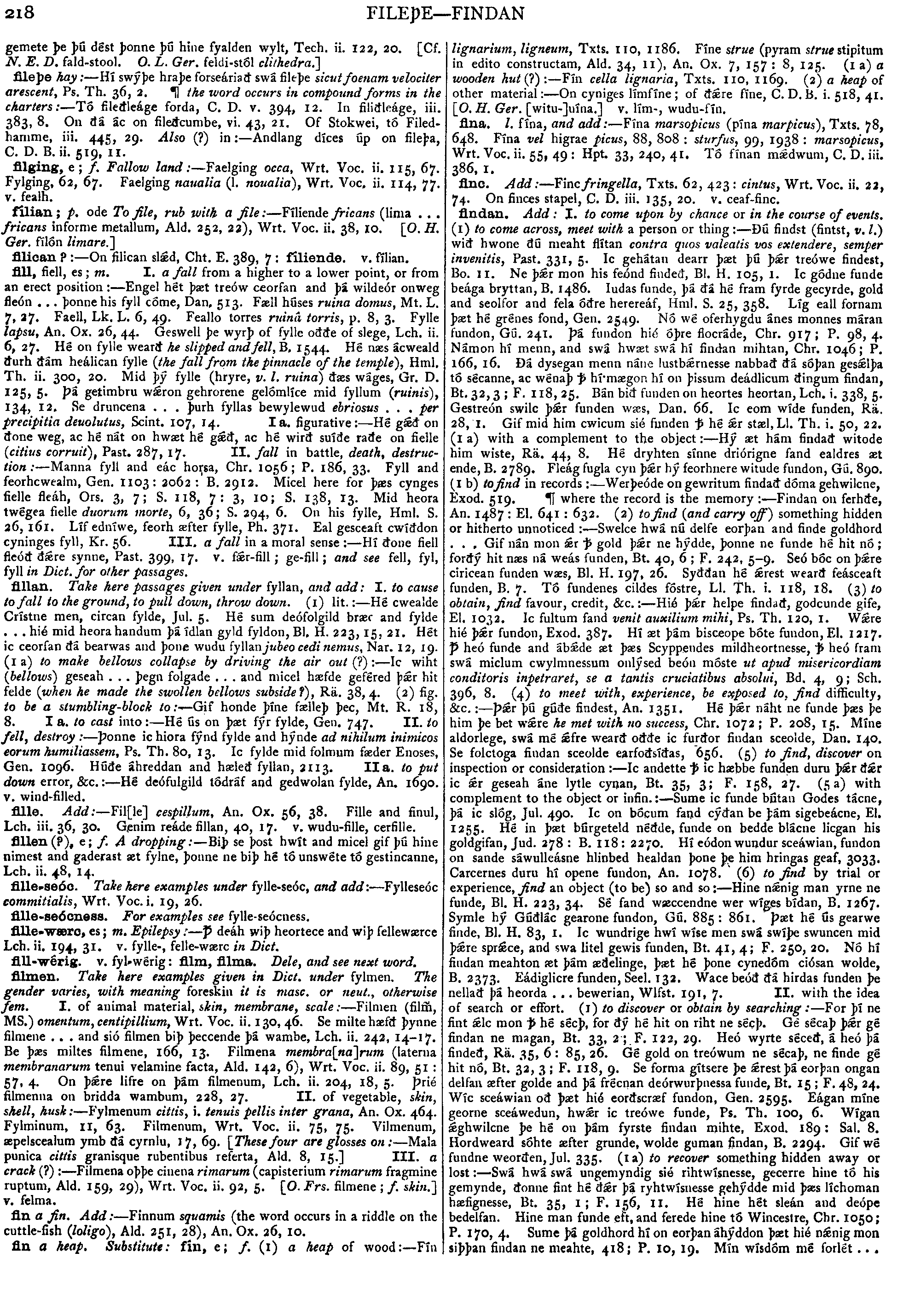
fillan.
Take
here
passages
given
under
fyllan,
and
add:
I.
to
cause
to
fall
to
the
ground,
to
pull
down,
throw
down,
(1)
lit.
:--
Hé
cwealde
Crístne
men,
circan
fylde,
Jul.
5.
Hé
sum
deófolgild
bræc
and
fylde
.
.
.
hié
mid
heora
handum
þá
ídlan
gyld
fyldon,
Bl.
H.
223,
15,
21.
Hét
ic
ceorfan
ðá
bearwas
and
þone
wudu
fyllan
jubeo
cedi
nemus.
Nar.
12,
19.
(la)
to
make
bellows
collapse
by
driving
the
air
out
(?)
:--
Ic
wiht
(bellows]
geseah
.
.
.
þegn
folgade
.
.
.
and
micel
hæfde
geféred
þr
hit
felde
(when
he
made
the
swollen
bellows
subside
?),
Ra.
38,
4.
(2)
fig.
to
be
a
stumbling-block
to
:--
Gif
honde
þíne
fælleþ
þec,
Mt.
R.
18,
8.
I
a.
to
cast
into
:--
Hé
ús
on
þæt
fýr
fylde,
Gen.
747.
II.
to
fell,
destroy
:--
Þonne
ic
hiora
fýnd
fylde
and
hýnde
ad
nihilum
inimicos
eorum
humiliassem.
Ps.
Th.
80,
13.
Ic
fylde
mid
folmum
fæder
Enoses,
Gen.
1096.
Húðe
áhreddan
and
hæleð
fyllan,
2113.
II
a.
to
put
down
error,
&c.
:--
Hé
deófulgild
tódráf
and
gedwolan
fylde,
An.
1690.
v.
wind-filled
| Result Page: |  |
Previous | 1 2 3 4 5 6 7 8 9 10 11 12 13 14 15 16 17 18 | Next |  |
Germanic Lexicon Project (main page)
This search system was written by
Sean Crist
Please consider
volunteering
to correct the data in these online dictionaries.
No rights reserved. Feel free to use these data in any way you please.