|
|

Search for til again, using less strict matching (2275 results)
|
Source: Cleasby/Vigfusson, page b0034, entry 54 View original page image as: [TIFF] [PNG] [View previous entry] [View next entry] |
[Comment on this entry] [View comments] |
The following entry has been hand-corrected once. |
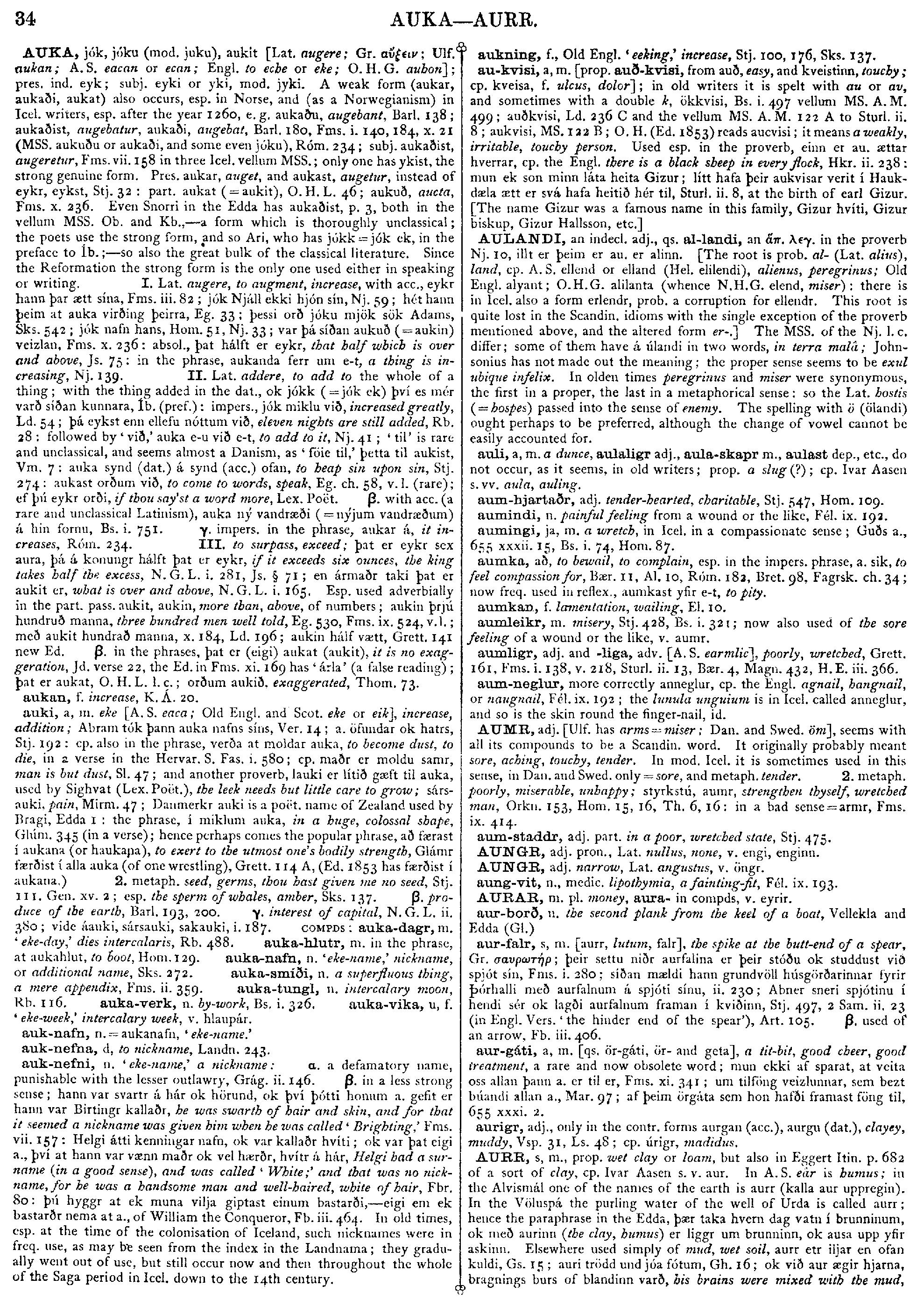
austr,
rs
and
rar,
m.
[ausa],
the
act
of
drawing
water
in
buckets,
pumping;
v.
dæluaustr
and
byttuaustr,
Grett.
ch.
19;
standa
í
austri,
to
toil
hard
at
the
pump,
Fas.
ii.
520,
Sturl.
iii.
68;
til
austrar,
Grett.
94
B.
 .
the
water
pumped
or
to
be
pumped,
bilge
water,
Gr.
GREEK,
Sturl.
iii.
67,
68;
skipið
fullt
af
austri,
full
of
bilge
water,
Fb.
ii.
204
(Fbr.),
Finnb.
234;
standa
í
a.,
v.
above.
COMPD:
austrs-ker,
austker
(N.
G.
L.
i.
59),
a
scoop,
pump-bucket
(cp.
ausker),
GÞl.
424.
.
the
water
pumped
or
to
be
pumped,
bilge
water,
Gr.
GREEK,
Sturl.
iii.
67,
68;
skipið
fullt
af
austri,
full
of
bilge
water,
Fb.
ii.
204
(Fbr.),
Finnb.
234;
standa
í
a.,
v.
above.
COMPD:
austrs-ker,
austker
(N.
G.
L.
i.
59),
a
scoop,
pump-bucket
(cp.
ausker),
GÞl.
424.
|
Source: Cleasby/Vigfusson, page b0034, entry 63 View original page image as: [TIFF] [PNG] [View previous entry] [View next entry] |
[Comment on this entry] [View comments] |
The following entry has been hand-corrected once. |
austr-mál, n. (navig.), the pumping-watch, the crew being told off two and two, to hand the buckets up, one of them standing in the bilge water down below and the other on deck, vide the Fbr. 131, Grett. ch. 19; en hverr Þeirra manna er síðar kemr en a. komi til hans, Þá er hann sekr níu ertogum, N. G. L. i. 335 [ausmaal, bilge water, Ivar Aasen].
|
Source: Cleasby/Vigfusson, page b0036, entry 11 View original page image as: [TIFF] [PNG] [View previous entry] [View next entry] |
[Comment on this entry] [View comments] |
The following entry has been hand-corrected once. |
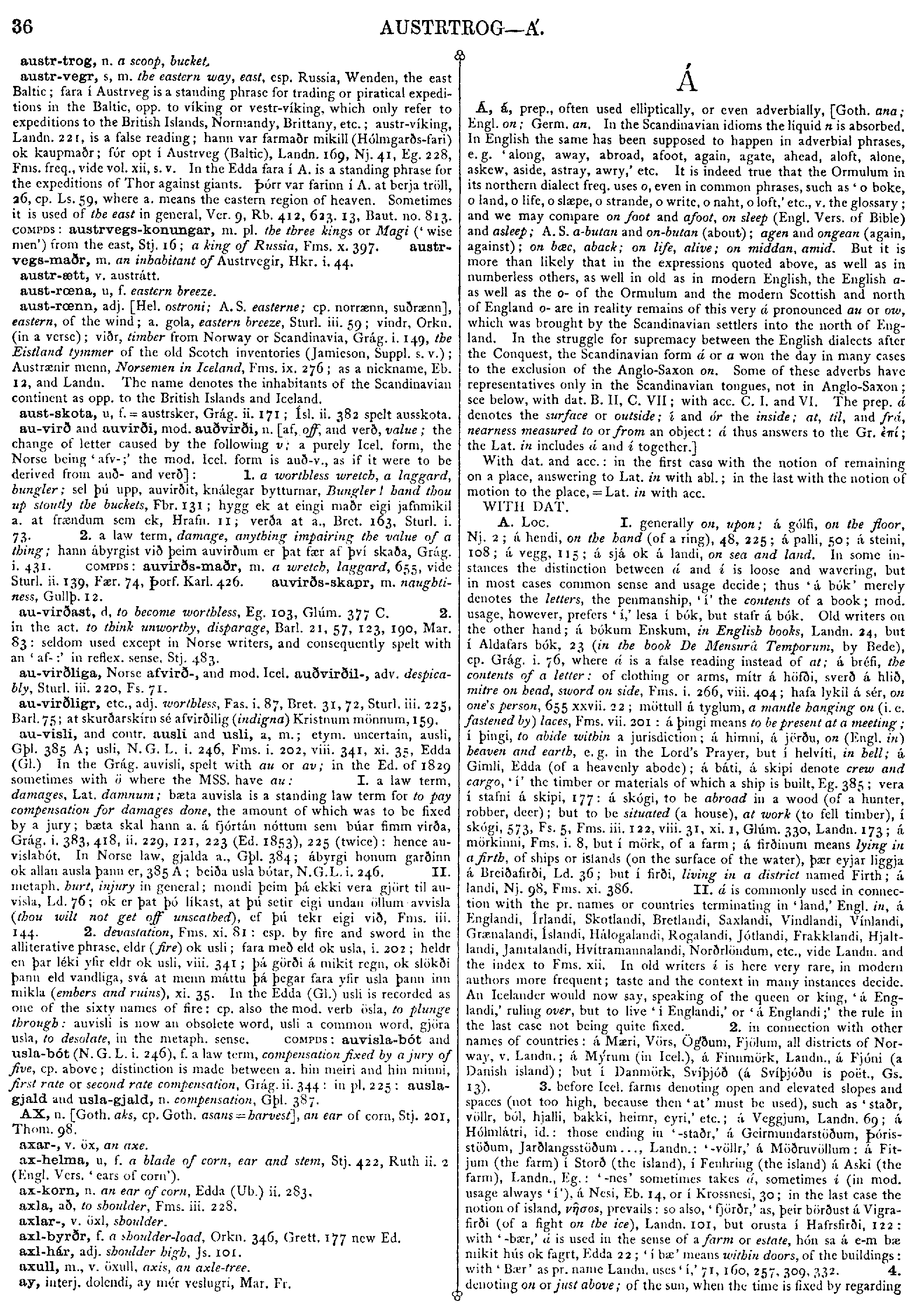
au-visli, and contr. ausli and usli, a, m.; etym. uncertain, ausli, Gþl. 385 A; usli, N. G. L. i. 246, Fms. i. 202, viii. 341, xi. 35, Edda (Gl.) In the Grág. auvisli, spelt with au or av; in the Ed. of 1829 sometimes with ö where the MSS. have au I. a law term, damages, Lat. damnum; bæta auvisla is a standing law term for to pay compensation for damages done, the amount of which was to be fixed by a jury; bæta skal hann a. á fjórtán nóttum sem búar fimm virða, Grág. i. 383, 418, ii. 229, 121, 223 (Ed. 1853), 225 (twice): hence auvislabót. In Norse law, gjalda a., Gþl. 384; ábyrgi honum garðinn ok allan ausla þann er, 385 A; beiða usla bótar, N. G. L. i. 246. II. metaph. hurt, injury in general; mondi þeim þá ekki vera gjört til auvisla, Ld. 76; ok er þat þó líkast, at þú setir eigi undan öllum avvisla (thou wilt not get off unscathed), ef þú tekr eigi við, Fms. iii. 144. 2. devastation, Fms. xi. 81: esp. by fire and sword in the alliterative phrase, eldr (fire) ok usli; fara með eld ok usla, i. 202; heldr en þar léki yfir eldr ok usli, viii. 341; þá görði á mikit regn, ok slökði þann eld vandliga, svá at menn máttu þá þegar fara yfir usla þann inn mikla (embers and ruins), xi. 35. In the Edda (Gl.) usli is recorded as one of the sixty names of fire: cp. also the mod. verb ösla, to plunge through: auvisli is now an obsolete word, usli a common word, gjöra usla, to desolate, in the metaph. sense. COMPDS: auvisla-bót and usla-bót (N. G. L. i. 246), f. a law term, compensation fixed by a jury of five, cp. above; distinction is made between a. hin meiri and hin minni, first rate or second rate compensation, Grág. ii. 344: in pl. 225: ausla-gjald and usla-gjald, n. compensation, Gþl. 387.
|
Source: Cleasby/Vigfusson, page b0036, entry 23 View original page image as: [TIFF] [PNG] [View previous entry] [View next entry] |
[Comment on this entry] [View comments] |
The following entry has been hand-corrected once. |
Á, á, prep., often used elliptically, or even adverbially, [Goth, ana; Engl. on; Germ. an. In the Scandinavian idioms the liquid n is absorbed. In English the same has been supposed to happen in adverbial phrases, e. g. 'along, away, abroad, afoot, again, agate, ahead, aloft, alone, askew, aside, astray, awry,' etc. It is indeed true that the Ormulum in its northern dialect freq. uses o, even in common phrases, such as 'o boke, o land, o life, o slæpe, o strande, o write, o naht, o loft,' etc., v. the glossary; and we may compare on foot and afoot, on sleep (Engl. Vers. of Bible) and asleep; A. S. a-butan and on-butan (about); agen and ongean (again, against); on bæc, aback; on life, alive; on middan, amid. But it is more than likely that in the expressions quoted above, as well as in numberless others, as well in old as in modern English, the English a- as well as the o- of the Ormulum and the modern Scottish and north of England o- are in reality remains of this very á pronounced au or ow, which was brought by the Scandinavian settlers into the north of England. In the struggle for supremacy between the English dialects after the Conquest, the Scandinavian form á or a won the day in many cases to the exclusion of the Anglo-Saxon on. Some of these adverbs have representatives only in the Scandinavian tongues, not in Anglo-Saxon; see below, with dat. B. II, C. VII; with acc. C. I. and VI. The prep. á denotes the surface or outside; í and ór the inside; at, til, and frá, nearness measured to or from an object: á thus answers to the Gr. GREEK the Lat. in includes á and i together.]
|
Source: Cleasby/Vigfusson, page b0037, entry 3 View original page image as: [TIFF] [PNG] [View previous entry] [View next entry] |
[Comment on this entry] [View comments] |
The following entry has been hand-corrected once. |
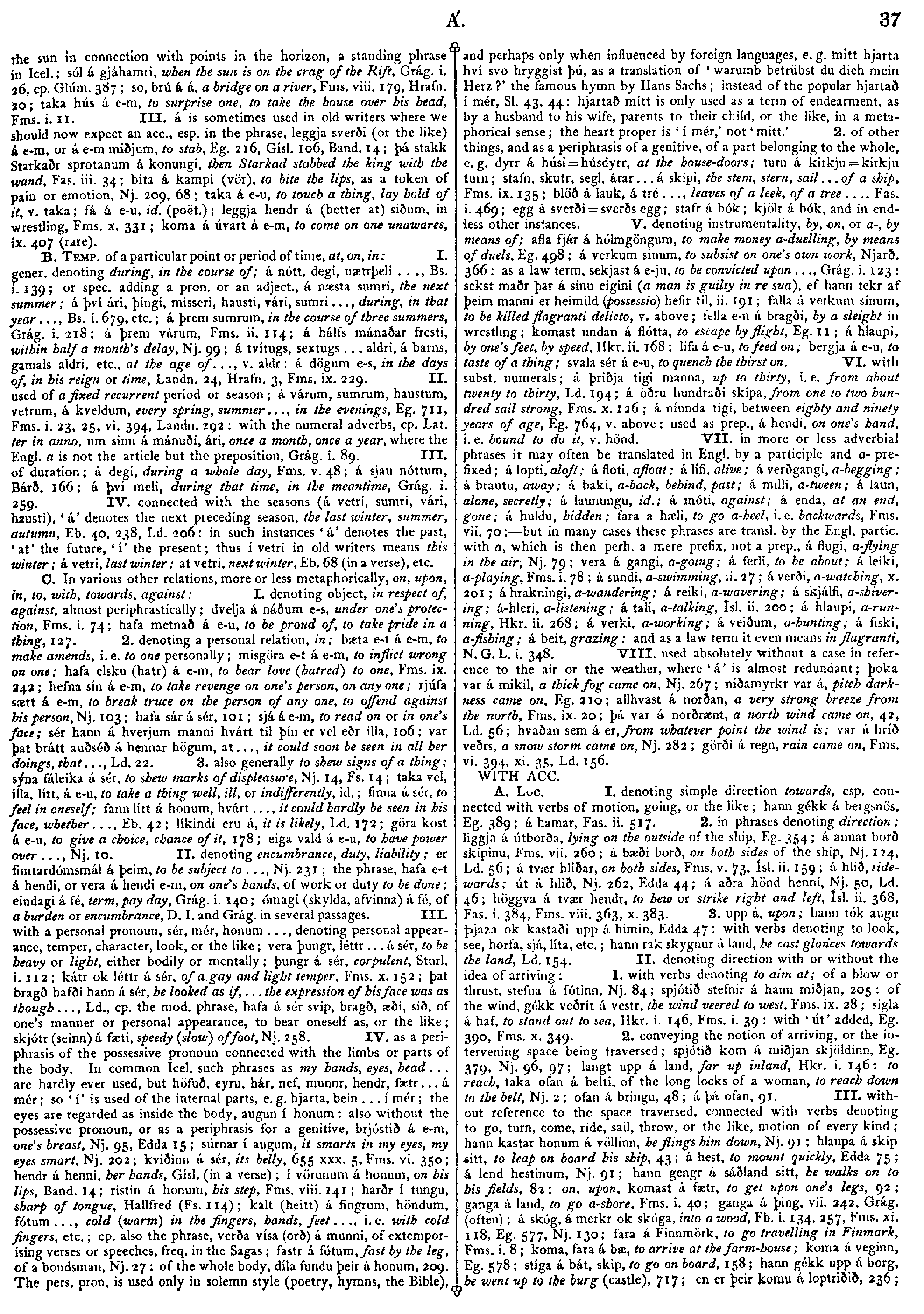
C. In various other relations, more or less metaphorically, on, upon, in, to, with, towards, against: I. denoting object, in respect of, against, almost periphrastically; dvelja á náðum e-s, under one's protection, Fms. i. 74; hafa metnað á e-u, to be proud of, to take pride in a thing, 127. 2. denoting a personal relation, in; bæta e-t á e-m, to make amends, i.e. to one personally; misgöra e-t á e-m, to inflict wrong on one; hafa elsku (hatr) á e-m, to bear love (hatred) to one, Fms. ix. 242; hefna sín á e-m, to take revenge on one's person, on anyone; rjúfa sætt á e-m, to break truce on the person of any one, to offend against his person, Nj. 103; hafa sár á sér, 101; sjá á e-m, to read on or in one's face; sér hann á hverjum manni hvárt til þín er vel eðr illa, 106; var þat brátt auðséð á hennar högum, at ..., it could soon be seen in all her doings, that ..., Ld. 22. 3. also generally to shew signs of a thing; sýna fáleika á sér, to shew marks of displeasure, Nj. 14, Fs. 14; taka vel, illa, lítt, á e-u, to take a thing well, ill, or indifferently, id.; finna á sér, to feel in oneself; fann lítt á honum, hvárt ..., it could hardly be seen in his face, whether ..., Eb. 42; líkindi eru á, it is likely, Ld. 172; göra kost á e-u, to give a choice, chance of it, 178; eiga vald á e-u, to have power over ..., Nj. 10. II. denoting encumbrance, duty, liability; er fimtardómsmál á þeim, to be subject to ..., Nj. 231; the phrase, hafa e-t á hendi, or vera á hendi e-m, on one's hands, of work or duty to be done; eindagi á fé, term, pay day, Grág. i. 140; ómagi (skylda, afvinna) á fé, of a burden or encumbrance, D. I. and Grág. in several passages. III. with a personal pronoun, sér, mér, honum ..., denoting personal appearance, temper, character, look, or the like; vera þungr, léttr ... á sér, to be heavy or light, either bodily or mentally; þungr á sér, corpulent, Sturl. i. 112; kátr ok léttr á sér, of a gay and light temper, Fms. x. 152; þat bragð hafði hann á sér, he looked as if, ... the expression of his face was as though ..., Ld., cp. the mod. phrase, hafa á sér svip, bragð, æði, sið, of one's manner or personal appearance, to bear oneself as, or the like; skjótr (seinn) á fæti, speedy (slow) of foot, Nj. 258. IV. as a periphrasis of the possessive pronoun connected with the limbs or parts of the body. In common Icel. such phrases as my hands, eyes, head ... are hardly ever used, but höfuð, eyru, hár, nef, munnr, hendr, faetr ... á mér; so 'í' is used of the internal parts, e.g. hjarta, bein ... í mér; the eyes are regarded as inside the body, augun í honum: also without the possessive pronoun, or as a periphrasis for a genitive, brjóstið á e-m, one's breast, Nj. 95, Edda 15; súrnar í augum, it smarts in my eyes, my eyes smart, Nj. 202; kviðinn á sér, its belly, 655 xxx. 5, Fms. vi. 350; hendr á henni, her hands, Gísl. (in a verse); í vörunum á honum, on his lips, Band. 14; ristin á honum, his step, Fms. viii. 141; harðr í tungu, sharp of tongue, Hallfred (Fs. 114); kalt (heitt) á fingrum, höndum, fótum ..., cold (warm) in the fingers, hands, feet ..., i.e. with cold fingers, etc.; cp. also the phrase, verða vísa (orð) á munni, of extemporising verses or speeches, freq. in the Sagas; fastr á fótum, fast by the leg, of a bondsman, Nj. 27: of the whole body, díla fundu þeir á honum, 209. The pers. pron. is used only in solemn style (poetry, hymns, the Bible), and perhaps only when influenced by foreign languages, e.g. mitt hjarta hví svo hryggist þú, as a translation of 'warumb betrübst du dich mein Herz?' the famous hymn by Hans Sachs; instead of the popular hjartað í mér, Sl. 43, 44: hjartað mitt is only used as a term of endearment, as by a husband to his wife, parents to their child, or the like, in a metaphorical sense; the heart proper is 'í mér,' not 'mitt.' 2. of other things, and as a periphrasis of a genitive, of a part belonging to the whole, e.g. dyrr á husi = húsdyrr, at the house-doors; turn á kirkju = kirkju turn; stafn, skutr, segl, árar ... á skipi, the stem, stern, sail ... of a ship, Fms. ix. 135; blöð á lauk, á tré ..., leaves of a leek, of a tree ..., Fas. i. 469; egg á sverði = sverðs egg; stafr á bók; kjölr á bók, and in endless other instances. V. denoting instrumentality, by, on, or a-, by means of; afla fjár á hólmgöngum, to make money a-duelling, by means of duels, Eg. 498; á verkum sínum, to subsist on one's own work, Njarð. 366: as a law term, sekjast á e-ju, to be convicted upon ..., Grág. i. 123; sekst maðr þar á sínu eigini (a man is guilty in re sua), ef hann tekr af þeim manni er heimild (possessio) hefir til, ii. 191; falla á verkum sínum, to be killed flagranti delicto, v. above; fella e-n á bragði, by a sleight in wrestling; komast undan á flótta, to escape by flight, Eg. 11; á hlaupi, by one's feet, by speed, Hkr. ii. 168; lifa á e-u, to feed on; bergja á e-u, to taste of a thing; svala sér á e-u, to quench the thirst on. VI. with subst. numerals; á þriðja tigi manna, up to thirty, i.e. from about twenty to thirty, Ld. 194; á öðru hundraði skipa, from one to two hundred sail strong, Fms. x. 126; á níunda tigi, between eighty and ninety years of age, Eg. 764, v. above: used as prep., á hendi, on one's hand, i.e. bound to do it, v. hönd. VII. in more or less adverbial phrases it may often be translated in Engl. by a participle and a- prefixed; á lopti, aloft; á floti, afloat; á lífi, alive; á verðgangi, a-begging; á brautu, away; á baki, a-back, behind, past; á milli, a-tween; á laun, alone, secretly; á launungu, id.; á móti, against; á enda, at an end, gone; á huldu, hidden; fara á hæli, to go a-heel, i.e. backwards, Fms. vii. 70; -- but in many cases these phrases are transl. by the Engl. partic. with a, which is then perh. a mere prefix, not a prep., á flugi, a-flying in the air, Nj. 79; vera á gangi, a-going; á ferli, to be about; á leiki, a-playing, Fms. i. 78; á sundi, a-swimming, ii. 27; á verði, a-watching, x. 201; á hrakningi, a-wandering; á reiki, a-wavering; á skjálfi, a-shivering; á-hleri, a-listening; á tali, a-talking, Ísl. ii. 200; á hlaupi, a-running, Hkr. ii. 268; á verki, a-working; á veiðum, a-hunting; á fiski, a-fishing; á beit, grazing: and as a law term it even means in flagranti, N. G. L. i. 348. VIII. used absolutely without a case in reference to the air or the weather, where 'á' is almost redundant; þoka var á mikil, a thick fog came on, Nj. 267; niðamyrkr var á, pitch darkness came on, Eg. 210; allhvast á norðan, a very strong breeze from the north, Fms. ix. 20; þá var á norðrænt, a north wind came on, 42, Ld. 56; hvaðan sem á er, from whatever point the wind is; var á hríð veðrs, a snow storm came on, Nj. 282; görði á regn, rain came on, Fms. vi. 394, xi. 35, Ld. 156.
|
Source: Cleasby/Vigfusson, page b0039, entry 1 View original page image as: [TIFF] [PNG] [View previous entry] [View next entry] |
[Comment on this entry] [View comments] |
The following entry has not been hand-corrected. However, the page is reserved and someone is correcting it. |
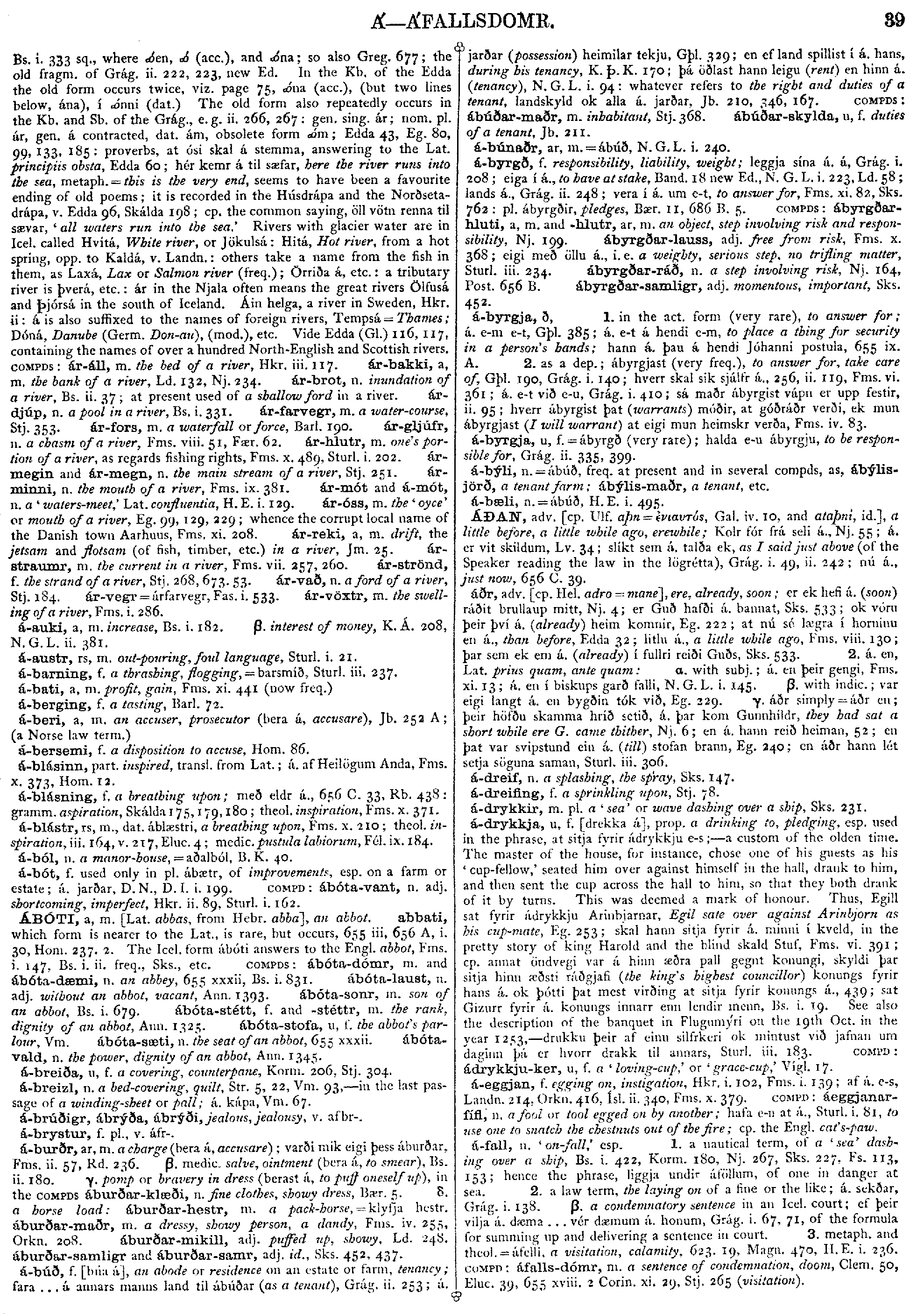
Bs. i. 333 sq., where den, ai (acc.), and tona; so also Greg. 677; the old fragm. of Grág. ii. 222, 223, new Ed. In the Kb. of the Edda the old form occurs twice, viz. page 75) *ona (acc.), (but two lines below, ána), í cónni (dat.) The old form also repeatedly occurs in the Kb. and Sb. of the Grág., e. g. ii. 266, 267: gen. sing, ár; nom. pi ar, gen. á contracted, dat. am, obsolete form com; Edda 43, Eg. 80, 99i ifå' l&5 '• proverbs, at ósi skal á stemma, answering to the Lat. principiis obsta, Edda 60; her kemr á til sæfar, here the riverrun s int o the s ea, metaph. = thi s is the very end, seems to have been a favourite ending of old poems; it is recorded in the Húsdrápa and the Norðseta- drápa, v. Edda 96, Skálda 198; cp. the common saying, oil vötn renna til sævar, ' all waters run into ike sea, ' Rivers with glacier water are in Icel. called Hvítá, White river, or Jökulsá: Hitá, Hot river, from a hot spring, opp. to Kaldá, v. Landn.: others take a name from the fish in them, as Laxá, Lax or Salmon river (freq.); Örriða á, etc.: a tributary river is þverá, etc.: ár in the Njala often means the great rivers Ölfusá and Þjórsá in the south of Iceland. Áin helga, a river in Sweden, Hkr. ii: á is also suffixed to the names of foreign rivers, Tempsá = Thames; Dóná, Danube (Germ. Don-au), (mod.), etc. Vide Edda (Gl.) 116, 117, containing the names of over a hundred North-English and Scottish rivers. COMPDS: ár-áll, m. tie bed of a river, Hkr. iii. 117. ar-bakki, a, m. the bank of a river, Ld. 132, Nj. 234. ar-brot, n. inundation of a river, Bs. ii. 37; at present used of a s hallow ford in a river. ar- djúp, n. a pool in a river, Bs. i. 331. ar-farvegr, m. a water-course, Stj. 353- ar-fors, m. a waterfall or force, Bad. 190. ár-gljúfr, n. a chasm of a river, Fms. viii. 51, Fær. 62. ár-hlutr, m. one's por- tion of a river, as regards fishing rights, Fms. x. 489, Sturl. i. 202. ár- megin and ar-megn, n. the ma in stream of a river, Stj. 251. ár- minni, n. the mouth of a river, Fms. ix. 381. ár-mót and á-mót, n. a ' waters-meet, ' Lat. cottfluentia, H. E. i. 129. ár-óss, m. the ' oyce' or mouth of a river, Eg. 99, 129, 229; whence the corrupt local name of the Danish town Aarhuus, Fms. xi. 208. ar-reki, a, m. drift, the jetsam and flotsam (of fish, timber, etc.) in a river, Jm. 25. ár- straumr, m. the current in n river, Fms. vii. 257, 260. ár-strönd, f. the strand of a river, Stj. 268, 673. 53. ár-vað, n. aford of a river, Stj. 184. ár-vegr = árfarvegr, Fas. i. 533. ár-vöxtr, m. the swell- ing of a river, Fms. i. 286.
|
Source: Cleasby/Vigfusson, page b0039, entry 20 View original page image as: [TIFF] [PNG] [View previous entry] [View next entry] |
[Comment on this entry] [View comments] |
The following entry has not been hand-corrected. However, the page is reserved and someone is correcting it. |
á-búð, f. [búa á], an abode or residence on an estate or farm, tenancy; fara ... a, annars manns land til ábúðar (as a tenant), Grág. ii. 253; a. jarðar (possession) heimilar tekju, Gþl. 329; en ef land spillist í a. hans, during his tenancy, K. Þ. K. 170; þá oðlast harm leigu (rent) en hinn á. (tenancy), N. G. L. i. 94: whatever refers to the ri g' ht and duties of a tenant, landskyld ok alla á. jarðar, Jb. 210, 346, 167. COMPDS: ábúðar-maðr, m. inhabitant, Stj. 368. ábúðar-skylda, u, f. dutie s of a tenant, Jb. 211.
|
Source: Cleasby/Vigfusson, page b0039, entry 32 View original page image as: [TIFF] [PNG] [View previous entry] [View next entry] |
[Comment on this entry] [View comments] |
The following entry has not been hand-corrected. However, the page is reserved and someone is correcting it. |
a-drykkja, u, f. [drekka á], prop, a drinking to, pledging, esp. used n the phrase, at sitja fyrir ádrykkju e-s; -- a custom of the olden time. The master of the house, for instance, chose one of his guests as his cup-fellow, ' seated him over against himself in the hall, drank to him, and then sent the cup across the hall to him, so that they both drank of it by turns. This was deemed a mark of honour. Thus, Egill at fyrir ádrykkju Arinbiarnar, Egil sale over against Arinbjorn as his cup-mate, Eg. 253; skal hann sitja fyrir á. minni í kveld, in the pretty story of king Harold and the blind skald Stuf, Fms. vi. 391; :p. annat öndvegi var á hinn æðra pall gegnt konungi, skyldi þar itja hinn æðsti ráðgjafi (the king's highest councillor) konungs fyrir hans á. ok þótti þat mest virðing at sitja fyrir konungs á., 439; sat izurr fyrir á. konungs innarr enn lendir menn, Bs. i. 19. See also the description of the banquet in Flugumyri on the 19th Oct. in the year 1253, -- drukku þeir af t-inu silfrkcri ok mintust við jafnan um daginn þá er hvorr drakk til annars, Sturl. iii. 183. COMPD: ádrykkju-ker, u, f. a 'loving-cup, ' or 'gracc-cup, ' Vígl. 17.
|
Source: Cleasby/Vigfusson, page b0040, entry 5 View original page image as: [TIFF] [PNG] [View previous entry] [View next entry] |
[Comment on this entry] [View comments] |
The following entry has not been hand-corrected. However, the page is reserved and someone is correcting it. |
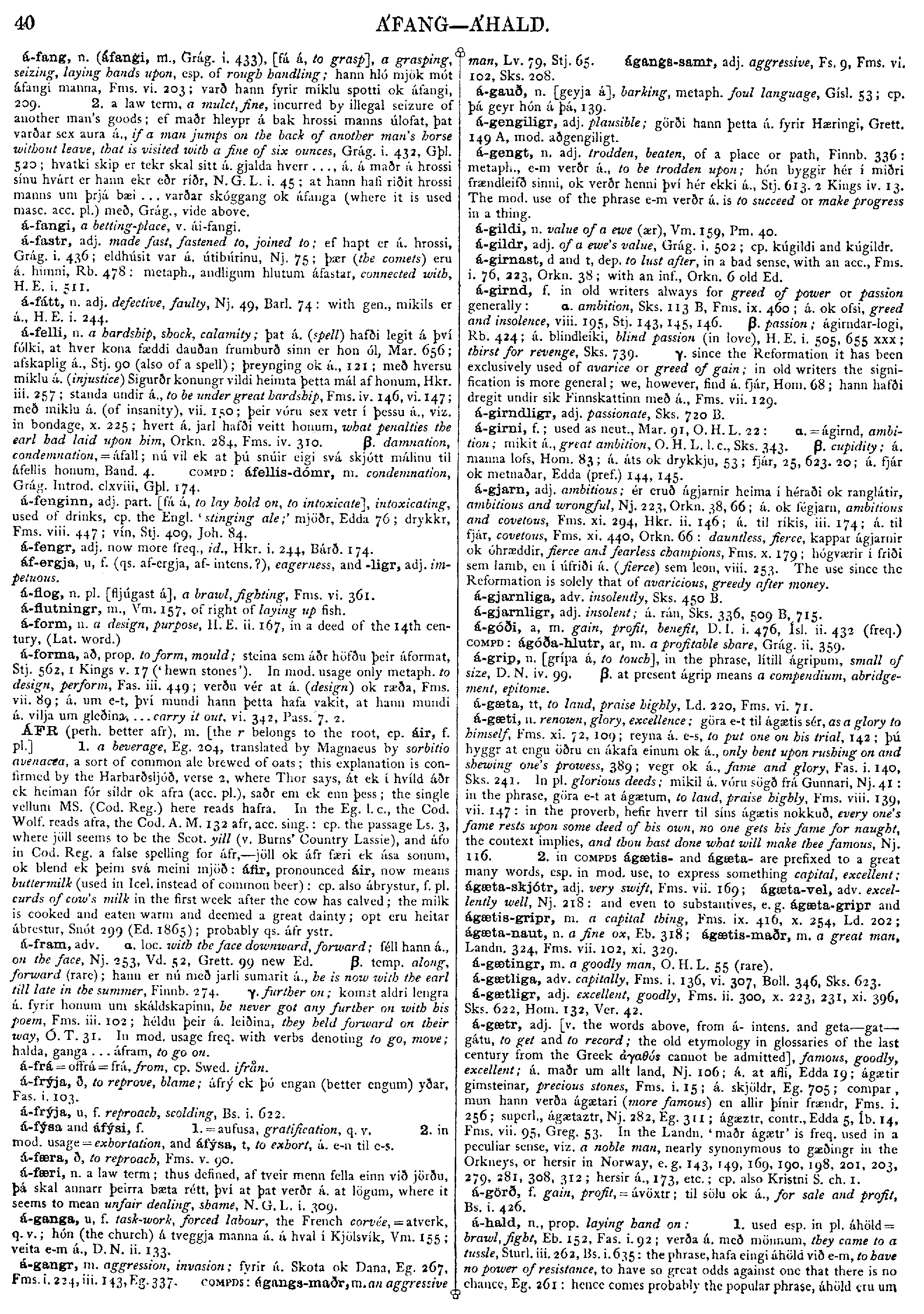
a-felli, n. a hardship, shock, calamity; þat á. (spell) hafði legit á því fólki, at hver kona fseddi dauðan frurnburð sinn er hon ol, Mar. 656; afskaplig á., Stj. 90 (also of a spell); þreynging ok á., 121; með hversu miklu á. (injustice) Sigurðr konungr vildi heimta þetta mál af honum, Hkr. iii. 257; standa undir a., to be wider great lordship, Fms. iv. 146, vi. 147; með miklu á. (of insanity), vii. i. ^o; þeir vóru sex vetr í þessu á., viz. in bondage, x. 225; hvert á. jarl hafði veitt honum, what penalties the earl bad laid upon him, Orkn. 284, Fms. iv. 310. |3. damnation, condemnation, = afall; nu vil ek at þú sniíir eigi svá skjótt málinu til áfellis honum, Band. 4. COMPD: áfellis-dómr, m. condemnation, Grág. Introd. clxviii, Gþl. 174.
|
Source: Cleasby/Vigfusson, page b0040, entry 18 View original page image as: [TIFF] [PNG] [View previous entry] [View next entry] |
[Comment on this entry] [View comments] |
The following entry has not been hand-corrected. However, the page is reserved and someone is correcting it. |
a-fysa and áfýsi, f. l. = aufusa, gratification, q. v. 2. in mod. usage = exhortation, and áfýsa, t, to exhort, á. e-n til e-s.
| Result Page: |  |
Previous | 4 5 6 7 8 9 10 11 12 13 14 15 16 17 18 19 20 21 22 | Next |  |
Germanic Lexicon Project (main page)
This search system was written by
Sean Crist
Please consider
volunteering
to correct the data in these online dictionaries.
No rights reserved. Feel free to use these data in any way you please.