|
|

Tip: In the search results, you can click on any word or abbreviation for more information.
|
Source: Cleasby/Vigfusson, page b0308, entry 2 View original page image as: [TIFF] [PNG] [View previous entry] [View next entry] |
[Comment on this entry] [View comments] |
The following entry has been hand-corrected once. |
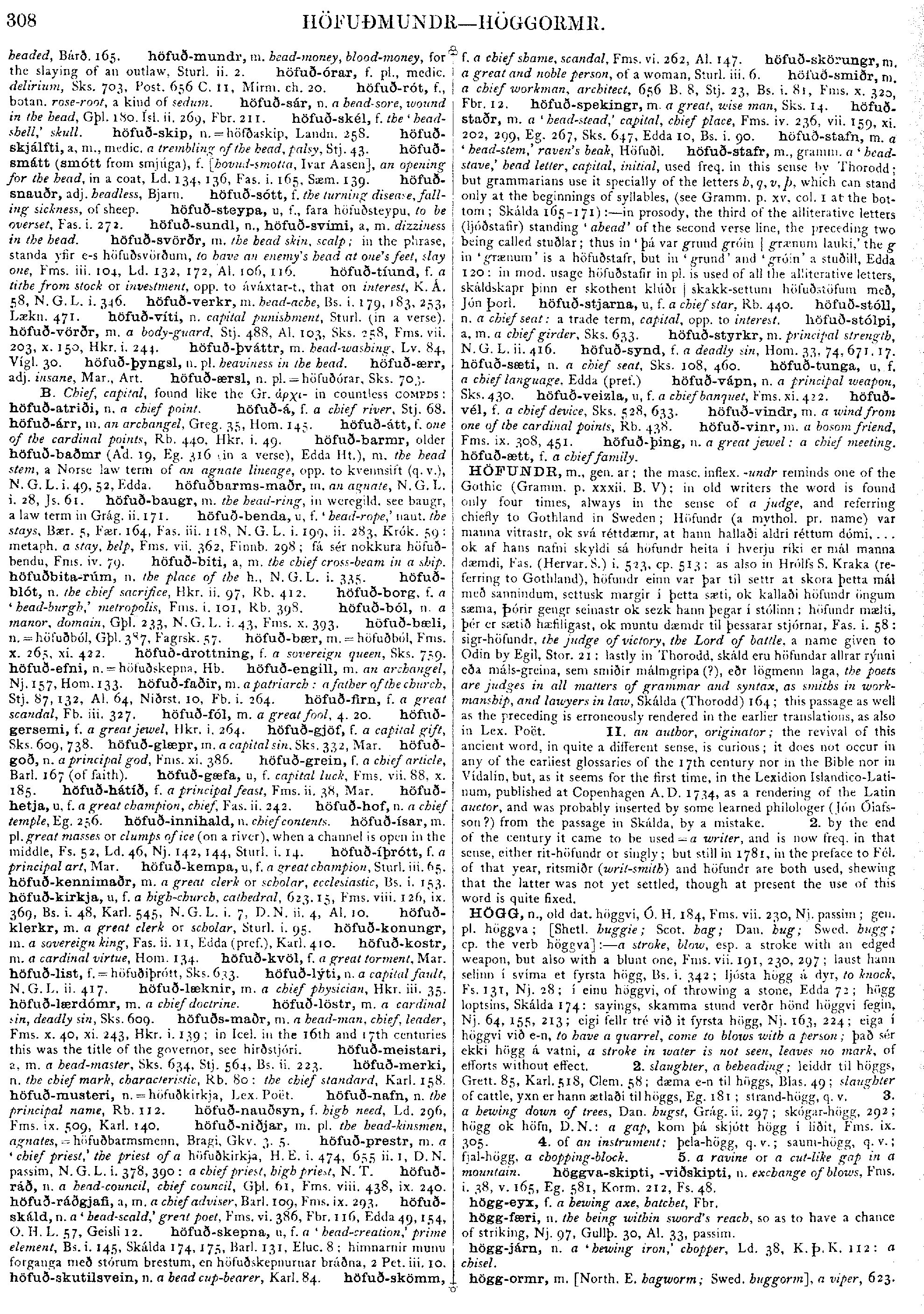
B. Chief, capital, found like the Gr. GREEK in countless COMPDS: höfuð-atriði, n. a chief point. höfuð-á, f. a chief river, Stj. 68. höfuð-árr, m. an archangel, Greg. 35, Hom. 145. höfuð-átt, f. one of the cardinal points, Rb. 440, Hkr. i. 49. höfuð-barmr, older höfuð-baðmr (Ad. 19, Eg. 316 (in a verse), Edda Ht.), m. the head stem, a Norse law term of an agnate lineage, opp. to kvennsift (q.v.), N. G. L. i. 49, 52, Edda. höfuðbarms-maðr, m. an agnate, N. G. L. i. 28, Js. 61. höfuð-baugr, m. the head-ring, in weregild. see baugr, a law term in Grág. ii. 171. höfuð-benda, u, f. 'head-rope' naut. the stays, Bær. 5, Fær. 164, Fas. iii. 118, N. G. L. i. 199, ii. 283, Krók. 59: metaph. a stay, help, Fms. vii. 362, Finnb. 298; fá sér nokkura höfuðbendu, Fms. iv. 79. höfuð-biti, a, m. the chief cross-beam in a ship. höfuðbita-rúm, n. the place of the h., N. G. L. i. 335. höfuð-blót, n. the chief sacrifice, Hkr. ii. 97, Rb. 412. höfuð-borg, f. a 'head-burgh,' metropolis, Fms. i. 101, Rb. 398. höfuð-ból, n. a manor, domain, Gþl. 233, N. G. L. i. 43, Fms. x. 393. höfuð-bæli, n. = höfuðból, Gþl. 387, Fagrsk. 57. höfuð-bær, m. = höfuðbúl, Fms. x. 265, xi. 422. höfuð-drottning, f. a sovereign queen, Sks. 759. höfuð-efni, n. = höfuðskepna, Hb. höfuð-engill, m. an archangel, Nj. 157, Hom. 133. höfuð-faðir, m. a patriarch: a father of the church, Stj. 87, 132, Al. 64, Niðrst. 10, Fb. i. 264. höfuð-firn, f. a great scandal, Fb. iii. 327. höfuð-fól, m. a great fool, 4. 20. höfuð-gersemi, f. a great jewel, Hkr. i. 264. höfuð-gjöf, f. a capital gift, Sks. 609, 738. höfuð-glæpr, m. a capital sin, Sks. 332, Mar. höfuð-goð, n. a principal god, Fms. xi. 386. höfuð-grein, f. a chief article, Barl. 167 (of faith). höfuð-gæfa, u, f. capital luck, Fms. vii. 88, x. 185. höfuð-hátíð, f. a principal feast, Fms. ii. 38, Mar. höfuð-hetja, u, f. a great champion, chief, Fas. ii. 242. höfuð-hof, n. a chief temple, Eg. 256. höfuð-innihald, n. chief contents. höfuð-ísar, m. pl. great masses or clumps of ice (on a river), when a channel is open in the middle, Fs. 52, Ld. 46, Nj. 142, 144, Sturl. i. 14. höfuð-íþrótt, f. a principal art, Mar. höfuð-kempa, u, f. a great champion, Sturl. iii. 65. höfuð-kennimaðr, m. a great clerk or scholar, ecclesiastic, Bs. i. 153. höfuð-kirkja, u, f. a high-church, cathedral, 623. 15, Fms. viii. 126, ix. 369, Bs. i. 48, Karl. 545, N. G. L. i. 7, D. N. ii. 4, Al. 10. höfuð-klerkr, m. a great clerk or scholar, Sturl. i. 95. höfuð-konungr, m. a sovereign king, Fas. ii. 11, Edda (pref.), Karl. 410. höfuð-kostr, m. a cardinal virtue, Hom. 134. höfuð-kvöl, f. a great torment, Mar. höfuð-list, f. = höfuðiþrótt, Sks. 633. höfuð-lýti, n. a capital fault, N. G. L. ii. 417. höfuð-læknir, m. a chief physician, Hkr. iii. 35. höfuð-lærdómr, m. a chief doctrine. höfuð-löstr, m. a cardinal sin, deadly sin, Sks. 609. höfuðs-maðr, m. a head-man, chief, leader, Fms. x. 40, xi. 243, Hkr. i. 139; in Icel. in the 16th and 17th centuries this was the title of the governor, see hirðstjóri. höfuð-meistari, a, m. a head-master, Sks. 634, Stj. 564, Bs. ii. 223. höfuð-merki, n. the chief mark, characteristic, Rb. 80: the chief standard, Karl. 158. höfuð-musteri, n. = höfuðkirkja, Lex. Poët. höfuð-nafn, n. the principal name, Rb. 112. höfuð-nauðsyn, f. high need, Ld. 296, Fms. ix. 509, Karl. 140. höfuð-niðjar, m. pl. the head-kinsmen, agnates, = hofuðbarmsmenn, Bragi, Gkv. 3. 5. höfuð-prestr, m. a 'chief priest,' the priest of a höfuðkirkja, H. E. i. 474, 655 ii. 1, D. N. passim, N. G. L. i. 378, 390: a chief priest, high priest, N. T. höfuð-ráð, n. a head-council, chief council, Gþl. 6l, Fms. viii. 438, ix. 240. höfuð-ráðgjafi, a, m. a chief adviser, Barl. 109, Fms. ix. 293. höfuð-skáld, n. a 'head-scald,' great poet, Fms. vi. 386, Fbr. 116, Edda 49, 154, O. H. L. 57, Geisli 12. höfuð-skepna, u, f. a 'head-creation,' prime element, Bs. i. 145, Skálda 174, 175, Barl. 131, Eluc. 8; himnarnir munu forganga með stórum brestum, en höfuðskepnurnar bráðna, 2 Pet. iii. 10. höfuð-skutilsvein, n. a head cup-bearer, Karl. 84. höfuð-skömm, f. a chief shame, scandal, Fms. vi. 262, Al. 147. höfuð-skörungr, m. a great and noble person, of a woman, Sturl. iii. 6. höfuð-smiðr, m. a chief workman, architect, 656 B. 8, Stj. 23, Bs. i. 81, Fms. x. 320, Fbr. 12. höfuð-spekingr, m. a great, wise man, Sks. 14. höfuð-staðr, m. a 'head-stead,' capital, chief place, Fms. iv. 236, vii. 159, xi. 202, 299, Eg. 267, Sks. 647, Edda 10, Bs. i. 90. höfuð-stafn, m. a 'head-stem,' raven's beak, Höfuðl. höfuð-stafr, m., gramm. a 'head-stave,' head letter, capital, initial, used freq. in this sense by Thorodd: but grammarians use it specially of the letters h, q, v, þ, which can stand only at the beginnings of syllables, (see Gramm. p. xv, col. 1 at the bottom; Skálda 165-171) :-- in prosody, the third of the alliterative letters (ljóðstafir) standing 'ahead' of the second verse line, the preceding two being called stuðlar; thus in 'þá var grund groin | grænum lauki,' the g in 'grænum' is a höfuðstafr, but in 'grund' and 'gróin' a stuðill, Edda 120: in mod. usage höfuðstafir in pl. is used of all the alliterative letters, skáldskapr þinn er skothent klúðr | skakk-settum höfuðstöfum með, Jón Þorl. höfuð-stjarna, u, f. a chief star, Rb. 440. höfuð-stóll, n. a chief seat: a trade term, capital, opp. to interest. höfuð-stólpi, a, m. a chief girder, Sks. 633. höfuð-styrkr, m. principal strength, N. G. L. ii. 416. höfuð-synd, f. a deadly sin, Hom. 33, 74, 671. 17. höfuð-sæti, n. a chief seat, Sks. 108, 460. höfuð-tunga, u, f. a chief language, Edda (pref.) höfuð-vápn, n. a principal weapon, Sks. 430. höfuð-veizla, u, f. a chief banquet, Fms. xi. 422. höfuð-vél, f. a chief device, Sks. 528, 633. höfuð-vindr, m. a wind from one of the cardinal points, Rb. 438. höfuð-vinr, m. a bosom friend, Fms. ix. 308, 451. höfuð-þing, n. a great jewel: a chief meeting. höfuð-ætt, f. a chief family.
|
Source: Cleasby/Vigfusson, page b0312, entry 23 View original page image as: [TIFF] [PNG] [View previous entry] [View next entry] |
[Comment on this entry] [View comments] |
The following entry has been hand-corrected once. |
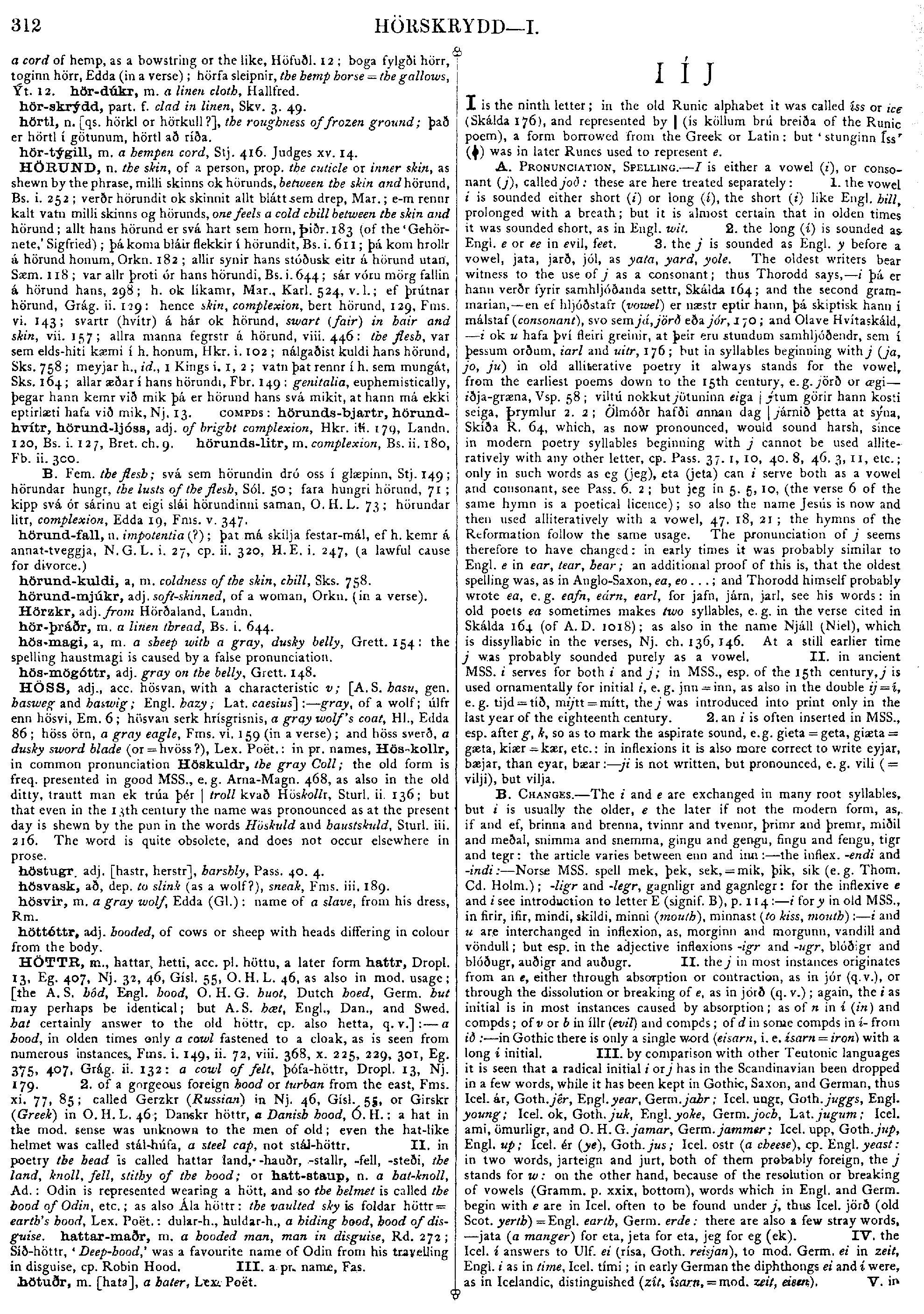
A. PRONUNCIATION, SPELLING. -- I is either a vowel (i), or consonant (j), called joð: these are here treated separately: 1. the vowel i is sounded either short (i) or long (í), the short (i) like Engl. hill, prolonged with a breath; but it is almost certain that in olden times it was sounded short, as in Engl. wit. 2. the long (í) is sounded as Engl. e or ee in evil, feet. 3. the j is sounded as Engl. y before a vowel, jata, jarð, jól, as yata, yard, yole. The oldest writers bear witness to the use of j as a consonant; thus Thorodd says, -- i þá er hann verðr fyrir samhljóðanda settr, Skálda 164; and the second grammarian, -- en ef hljóðstafr (vowel) er næstr eptir hann, þá skiptisk hann í málstaf (consonant), svo sem já, jörð eða jór, 170; and Olave Hvítaskáld, -- i ok u hafa því fleiri greinir, at þeir eru stundum samhljóðendr, sem í þessum orðum, iarl and uitr, 176; but in syllables beginning with j (ja, jo, ju) in old alliterative poetry it always stands for the vowel, from the earliest poems down to the 15th century, e.g. jörð or ægi -- iðja-græna, Vsp. 58; viltú nokkut jötuninn eiga | ýtum görir hann kosti seiga, Þrymlur 2. 2; Ölmóðr hafði annan dag | járnið þetta at sýna, Skíða R. 64, which, as now pronounced, would sound harsh, since in modern poetry syllables beginning with j cannot be used alliteratively with any other letter, cp. Pass. 37. 1, 10, 40. 8, 46. 3, 11, etc.; only in such words as eg (jeg), eta (jeta) can i serve both as a vowel and consonant, see Pass. 6. 2; but jeg in 5. 5, 10, (the verse 6 of the same hymn is a poetical licence); so also the name Jesús is now and then used alliteratively with a vowel, 47. 18, 21; the hymns of the Reformation follow the same usage. The pronunciation of j seems therefore to have changed: in early times it was probably similar to Engl. e in ear, tear, hear; an additional proof of this is, that the oldest spelling was, as in Anglo-Saxon, ea, eo ...; and Thorodd himself probably wrote ea, e.g. eafn, eárn, earl, for jafn, járn, jarl, see his words: in old poets ea sometimes makes two syllables, e.g. in the verse cited in Skálda 164 (of A.D. 1018); as also in the name Njáll (Niel), which is dissyllabic in the verses, Nj. ch. 136, 146. At a still earlier time j was probably sounded purely as a vowel. II. in ancient MSS. i serves for both i and j; in MSS., esp. of the 15th century, j is used ornamentally for initial i, e.g. jnn = inn, as also in the double ij = í, e.g. tijd = tíð, mijtt = mítt, the j was introduced into print only in the last year of the eighteenth century. 2. an i is often inserted in MSS., esp. after g, k, so as to mark the aspirate sound, e.g. gieta = geta, giæta = gæta, kiær = kær, etc.: in inflexions it is also more correct to write eyjar, bæjar, than eyar, bæar :-- ji is not written, but pronounced, e.g. vili ( = vilji), but vilja.
|
Source: Cleasby/Vigfusson, page b0312, entry 24 View original page image as: [TIFF] [PNG] [View previous entry] [View next entry] |
[Comment on this entry] [View comments] |
The following entry has been hand-corrected once. |
B. CHANGES. -- The i and e are exchanged in many root syllables, but i is usually the older, e the later if not the modern form, as, if and ef, brinna and brenna, tvinnr and tvennr, þrimr and þremr, miðil and meðal, snimma and snemma, gingu and gengu, fingu and fengu, tigr and tegr: the article varies between enn and inn :-- the inflex. -endi and -indi :-- Norse MSS. spell mek, þek, sek, = mik, þik, sik (e.g. Thom. Cd. Holm.); -ligr and -legr, gagnligr and gagnlegr: for the inflexive e and i see introduction to letter E (signif. B), p. 114 :-- i for y in old MSS., in firir, ifir, mindi, skildi, minni (mouth), minnast (to kiss, mouth) :-- i and u are interchanged in inflexion, as, morginn and morgunn, vandill and vöndull; but esp. in the adjective inflexions - igr and -ugr, blóðigr and blóðugr, auðigr and auðugr. II. the j in most instances originates from an e, either through absorption or contraction, as in jór (q.v.), or through the dissolution or breaking of e, as in jörð (q.v.); again, the i as initial is in most instances caused by absorption; as of n in í (in) and compds; of v or b in íllr (evil) and compds; of d in some compds in í- from ið; -- in Gothic there is only a single word (eisarn, i.e. ísarn = iron) with a long í initial. III. by comparison with other Teutonic languages it is seen that a radical initial i or j has in the Scandinavian been dropped in a few words, while it has been kept in Gothic, Saxon, and German, thus Icel. ár, Goth. jêr, Engl. year, Germ. jahr; Icel. ungr, Goth. juggs, Engl. young; Icel. ok, Goth. juk, Engl. yoke, Germ. joch, Lat. jugum; Icel. ami, ömurligr, and O. H. G. jamar, Germ. jammer; Icel. upp, Goth. jup, Engl. up; Icel. ér (ye), Goth. jus; Icel. ostr (a cheese), cp. Engl. yeast: in two words, jarteign and jurt, both of them probably foreign, the j stands for w: on the other hand, because of the resolution or breaking of vowels (Gramm. p. xxix, bottom), words which in Engl. and Germ. begin with e are in Icel. often to be found under j, thus Icel. jörð (old Scot. yerth) = Engl. earth, Germ. erde: there are also a few stray words, -- jata (a manger) for eta, jeta for eta, jeg for eg (ek). IV. the Icel. í answers to Ulf. ei (rísa, Goth. reisjan), to mod. Germ. ei in zeit, Engl. i as in time, Icel. tími; in early German the diphthongs ei and í were, as in Icelandic, distinguished (zît, îsarn, = mod. zeit, eisen). V. in
|
Source: Cleasby/Vigfusson, page b0385, entry 1 View original page image as: [TIFF] [PNG] [View previous entry] [View next entry] |
[Comment on this entry] [View comments] |
The following entry has not been hand-corrected. However, the page is reserved and someone is correcting it. |
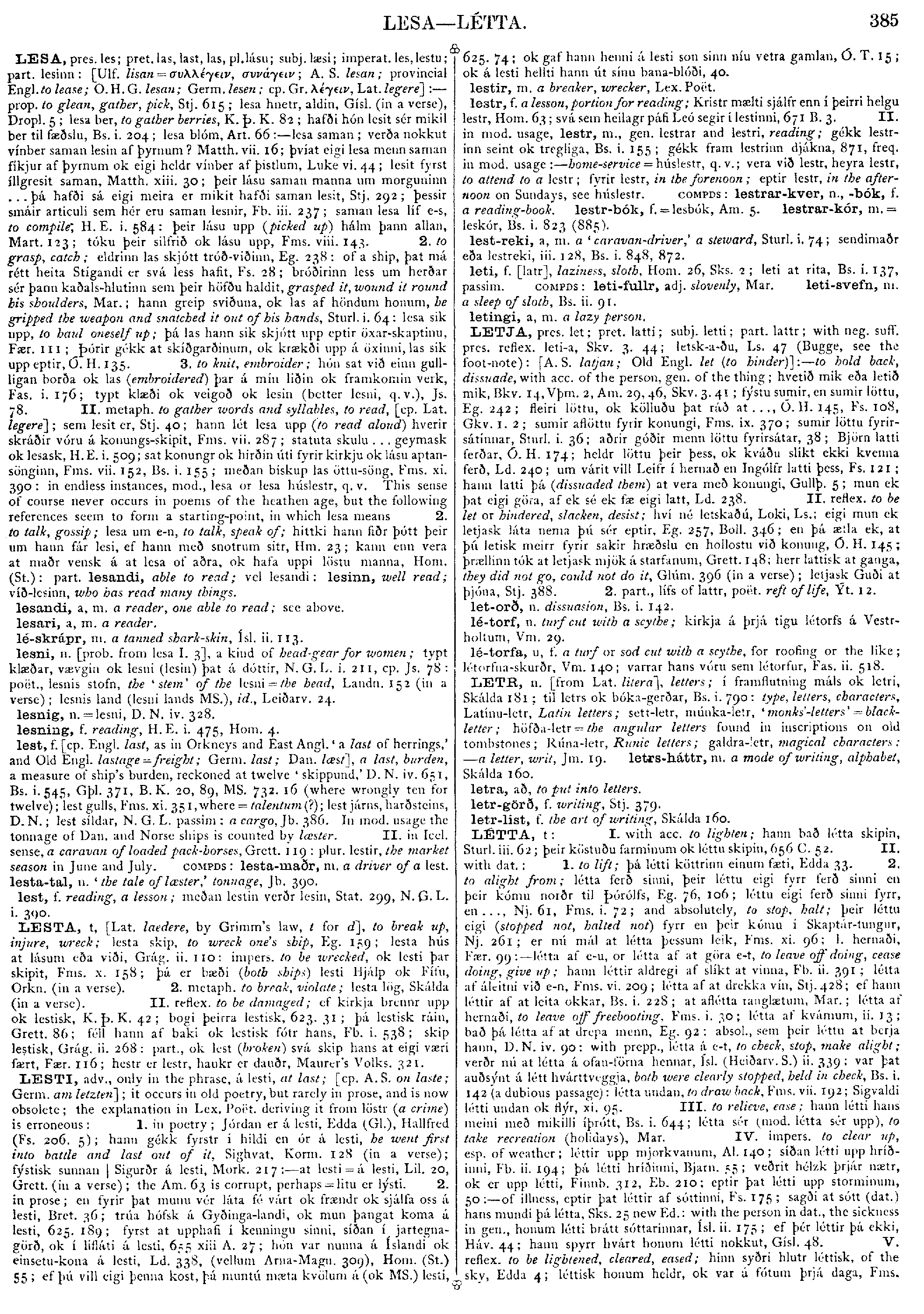
LESA, pres. les; pret. las, last, las, pl. lásu; subj. læsi; imperat. les. lestu; part, lesinn: [Ulf. lisan = av\ty(iv, avvaytiv; A. S. lesan; provincial Engl. to lease; O. H. G. lesan; Germ. lesen; cp. Gr.
|
Source: Cleasby/Vigfusson, page b0462, entry 6 View original page image as: [TIFF] [PNG] [View previous entry] [View next entry] |
[Comment on this entry] [View comments] |
The following entry has been hand-corrected once. |
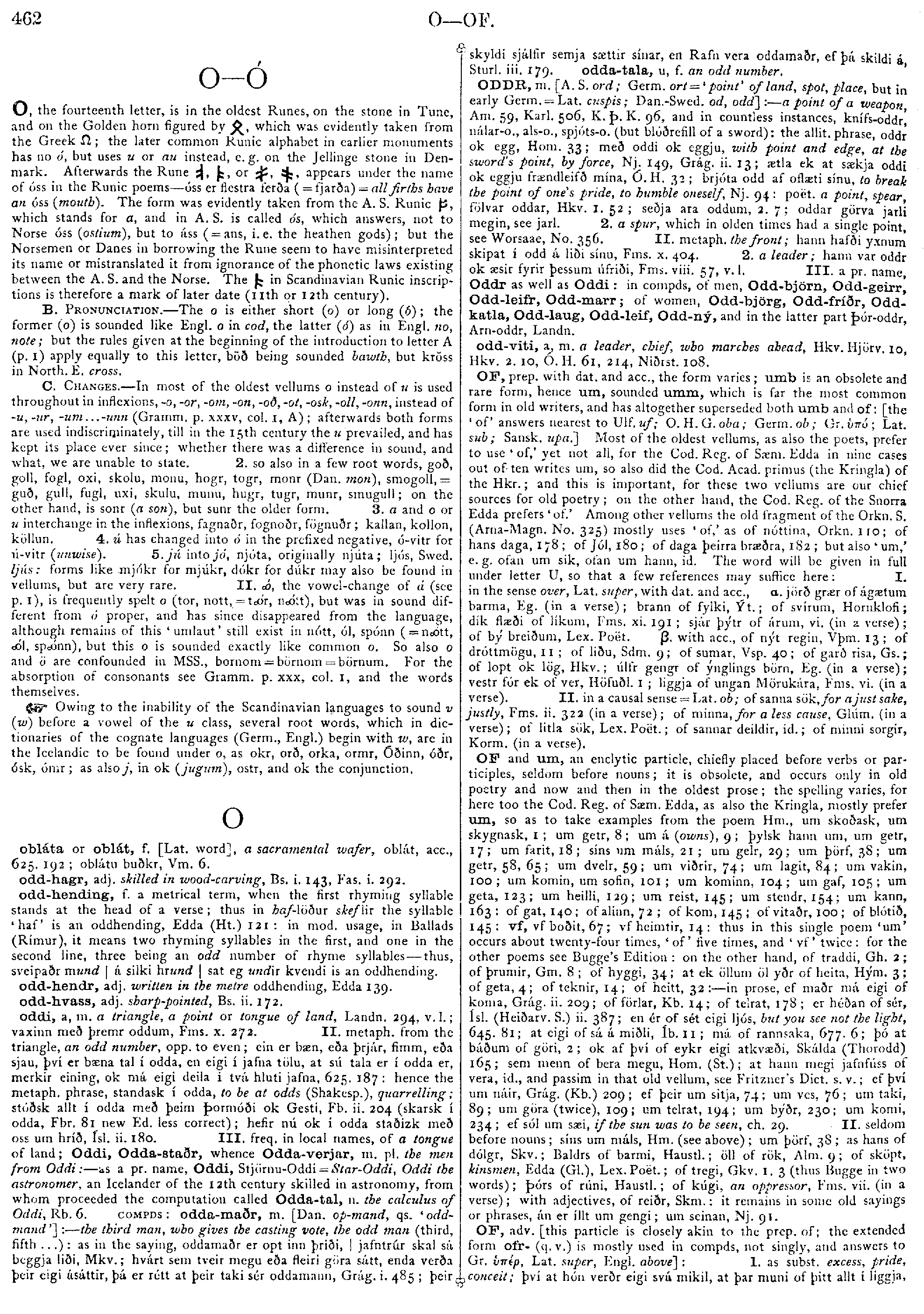
odd-hending, f. a metrical term, when the first rhyming syllable stands at the head of a verse; thus in haf-löður skeflir the syllable 'haf' is an oddhending, Edda (Ht.) 121: in mod. usage, in Ballads (Rímur), it means two rhyming syllables in the first, and one in the second line, three being an odd number of rhyme syllables -- thus, sveipaðr mundd | á silki hrund | sat eg undir kvendi is an oddhending.
|
Source: Cleasby/Vigfusson, page b0470, entry 3 View original page image as: [TIFF] [PNG] [View previous entry] [View next entry] |
[Comment on this entry] [View comments] |
The following entry has been hand-corrected once. |
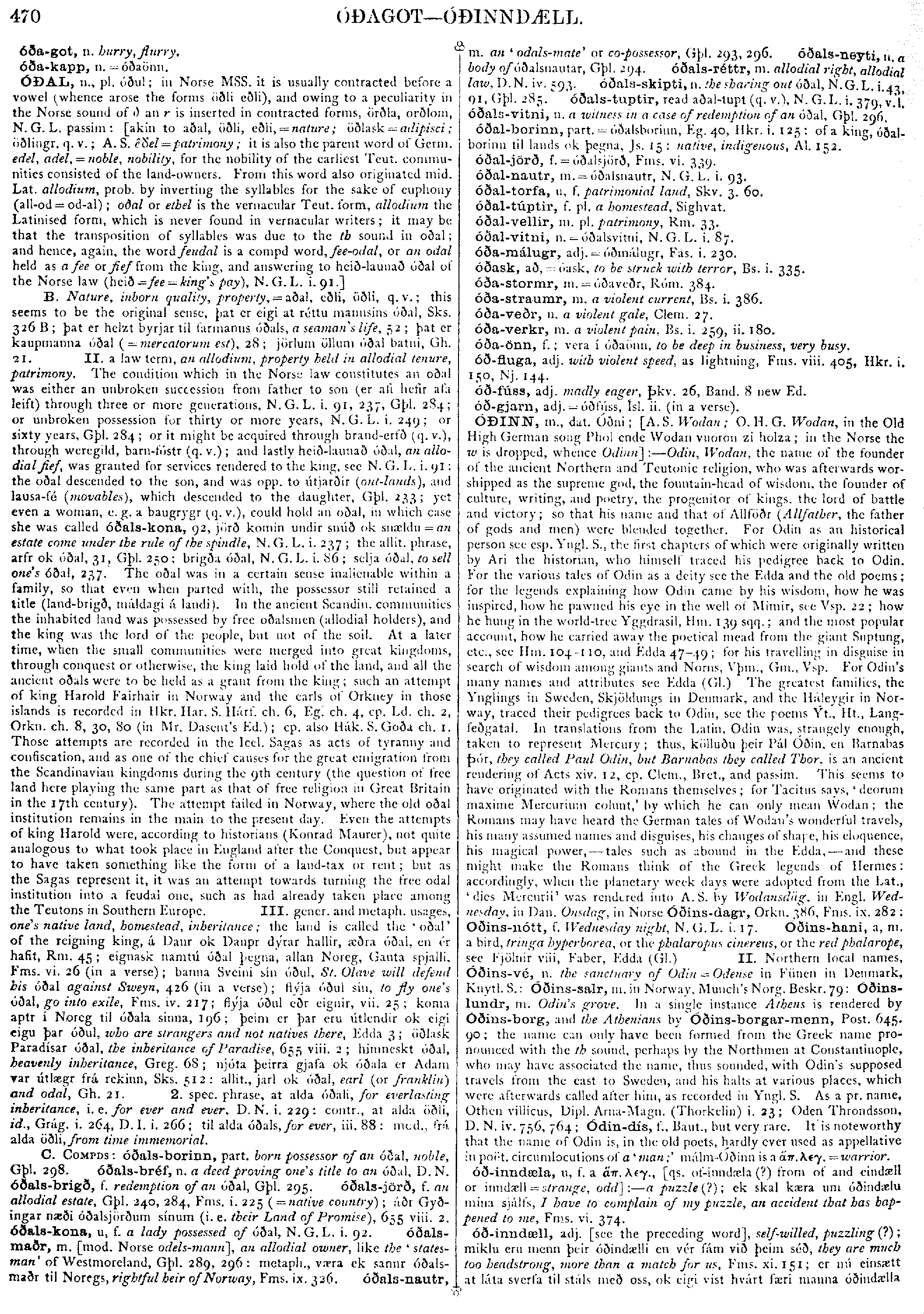
ÓÐAL, n., pl. óðul; in Norse MSS. it is usually contracted before a vowel (whence arose the forms öðli eðli), and owing to a peculiarity in the Norse sound of ð an r is inserted in contracted forms, örðla, orðlom, N.G.L. passim: [akin to aðal, öðli, eðli, = nature; öðlask = adipisci; oðlingr, q.v.; A.S. êðel = patrimony; it is also the parent word of Germ. edel, adel, = noble, nobility, for the nobility of the earliest Teut. communities consisted of the land-owners. From this word also originated mid. Lat. allodium, prob. by inverting the syllables for the sake of euphony (all-od = od-al); oðal or ethel is the vernacular Teut. form, allodium the Latinised form, which is never found in vernacular writers; it may be that the transposition of syllables was due to the th sound in oðal; and hence, again, the word feudal is a compd word, fee-odal, or an odal held as a fee or feif from the king, and answering to heið-launað óðal of the Norse law (heið = fee = king's pay), N.G.L. i. 91.] B. Nature, inborn quality, property, = aðal, eðli, öðli, q.v.; this seems to be the original sense, þat er eigi at réttu mannsins óðal, Sks. 326 B; þat er helzt byrjar til farmanns óðals, a seaman's life, 52; þat er kaupmanna óðal ( = mercatorum est), 28; jörlum öllum óðal batni, Gh. 21. II. a law term, an allodium, property held in allodial tenure, patrimony. The condition which in the Norse law constitutes an oðal was either an unbroken succession from father to son (er afi hefir afa leift) through three or more generations, N.G.L. i. 91, 237, Gþl. 284; or unbroken possession for thirty or more years, N.G.L. i. 249; or sixty years, Gþl. 284; or it might be acquired through brand-erfð (q.v.), through weregild, barn-fóstr (q.v.); and lastly heið-launað óðal, an allodial fief, was granted for services rendered to the king, see N.G.L. i. 91: the oðal descended to the son, and was opp. to útjarðir (out-lands), and lausa-fé (movables), which descended to the daughter, Gþl. 233; yet even a woman, e.g. a baugrygr (q.v.), could hold an oðal, in which case she was called óðals-kona, 92, jörð komin undir snúð ok snældu = an estate come under the rule of the spindle, N.G.L. i. 237; the allit. phrase, arfr ok óðal, 31, Gþl. 250: brigða óðal, N.G.L. i. 86; selja óðal, to sell one's óðal, 237. The oðal was in a certain sense inalienable within a family, so that even when parted with, the possessor still retained a title (land-brigð, máldagi á landi). In the ancient Scandin. communities the inhabited land was possessed by free oðalsmen (allodial holders), and the king was the lord of the people, but not of the soil. At a later time, when the small communities were merged into great kingdoms, through conquest or otherwise, the king laid hold of the land, and all the ancient oðals were to be held as a grant from the king; such an attempt of king Harold Fairhair in Norway and the earls of Orkney in those islands is recorded in Hkr. Har. S. Hárf. ch. 6, Eg. ch. 4, cp. Ld. ch. 2, Orkn. ch. 8, 30, 80 (in Mr. Dasent's Ed.); cp. also Hák. S. Goða ch. 1. Those attempts are recorded in the Icel. Sagas as acts of tyranny and confiscation, and as one of the chief causes for the great emigration from the Scandinavian kingdoms during the 9th century (the question of free land here playing the same part as that of free religion in Great Britain in the 17th century). The attempt failed in Norway, where the old oðal institution remains in the main to the present day. Even the attempts of king Harold were, according to historians (Konrad Maurer), not quite analogous to what took place in England after the Conquest, but appear to have taken something like the form of a land-tax or rent; but as the Sagas represent it, it was an attempt towards turning the free odal institution into a feudal one, such as had already taken place among the Teutons in Southern Europe. III. gener. and metaph. usages, one's native land, homestead, inheritance; the land is called the 'oðal' of the reigning king, á Danr ok Danpr dýrar hallir, æðra óðal, en ér hafit, Rm. 45; eignask namtú óðal þegna, allan Noreg, Gauta spjalli, Fms. vi. 26 (in a verse); banna Sveini sín óðul, St. Olave will defend his óðal against Sweyn, 426 (in a verse); flýja óðul sín, to fly one's óðal, go into exile, Fms. iv. 217; flýja óðul eðr eignir, vii. 25; koma aptr í Noreg til óðala sinna, 196; þeim er þar eru útlendir ok eigi eigu þar óðul, who are strangers and not natives there, Edda 3; öðlask Paradísar óðal, the inheritance of Paradise, 655 viii. 2; himneskt óðal, heavenly inheritance, Greg. 68; njóta þeirra gjafa ok óðala er Adam var útlægr frá rekinn, Sks. 512: allit., jarl ok óðal, earl (or franklin) and odal, Gh. 21. 2. spec. phrase, at alda óðali, for everlasting inheritance, i.e. for ever and ever, D.N. i. 229: contr., at alda öðli, id., Grág. i. 264, D.I. i. 266; til alda óðals, for ever, iii. 88: mod., frá, alda öðli, from time immemorial. C. COMPDS: óðals-borinn, part. born possessor of an óðal, noble, Gþl. 298. óðals-bréf, n. a deed proving one's title to an óðal, D.N. óðals-brigð, f. redemption of an óðal, Gþl. 295. óðals-jörð, f. an allodial estate, Gþl. 240, 284, Fms. i. 225 (= native country); áðr Gyðingar næði óðalsjörðum sínum (i.e. their Land of Promise), 655 viii. 2. óðals-kona, u, f. a lady possessed of óðal, N.G.L. i. 92. óðals-maðr, m. [mod. Norse odels-mann], an allodial owner, like the 'statesman' of Westmorland, Gþl. 289, 296: metaph., væra ek sannr óðalsmaðr til Noregs, rightful heir of Norway, Fms. ix. 326. óðals-nautr, m. an 'odals-mate' or co-possessor, Gþl. 293, 296. óðals-neyti, u. a body of óðalsnautar, Gþl. 294. óðals-réttr, m. allodial right, allodial law, D.N. iv. 593. óðals-skipti, n. the sharing out óðal, N.G.L. i. 43, 91, Gþl. 285. óðals-tuptir, read aðal-tupt (q.v.), N.G.L. i. 379, v.l. óðals-vitni, n. a witness in a case of redemption of an óðal, Gþl. 296.
|
Source: Cleasby/Vigfusson, page b0497, entry 4 View original page image as: [TIFF] [PNG] [View previous entry] [View next entry] |
[Comment on this entry] [View comments] |
The following entry has been hand-corrected once. |
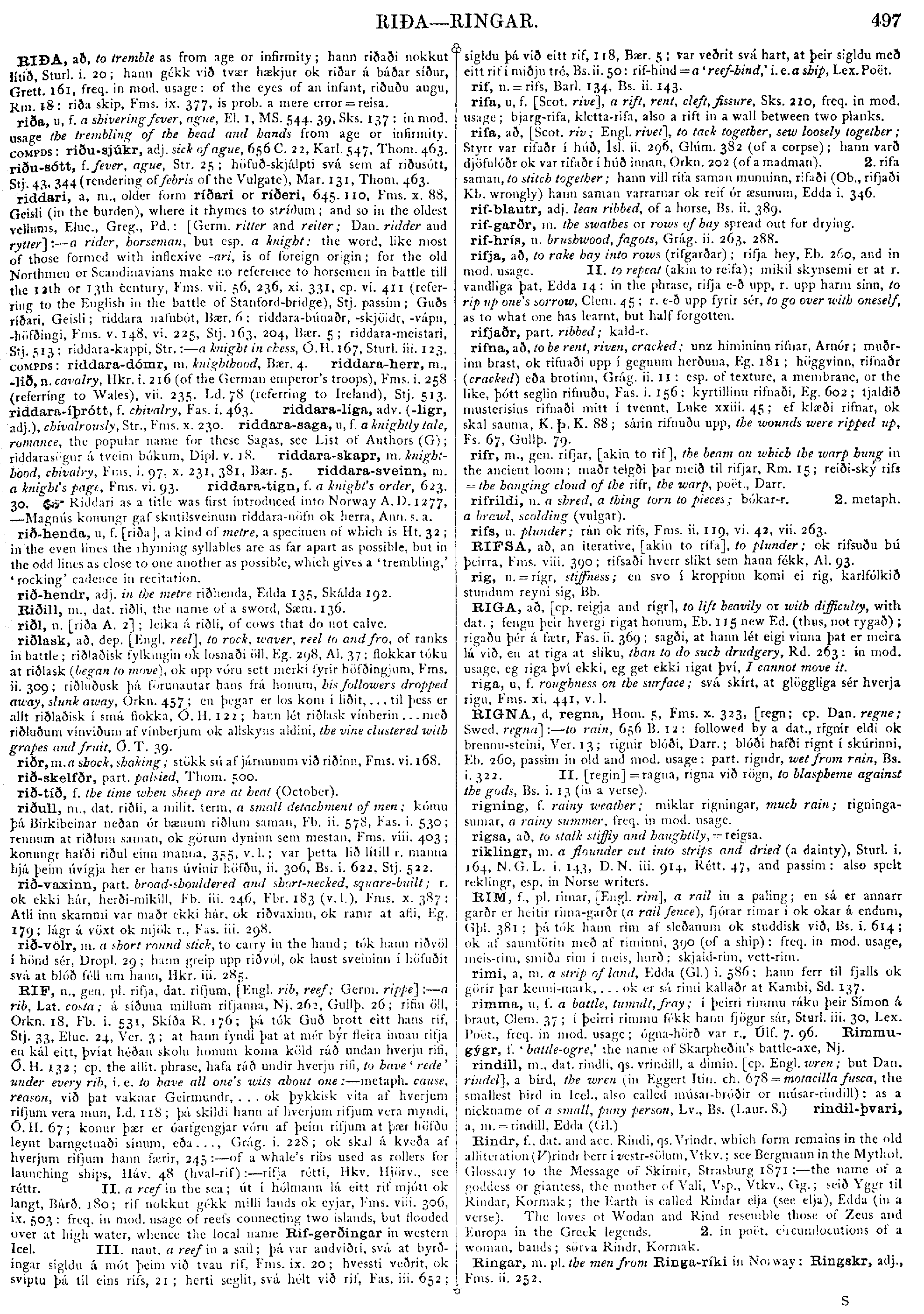
rið-henda, u, f. [riða], a kind of metre, a specimen of which is Ht. 32; in the even lines the rhyming syllables are as far apart as possible, but in the odd lines as close to one another as possible, which gives a 'trembling,' 'rocking' cadence in recitation.
|
Source: Cleasby/Vigfusson, page b0646, entry 1 View original page image as: [TIFF] [PNG] [View previous entry] [View next entry] |
[Comment on this entry] [View comments] |
The following entry has been hand-corrected once. |
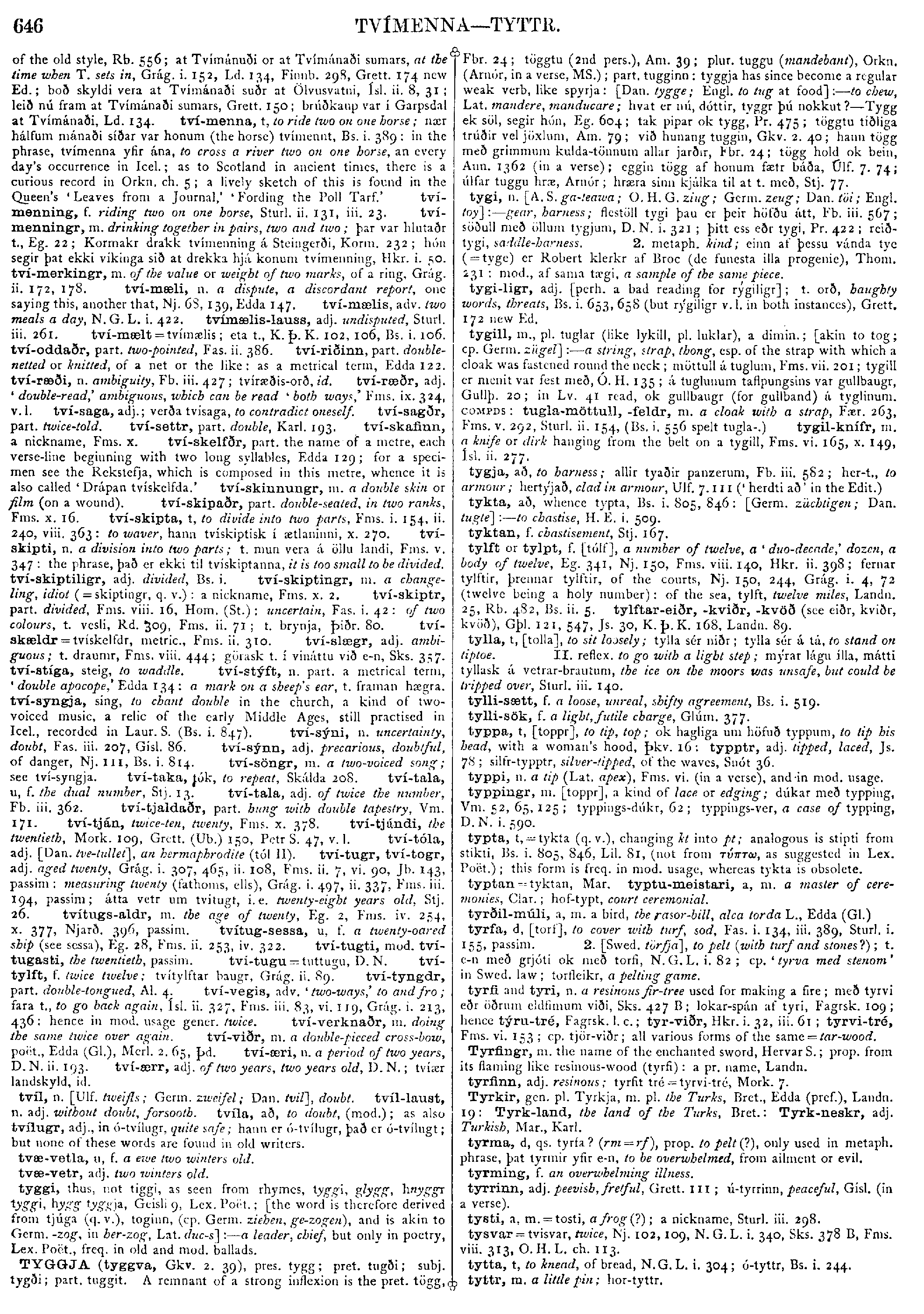
of the old style, Rb. 556; at Tvímánuði or at Tvímánaði sumars, at the time when T. sets in, Grág. i. 152, Ld. 134, Finnb. 298, Grett. 174 new Ed.; boð skyldi vera at Tvímánaði suðr at Ölvusvatni, Ísl. ii. 8, 31; leið nú fram at Tvímánaði sumars, Grett. 150; brúðkaup var í Garpsdal at Tvímánaði, Ld. 134. tví-menna, t, to ride two on one horse; nær hálfum mánaði síðar var honum (the horse) tvímennt, Bs. i. 389: in the phrase, tvímenna yfir ána, to cross a river two on one horse, an every day's occurrence in Icel.; as to Scotland in ancient times, there is a curious record in Orkn. ch. 5; a lively sketch of this is found in the Queen's 'Leaves from a Journal,' 'Fording the Poll Tarf.' tví-menning, f. riding two on one horse, Sturl. ii. 131, iii. 23. tví-menningr, m. drinking together in pairs, two and two; þar var hlutaðr t., Eg. 22; Kormakr drakk tvímenning á Steingerði, Korm. 232; hón segir þat ekki víkinga sið at drekka hjá konum tvímenning, Hkr. i. 50. tví-merkingr, m. of the value or weight of two marks, of a ring, Grág. ii. 172, 178. tví-mæli, n. a dispute, a discordant report, one saying this, another that, Nj. 68, 139, Edda 147. tví-mælis, adv. two meals a day, N.G.L. i. 422. tvímælis-lauss, adj. undisputed, Sturl. iii. 261. tví-mælt = tvímælis; eta t., K.Þ.K. 102, 106, Bs. i. 106. tví-oddaðr, part. two-pointed, Fas. ii. 386. tví-riðinn, part. double-netted or knitted, of a net or the like: as a metrical term, Edda 122. tví-ræði, n. ambiguity, Fb. iii. 427; tvíræðis-orð, id. tví-ræðr, adj. 'double-read,' ambiguous, which can be read 'both ways' Fms. ix. 324, v.l. tví-saga, adj.; verða tvísaga, to contradict oneself. tví-sagðr, part. twice-told. tí-settr, part. double, Karl. 193. tví-skafinn, a nickname, Fms. x. tví-skelfðr, part. the name of a metre, each verse-line beginning with two long syllables, Edda 129; for a specimen see the Rekstefja, which is composed in this metre, whence it is also called 'Drápan tvískelfda.' tví-skinnungr, m. a double skin or film (on a wound). tví-skipaðr, part. double-seated, in two ranks, Fms. x. 16. tví-skipta, t, to divide into two parts, Fms. i. 154, ii. 240, viii. 363: to waver, hann tvískiptisk í ætlaninni, x. 270. tví-skipti, n. a division into two parts; t. mun vera á öllu landi, Fms. v. 347: the phrase, það er ekki til tvískiptanna, it is too small to be divided. tví-skiptiligr, adj. divided, Bs. i. tví-skiptingr, m. a changeling, idiot (= skiptingr, q.v.): a nickname, Fms. x. 2. tví-skiptr, part. divided, Fms. viii. 16, Hom. (St.): uncertain, Fas. i. 42: of two colours, t. vesli, Rd. 309, Fms. ii. 71; t. brynja, Þiðr. 80. tví-skældr = tvískelfdr, metric., Fms. ii. 310. tví-slægr, adj. ambiguous; t. draumr, Fms. viii. 444; görask t. í vináttu við e-n, Sks. 357. tví-stíga, steig, to waddle. tví-stýft, n. part. a metrical term, 'double apocope' Edda 134: a mark on a sheep's ear, t. framan hægra. tví-syngja, sing, to chant double in the church, a kind of two-voiced music, a relic of the early Middle Ages, still practised in Icel., recorded in Laur. S. (Bs. i. 847). tví-sýni, n. uncertainty, doubt, Fas. iii. 207, Gísl. 86. tví-sýnn, adj. precarious, doubtful, of danger, Nj. 111, Bs. i. 814. tví-söngr, m. a two-voiced song; see tví-syngja. tví-taka, tók, to repeat, Skálda 208. tví-tala, u, f. the dual number, Stj. 13. tví-tala, adj. of twice the number, Fb. iii. 362. tví-tjaldaðr, part. hung with double tapestry, Vm. 171. tví-tján, twice-ten, twenty, Fms. x. 378. tví-tjándi, the twentieth, Mork. 109, Grett. (Ub.) 150, Petr S. 47, v.l. tví-tóla, adj. [Dan. tve-tullet], an hermaphrodite (tól II). tví-tugr, tví-togr, adj. aged twenty, Grág. i. 307, 465, ii. 108, Fms. ii. 7, vi. 90, Jb. 143, passim: measuring twenty (fathoms, ells), Grág. i. 497, ii. 337, Fms. iii. 194, passim; átta vetr um tvítugt, i.e. twenty-eight years old, Stj. 26. tvítugs-aldr, m. the age of twenty, Eg. 2, Fms. iv. 254, x. 377, Njarð. 396, passim. tvítug-sessa, u, f. a twenty-oared ship (see sessa), Eg. 28, Fms. ii. 253, iv. 322. tví-tugu, mod. tví-tugasti, the twentieth, passim. tví-tugu = tuttugu, D.N. tví-tylft, f. twice twelve; tvítylftar baugr, Grág. ii. 89. tví-tyngdr, part. double-tongued, Al. 4. tví-vegis, adv. 'two-ways' to and fro; fara t., to go back again, Ísl. ii. 327, Fms. iii. 83, vi. 119, Grág. i. 213, 436: hence in mod. usage gener. twice. tví-verknaðr, m. doing the same twice over again. tví-viðr, m. a double-pieced cross-bow, poët., Edda (Gl.), Merl. 2. 65, Þd. tví-æri, n. a period of two years, D.N. ii. 193. tví-ærr, adj. of two years, two years old, D.N.; tvíær landskyld, id.
|
Source: Cleasby/Vigfusson, page b0673, entry 1 View original page image as: [TIFF] [PNG] [View previous entry] [View next entry] |
[Comment on this entry] [View comments] |
The following entry has been hand-corrected once. |
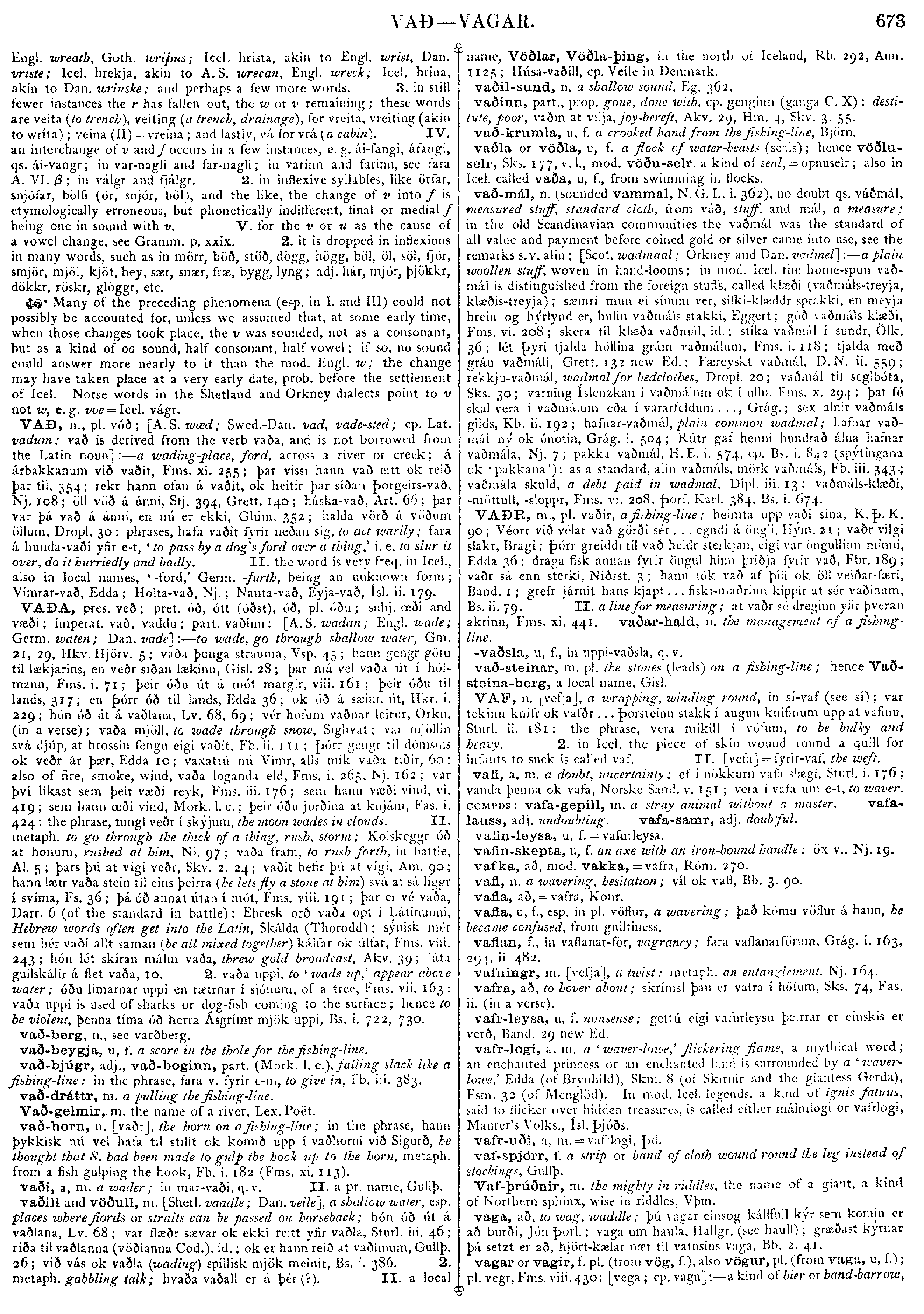
Engl.
wreath,
Goth.
wriþus;
Icel.
hrista,
akin
to
Engl.
wrist.
Dan.
vriste;
Icel.
hrekja,
akin
to
A.S.
wrecan,
Engl.
wreck;
Icel.
hrína,
akin
to
Dan.
wrinske;
and
perhaps
a
few
more
words.
3.
in
still
fewer
instances
the
r
has
fallen
out,
the
w
or
v
remaining;
these
words
are
veita
(to
trench),
veiting
(a
trench,
drainage),
for
vreita,
vreiting
(akin
to
wríta);
veina
(II)
=
vreina;
and
lastly,
vá
for
vrá
(a
cabin).
IV.
an
interchange
of
v
and
f
occurs
in
a
few
instances,
e.g.
ái-fangi,
áfangi,
qs.
ái-vangr;
in
var-nagli
and
far-nagli;
in
varinn
and
farinn,
see
fara
A.
VI.
 ;
in
válgr
and
fjálgr.
2.
in
inflexive
syllables,
like
örfar,
snjófar,
bölfi
(ör,
snjór,
böl),
and
the
like,
the
change
of
v
into
f
is
etymologically
erroneous,
but
phonetically
indifferent,
final
or
medial
f
being
one
in
sound
with
v.
V.
for
the
v
or
u
as
the
cause
of
a
vowel
change,
see
Gramm.
p.
xxix.
2.
it
is
dropped
in
inflexions
in
many
words,
such
as
in
mörr,
böð,
stöð,
dögg,
högg,
böl,
öl,
söl,
fjör,
smjör,
mjöl,
kjöt,
hey,
sær,
snær,
fræ,
bygg,
lyng;
adj.
hár,
mjór,
þjökkr,
dökkr,
röskr,
glöggr,
etc.
&FINGER;
Many
of
the
preceding
phenomena
(esp.
in
I.
and
III)
could
not
possibly
be
accounted
for,
unless
we
assumed
that,
at
some
early
time,
when
those
changes
took
place,
the
v
was
sounded,
not
as
a
consonant,
but
as
a
kind
of
oo
sound,
half
consonant,
half
vowel;
if
so,
no
sound
could
answer
more
nearly
to
it
than
the
mod.
Engl.
w;
the
change
may
have
taken
place
at
a
very
early
date,
prob.
before
the
settlement
of
Icel.
Norse
words
in
the
Shetland
and
Orkney
dialects
point
to
v
not
w,
e.g.
voe
=
Icel.
vágr.
;
in
válgr
and
fjálgr.
2.
in
inflexive
syllables,
like
örfar,
snjófar,
bölfi
(ör,
snjór,
böl),
and
the
like,
the
change
of
v
into
f
is
etymologically
erroneous,
but
phonetically
indifferent,
final
or
medial
f
being
one
in
sound
with
v.
V.
for
the
v
or
u
as
the
cause
of
a
vowel
change,
see
Gramm.
p.
xxix.
2.
it
is
dropped
in
inflexions
in
many
words,
such
as
in
mörr,
böð,
stöð,
dögg,
högg,
böl,
öl,
söl,
fjör,
smjör,
mjöl,
kjöt,
hey,
sær,
snær,
fræ,
bygg,
lyng;
adj.
hár,
mjór,
þjökkr,
dökkr,
röskr,
glöggr,
etc.
&FINGER;
Many
of
the
preceding
phenomena
(esp.
in
I.
and
III)
could
not
possibly
be
accounted
for,
unless
we
assumed
that,
at
some
early
time,
when
those
changes
took
place,
the
v
was
sounded,
not
as
a
consonant,
but
as
a
kind
of
oo
sound,
half
consonant,
half
vowel;
if
so,
no
sound
could
answer
more
nearly
to
it
than
the
mod.
Engl.
w;
the
change
may
have
taken
place
at
a
very
early
date,
prob.
before
the
settlement
of
Icel.
Norse
words
in
the
Shetland
and
Orkney
dialects
point
to
v
not
w,
e.g.
voe
=
Icel.
vágr.
|
Source: Cleasby/Vigfusson, page b0694, entry 11 View original page image as: [TIFF] [PNG] [View previous entry] [View next entry] |
[Comment on this entry] [View comments] |
The following entry has been hand-corrected once. |
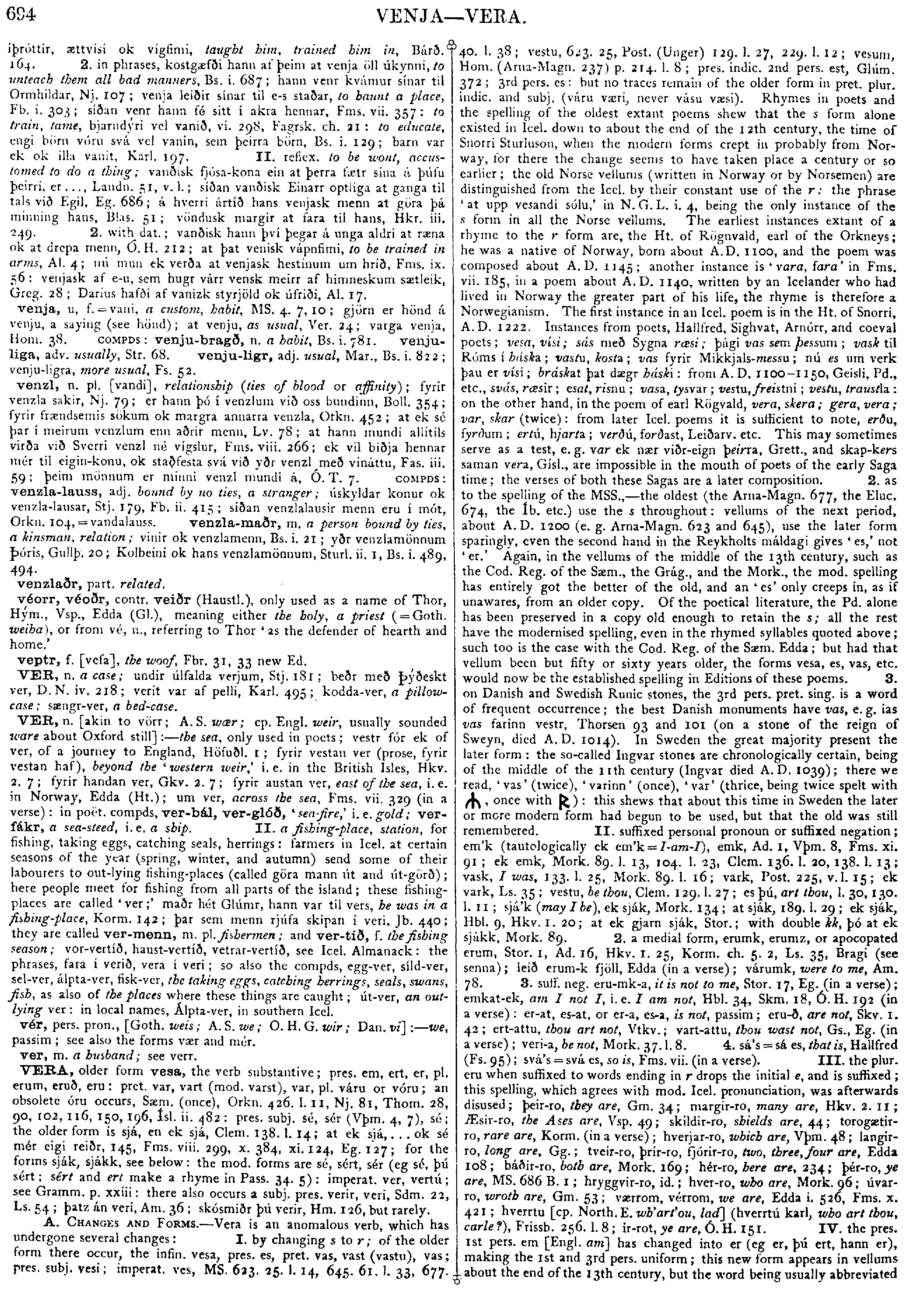
VERA, older form vesa, the verb substantive; pres. em, ert, er, pl. erum, eruð, eru: pret. var, vart (mod. varst), var, pl. váru or vóru; a obsolete óru occurs, Sæm. (once), Orkn. 426. l. 11, Nj. 81, Thom. 28, 90, 102, 116, 150, 196, Ísl. ii. 482: pres. subj. sé, sér (Vþm. 4, 7), sé; the older form is sjá, en ek sjá, Clem. 138. l. 14; at ek sjá, ... ok sé mér eigi reiðr, 145, Fms. viii. 299, x. 384, xi. 124, Eg. 127; for the forms sják, sjákk, see below: the mod. forms are sé, sért, sér (eg sé, þú sért; sert and ert make a rhyme in Pass. 34. 5): imperat. ver, vertú; see Gramm. p. xxiii: there also occurs a subj. pres. verir, veri, Sdm. 22, Ls. 54; þatz án veri, Am. 36; skósmiðr þú verir, Hm. 126, but rarely. A. CHANGES AND FORMS. -- Vera is an anomalous verb, which has undergone several changes: I. by changing s to r; of the older form there occur, the infin. vesa, pres. es, pret. vas, vast (vastu), vas; pres. subj. vesi; imperat. ves, MS. 623. 25. l. 14, 645. 6l. l. 33, 677. 40. l. 38; vestu, 623. 25, Post. (Unger) 129. l. 27, 229. l. 12; vesum, Hom. (Arna-Magn. 237) p. 214. l. 8; pres. indic. 2nd pers. est, Glúm. 372; 3rd pers. es: but no traces remain of the older form in pret. plur. indic. and subj. (váru væri, never vásu væsi). Rhymes in poets and the spelling of the oldest extant poems shew that the s form alone existed in Icel. down to about the end of the 12th century, the time of Snorri Sturluson, when the modern forms crept in probably from Norway, for there the change seems to have taken place a century or so earlier; the old Norse vellums (written in Norway or by Norsemen) are distinguished from the Icel. by their constant use of the r: the phrase 'at upp vesandi sólu', in N.G.L. i. 4, being the only instance of the s form in all the Norse vellums. The earliest instances extant of a rhyme to the r form are, the Ht. of Rögnvald, earl of the Orkneys; he was a native of Norway, born about A.D. 1100, and the poem was composed about A.D. 1145; another instance is 'vara, fara' in Fms. vii. 185, in a poem about A.D. 1140, written by an Icelander who had lived in Norway the greater part of his life, the rhyme is therefore a Norwegianism. The first instance in an Icel. poem is in the Ht. of Snorri, A.D. 1222. Instances from poets, Hallfred, Sighvat, Arnórr, and coeval poets; vesa, vísi; sás með Sygna ræsi; þági vas sem þessum; vask til Róms í háska; vastu, kosta; vas fyrir Mikkjals-messu; nú es um verk þau er vísi; bráskat þat dægr háski: from A.D. 1100-1150, Geisli, Pd., etc., svás, ræsir; esat, risnu; vasa, tysvar; vestu. freistni; vestu, traustla: on the other hand, in the poem of earl Rögvald, vera, skera; gera, vera; var, skar (twice): from later Icel. poems it is sufficient to note, erðu, fyrðum; ertú, hjarta; verðú, forðast, Leiðarv. etc. This may sometimes serve as a test, e.g. var ek nær viðr-eign þeirra, Grett., and skap-kers saman vera, Gísl., are impossible in the mouth of poets of the early Saga time; the verses of both these Sagas are a later composition. 2. as to the spelling of the MSS., -- the oldest (the Arna-Magn. 677, the Eluc. 674, the Íb. etc.) use the s throughout: vellums of the next period, about A.D. 1200 (e.g. Arna-Magn. 623 and 645), use the later form sparingly, even the second hand in the Reykholts máldagi gives 'es,' not 'er.' Again, in the vellums of the middle of the 13th century, such as the Cod. Reg. of the Sæm., the Grág., and the Mork., the mod. spelling has entirely got the better of the old, and an 'es' only creeps in, as if unawares, from an older copy. Of the poetical literature, the Pd. alone has been preserved in a copy old enough to retain the s; all the rest have the modernised spelling, even in the rhymed syllables quoted above; such too is the case with the Cod. Reg. of the Sæm. Edda; but had that vellum been but fifty or sixty years older, the forms vesa, es, vas, etc. would now be the established spelling in Editions of these poems. 3. on Danish and Swedish Runic stones, the 3rd pers. pret. sing. is a word of frequent occurrence; the best Danish monuments have vas, e.g. ias vas farinn vestr, Thorsen 93 and 101 (on a stone of the reign of Sweyn, died A.D. 1014). In Sweden the great majority present the later form: the so-called Ingvar stones are chronologically certain, being of the middle of the 11th century (Ingvar died A.D. 1039); there we read, 'vas' (twice), 'varinn' (once), 'var' (thrice, being twice spelt with RUNE, once with RUNE): this shews that about this time in Sweden the later or more modern form had begun to be used, but that the old was still remembered. II. suffixed personal pronoun or suffixed negation; em'k (tautologically ek em'k = I-am-I), emk, Ad. 1, Vþm. 8, Fms. xi. 91; ek emk, Mork. 89. l. 13, 104. l. 23, Clem. 136. l. 20, 138. l. 13; vask, I was, 133. l. 25, Mork. 89. l. 16; vark, Post. 225, v.l. 15; ek vark, Ls. 35; vestu, be thou, Clem. 129. l. 27; es þú, art thou, l. 30, 130. l. 11; sjá'k (may I be), ek sják, Mork. 134; at sják, 189. l. 29; ek sják, Hbl. 9, Hkv. 1. 20; at ek gjarn sják, Stor.; with double kk, þó at ek sjákk, Mork. 89. 2. a medial form, erumk, erumz, or apocopated erum, Stor. 1, Ad. 16, Hkv. 1. 25, Korm. ch. 5. 2, Ls. 35, Bragi (see senna); leið erum-k fjöll, Edda (in a verse); várumk, were to me, Am. 78. 3. suff. neg. eru-mk-a, it is not to me, Stor. 17, Eg. (in a verse); emkat-ek, am I not I, i.e. I am not, Hbl. 34, Skm. 18, Ó.H. 192 (in a verse): er-at, es-at, or er-a, es-a, is not, passim; eru-ð, are not, Skv. 1. 42; ert-attu, thou art not, Vtkv.; vart-attu, thou wast not, Gs., Eg. (in a verse); veri-a, be not, Mork. 37. l. 8. 4. sá's = sá es, that is, Hallfred (Fs. 95); svá's = svá es, so is, Fms. vii. (in a verse). III. the plur. eru when suffixed to words ending in r drops the initial e, and is suffixed; this spelling, which agrees with mod. Icel. pronunciation, was afterwards disused; þeir-ro, they are, Gm. 34; margir-ro, many are, Hkv. 2. 11; Æsir-ro, the Ases are, Vsp. 49; skildir-ro, shields are, 44; torogætir-ro, rare are, Korm. (in a verse); hverjar-ro, which are, Vþm. 48; langir-ro, long are, Gg.; tveir-ro, þrír-ro, fjórir-ro, two, three, four are, Edda 108; báðir-ro, both are, Mork. 169; hér-ro, here are, 234; þér-ro, ye are, MS. 686 B. 1; hryggvir-ro, id.; hver-ro, who are, Mork. 96; úvar-ro, wroth are, Gm. 53; værrom, vérrom, we are, Edda i. 526, Fms. x. 421; hverrtu [cp. North. E. wh'art'ou, lad] (hverrtú karl, who art thou, carle?), Frissb. 256. l. 8; ir-rot, ye are, Ó.H. 151. IV. the pres. 1st pers. em [Engl. am] has changed into er (eg er, þú ert, hann er), making the 1st and 3rd pers. uniform; this new form appears in vellums about the end of the 13th century, but the word being usually abbreviated
| Result Page: |  |
Previous | 1 2 3 4 | Next |  |
Germanic Lexicon Project (main page)
This search system was written by
Sean Crist
Please consider
volunteering
to correct the data in these online dictionaries.
No rights reserved. Feel free to use these data in any way you please.