|
|

|
Source: Bosworth/Toller, page d0341, entry 10 View original page image as: [TIFF] [PNG] [View previous entry] [View next entry] |
[Comment on this entry] [View comments] |
The following entry has been hand-corrected once. |
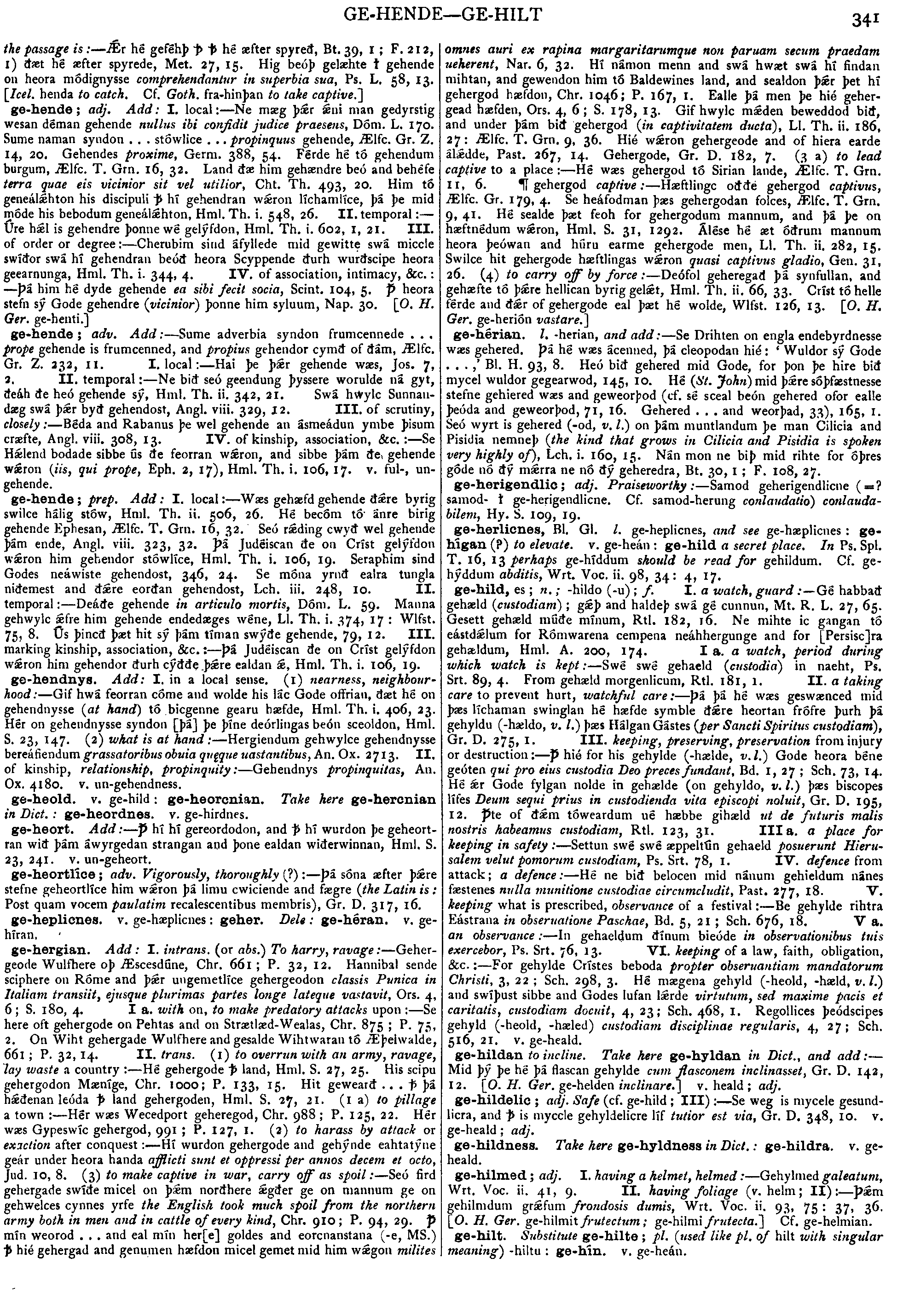
ge-hergian.
Add:
I.
intrant,
(or
abs.)
To
harry,
ravage
:--
Geher-geode
Wulfhere
oþ
Æscesd ne,
Chr.
661;
P.
32,
12,
Hannibal
sende
sciphere
on
R
ne,
Chr.
661;
P.
32,
12,
Hannibal
sende
sciphere
on
R me
and
þ
me
and
þ r
ungemetl
r
ungemetl ce
gehergeodon
classis
Punica
in
Italiam
transiit,
ejusque
plurimas
partes
longe
lateque
vastavit,
Ors.
4,
6;
S.
180,
4.
I
a.
with
on,
to
make
predatory
attacks
upon
:--
Se
here
oft
gehergode
on
Pehtas
and
on
Strætlæd-Wealas,
Chr.
875
;
P.
75,
2.
On
Wiht
gehergade
Wulfhere
and
gesalde
Wihtwaran
t
Æþelwalde,
661;
P.
32,
14.
II.
trans.
(1)
to
overrun
with
an
army,
ravage,
lay
waste
a
country
:--
H
ce
gehergeodon
classis
Punica
in
Italiam
transiit,
ejusque
plurimas
partes
longe
lateque
vastavit,
Ors.
4,
6;
S.
180,
4.
I
a.
with
on,
to
make
predatory
attacks
upon
:--
Se
here
oft
gehergode
on
Pehtas
and
on
Strætlæd-Wealas,
Chr.
875
;
P.
75,
2.
On
Wiht
gehergade
Wulfhere
and
gesalde
Wihtwaran
t
Æþelwalde,
661;
P.
32,
14.
II.
trans.
(1)
to
overrun
with
an
army,
ravage,
lay
waste
a
country
:--
H gehergode
 land,
Hml.
S.
27,
25.
His
scipu
gehergodon
Mæníge,
Chr.
1000;
P.
133,
15.
Hit
gewear
land,
Hml.
S.
27,
25.
His
scipu
gehergodon
Mæníge,
Chr.
1000;
P.
133,
15.
Hit
gewear .
.
.
þ
.
.
.
þ henan
leóda
land
gehergoden,
Hml.
S.
27,
21.
(l
a)
to
pillage
a
town
:--
Hr
wæs
Wecedport
geheregod,
Chr.
988
;
P.
125,
22.
Her
wæs
Gypeswc
gehergod,
991
;
P.
127,
(2)
to
harass
by
attack
or
exaction
after
conquest
:--
H
wurdon
gehergode
and
geh
henan
leóda
land
gehergoden,
Hml.
S.
27,
21.
(l
a)
to
pillage
a
town
:--
Hr
wæs
Wecedport
geheregod,
Chr.
988
;
P.
125,
22.
Her
wæs
Gypeswc
gehergod,
991
;
P.
127,
(2)
to
harass
by
attack
or
exaction
after
conquest
:--
H
wurdon
gehergode
and
geh nde
eahtatne
geár
under
heora
handa
afflicti
sunt
et
oppressi
per
annos
decem
et
octo,
Jud.
10,
8.
(3)
to
make
captive
in
war,
carry
off
as
spoil
:--
Seó
fird
gehergade
swe
micel
on
þm
norhere
ger
ge
on
mannum
ge
on
gehwelces
cynnes
yrfe
the
English
took
much
spoil
from
the
northern
army
both
in
men
and
in
cattle
of
every
kind,
Chr.
910;
P.
94,
29.
mn
weorod
.
.
.
and
eal
mn
her[e]
goldes
and
eorcnanstana
(-e,
MS.)
hi
gehergad
and
genumen
hæfdon
micel
gemet
mid
him
wgon
milites
omnes
auri
ex
rapina
margaritarumque
nan
paruam
secum
praedam
ueherent,
Nar.
6,
32.
H
nmon
menn
and
sw
hwæt
sw
h
findan
mihtan,
and
gewendon
him
t
Baldewines
land,
and
sealdon
þr
þet
h
gehergod
hæfdon,
Chr.
1046;
P.
167,
I.
Ealle
þ
men
þe
hi
geher-gead
hæfden,
Ors.
4,
6
;
S.
178,
13.
Gif
hwylc
mden
beweddod
bi,
and
under
þám
bið
gehergod
(in
captivitatem
ducta).
Ll.
Th.
ii.
186,
27:
Ælfc.
T.
Grn.
9,
36.
Hié
wron
gehergeode
and
of
hiera
earde
ldde,
Past.
267,
14.
Gehergode,
Gr.
D.
182,
7.
(3
a)
to
lead
captive
to
a
place
:--
H
wæs
gehergod
t
Sirian
lande,
Ælfc.
T.
Grn.
11,
6.

gehergod
captive
:--
Hæftlingc
oe
gehergod
captivus,
Ælfc.
Gr.
179,
4.
Se
heáfodman
þæs
gehergodan
folces,
Ælfc.
T.
Grn.
9,
41.
H
sealde
þæt
feoh
for
gehergodum
mannum,
and
þ
þe
on
hæftndum
wron,
Hml.
S.
31,
1292.
&A-long;lse
h
æt
rum
mannum
heora
þeówan
and
hru
earme
gehergode
men,
Ll.
Th.
ii.
282,
15.
Swilce
hit
gehergode
hæftlingas
wron
quasi
captivus
gladio.
Gen.
31,
26.
(4)
to
carry
off
by
force
:--
Deófol
geherega
þ
synfullan,
and
gehæfte
t
þre
hellican
byrig
gelt,
Hml.
Th.
ii.
66,
33.
Crst
t
helle
frde
and
r
of
gehergode
eal
þæt
h
wolde,
Wlfst.
126,
13.
[O.
H.
Ger.
ge-herin
vastare.]
nde
eahtatne
geár
under
heora
handa
afflicti
sunt
et
oppressi
per
annos
decem
et
octo,
Jud.
10,
8.
(3)
to
make
captive
in
war,
carry
off
as
spoil
:--
Seó
fird
gehergade
swe
micel
on
þm
norhere
ger
ge
on
mannum
ge
on
gehwelces
cynnes
yrfe
the
English
took
much
spoil
from
the
northern
army
both
in
men
and
in
cattle
of
every
kind,
Chr.
910;
P.
94,
29.
mn
weorod
.
.
.
and
eal
mn
her[e]
goldes
and
eorcnanstana
(-e,
MS.)
hi
gehergad
and
genumen
hæfdon
micel
gemet
mid
him
wgon
milites
omnes
auri
ex
rapina
margaritarumque
nan
paruam
secum
praedam
ueherent,
Nar.
6,
32.
H
nmon
menn
and
sw
hwæt
sw
h
findan
mihtan,
and
gewendon
him
t
Baldewines
land,
and
sealdon
þr
þet
h
gehergod
hæfdon,
Chr.
1046;
P.
167,
I.
Ealle
þ
men
þe
hi
geher-gead
hæfden,
Ors.
4,
6
;
S.
178,
13.
Gif
hwylc
mden
beweddod
bi,
and
under
þám
bið
gehergod
(in
captivitatem
ducta).
Ll.
Th.
ii.
186,
27:
Ælfc.
T.
Grn.
9,
36.
Hié
wron
gehergeode
and
of
hiera
earde
ldde,
Past.
267,
14.
Gehergode,
Gr.
D.
182,
7.
(3
a)
to
lead
captive
to
a
place
:--
H
wæs
gehergod
t
Sirian
lande,
Ælfc.
T.
Grn.
11,
6.

gehergod
captive
:--
Hæftlingc
oe
gehergod
captivus,
Ælfc.
Gr.
179,
4.
Se
heáfodman
þæs
gehergodan
folces,
Ælfc.
T.
Grn.
9,
41.
H
sealde
þæt
feoh
for
gehergodum
mannum,
and
þ
þe
on
hæftndum
wron,
Hml.
S.
31,
1292.
&A-long;lse
h
æt
rum
mannum
heora
þeówan
and
hru
earme
gehergode
men,
Ll.
Th.
ii.
282,
15.
Swilce
hit
gehergode
hæftlingas
wron
quasi
captivus
gladio.
Gen.
31,
26.
(4)
to
carry
off
by
force
:--
Deófol
geherega
þ
synfullan,
and
gehæfte
t
þre
hellican
byrig
gelt,
Hml.
Th.
ii.
66,
33.
Crst
t
helle
frde
and
r
of
gehergode
eal
þæt
h
wolde,
Wlfst.
126,
13.
[O.
H.
Ger.
ge-herin
vastare.]
|
Source: Cleasby/Vigfusson, page b0284, entry 27 View original page image as: [TIFF] [PNG] [View previous entry] [View next entry] |
[Comment on this entry] [View comments] |
The following entry has been hand-corrected once. |
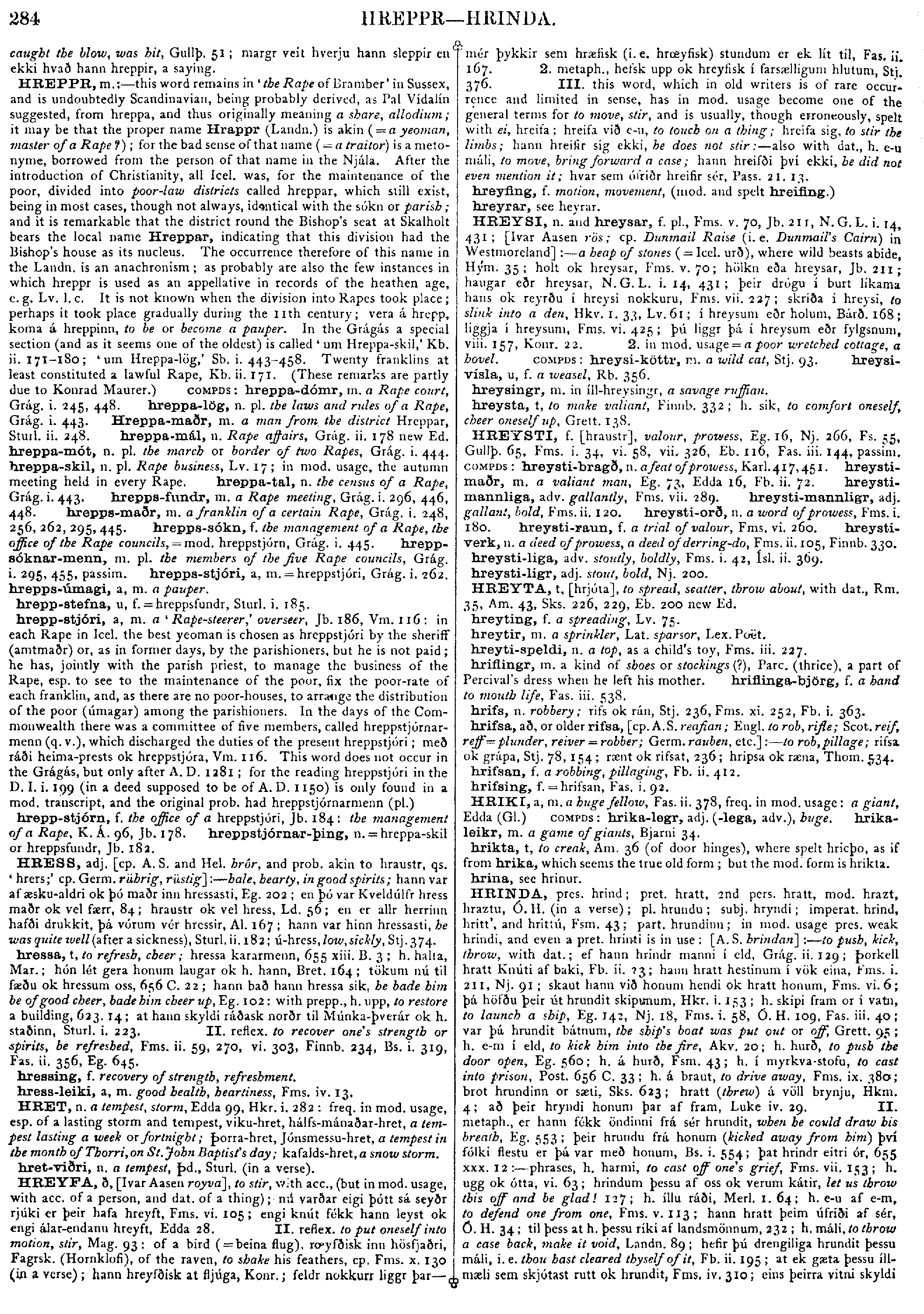
hrifsa, að, or older rifsa, [cp. A. S. reafian; Engl. to rob, rifle; Scot. reif, reff = plunder, reiver = robber; Germ. rauben, etc.] :-- to rob, pillage; rifsa ok grápa, Stj. 78, 154; rænt ok rifsat, 236; hripsa ok ræna, Thom. 534.
|
Source: Cleasby/Vigfusson, page b0350, entry 33 View original page image as: [TIFF] [PNG] [View previous entry] [View next entry] |
[Comment on this entry] [View comments] |
The following entry has been hand-corrected once. |
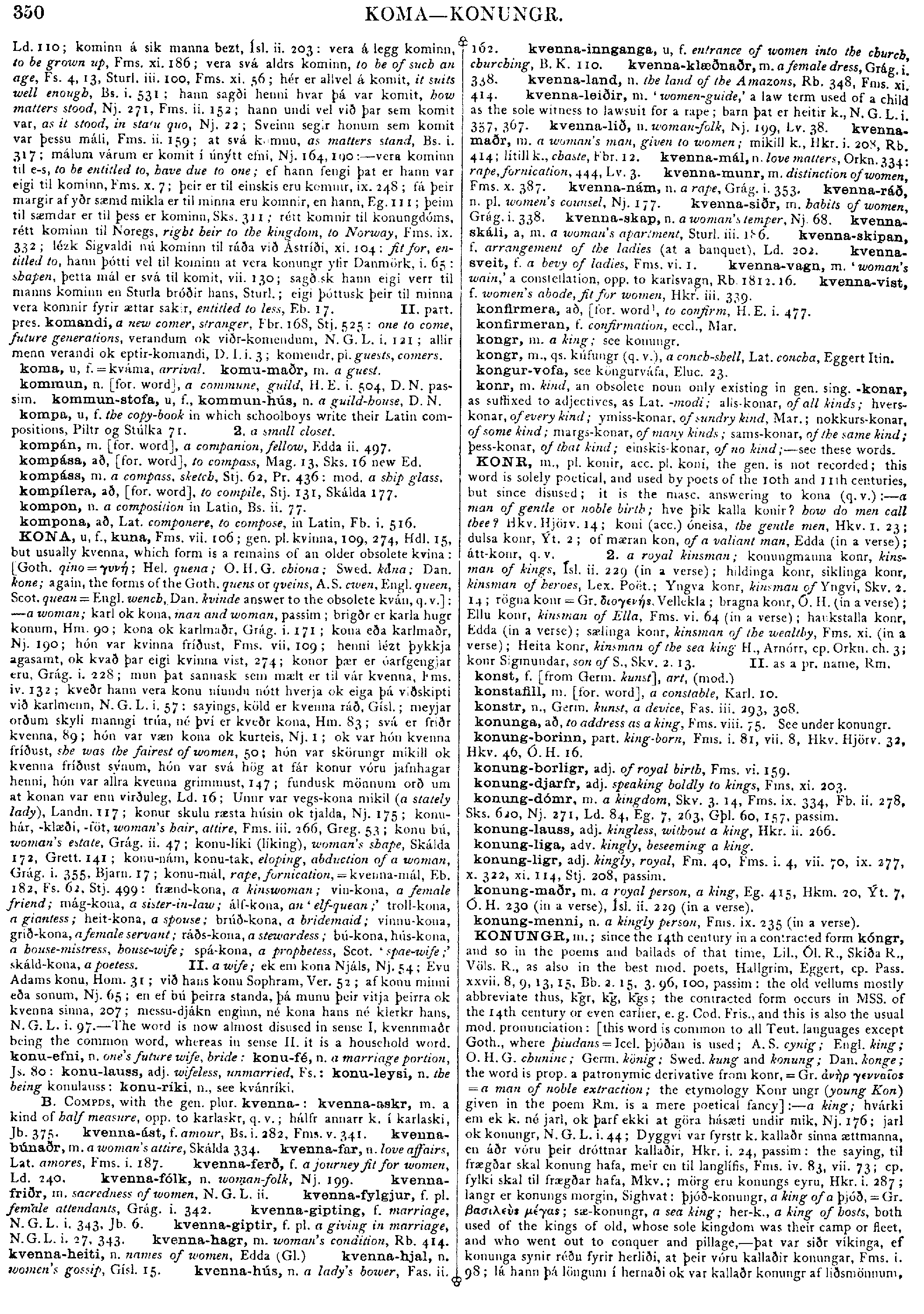
KONUNGR, m.; since the 14th century in a contracted form kóngr, and so in the poems and ballads of that time, Lil., Ól. R., Skíða R., Völs. R., as also in the best mod. poets, Hallgrim, Eggert, cp. Pass. xxvii. 8, 9, 13, 15, Bb. 2. 15, 3. 96, 100, passim: the old vellums mostly abbreviate thus, kgr, kg, kgs UNCERTAIN; the contracted form occurs in MSS. of the 14th century or even earlier, e.g. Cod. Fris., and this is also the usual mod. pronunciation: [this word is common to all Teut. languages except Goth., where þiudans = Icel. þjóðan is used; A. S. cynig; Engl. king; O. H. G. chuninc; Germ. könig; Swed. kung and konung; Dan. konge; the word is prop. a patronymic derivative from konr, = Gr. GREEK = a man of noble extraction; the etymology Konr ungr (young Kon) given in the poem Rm. is a mere poetical fancy] :-- a king; hvárki em ek k. né jarl, ok þarf ekki at göra hásæti undir mik, Nj. 176; jarl ok konungr, N. G. L. i. 44; Dyggvi var fyrstr k. kallaðr sinna ættmanna, en áðr vóru þeir dróttnar kallaðir, Hkr. i. 24, passim: the saying, til frægðar skal konung hafa, meir en til langlífis, Fms. iv. 83, vii. 73; cp. fylki skal til frægðar hafa, Mkv.; mörg eru konungs eyru, Hkr. i. 287; langr er konungs morgin, Sighvat: þjóð-konungr, a king of a þjóð, = Gr. GREEK; sæ-konungr, a sea king; her-k., a king of hosts, both used of the kings of old, whose sole kingdom was their camp or fleet, and who went out to conquer and pillage, -- þat var siðr víkinga, ef konunga synir réðu fyrir herliði, at þeir vóru kallaðir konungar, Fms. i. 98; lá hann þá löngum í hernaði ok var kallaðr konungr af liðsmönnum,
|
Source: Cleasby/Vigfusson, page b0478, entry 7 View original page image as: [TIFF] [PNG] [View previous entry] [View next entry] |
[Comment on this entry] [View comments] |
The following entry has been hand-corrected once. |
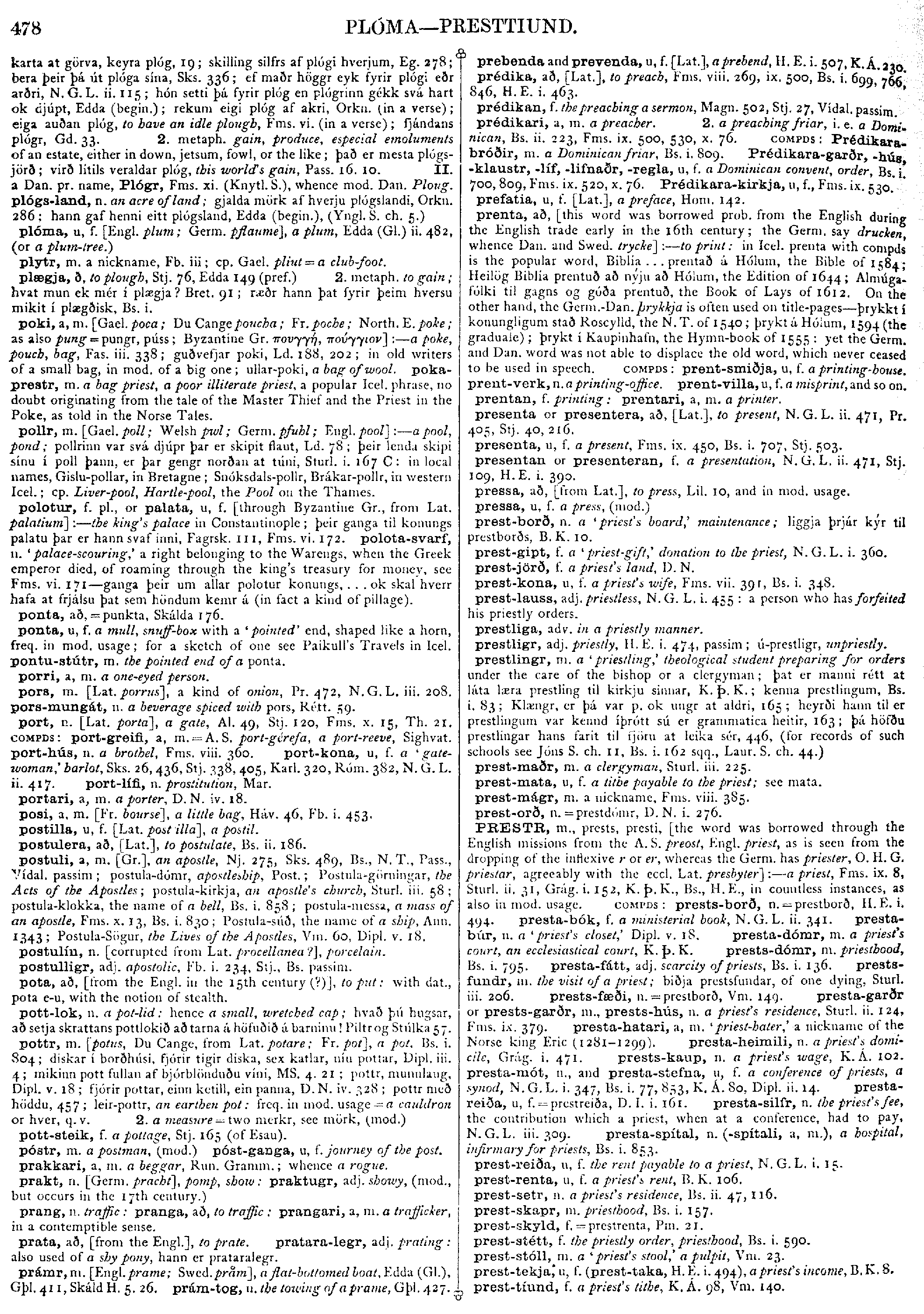
polotur, f. pl., or palata, u, f. [through Byzantine Gr., from Lat. palatium] :-- the king's palace in Constantinople; þeir ganga til konungs palatu þar er hann svaf inni, Fagrsk. 111, Fms. vi. 172. polota-svarf, n. 'palace-scouring,' a right belonging to the Warengs, when the Greek emperor died, of roaming through the king's treasury for money, see Fms. vi. 171 -- ganga þeir um allar polotur konungs, ... ok skal hverr hafa at frjálsu þat sem höndum kemr á (in fact a kind of pillage).
| Result Page: |  |
Previous | 1 2 |
Germanic Lexicon Project (main page)
This search system was written by
Sean Crist
Please consider
volunteering
to correct the data in these online dictionaries.
No rights reserved. Feel free to use these data in any way you please.