|
|

|
Source: Wright's Gothic Grammar, page b0326, entry 18 View original page image as: [TIFF] [PNG] [View previous entry] [View next entry] |
[Comment on this entry] [View comments] |
The following entry has been hand-corrected once. |
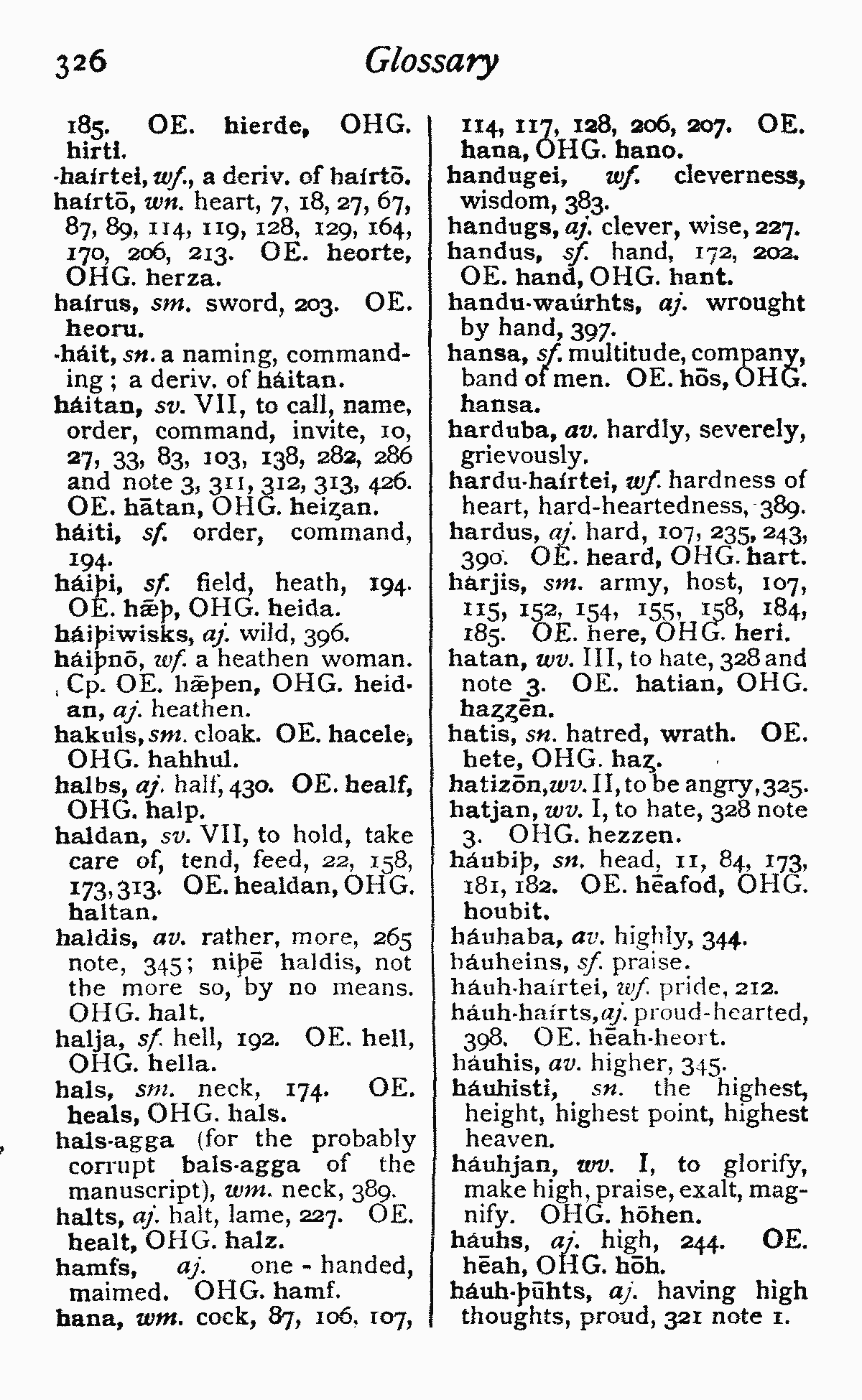
hamfs, aj. one-handed, maimed. OHG. hamf.
|
Source: Bosworth/Toller, page b0219, entry 7 View original page image as: [TIFF] [PNG] [View previous entry] [View next entry] |
[Comment on this entry] [View comments] |
The following entry has been hand-corrected once. |
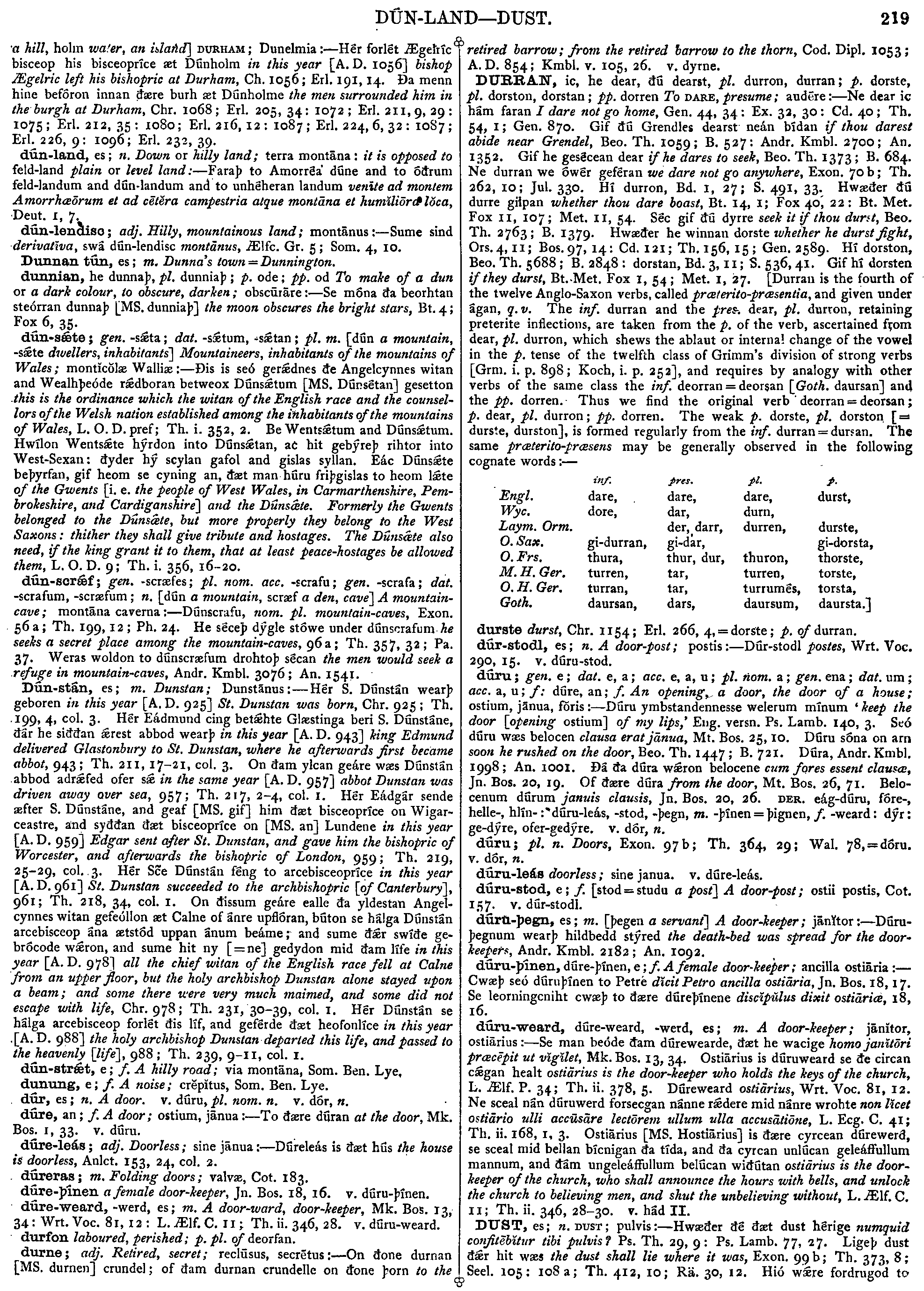
Dún-stán,
es;
m.
Dunstan;
Dunst nus
:--
Hér
S.
Dúnstán
wearþ
geboren
in
this
year
[A.
D.
925]
St.
Dunstan
was
born,
Chr.
925;
Th.
199,
4,
col.
3.
Hér
Eádmund
cing
bet
nus
:--
Hér
S.
Dúnstán
wearþ
geboren
in
this
year
[A.
D.
925]
St.
Dunstan
was
born,
Chr.
925;
Th.
199,
4,
col.
3.
Hér
Eádmund
cing
bet hte
Glæstinga
beri
S.
Dúnstáne,
ðár
he
siððan
rest
abbod
wearþ
in
this
year
[A.
D.
943]
king
Edmund
delivered
Glastonbury
to
St.
Dunstan,
where
he
afterwards
first
became
abbot,
943;
Th.
211,
17-21,
col.
3.
On
ðam
ylcan
geáre
wæs
Dúnstán
abbod
adrfed
ofer
s
in
the
same
year
[A.
D.
957]
abbot
Dunstan
was
driven
away
over
sea,
957;
Th.
217,
2-4,
col.
1.
Hér
Eádgár
sende
æfter
S.
Dúnstáne,
and
geaf
[MS.
gif]
him
ðæt
bisceopríce
on
Wigarceastre,
and
syððan
ðæt
bisceopríce
on
[MS.
an]
Lundene
in
this
year
[A.
D.
959]
Edgar
sent
after
St.
Dunstan,
and
gave
him
the
bishopric
of
Worcester,
and
afterwards
the
bishopric
of
London,
959;
Th.
219,
25-29,
col.
3.
Hér
Sce
Dúnstán
féng
to
arcebisceopríce
in
this
year
[A.
D.
961]
St.
Dunstan
succeeded
to
the
archbishopric
[of
Canterbury],
961;
Th.
218,
34,
col.
1.
On
ðissum
geáre
ealle
ða
yldestan
Angelcynnes
witan
gefeóllon
æt
Calne
of
ánre
upflóran,
búton
se
hálga
Dúnstán
arcebisceop
ána
ætstód
uppan
ánum
beáme;
and
sume
ðr
swíðe
gebrócode
wron,
and
sume
hit
ny
[
=
ne]
gedydon
mid
ðam
lífe
in
this
year
[A.
D.
978]
all
the
chief
witan
of
the
English
race
fell
at
Calne
from
an
upper
floor,
but
the
holy
archbishop
Dunstan
alone
stayed
upon
a
beam;
and
some
there
were
very
much
maimed,
and
some
did
not
escape
with
life,
Chr.
978;
Th.
231,
30-39,
col.
1.
Hér
Dúnstán
se
hálga
arcebisceop
forlét
ðis
líf,
and
geférde
ðæt
heofonlíce
in
this
year
[A.
D.
988]
the
holy
archbishop
Dunstan
departed
this
life,
and
passed
to
the
heavenly
[life],
988;
Th.
239,
9-11,
col.
1.
hte
Glæstinga
beri
S.
Dúnstáne,
ðár
he
siððan
rest
abbod
wearþ
in
this
year
[A.
D.
943]
king
Edmund
delivered
Glastonbury
to
St.
Dunstan,
where
he
afterwards
first
became
abbot,
943;
Th.
211,
17-21,
col.
3.
On
ðam
ylcan
geáre
wæs
Dúnstán
abbod
adrfed
ofer
s
in
the
same
year
[A.
D.
957]
abbot
Dunstan
was
driven
away
over
sea,
957;
Th.
217,
2-4,
col.
1.
Hér
Eádgár
sende
æfter
S.
Dúnstáne,
and
geaf
[MS.
gif]
him
ðæt
bisceopríce
on
Wigarceastre,
and
syððan
ðæt
bisceopríce
on
[MS.
an]
Lundene
in
this
year
[A.
D.
959]
Edgar
sent
after
St.
Dunstan,
and
gave
him
the
bishopric
of
Worcester,
and
afterwards
the
bishopric
of
London,
959;
Th.
219,
25-29,
col.
3.
Hér
Sce
Dúnstán
féng
to
arcebisceopríce
in
this
year
[A.
D.
961]
St.
Dunstan
succeeded
to
the
archbishopric
[of
Canterbury],
961;
Th.
218,
34,
col.
1.
On
ðissum
geáre
ealle
ða
yldestan
Angelcynnes
witan
gefeóllon
æt
Calne
of
ánre
upflóran,
búton
se
hálga
Dúnstán
arcebisceop
ána
ætstód
uppan
ánum
beáme;
and
sume
ðr
swíðe
gebrócode
wron,
and
sume
hit
ny
[
=
ne]
gedydon
mid
ðam
lífe
in
this
year
[A.
D.
978]
all
the
chief
witan
of
the
English
race
fell
at
Calne
from
an
upper
floor,
but
the
holy
archbishop
Dunstan
alone
stayed
upon
a
beam;
and
some
there
were
very
much
maimed,
and
some
did
not
escape
with
life,
Chr.
978;
Th.
231,
30-39,
col.
1.
Hér
Dúnstán
se
hálga
arcebisceop
forlét
ðis
líf,
and
geférde
ðæt
heofonlíce
in
this
year
[A.
D.
988]
the
holy
archbishop
Dunstan
departed
this
life,
and
passed
to
the
heavenly
[life],
988;
Th.
239,
9-11,
col.
1.
|
Source: Bosworth/Toller, page b0616, entry 18 View original page image as: [TIFF] [PNG] [View previous entry] [View next entry] |
[Comment on this entry] [View comments] |
The following entry has been hand-corrected once. |
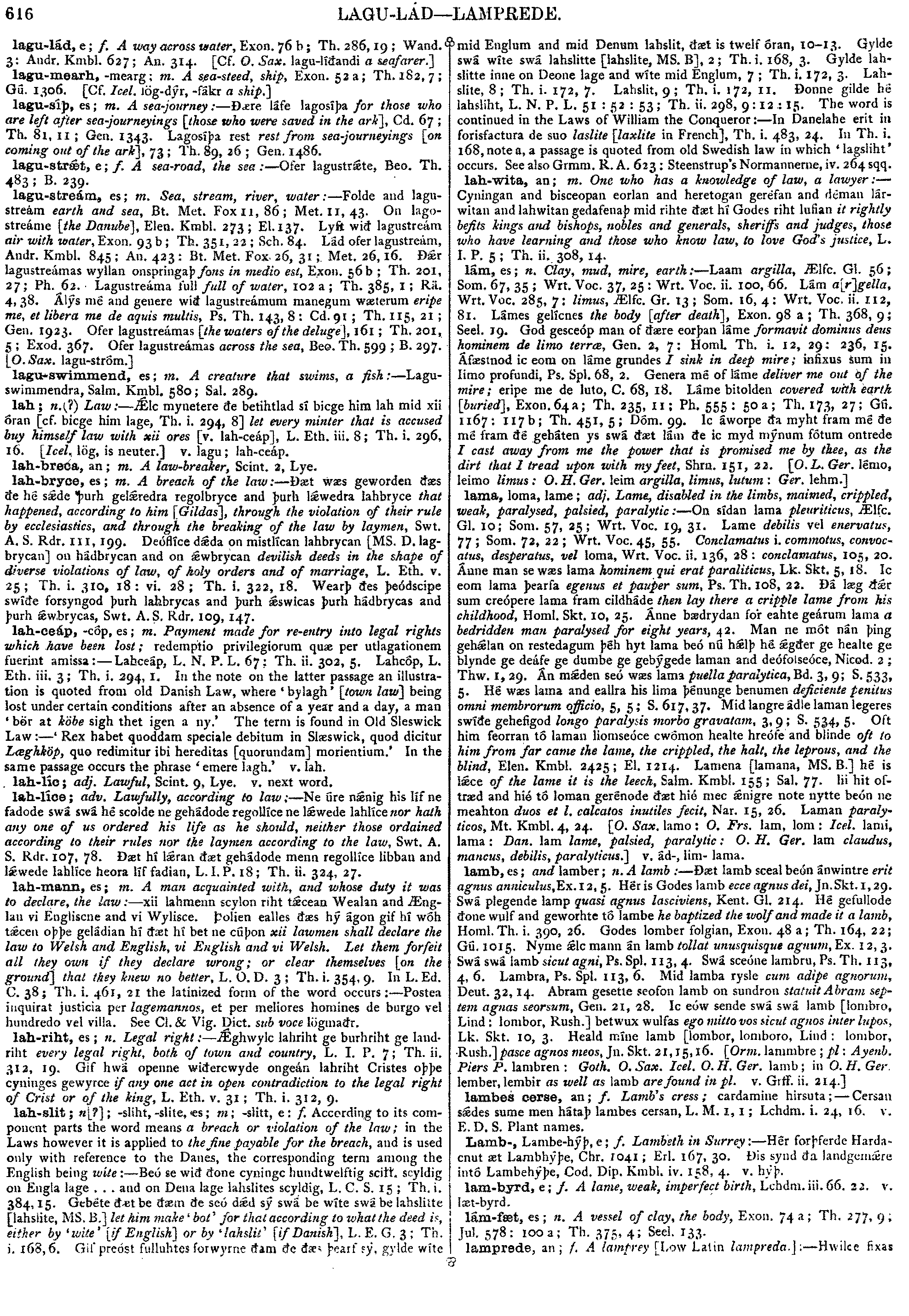
lama,
loma,
lame;
adj.
Lame,
disabled
in
the
limbs,
maimed,
crippled,
weak,
paralysed,
palsied,
paralytic
:--
On
sídan
lama
pleuriticus,
Ælfc.
Gl.
10;
Som.
57,
25;
Wrt.
Voc.
19,
31.
Lame
debilis
vel
enervatus,
77;
Som.
72,
22;
Wrt.
Voc.
45,
55.
Conclamatus
i.
commotus,
convocatus,
desperatus,
vel
loma,
Wrt.
Voc.
ii.
136,
28:
conclamatus,
105,
20.
Ánne
man
se
wæs
lama
hominem
qui
erat
paraliticus,
Lk.
Skt.
5,
18.
Ic
eom
lama
þearfa
egenus
et
pauper
sum,
Ps.
Th.
108,
22.
Ðá
læg
ðr
sum
creópere
lama
fram
cildháde
then
lay
there
a
cripple
lame
from
his
childhood,
Homl.
Skt.
10,
25.
Ánne
bædrydan
for
eahte
geárum
lama
a
bedridden
man
paralysed
for
eight
years,
42.
Man
ne
mót
nán
þing
gehlan
on
restedagum
þéh
hyt
lama
beó
nú
hlþ
hé
gðer
ge
healte
ge
blynde
ge
deáfe
ge
dumbe
ge
gebýgede
laman
and
deófolseóce,
Nicod.
2;
Thw.
1,
29.
Án
mden
seó
wæs
lama
puella
paralytica,
Bd.
3,
9;
S.
533,
5.
Hé
wæs
lama
and
eallra
his
lima
þénunge
benumen
deficiente
penitus
omni
membrorum
officio,
5,
5;
S.
617,
37.
Mid
langre
ádle
laman
legeres
swíðe
gehefigod
longo
paralysis
morbo
gravatam,
3,
9;
S.
534,
5.
Oft
him
feorran
tó
laman
liomseóce
cwómon
healte
hreófe
and
blinde
oft
to
him
from
far
cane
the
lame,
the
crippled,
the
halt,
the
leprous,
and
the
blind,
Elen.
Kmbl.
2425;
El.
1214.
Lamena
[lamana,
MS.
B.]
hé
is
lce
of
the
lame
it
is
the
leech,
Salm.
Kmbl.
155;
Sal.
77.
lii
hit
oftræd
and
hié
tó
loman
gerénode
ðæt
hió
mec
nigre
note
nytte
beón
ne
meahton
duos
et
1.
calcatos
inutiles
fecit,
Nar.
15,
26.
Laman
paralyticos,
Mt.
Kmbl.
4,
24.
[O.
Sax.
lamo:
O.
Frs.
lam,
lom:
Icel.
lami,
lama:
Dan.
lam
lame,
palsied,
paralytic:
O.
H.
Ger.
lam
claudus,
mancus,
debilis,
paralyticus.]
v.
ád-,
lim-
lama.
|
Source: Bosworth/Toller, page b0641, entry 18 View original page image as: [TIFF] [PNG] [View previous entry] [View next entry] |
[Comment on this entry] [View comments] |
The following entry has been hand-corrected once. |
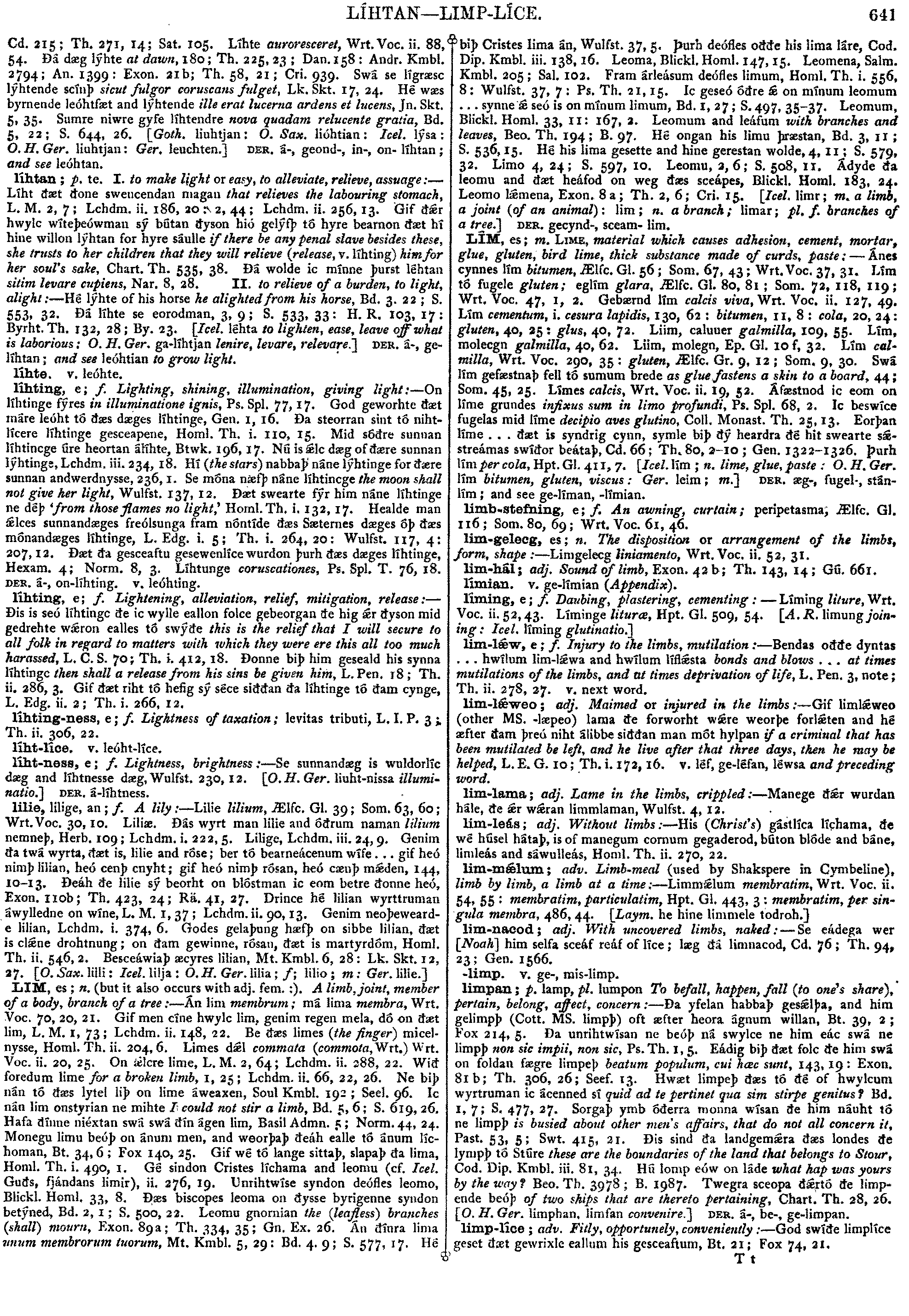
lim-lweo;
adj.
Maimed
or
injured
in
the
limbs
:--
Gif
limlweo
(other
MS.
-læpeo)
lama
ðe
forworht
wre
weorþe
forlten
and
hé
æfter
ðam
þreó
niht
álibbe
siððan
man
mót
hylpan
if
a
criminal
that
has
been
mutilated
be
left,
and
he
live
after
that
three
days,
then
he
may
be
helped,
L.
E.
G.
10;
Th,
i.
172,
16.
v.
léf,
ge-léfan,
léwsa
and
preceding
word.
|
Source: Bosworth/Toller, page b1166, entry 17 View original page image as: [TIFF] [PNG] [View previous entry] [View next entry] |
[Comment on this entry] [View comments] |
The following entry has been hand-corrected once. |
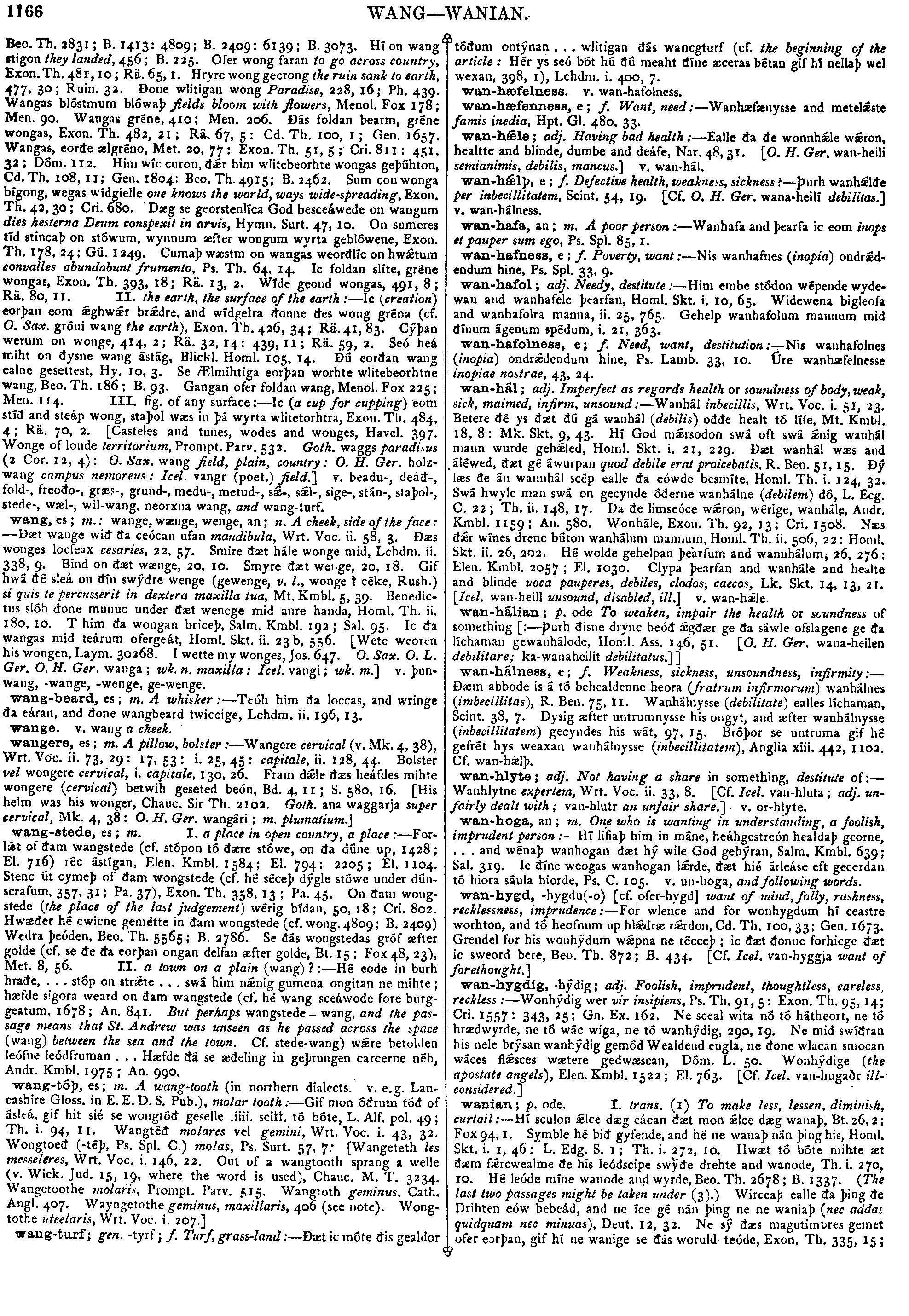
wan-hál;
adj.
Imperfect
as
regards
health
or
soundness
of
body,
weak,
sick,
maimed,
infirm,
unsound
:--
Wanhál
inbecillis,
Wrt.
Voc.
i.
51,
23.
Betere
ðé
ys
ðæt
ðú
gá
wanhál
(debilis)
oððe
healt
tó
lífe,
Mt.
Kmbl.
18,
8:
Mk.
Skt.
9,
43.
Hú
God
m rsodon
swá
oft
swá
nig
wanhál
mann
wurde
gehled,
Homl.
Skt.
i.
21,
229.
Ðæt
wanhál
wæs
and
áléwed,
ðæt
gé
áwurpan
quod
debile
erat
proicebatis,
R.
Ben.
51,
15.
Ðýæs
ðe
án
wannhál
scép
ealle
ða
eówde
besmíte,
Homl.
Th.
i.
124,
32.
Swá
hwylc
man
swá
on
gecynde
óðerne
wanhálne
(debilem)
dó,
L.
Ecg.
C.
22
;
Th.
ii.
148,
17.
Ða
ðe
limseóce
wron,
wérige,
wanhále,
Andr.
Kmbl.
1159
;
An.
580.
Wonhále,
Exon.
Th.
92,
13;
Cri.
1508.
Næs
ðr
wínes
drenc
búton
wanhálum
mannum,
Homl.
Th.
ii.
506,
22:
Homl.
Skt.
ii.
26,
202.
Hé
wolde
gehelpan
þearfum
and
wanuhálum,
26,
276:
Elen.
Kmbl.
2057
;
El.
1030.
Clypa
þearfan
and
wanhále
and
healte
and
blinde
uoca
pauperes,
debiles,
clodos,
caecos,
Lk.
Skt.
14,
13,
21.
[Icel.
wan-heill
unsound,
disabled,
ill.]
v.
wan-hle.
rsodon
swá
oft
swá
nig
wanhál
mann
wurde
gehled,
Homl.
Skt.
i.
21,
229.
Ðæt
wanhál
wæs
and
áléwed,
ðæt
gé
áwurpan
quod
debile
erat
proicebatis,
R.
Ben.
51,
15.
Ðýæs
ðe
án
wannhál
scép
ealle
ða
eówde
besmíte,
Homl.
Th.
i.
124,
32.
Swá
hwylc
man
swá
on
gecynde
óðerne
wanhálne
(debilem)
dó,
L.
Ecg.
C.
22
;
Th.
ii.
148,
17.
Ða
ðe
limseóce
wron,
wérige,
wanhále,
Andr.
Kmbl.
1159
;
An.
580.
Wonhále,
Exon.
Th.
92,
13;
Cri.
1508.
Næs
ðr
wínes
drenc
búton
wanhálum
mannum,
Homl.
Th.
ii.
506,
22:
Homl.
Skt.
ii.
26,
202.
Hé
wolde
gehelpan
þearfum
and
wanuhálum,
26,
276:
Elen.
Kmbl.
2057
;
El.
1030.
Clypa
þearfan
and
wanhále
and
healte
and
blinde
uoca
pauperes,
debiles,
clodos,
caecos,
Lk.
Skt.
14,
13,
21.
[Icel.
wan-heill
unsound,
disabled,
ill.]
v.
wan-hle.
|
Source: Bosworth/Toller, page b1263, entry 4 View original page image as: [TIFF] [PNG] [View previous entry] [View next entry] |
[Comment on this entry] [View comments] |
The following entry has been hand-corrected once. |
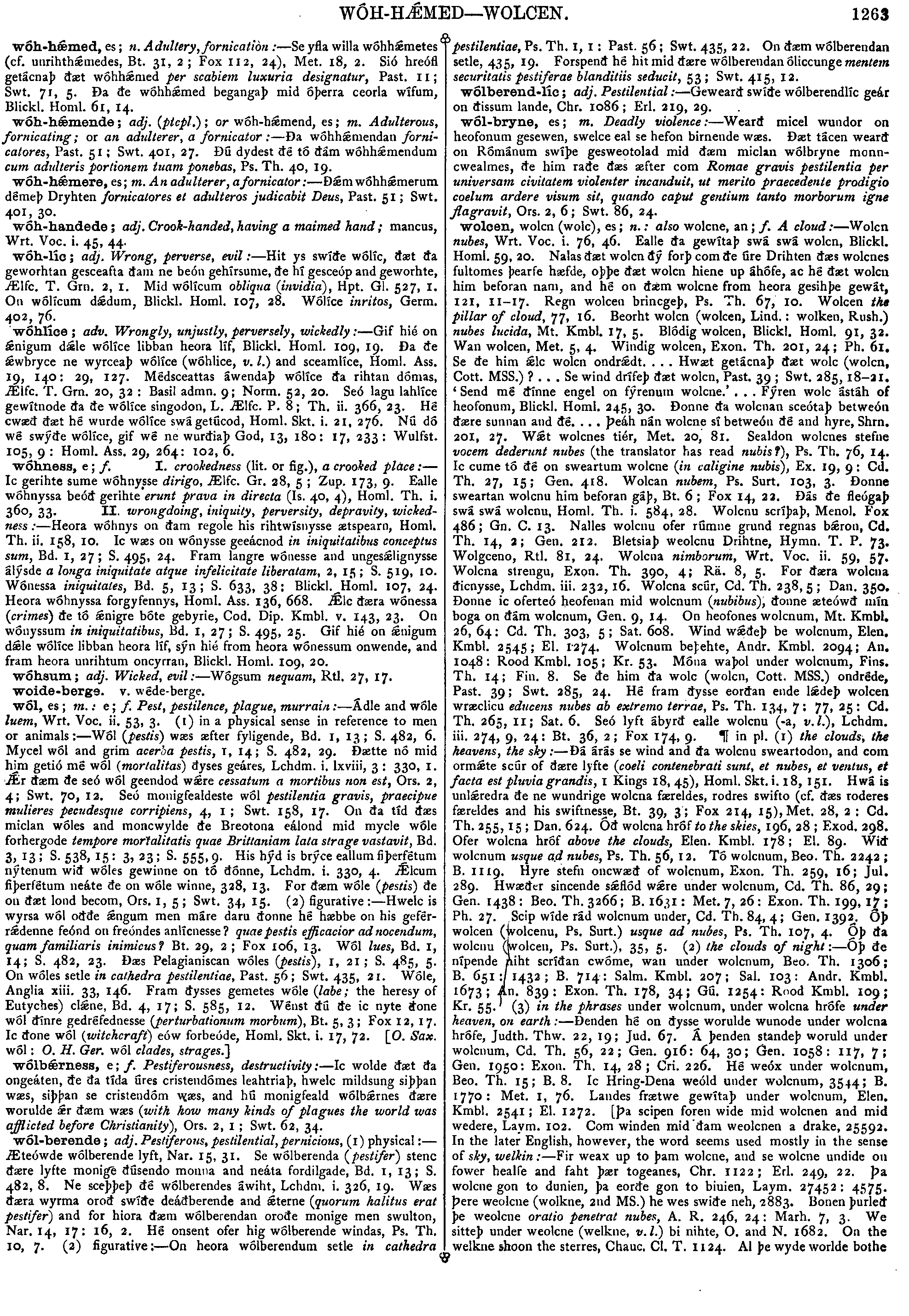
wóh-handede; adj. Crook-handed, having a maimed hand; mancus, Wrt. Voc. i. 45, 44.
|
Source: Cleasby/Vigfusson, page b0027, entry 2 View original page image as: [TIFF] [PNG] [View previous entry] [View next entry] |
[Comment on this entry] [View comments] |
The following entry has been hand-corrected once. |
C.
METAPH.
and
in
various
cases:
I.
denoting
a
transforma-
tion
or
change
into,
to,
with
the
notion
of
destruction;
brenna
at
ösku,
at
köldum
kolum,
to
burn
to
ashes,
to
be
quite
destroyed,
Fms.
i.
105,
Edda
3,
Sturl.
ii.
51:
with
the
notion
of
transformation
or
transfiguration,
in
such
phrases
as,
verða
at
e-u,
göra
e-t
at
e-u,
to
turn
it
into:
a.
by
a
spell;
verða
at
ormi,
to
become
a
snake,
Fms.
xi.
158;
at
flugdrekum,
Gullþ.
7;
urðu
þau
bönd
at
járni,
Edda
40.
P.
by
a
natural
process
it
can
often
be
translated
by
an
acc.
or
by
as;
göra
e-n
at
urðarmanni,
'
t
o
make
him
an
outlaw,
Eg.
728;
græða
e-n
at
orkumlamanni,
to
heal
him
so
as
to
maim
him
for
life,
of
bad
treatment
by
a
leech,
Eb.
244:
in
the
law
terms,
sár
görist
at
ben,
a
wound
turning
into
a
ben,
proving
to
be
mortal,
Grág.,
Nj.;
verða
at
ljúgvætti,
to
prove
to
be
a
false
evidence,
Grág.
i.
44;
verða
at
sætt,
to
turn
into
reconciliation,
Fms.
i.
13;
göra
e-t
at
reiði
málum,
to
take
offence
at,
Fs.
20;
at
nýjum
tíðindum,
to
tell
as
news,
Nj.
14;
verða
fátt
at
orðum,
to
be
sparing
of
words,
18;
kveðr
(svá)
at
orði,
to
speak,
utter,
10;
verða
at
þrifnaði,
to
geton
well,
Fms.
vii.
196:
at
liði,
at
skaða,
to
be
a
help
or
hurt
to
one;
at
bana,
to
cause
one's
death,
Nj.
223,
Eg.
21,
Grág.
ii.
29:
at
undrum,
at
hlátri,
to
become
a
wonder,
a
laughing-stock,
623.
35,
Eg.
553.
II.
denoting
capacity,
where
it
may
be
translated
merely
by
as
or
for;
gefa
at
Jólagjöf,
to
give
for
a
Christmas-box,
Eg.
516;
at
gjöf,
for
a
present;
at
erfð,
at
láni,
launum,
as
an
inheritance,
a
loan;
at
kaupum
ok
sökum,
for
buying
and
selling,
Ísl.
ii.
223,
Grág.
i.
423;
at
solum,
ii.
204;
at
herfangi,
as
spoil
or
plunder;
at
sakbótum,
at
niðgjöldum,
as
a
compensation,
weregeld,
i.
339,
ii.
171,
Hkr.
ii.
168;
taka
at
gíslingu,
to
take
as
an
hostage,
Edda
15;
eiga
e-n
at
vin,
at
óvin,
to
have
one
as
friend
or
foe,
illt
er
at
eiga
þræl
at
eingavin,
'tis
ill
to
have
a
thrall
for
one's
bosom
friend
(a
proverb),
Nj.
77;
fæða,
eiga,
at
sonum
(syni),
to
beget
a
son,
Edda
8,
Bs.
i.
60
(but
eiga
at
dóttur
cannot
be
said);
hafa
möttul
at
yfirhöfn,
Fms.
vii.
201;
verða
nökkut
at
manni
(mönnum),
to
turn
out
to
be
a
worthy
man;
verða
ekki
at
manni,
to
turn
out
a
worthless
person,
xi.
79,
268.
2.
in
such
phrases
as,
verða
at
orðum,
to
come
towards,
Nj.
26;
var
þat
at
erindum,
Eg.
148;
hafa
at
veizlum,
to
draw
veizlur
(dues)
from,
'Fms.
iv.
275,
Eg.
647;
gora
e-t
at
álitum,
to
take
it
into
consideration,
Nj-3.
III.
denoting
belonging
to,
fitting,
of
parts
of
the
whole
or
the
like;
vóru
at
honum
(viz.
the
sword)
hjölt
gullbúin,
the
sword
was
ornamented
with
a
hilt
of
gold,
Ld.
330;
umgörð
at
(belonging
to)
sverði,
Fs.
97
(Hs.)
in
a
verse;
en
ef
mór
er
eigi
at
landinu,
if
there
be
no
turf
moor
belonging
to
the
land,
Grág.
ii.
338;
svá
at
eigi
brotnaði
nokkuð
at
Orminum,
so
that
no
harm
happened
to
the
ship
Worm,
Fms.
x.
356;
hvatki
er
meiðir
at
skipinu
eðr
at
reiðinu
eðr
at
viðum,
damage
done
t
o
...,
Grág.
ii.
403;
lesta
(to
injure)
hús
at
lásum,
við
eðr
torfi,
110;
ef
land
hefir
batnað
at
húsum,
if
the
land
has
been
bettered
as
to
its
buildings,
210;
cp.
the
phrase,
göra
at
e-u,
to
repair:
hamlaðr
at
höndum
eðr
fótum,
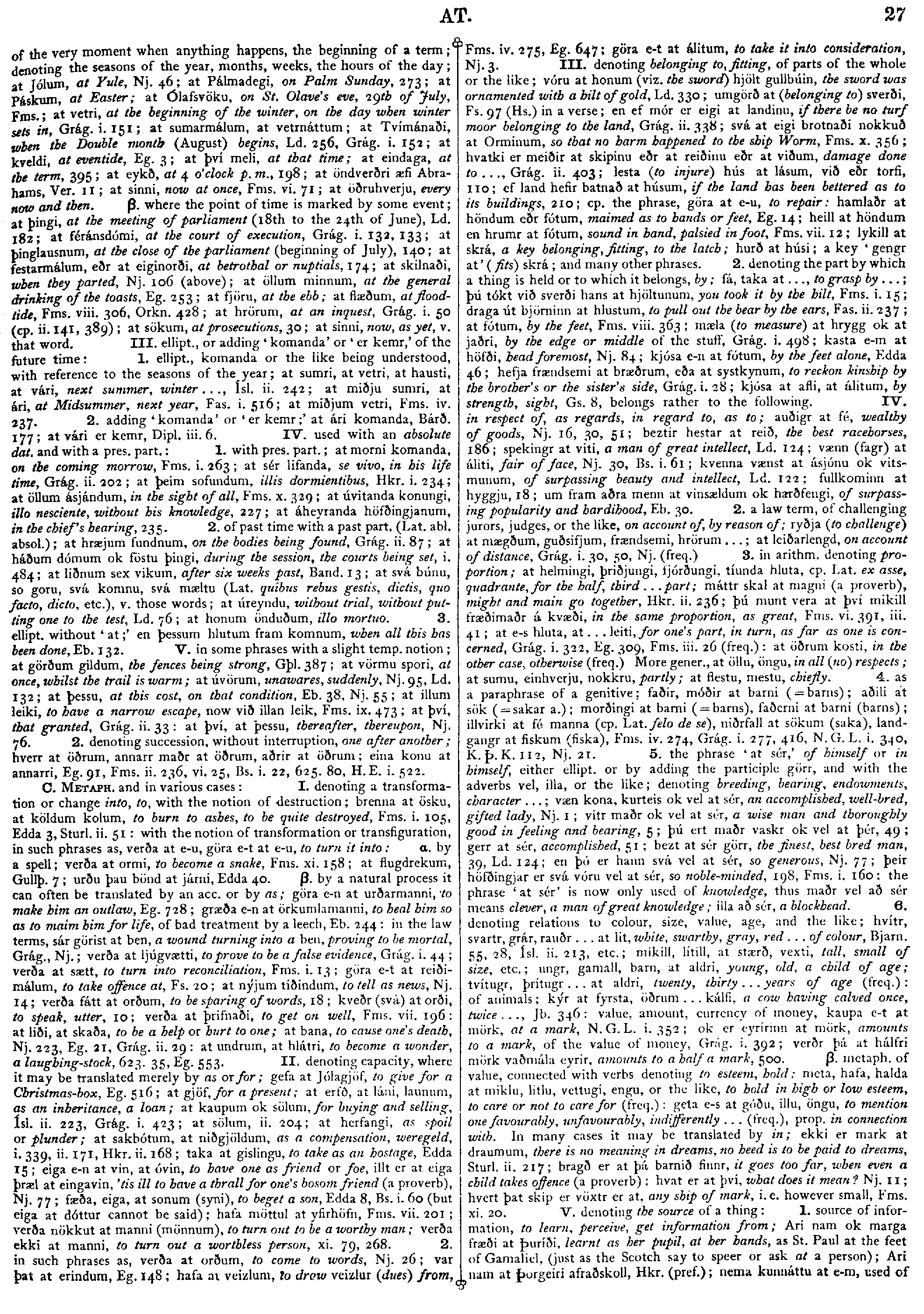
maimed
as
to
hands
or
feet,
Eg.
14;
heill
at
höndum
en
hrumr
at
fótum,
sound
in
band,
palsied
in
foot,
Fms.
vii.
12;
lykill
at
skrá,
a
key
belonging,
fitting,
to
the
latch;
hurð
at
húsi;
a
key
'gengr
at'
(fits)
skrá;
and
many
other
phrases.
2.
denoting
the
part
by
which
a
thing
is
held
or
to
which
it
belongs,
by;
fá,
taka
at...,
to
grasp
by
...;
þú
tókt
við
sverði
hans
at
hjöltunum,
you
took
it
by
the
bill,
Fms.
i.
15;
draga
út
björninn
at
hlustum,
to
pull
out
the
bear
by
the
ears,
Fas.
ii.
237;
at
fótum,
by
the
feet,
Fms.
viii.
363;
mæla
(to
measure)
at
hrygg
ok
at
jaðri,
by
the
edge
or
middle
of
the
stuff,
Grág.
i.
498;
kasta
e-m
at
höfði,
head
foremost,
Nj.
84;
kjósa
e-n
at
fótum,
by
the
feet
alone,
Edda
46;
hefja
frændsemi
at
bræðrum,
eða
at
systkynum,
to
reckon
kinship
by
the
brother's
or
the
sister's
side,
Grág.
i.
28;
kjósa
at
afli,
at
álitum,
by
strength,
sight,
Gs.
8,
belongs
rather
to
the
following.
IV.
in
respect
of,
as
regards,
in
regard
to,
as
to;
auðigr
at
fé,
wealthy
of
goods,
Nj.
16,
30,
51;
beztir
hestar
at
reið,
the
best
racehorses,
186;
spekingr
at
viti,
a
man
of
great
intellect,
Ld.
124;
vænn
(fagr)
at
áliti,
fair
of
face,
Nj.
30,
Bs.
i.
61;
kvenna
vænst
at
ásjónu
ok
vits
munum,
of
surpassing
beauty
and
intellect,
Ld.
122;
fullkominn
at
hyggju,
18;
um
fram
aðra
menn
at
vinsældum
ok
harðfengi,
of
surpass-
ing
popularity
and
hardihood,
Eb.
30.
2.
a
law
term,
of
challenging
jurors,
judges,
or
the
like,
on
account
of,
by
reason
of;
ryðja
(to
challenge)
at
mægðum,
guðsifjum,
frændsemi,
hrörum
...;
at
leiðarlengd,
on
account
of
distance,
Grág.
i.
30,
50,
Nj.
(freq.)
3.
in
arithm.
denoting
pro
portion;
at
helmingi,
þriðjungi,
fjórðungi,
tíunda
hluta,
cp.
Lat.
ex
asse,
quadrante,
for
the
half,
third...
part;
máttr
skal
at
magni
(a
proverb),
might
and
main
go
together,
Hkr.
ii.
236;
þú
munt
vera
at
því
mikill
fræðimaðr
á
kvæði,
in
the
same
proportion,
as
great,
Fms.
vi.
391,
iii.
41;
at
e-s
hluta,
at...
leiti,
for
one's
part,
in
turn,
as
far
as
one
is
con
cerned,
Grág.
i.
322,
Eg.
309,
Fms.
iii.
26
(freq.):
at
öðrum
kosti,
in
the
other
case,
otherwise
(freq.)
More
gener.,
at
öllu,
öngu,
in
all
(no)
respects;
at
sumu,
einhverju,
nokkru,
partly;
at
flestu,
mestu,
chiefly.
4.
as
a
paraphrase
of
a
genitive;
faðir,
móðir
at
barni
(=
barns);
aðili
at
sök
(=
sakar
a.);
morðingi
at
barni
(=
barns),
faðerni
at
barni
(barns);
illvirki
at
fé
manna
(cp.
Lat.
felo
de
se),
niðrfall
at
sökum
(saka),
land
gangr
at
fiskum
(fiska),
Fms.
iv.
274,
Grág.
i.
277,
416,
N.
G.
L.
i.
340,
K.
Þ.
K.
112,
Nj.
21.
5.
the
phrase
'at
sér,'
of
himself
or
in
himself,
either
ellipt.
or
by
adding
the
participle
görr,
and
with
the
adverbs
vel,
ilia,
or
the
like;
denoting
breeding,
bearing,
endowments,
character
...;
væn
kona,
kurteis
ok
vel
at
sér,
an
accomplished,
well-bred,
gifted
lady,
Nj.
I;
vitr
maðr
ok
vel
at
sér,
a
wise
man
and
thoroughly
good
in
feeling
and
bearing,
5;
þú
ert
maðr
vaskr
ok
vel
at
þér,
49;
gerr
at
sér,
accomplished,
51;
bezt
at
sér
görr,
the
finest,
best
bred
man,
39,
Ld.
124;
en
þó
er
hann
svá
vel
at
sér,
so
generous,
Nj.
77;
þeir
höfðingjar
er
svá
vóru
vel
at
sér,
so
noble-minded,
198,
Fms.
i.
160:
the
phrase
'at
sér'
is
now
only
used
of
knowledge,
thus
maðr
vel
að
sér
means
clever,
a
man
of
great
knowledge;
illa
að
sér,
a
blockhead.
6.
denoting
relations
to
colour,
size,
value,
age,
and
the
like;
hvitr,
svartr,
grár,
rauðr
...
at
lit,
white,
swarthy,
gray,
red
...
of
colour,
Bjarn.
55,
28,
Ísl.
ii.
213,
etc.;
mikill,
litill,
at
stærð,
vexti,
tall,
small
of
size,
etc.;
ungr,
gamall,
barn,
at
aldri,
young,
old,
a
child
of
age;
tvítugr,
þrítugr
...
at
aldri,
twenty,
thirty
...
years
of
age
(freq.):
of
animals;
kyr
at
fyrsta,
öðrum
...
kálfi,
a
cow
having
calved
once,
twice...,
Jb.
346:
value,
amount,
currency
of
money,
kaupa
e-t
at
mörk,
at
a
mark,
N.
G.
L.
1.
352;
ok
er
eyririnn
at
mörk,
amounts
to
a
mark,
of
the
value
of
money,
Grág.
i.
392;
verðr
þá
at
hálfri
murk
vaðmála
eyrir,
amounts
to
a
half
a
mark,
500.
 .
metaph.
of
value,
connected
with
verbs
denoting
to
esteem,
hold;
meta,
hafa,
halda
at
miklu,
litlu,
vettugi,
engu,
or
the
like,
to
hold
in
high
or
low
esteem,
to
care
or
not
to
care
for
(freq.):
geta
e-s
at
góðu,
illu,
öngu,
to
mention
one
favourably,
unfavourably,
indifferently
...
(freq.),
prop,
in
connection
with.
In
many
cases
it
may
be
translated
by
in;
ekki
er
mark
at
draumum,
there
is
no
meaning
in
dreams,
no
heed
is
to
be
paid
to
dreams,
Sturl.
ii.
217;
bragð
er
at
þá
barnið
finnr,
it
goes
too
far,
when
even
a
child
takes
offence
(a
proverb):
hvat
er
at
því,
what
does
it
mean?
Nj.
11;
hvert
þat
skip
er
vöxtr
er
at,
any
ship
of
mark,
i.
e.
however
small,
Fms.
xi.
2O.
V.
denoting
the
source
of
a
thing:
1.
source
of
infor
mation,
to
learn,
perceive,
get
information
from;
Ari
nam
ok
marga
fræði
at
Þuríði,
learnt
as
her
pupil,
at
her
hands,
as
St.
Paul
at
the
feet
of
Gamaliel,
(just
as
the
Scotch
say
to
speer
or
ask
at
a
person);
Ari
nam
at
Þorgeiri
afraðskoll,
Hkr.
(pref.);
nema
kunnáttu
at
e-m,
used
of
.
metaph.
of
value,
connected
with
verbs
denoting
to
esteem,
hold;
meta,
hafa,
halda
at
miklu,
litlu,
vettugi,
engu,
or
the
like,
to
hold
in
high
or
low
esteem,
to
care
or
not
to
care
for
(freq.):
geta
e-s
at
góðu,
illu,
öngu,
to
mention
one
favourably,
unfavourably,
indifferently
...
(freq.),
prop,
in
connection
with.
In
many
cases
it
may
be
translated
by
in;
ekki
er
mark
at
draumum,
there
is
no
meaning
in
dreams,
no
heed
is
to
be
paid
to
dreams,
Sturl.
ii.
217;
bragð
er
at
þá
barnið
finnr,
it
goes
too
far,
when
even
a
child
takes
offence
(a
proverb):
hvat
er
at
því,
what
does
it
mean?
Nj.
11;
hvert
þat
skip
er
vöxtr
er
at,
any
ship
of
mark,
i.
e.
however
small,
Fms.
xi.
2O.
V.
denoting
the
source
of
a
thing:
1.
source
of
infor
mation,
to
learn,
perceive,
get
information
from;
Ari
nam
ok
marga
fræði
at
Þuríði,
learnt
as
her
pupil,
at
her
hands,
as
St.
Paul
at
the
feet
of
Gamaliel,
(just
as
the
Scotch
say
to
speer
or
ask
at
a
person);
Ari
nam
at
Þorgeiri
afraðskoll,
Hkr.
(pref.);
nema
kunnáttu
at
e-m,
used
of
|
Source: Cleasby/Vigfusson, page b0050, entry 6 View original page image as: [TIFF] [PNG] [View previous entry] [View next entry] |
[Comment on this entry] [View comments] |
The following entry has been hand-corrected once. |
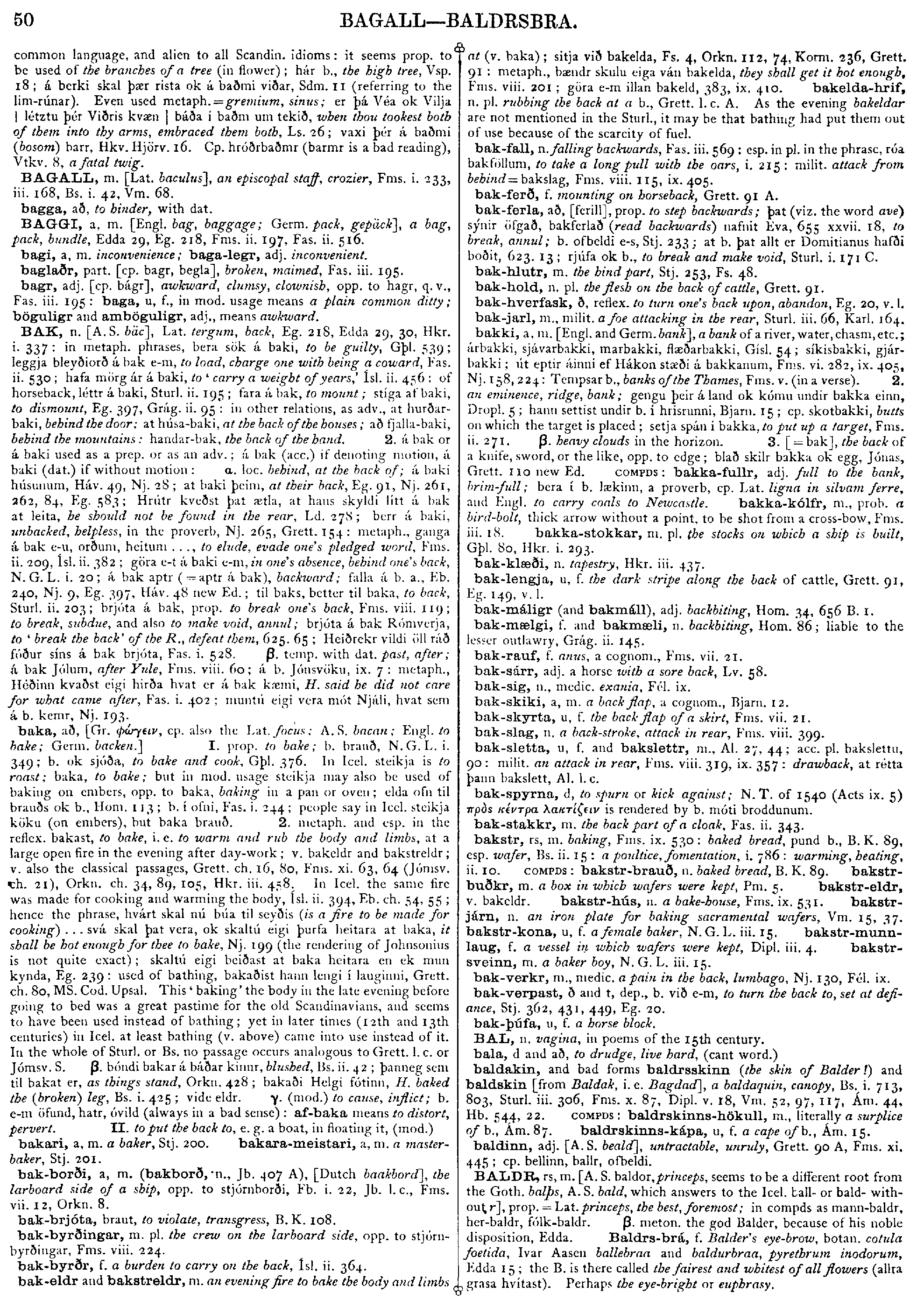
baglaðr, part. [cp. bagr, begla], broken, maimed, Fas. iii. 195.
|
Source: Cleasby/Vigfusson, page b0238, entry 14 View original page image as: [TIFF] [PNG] [View previous entry] [View next entry] |
[Comment on this entry] [View comments] |
The following entry has been hand-corrected once. |
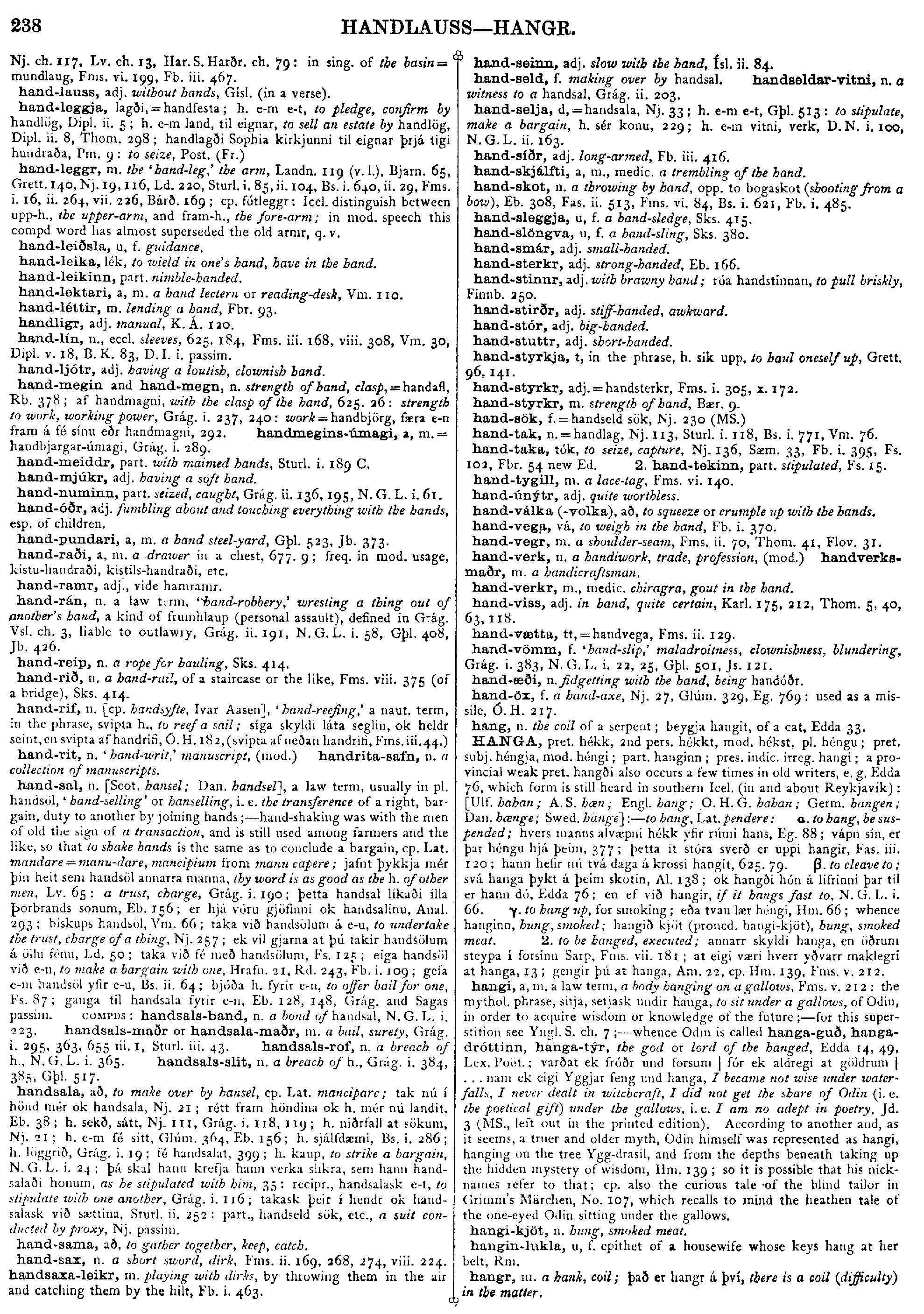
hand-meiddr, part. with maimed hands, Sturl. i. 189 C.
|
Source: Cleasby/Vigfusson, page b0275, entry 38 View original page image as: [TIFF] [PNG] [View previous entry] [View next entry] |
[Comment on this entry] [View comments] |
The following entry has been hand-corrected once. |
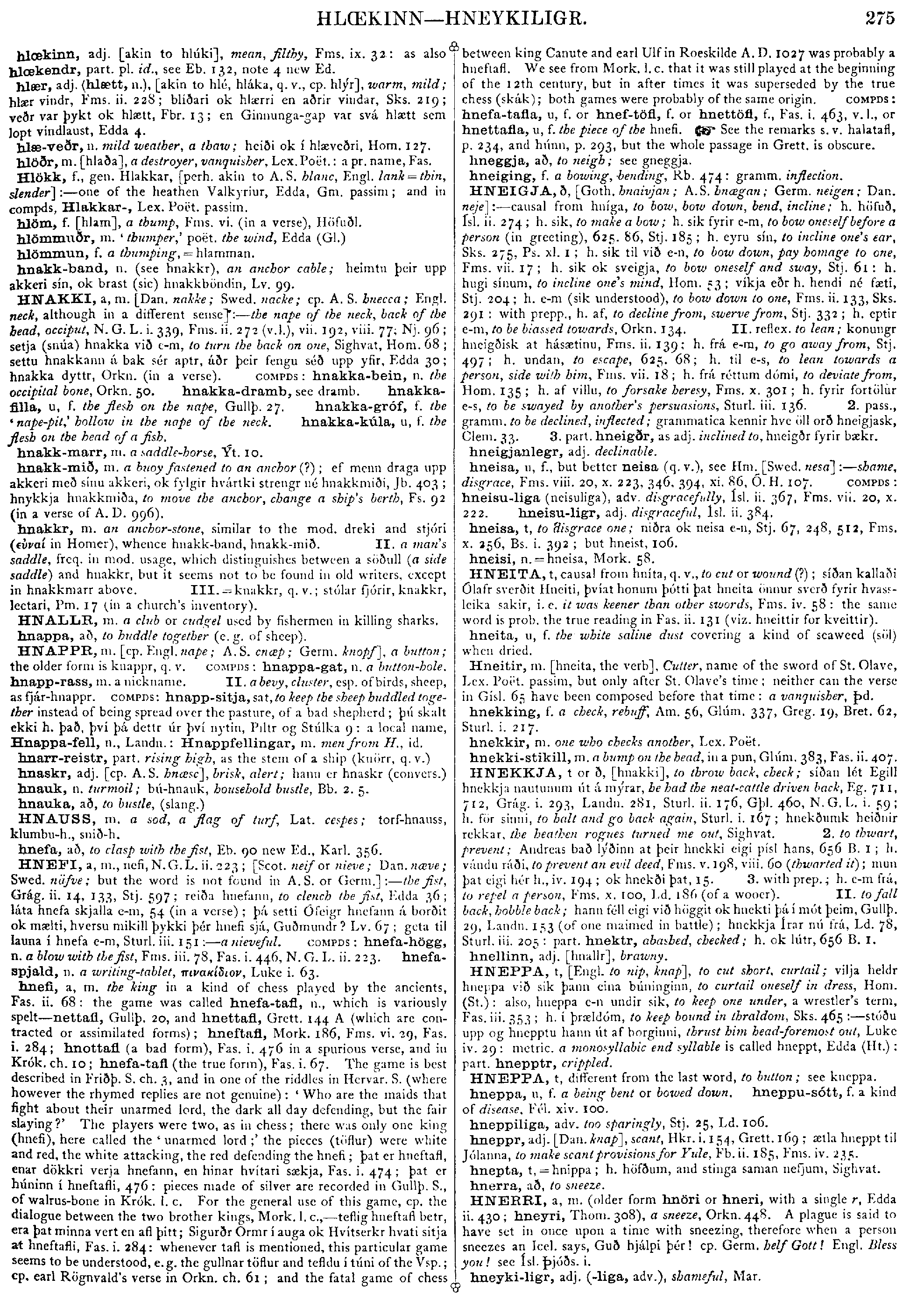
HNEKKJA, t or ð, [hnakki], to throw back, check; síðan lét Egill hnekkja nautunum út á mýrar, he had the neat-cattle driven back, Eg. 711, 712, Grág. i. 293, Landn. 281, Sturl. ii. 176, Gþl. 460, N. G. L. i. 59; h. för sinni, to halt and go back again, Sturl. i. 167; hnekðumk heiðnir rekkar, the heathen rogues turned me out, Sighvat. 2. to thwart, prevent; Andreas bað lýðinn at þeir hnekki eigi písl hans, 656 B. 1; h. vándu ráði, to prevent an evil deed, Fms. v. 198, viii. 60 (thwarted it); mun þat eigi hér h., iv. 194; ok hnekði þat, 15. 3. with prep.; h. e-m frá, to repel a person, Fms. x. 100, Ld. 186 (of a wooer). II. to fall back, hobble back; hann féll eigi við höggit ok hnekti þá í mot þeim, Gullþ. 29, Landn. 153 (of one maimed in battle); hnekkja Írar nú frá, Ld. 78, Sturl. iii. 205: part. hnektr, abashed, checked; h. ok lútr, 656 B. 1.
| Result Page: | 1 2 | Next |  |
Germanic Lexicon Project (main page)
This search system was written by
Sean Crist
Please consider
volunteering
to correct the data in these online dictionaries.
No rights reserved. Feel free to use these data in any way you please.