|
|

|
Source: Cleasby/Vigfusson, page b0519, entry 12 View original page image as: [TIFF] [PNG] [View previous entry] [View next entry] |
[Comment on this entry] [View comments] |
The following entry has been hand-corrected once. |
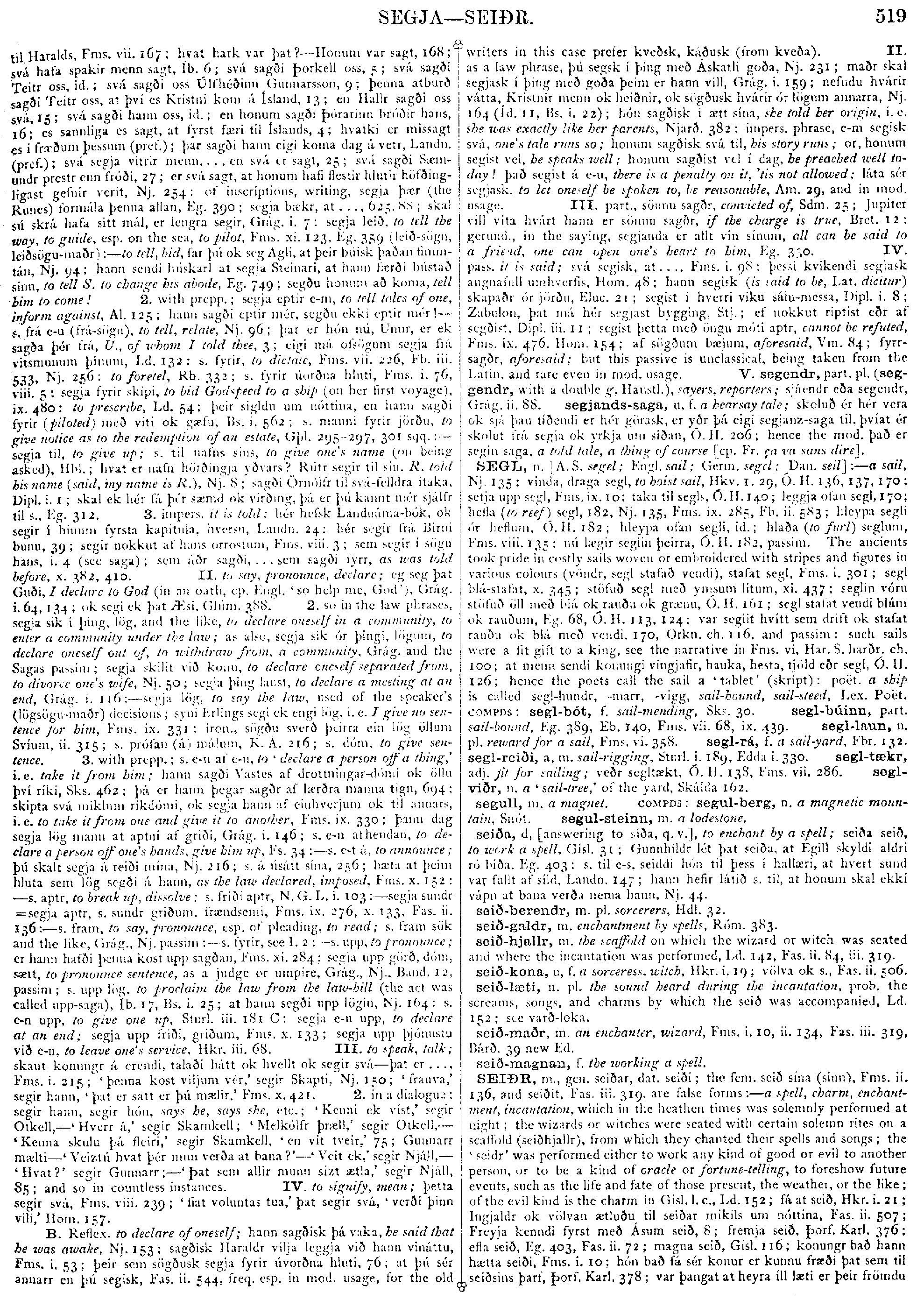
SEIÐR, m., gen. seiðar, dat. seiði; the fem, seið sina (sinn), Fms. ii. 136, and seiðit, Fas. iii. 319, are false forms :-- a spell, charm, enchantment, incantation, which in the heathen times was solemnly performed at night; the wizards or witches were seated with certain solemn rites on a scaffold (seiðhjallr), from which they chanted their spells and songs; the 'seidr' was performed either to work any kind of good or evil to another person, or to be a kind of oracle or fortune-telling, to foreshow future events, such as the life and fate of those present, the weather, or the like; of the evil kind is the charm in Gísl. l.c., Ld. 152; fá at seið, Hkr. i. 21; Ingjaldr ok völvan ætluðu til seiðar mikils um nóttina, Fas. ii. 507; Freyja kenndi fyrst með Ásum seið, 8; fremja seið, Þorf. Karl. 376; efla seið, Eg. 403, Fas. ii. 72; magna seið, Gísl. 116; konungr bað hann hætta seiði, Fms. i. 10: hón bað fá sér konur er kunnu fræði þat sem til seiðsins þarf, Þorf. Karl. 378; var þangat at heyra íll læti er þeir frömdu
|
Source: Cleasby/Vigfusson, page b0597, entry 1 View original page image as: [TIFF] [PNG] [View previous entry] [View next entry] |
[Comment on this entry] [View comments] |
The following entry has been hand-corrected once. |
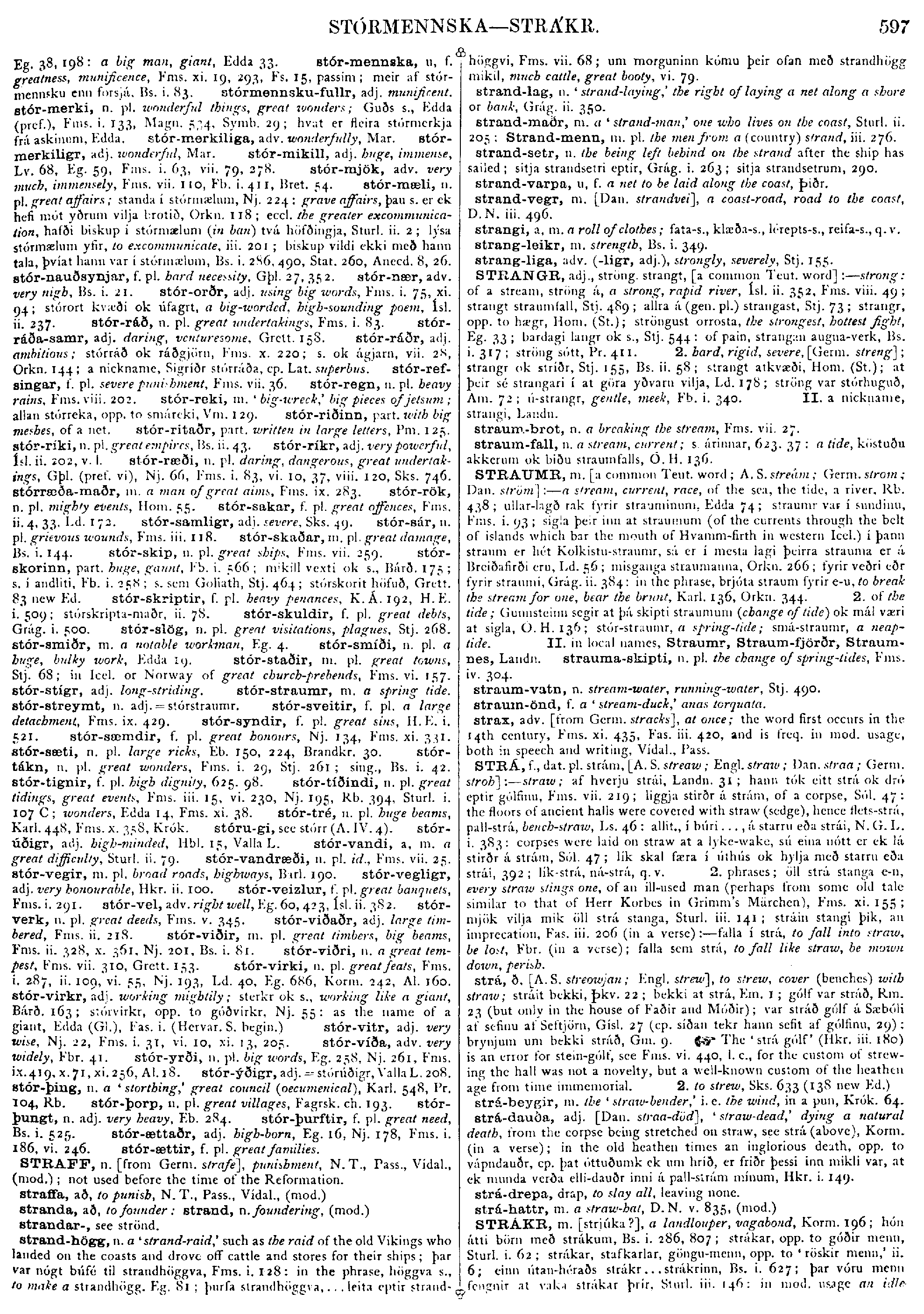
Eg. 38, 198: a big man, giant, Edda 33. stór-mennska, u, f. greatness, munificence, Fms. xi. 19, 293, Fs. 15, passim; meir af stór-mennsku enu forsjá, Bs. i. 83. stórmennsku-fullr, adj. munificent. stór-merki, n. pl. wonderful things, great wonders; Guðs s., Edda (pref.), Fms. i. 133, Magn. 534, Symb. 29; hvat er fleira stórmerkja frá askinum, Edda. stór-merkiliga, adv. wonderfully, Mar. stór-merkiligr, adj. wonderful, Mar. stór-mikill, adj. huge, immense, Lv. 68, Eg. 59, Fms. i. 63, vii. 79, 278. stór-mjök, adv. very much, immensely, Fms. vii. 110, Fb. 1. 411, Bret. 54. stór-mæli, n. pl. great affairs; standa í stórmælum, Nj. 224: grave affairs, þau s. er ek hefi mót yðrum vilja brotið, Orkn. 118; eccl. the greater excommunication, hafði biskup í stórmælum (in ban) tvá höfðingja, Sturl. ii. 2; lýsa stórmælum yfir, to excommunicate, iii. 201; biskup vildi ekki með hann tala, þvíat hann var í stórmælum, Bs. i. 286, 490, Stat. 260, Anecd. 8, 26. stór-nauðsynjar, f. pl. hard necessity, Gþl. 27, 352. stór-nær, adv. very nigh, Bs. i. 21. stór-orðr, adj. using big words, Fms. i. 75, xi. 94; stórort kvæði ok úfagrt, a big-worded, high-sounding poem, Ísl. ii. 237. stór-ráð, n. pl. great undertakings, Fms. i. 83. stór-ráða-samr, adj. daring, venturesome, Grett. 158. stór-ráðr, adj. ambitious; stórráð ok ráðgjörn, Fms. x. 220; s. ok ágjarn, vii. 28, Orkn. 144; a nickname, Sigríðr stórráða, cp. Lat. superbus. stór-ref-singar, f. pl. severe punishment. Fms. vii. 36. stór-regn, n. pl. heavy rains. Fms. viii. 202. stór-reki, m. 'big-wreck' big pieces of jetsum; allan stórreka, opp. to smáreki, Vm. 129. stór-riðinn, part. with big meshes, of a net. stór-ritaðr, part. written in large letters, Pm. 125. stór-ríki, n. pl. great empires, Bs. ii. 43. stór-ríkr, adj. very powerful,Ísl. ii. 202, v.l. stór-ræði, n. pl. daring, dangerous, great undertakings, Gþl. (pref. vi), Nj. 66, Fms. i. 83, vi. 10, 37, viii. 120, Sks. 746. stórræða-maðr, m. a man of great aims. Fms. ix. 283. stór-rök, n. pl. mighty events, Hom. 55. stór-sakar, f. pl. great offences. Fms. ii. 4, 33, Ld. 172. stór-samligr, adj. severe, Sks. 49. stór-sár, n. pl. grievous wounds, Fms. iii. 118. stór-skaðar, m. pl. great damage, Bs. i. 144. stór-skip, n. pl. great ships. Fms. vii. 259. stór-skorinn, part. huge, gaunt, Fb. i. 566; mikill vexti ok s., Bárð. 175; s. í andliti, Fb. i. 258; s. sem Goliath, Stj. 464; stórskorit höfuð, Grett. 83 new Ed. stór-skriptir, f. pl. heavy penances, K.Á. 192, H.E. i. 509; stórskripta-maðr, ii. 78. stór-skuldir, f. pl. great debts, Grág. i. 500. stór-slög, n. pl. great visitations, plagues, Stj. 268. stór-smiðr, m. a notable workman, Eg. 4. stór-smíði, n. pl. a huge, bulky work, Edda 19. stór-staðir, m. pl. great towns, Stj. 68; in Icel. or Norway of great church-prebends, Fms. vi. 157. stór-stígr, adj. long-striding. stór-straumr, m. a spring tide. stór-streymt, n. adj. = stórstraumr. stór-sveitir, f. pl. a large detachment., Fms. ix. 429. stór-syndir, f. pl. great sins, H.E. i. 521. stór-sæmdir, f. pl. great honours, Nj. 134, Fms. xi. 331. stór-sæti, n. pl. large ricks, Eb. 150, 224, Brandkr. 30. stór-tákn, n. pl. great wonders. Fms. i. 29, Stj. 261; sing., Bs. i. 42. stór-tignir, f. pl. high dignity, 625. 98. stór-tíðindi, n. pl. great tidings, great events, Fms. iii. 15, vi. 230, Nj. 195, Rb. 394, Sturl. i. 107 C; wonders, Edda 14, Fms. xi. 38. stór-tré, n. pl. huge beams, Karl. 448, Fms. x. 358, Krók. stóru-gi, see stórr (A. IV. 4). stór-úðigr, adj. high-minded, Hbl. 15, Valla L. stór-vandi, a, m. a great difficulty, Sturl. ii. 79. stór-vandræði, n. pl. id., Fms. vii. 25. stór-vegir, m. pl. broad roads, highways, Barl. 190. stór-vegligr, adj. very honourable, Hkr. ii. 100. stór-veizlur, f. pl. great banquets, Fms. i. 291. stór-vel, adv. right well, Eg. 60, 423, Ísl. ii. 382. stór-verk, n. pl. great deeds, Fms. v. 345. stór-viðaðr, adj. large timbered, Fms. ii. 218. stór-viðir, m. pl. great timbers, big beams, Fms. ii. 328, x. 361. Nj. 201, Bs. i. 81. stór-viðri, n. a great tempest, Fms. vii. 310, Grett. 153. stór-virki, n. pl. great feats, Fms. i. 287, ii. 109, vi. 55, Nj. 193, Ld. 40, Eg. 686, Korm. 242, Al. 160. stór-virkr, adj. working mightily; sterkr ok s., working like a giant, Bárð. 163; stórvirkr, opp. to góðvirkr, Nj. 55: as the name of a giant, Edda (Gl.), Fas. i. (Hervar. S. begin.) stór-vitr, adj. very wise, Nj. 22, Fms. i. 31, vi. 10, xi. 13, 205. stór-víða, adv. very widely, Fbr. 41. stór-yrði, n. pl. big words, Eg. 258, Nj. 261, Fms. ix. 419, x. 71, xi. 256, Al. 18. stór-ýðigr, adj. = stórúðigr, Valla L. 208. stór-þing, n. a 'storthing,' great council (oecumenical), Karl. 548, Pr. 104, Rb. stór-þorp, n. pl. great villages, Fagrsk. ch. 193. stór-þungt, n. adj. very heavy, Eb. 284. stór-þurftir, f. pl. great need, Bs. i. 525. stór-ættaðr, adj. high-born, Eg. 16, Nj. 178, Fms. i. 186, vi. 246. stór-ættir, f. pl. great families.
|
Source: Cleasby/Vigfusson, page b0760, entry 8 View original page image as: [TIFF] [PNG] [View previous entry] [View next entry] |
[Comment on this entry] [View comments] |
The following entry has been hand-corrected once. |
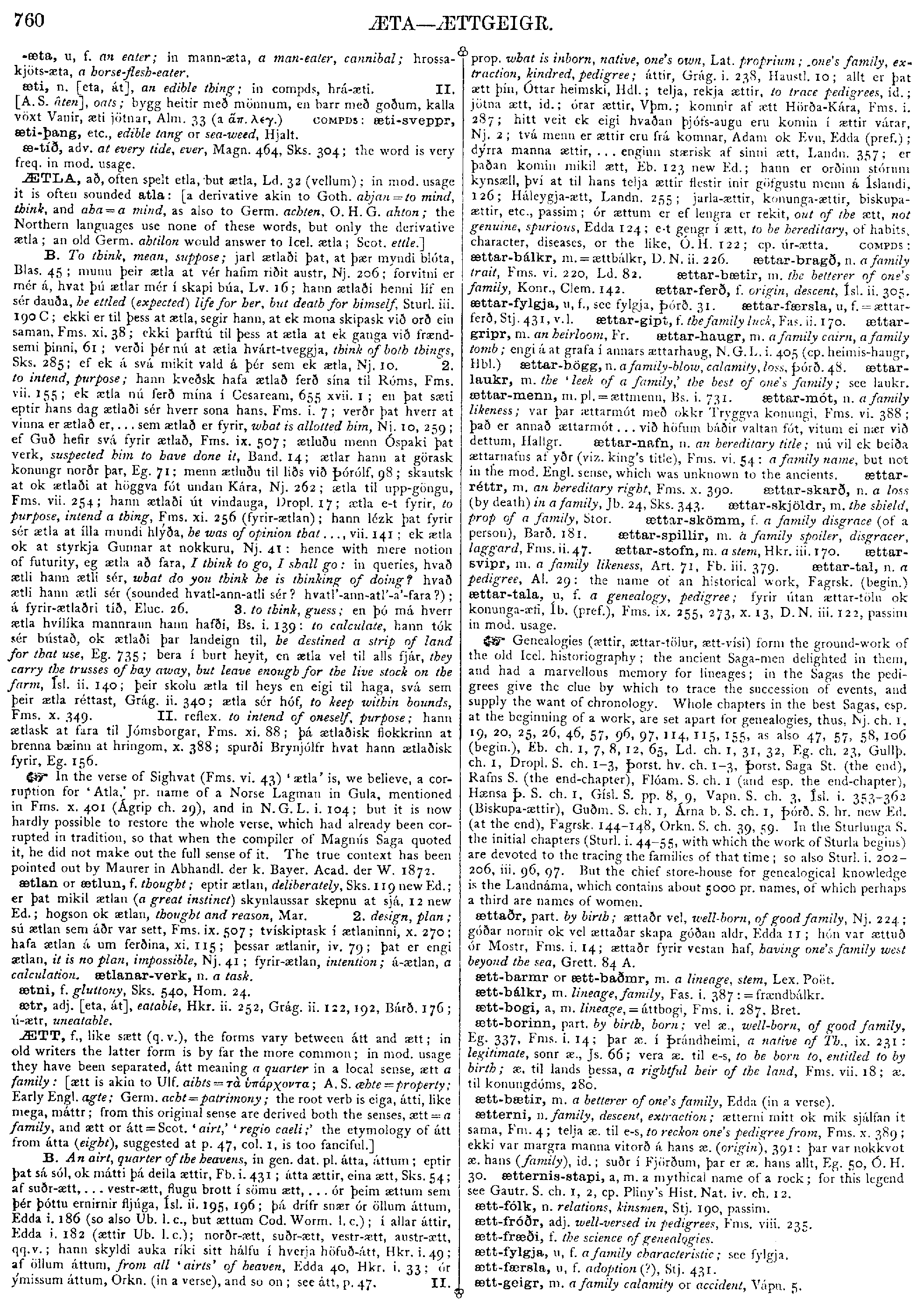
ÆTT, f., like sætt (q.v.), the forms vary between átt and ætt; in old writers the latter form is by far the more common; in mod. usage they have been separated, átt meaning a quarter in a local sense, ætt a family: [ætt is akin to Ulf. aihts = GREEK; A.S. æhte = property; Early Engl. agte; Germ. acht = patrimony; the root verb is eiga, átti, like mega, máttr; from this original sense are derived both the senses, ætt = a family, and ætt or átt = Scot. 'airt,' 'regio caeli;' the etymology of átt from átta (eight), suggested at p. 47, col. 1, is too fanciful.] B. An airt, quarter of the heavens, in gen. dat. pl. átta, áttum; eptir þat sá sól, ok mátti þá deila ættir, Fb. i. 431; átta ættir, eina ætt, Sks. 54; af suðr-ætt, ... vestr-ætt, flugu brott í sömu ætt, ... ór þeim ættum sem þér þóttu ernirnir fljúga, Ísl. ii. 195, 196; þá drífr snær ór öllum áttum, Edda i. 186 (so also Ub. l.c., but ættum Cod. Worm. l.c.); í allar áttir, Edda i. 182 (ættir Ub. l.c.); norðr-ætt, suðr-ætt, vestr-ætt, austr-ætt, qq.v.; hann skyldi auka ríki sitt hálfu í hverja höfuð-átt, Hkr. i. 49; af öllum áttum, from all 'airts' of heaven, Edda 40, Hkr. i. 33; ór ýmissum áttum, Orkn. (in a verse), and so on; see átt, p. 47. II. prop. what is inborn, native, one's own, Lat. proprium; one's family, extraction, kindred, pedigree; áttir, Grág. i. 238, Haustl. 10; allt er þat ætt þín, Óttar heimski, Hdl.; telja, rekja ættir, to trace pedigrees, id.; jötna ætt, id.; órar ættir, Vþm.; komnir af ætt Hörða-Kára, Fms. i. 287; hitt veit ek eigi hvaðan þjófs-augu eru komin í ættir várar, Nj. 2; tvá menn er ættir eru frá komnar, Adam ok Evu, Edda (pref.); dýrra manna ættir, ... enginn stærisk af sinni ætt, Landn. 357; er þaðan komin mikil ætt, Eb. 123 new Ed.; hann er orðinn stórum kynsæll, því at til hans telja ættir flestir inir göfgustu menn á Íslandi, 126; Háleygja-ætt, Landn. 255; jarla-ættir, konunga-ættir, biskupa-ættir, etc., passim; ór ættum er ef lengra er rekit, out of the ætt, not genuine, spurious, Edda 124; e-t gengr í ætt, to be hereditary, of habits, character, diseases, or the like, Ó.H. 122; cp. úr-ætta. COMPDS: ættar-bálkr, m. = ættbálkr, D.N. ii. 226. ættar-bragð, n. a family trait, Fms. vi. 220, Ld. 82. ættar-bætir, m. the betterer of one's family, Konr., Clem. 142. ættar-ferð, f. origin, descent, Ísl. ii. 305. ættar-fylgja, u, f., see fylgja, Þórð. 31. ættar-færsla, u, f. = ættarferð, Stj. 431, v. l. ættar-gipt, f. the family luck, Fas. ii. 170. ættar-gripr, m. an heirloom, Fr. ættar-haugr, m. a family cairn, a family tomb; engi á at grafa í annars ættarhaug, N.G.L. i. 405 (cp. heimis-haugr, Hbl.) ættar-högg, n. a family-blow, calamity, loss, Þórð. 48. ættar-laukr, m. the 'leek of a family,' the best of one's family; see laukr. ættar-menn, m. pl. = ættmenn, Bs. i. 731. ættar-mót, n. a family likeness; var þar ættarmót með okkr Tryggva konungi, Fms. vi. 388; það er annað ættarmót ... við höfum báðir valtan fót, vitum ei nær við dettum, Hallgr. ættar-nafn, n. an hereditary title; nú vil ek beiða ættarnafns af yðr (viz. king's title), Fms. vi. 54: a family name, but not in the mod. Engl. sense, which was unknown to the ancients. ættar-réttr, m. an hereditary right, Fms. x. 390. ættar-skarð, n. a loss (by death) in a family, Jb. 24, Sks. 343. ættar-skjöldr, m. the shield, prop of a family, Stor. ættar-skömm, f. a family disgrace (of a person), Bárð. 181. ættar-spillir, m. a family spoiler, disgracer, laggard, Fms. ii. 47. ættar-stofn, m. a stem, Hkr. iii. 170. ættar-svipr, m. a family likeness, Art. 71, Fb. iii. 379. ættar-tal, n. a pedigree, Al. 29: the name of an historical work, Fagrsk. (begin.) ættar-tala, u, f. a genealogy, pedigree; fyrir útan ættar-tölu ok konunga-æfi, Íb. (pref.), Fms. ix. 255, 273, x. 13, D.N. iii. 122, passim in mod. usage. &FINGER; Genealogies (ættir, ættar-tölur, ætt-vísi) form the ground-work of the old Icel. historiography; the ancient Saga-men delighted in them, and had a marvellous memory for lineages; in the Sagas the pedigrees give the clue by which to trace the succession of events, and supply the want of chronology. Whole chapters in the best Sagas, esp. at the beginning of a work, are set apart for genealogies, thus. Nj. ch. 1, 19, 20, 25, 26, 46, 57, 96, 97, 114, 115, 155, as also 47, 57, 58, 106 (begin.), Eb. ch. 1, 7, 8, 12, 65, Ld. ch. 1, 31, 32, Eg. ch. 23, Gullþ. ch. 1, Dropl. S. ch. 1-3, Þorst. hv. ch. 1-3, Þorst. Saga St. (the end), Rafns S. (the end-chapter), Flóam. S. ch. 1 (and esp. the end-chapter), Hænsa Þ. S. ch. 1, Gísl. S. pp. 8, 9, Vapn. S. ch. 3, Ísl. i. 353-362 (Biskupa-ættir), Guðm. S. ch. 1, Árna b. S. ch. 1, Þórð. S. hr. new Ed. (at the end), Fagrsk. 144-148, Orkn. S. ch. 39, 59. In the Sturlunga S. the initial chapters (Sturl. i. 44-55, with which the work of Sturla begins) are devoted to the tracing the families of that time; so also Sturl. i. 202-206, iii. 96, 97. But the chief store-house for genealogical knowledge is the Landnáma, which contains about 5000 pr. names, of which perhaps a third are names of women.
|
Source: Cleasby/Vigfusson, page b0776, entry 10 View original page image as: [TIFF] [PNG] [View previous entry] [View next entry] |
[Comment on this entry] [View comments] |
The following entry has been hand-corrected once. |
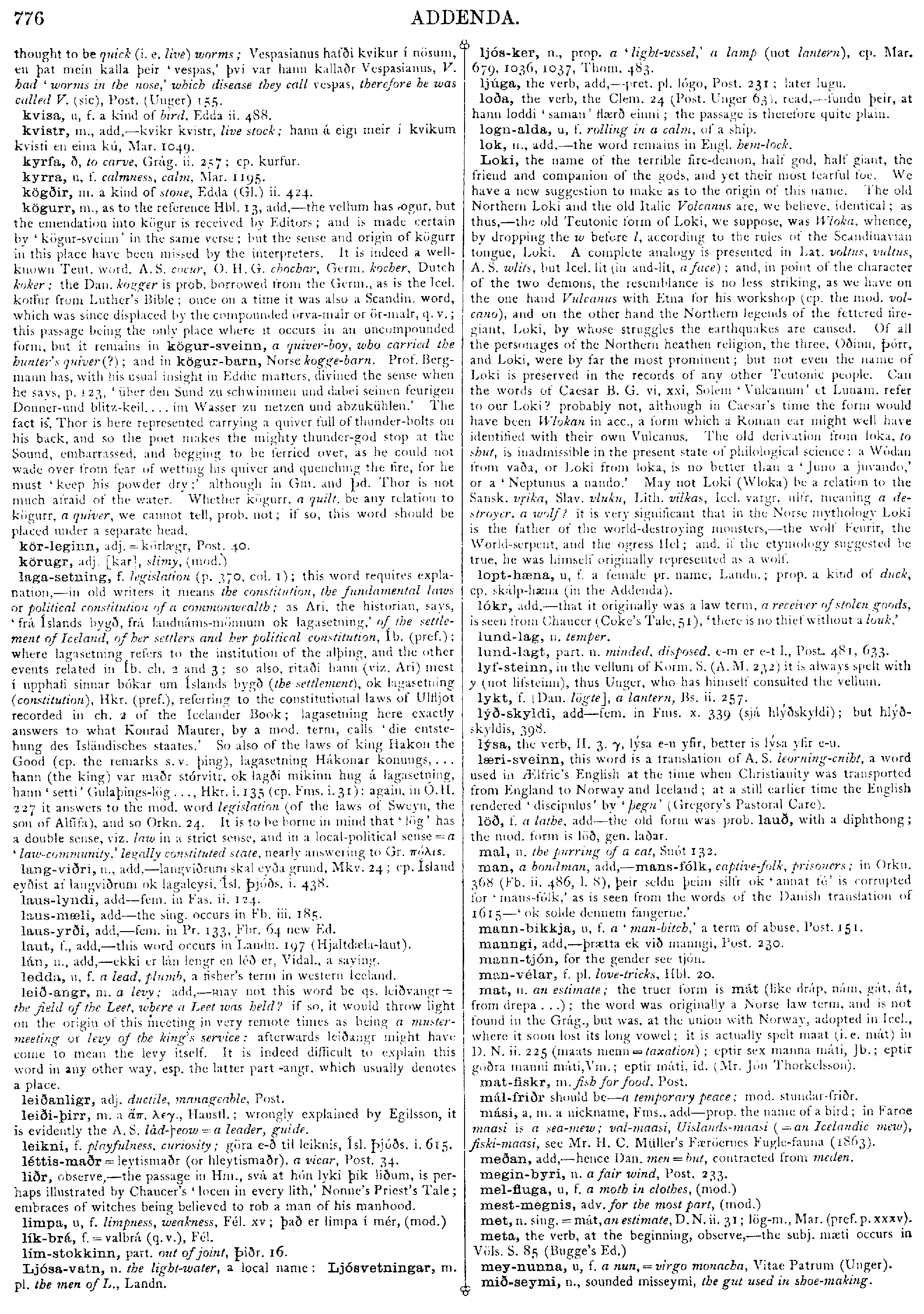
laga-setning, f. legislation (p. 370, col. 1); this word requires explanation, -- in old writers it means the constitution, the fundamental laws or political constitution of a commonwealth; as Ari, the historian, says, 'frá Íslands bygð, frá landnáms-mönnum ok lagasetning,' of the settlement of Iceland, of her settlers and her political constitution, Íb. (pref.); where lagasetning refers to the institution of the alþing, and the other events related in Íb. ch. 2 and 3; so also, ritaði hann (viz. Ari) mest í upphafi sinnar bókar um Íslands bygð (the settlement), ok lagasetning (constitution), Hkr. (pref.), referring to the constitutional laws of Ulfljot recorded in ch. 2 of the Icelander Book; lagasetning here exactly answers to what Konrad Maurer, by a mod. term, calls 'die entstehung des Isländisches staates.' So also of the laws of king Hakon the Good (cp. the remarks s.v. þing), lagasetning Hákonar konungs, ... hann (the king) var maðr stórvitr, ok lagði mikinn hug á lagasetning, hann 'setti' Gulaþings-lög ..., Hkr. i. 135 (cp. Fms. i. 31): again, in Ó.H. 227 it answers to the mod. word legislation (of the laws of Sweyn, the son of Alfifa), and so Orkn. 24. It is to be borne in mind that 'lög' has a double sense, viz. law in a strict sense, and in a local-political sense = a 'law-community,' legally constituted state, nearly answering to Gr. GREEK.
| Result Page: |  |
Previous | 1 2 3 4 5 6 |
Germanic Lexicon Project (main page)
This search system was written by
Sean Crist
Please consider
volunteering
to correct the data in these online dictionaries.
No rights reserved. Feel free to use these data in any way you please.