|
|

|
Source: Bosworth/Toller, page b0590, entry 23 View original page image as: [TIFF] [PNG] [View previous entry] [View next entry] |
[Comment on this entry] [View comments] |
The following entry has been hand-corrected once. |
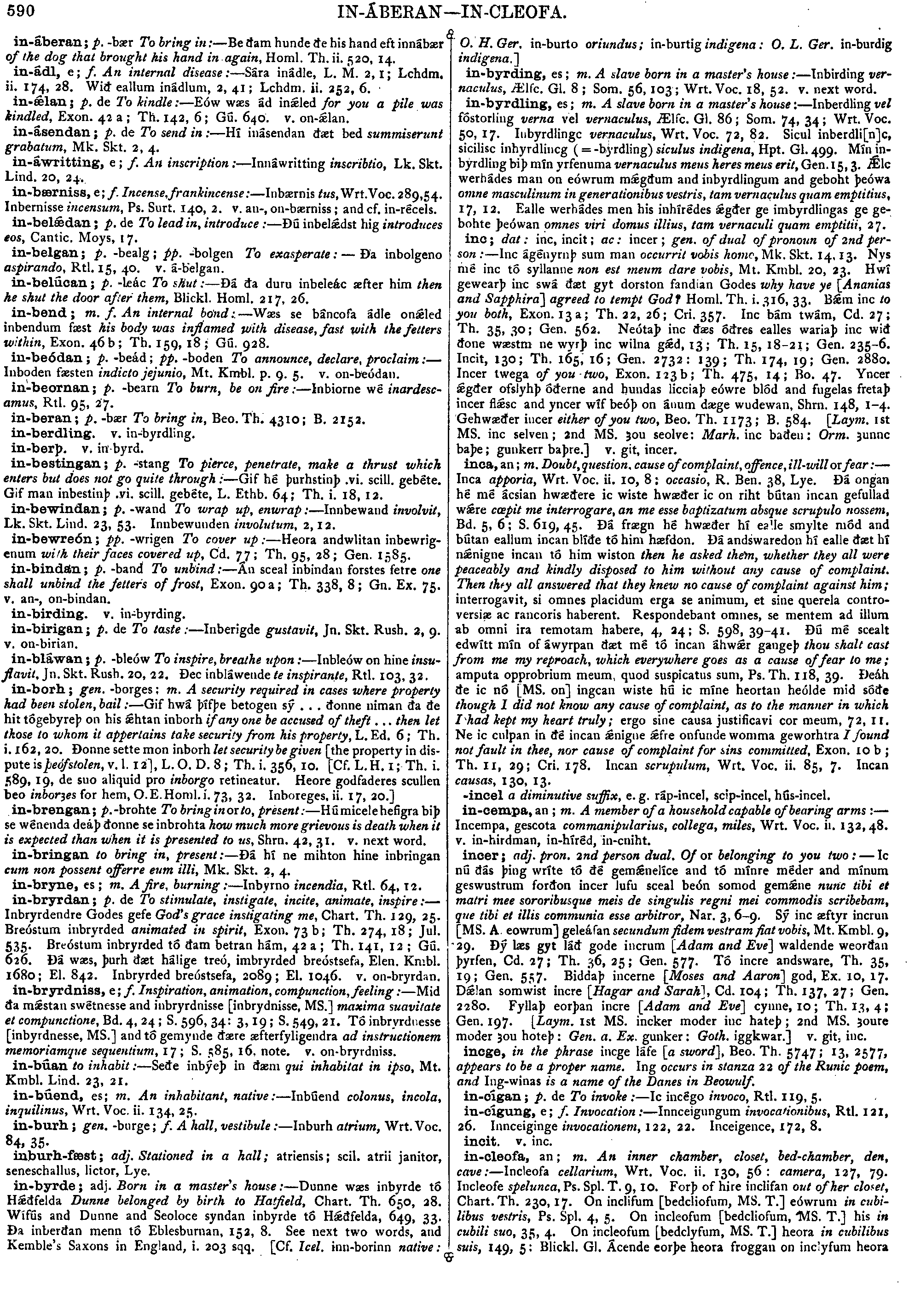
in-borh;
gen.
-borges
;
m.
A
security
required
in
cases
where
property
had
been
stolen,
bail
:--
Gif
hwá
þífþe
betogen
sý
...
ðonne
niman
ða
ðe
hit
tógebyreþ
on
his
 htan
inborh
if
any
one
be
accused
of
theft
.
..
then
let
those
to
whom
it
appertains
take
security
from
his
property,
L.
Ed.
6
;
Th.
i.162,
20.
Ðonne
sette
mon
inborh
let
security
be
given
[the
property
in
dispute
is
þeófstolen,
v.
l.
12],
L.
O.
D.
8
;
Th.
i.
356,
10.
[Cf.
L.
H.
1;
Th.
i.
589,
19,
de
suo
aliquid
pro
inborgo
retineatur.
Heore
godfaderes
scullen
beo
inbor
htan
inborh
if
any
one
be
accused
of
theft
.
..
then
let
those
to
whom
it
appertains
take
security
from
his
property,
L.
Ed.
6
;
Th.
i.162,
20.
Ðonne
sette
mon
inborh
let
security
be
given
[the
property
in
dispute
is
þeófstolen,
v.
l.
12],
L.
O.
D.
8
;
Th.
i.
356,
10.
[Cf.
L.
H.
1;
Th.
i.
589,
19,
de
suo
aliquid
pro
inborgo
retineatur.
Heore
godfaderes
scullen
beo
inbor es
for
hem,
O.
E.
Homl.
i.
73,
32.
Inboreges,
ii.
17,
20.]
es
for
hem,
O.
E.
Homl.
i.
73,
32.
Inboreges,
ii.
17,
20.]
|
Source: Bosworth/Toller, page b0592, entry 4 View original page image as: [TIFF] [PNG] [View previous entry] [View next entry] |
[Comment on this entry] [View comments] |
The following entry has been hand-corrected once. |
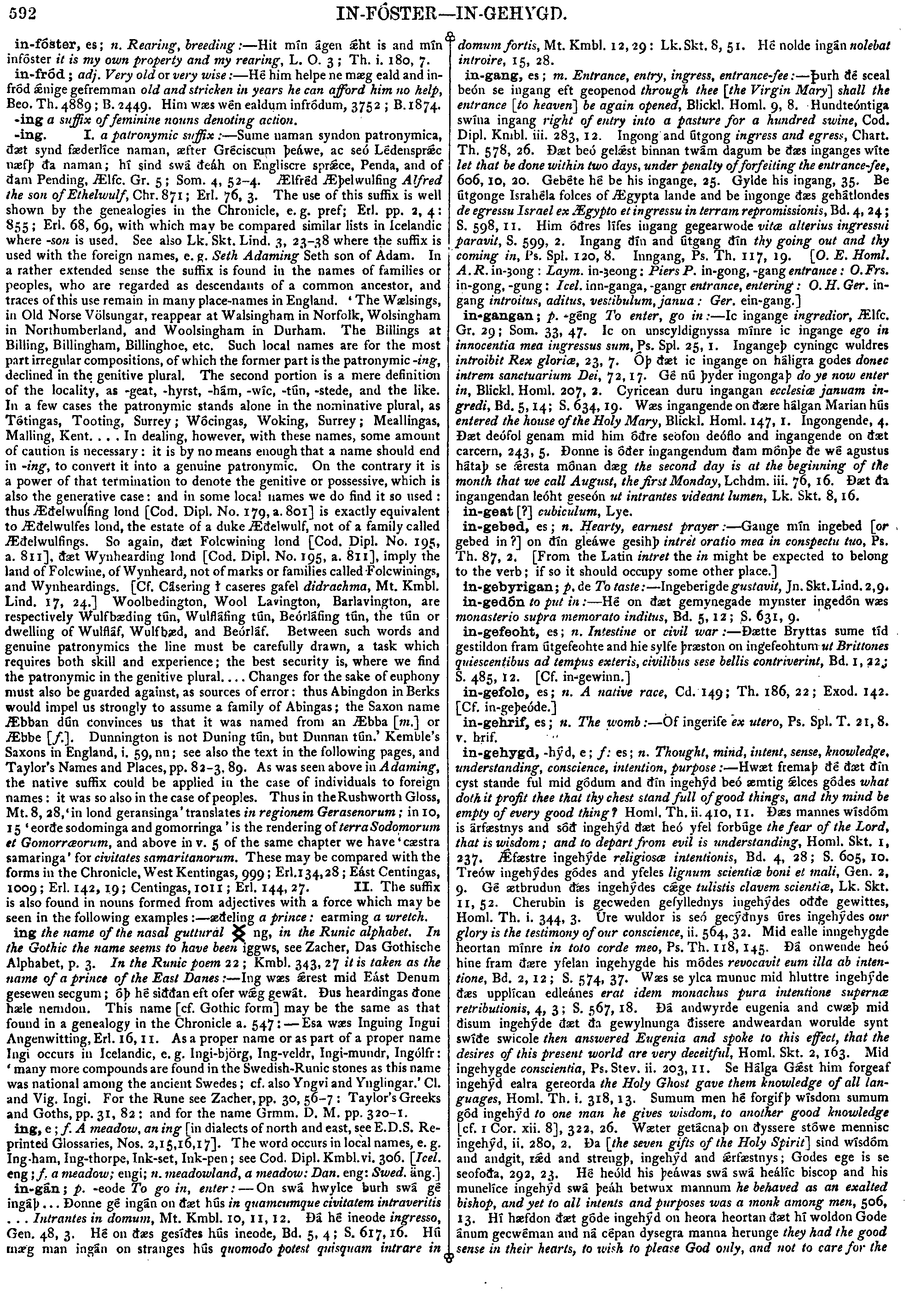
-ing.
I.
a
patronymic
suffix
:--
Sume
naman
syndon
patronymica,
ðæt
synd
fæderlíce
naman,
æfter
Gréciscum
þeáwe,
ac
seó
Lédensprc
næfþ
ða
naman;
hí
sind
swá
ðeáh
on
Engliscre
sprce,
Penda,
and
of
ðam
Pending,
Ælfc.
Gr.
5
;
Som.
4,
52-4.
Ælfréd
Æþelwulfing
Alfred
the
son
of
Ethelwulf,
Chr.
871;
Erl.
76,
3.
The
use
of
this
suffix
is
well
shown
by
the
genealogies
in
the
Chronicle,
e.g.
pref;
Erl.
pp.
2,
4
:
855;
Erl.
68,
69,
with
which
may
be
compared
similar
lists
in
Icelandic
where
-son
is
used.
See
also
Lk.
Skt.
Lind.
3,
23-38
where
the
suffix
is
used
with
the
foreign
names,
e.
g.
Seth
Adaming
Seth
son
of
Adam.
In
a
rather
extended
sense
the
suffix
is
found
in
the
names
of
families
or
peoples,
who
are
regarded
as
descendants
of
a
common
ancestor,
and
traces
of
this
use
remain
in
many
place-names
in
England.
'The
Wælsings,
in
Old
Norse
Völsungar,
reappear
at
Walsingham
in
Norfolk,
Wolsingham
in
Northumberland,
and
Woolsingham
in
Durham.
The
Billings
at
Billing,
Billingham,
Billinghoe,
etc.
Such
local
names
are
for
the
most
part
irregular
compositions,
of
which
the
former
part
is
the
patronymic
-ing,
declined
in
the
genitive
plural.
The
second
portion
is
a
mere
definition
of
the
locality,
as
-geat,
-hyrst,
-hám,
-wíc,
-tún,
-stede,
and
the
like.
In
a
few
cases
the
patronymic
stands
alone
in
the
nominative
plural,
as
Tótingas,
Tooting,
Surrey
;
Wócingas,
Woking,
Surrey
;
Meallingas,
Malling,
Kent....
In
dealing,
however,
with
these
names,
some
amount
of
caution
is
necessary
:
it
is
by
no
means
enough
that
a
name
should
end
in
-ing,
to
convert
it
into
a
genuine
patronymic.
On
the
contrary
it
is
a
power
of
that
termination
to
denote
the
genitive
or
possessive,
which
is
also
the
generative
case:
and
in
some
local
names
we
do
find
it
so
used
:
thus
Æðelwulfing
lond
[Cod.
Dipl.
No.
179,
a.
801]
is
exactly
equivalent
to
Æðelwulfes
lond,
the
estate
of
a
duke
Æðelwulf,
not
of
a
family
called
Æðelwulfings.
So
again,
ðæt
Folcwining
lond
[Cod.
Dipl.
No.
195,
a.
811],
ðæt
Wynhearding
lond
[Cod.
Dipl.
No.
195,
a.
811],
imply
the
land
of
Folcwine,
of
Wynheard,
not
of
marks
or
families
called
Folcwinings,
and
Wynheardings.
[Cf.
Cásering
 caseres
gafel
didrachma,
Mt.
Kmbl.
Lind.
17,
24.]
Woolbedington,
Wool
Lavington,
Barlavington,
are
respectively
Wulfbæding
tún,
Wulfláfing
tún,
Beórláfing
tún,
the
tún
or
dwelling
of
Wulfláf,
Wulfbæd,
and
Beórláf.
Between
such
words
and
genuine
patronymics
the
line
must
be
carefully
drawn,
a
task
which
requires
both
skill
and
experience;
the
best
security
is,
where
we
find
the
patronymic
in
the
genitive
plural....
Changes
for
the
sake
of
euphony
must
also
be
guarded
against,
as
sources
of
error
:
thus
Abingdon
in
Berks
would
impel
us
strongly
to
assume
a
family
of
Abingas;
the
Saxon
name
Æbban
dún
convinces
us
that
it
was
named
front
an
Æbba
[m.]
or
Æbbe
[f.].
Dunnington
is
not
Duning
tún,
but
Dunnan
tún.'
Kemble's
Saxons
in
England,
i.
59,
nn;
see
also
the
text
in
the
following
pages,
and
Taylor's
Names
and
Places,
pp.
82-3,
89.
As
was
seen
above
in
Adaming,
the
native
suffix
could
be
applied
in
the
case
of
individuals
to
foreign
names
:
it
was
so
also
in
the
case
of
peoples.
Thus
in
the
Rushworth
Gloss,
Mt.
8,
28,
'in
lond
geransinga'
translates
in
regionem
Gerasenorum;
in
10,
15
'eorðe
sodominga
and
gomorringa'
is
the
rendering
of
terra
Sodomorum
et
Gomorræorum,
and
above
in
v.
5
of
the
same
chapter
we
have
'cæstra
samaringa'
for
civitates
samaritanorum.
These
may
be
compared
with
the
forms
in
the
Chronicle,
West
Kentingas,
999;
Erl.
134,
28
;
Eást
Centingas,
1009
;
Erl.
142,
19;
Centingas,
l0ll
;
Erl.
144,
27.
II.
The
suffix
is
also
found
in
nouns
formed
from
adjectives
with
a
force
which
may
be
seen
in
the
following
examples
:--
æðeling
a
prince
:
earming
a
wretch.
caseres
gafel
didrachma,
Mt.
Kmbl.
Lind.
17,
24.]
Woolbedington,
Wool
Lavington,
Barlavington,
are
respectively
Wulfbæding
tún,
Wulfláfing
tún,
Beórláfing
tún,
the
tún
or
dwelling
of
Wulfláf,
Wulfbæd,
and
Beórláf.
Between
such
words
and
genuine
patronymics
the
line
must
be
carefully
drawn,
a
task
which
requires
both
skill
and
experience;
the
best
security
is,
where
we
find
the
patronymic
in
the
genitive
plural....
Changes
for
the
sake
of
euphony
must
also
be
guarded
against,
as
sources
of
error
:
thus
Abingdon
in
Berks
would
impel
us
strongly
to
assume
a
family
of
Abingas;
the
Saxon
name
Æbban
dún
convinces
us
that
it
was
named
front
an
Æbba
[m.]
or
Æbbe
[f.].
Dunnington
is
not
Duning
tún,
but
Dunnan
tún.'
Kemble's
Saxons
in
England,
i.
59,
nn;
see
also
the
text
in
the
following
pages,
and
Taylor's
Names
and
Places,
pp.
82-3,
89.
As
was
seen
above
in
Adaming,
the
native
suffix
could
be
applied
in
the
case
of
individuals
to
foreign
names
:
it
was
so
also
in
the
case
of
peoples.
Thus
in
the
Rushworth
Gloss,
Mt.
8,
28,
'in
lond
geransinga'
translates
in
regionem
Gerasenorum;
in
10,
15
'eorðe
sodominga
and
gomorringa'
is
the
rendering
of
terra
Sodomorum
et
Gomorræorum,
and
above
in
v.
5
of
the
same
chapter
we
have
'cæstra
samaringa'
for
civitates
samaritanorum.
These
may
be
compared
with
the
forms
in
the
Chronicle,
West
Kentingas,
999;
Erl.
134,
28
;
Eást
Centingas,
1009
;
Erl.
142,
19;
Centingas,
l0ll
;
Erl.
144,
27.
II.
The
suffix
is
also
found
in
nouns
formed
from
adjectives
with
a
force
which
may
be
seen
in
the
following
examples
:--
æðeling
a
prince
:
earming
a
wretch.
|
Source: Bosworth/Toller, page b0604, entry 13 View original page image as: [TIFF] [PNG] [View previous entry] [View next entry] |
[Comment on this entry] [View comments] |
The following entry has been hand-corrected once. |
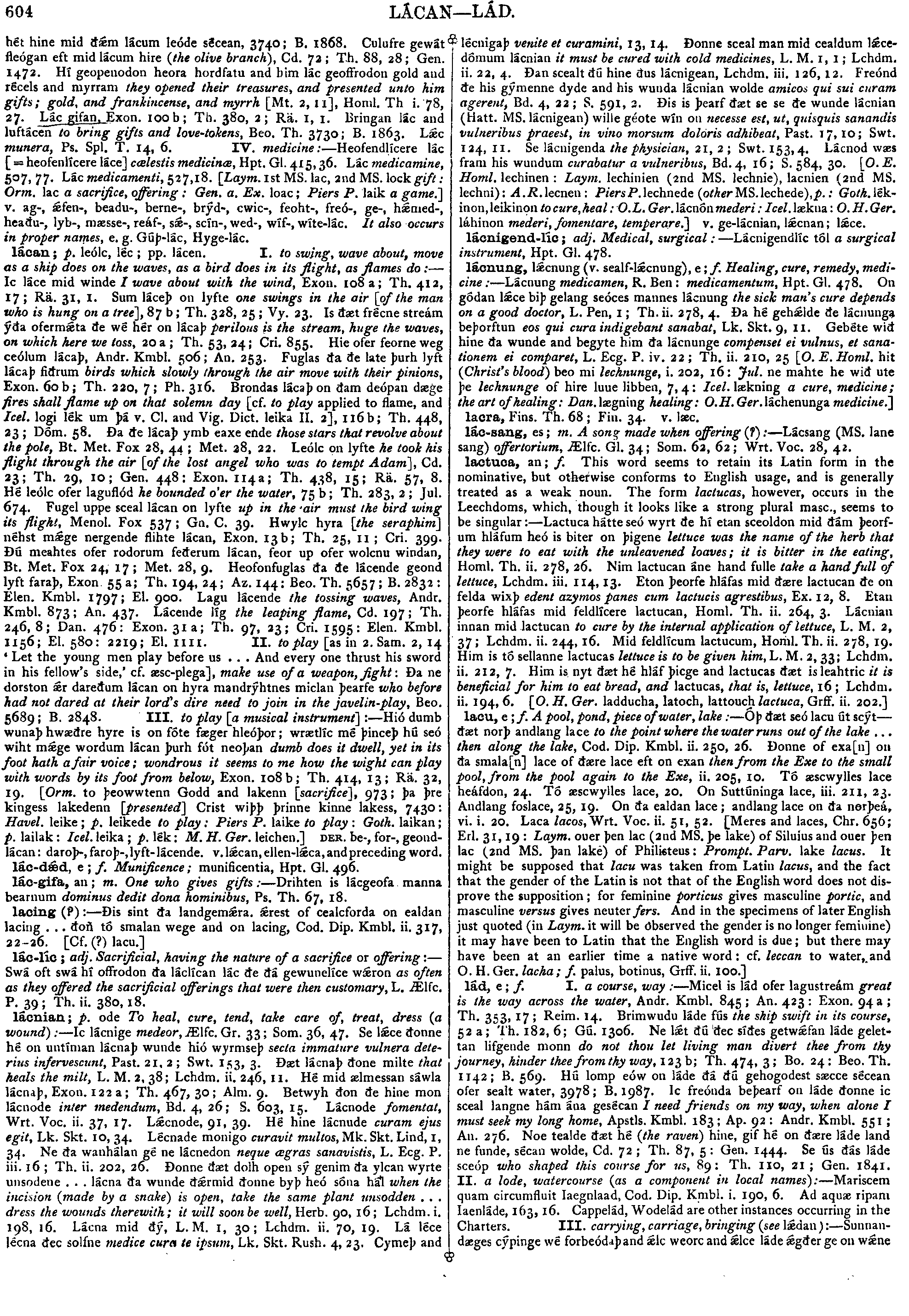
lád,
e;
f.
I.
a
course,
way
:--
Micel
is
lád
ofer
lagustreám
great
is
the
way
across
the
water,
Andr.
Kmbl.
845;
An.
423:
Exon.
94
a;
Th.
353,
17;
Reim.
14.
Brimwudu
láde
fús
the
ship
swift
in
its
course,
52
a;
Th.
182,
6;
Gú.
1306.
Ne
lt
ðú
ðec
síðes
getwfan
láde
gelettan
lifgende
monn
do
not
thou
let
living
man
divert
thee
from
thy
journey,
hinder
thee
from
thy
way,
123
b;
Th.
474,
3;
Bo.
24:
Beo.
Th.
1142
;
B.
569.
Hú
lomp
eów
on
láde
ðá
ðú
gehogodest
sæcce
sécean
ofer
sealt
water,
3978;
B.
1987.
Ic
freónda
beþearf
on
láde
ðonne
ic
sceal
langne
hám
ána
gesécan
I
need
friends
on
my
way,
when
alone
I
must
seek
my
long
home,
Apstls.
Kmbl.
183;
Ap.
92:
Andr.
Kmbl.
551;
An.
276.
Noe
tealde
ðæt
hé
(the
raven)
hine,
gif
hé
on
ðære
láde
land
ne
funde,
sécan
wolde,
Cd.
72;
Th.
87,
5:
Gen.
1444.
Se
ús
ðás
láde
sceóp
who
shaped
this
course
for
us,
89:
Th.
110,
21;
Gen.
1841.
II.
a
lode,
watercourse
(as
a
component
in
local
names)
:--
Mariscem
quam
circumfluit
Iaegnlaad,
Cod.
Dip.
Kmbl.
i.
190,
6.
Ad
aquæ
ripam
Iaenláde,
163,
16.
Cappelád,
Wodelád
are
other
instances
occurring
in
the
Charters.
III.
carrying,
carriage,
bringing
(see
ldan)
:--
Sunnandæges
cýpinge
wé
forbeódaþand
lc
weorc
and
lce
láde
gðer
ge
on
wne
ge
on
horse
ge
on
byrdene
we
forbid
Sunday
traffic
and
all
work
and
all
carrying
(of
goods,
&c.)
both
by
waggon
and
by
horse
and
by
the
man
himself,
L.
N.
P.
L.
55;
Th.
ii.
298,
22.
[The
word
lád
in
this
passage
can
hardly
be
translated
'journeying
;'
for,
in
the
first
place,
such
a
meaning
does
not
well
suit
the
phrase
on
byrdene,
and,
next,
some
journeying
was
allowed.
Thus,
L.
E.
I.
24;
Th.
ii.
420,
21-,
it
is
said
no
secular
work
was
to
be
done
'bútan
hwam
gebyrige
ðæt
hé
nýde
faran
scyle;
ðonne
mót
hé
swá
rídan
swá
rówan
swá
swilce
færelde
faran
swylce
tó
his
wege
gehyrige.'
The
threefold
division
of
the
means
of
carriage
seems
to
be
that
found
in
the
Icelandic
law
where,
dealing
with
the
observance
of
Sunday,
it
is
said
of
the
amount
that
might
be
carried
in
journeying
on
that
day
'er
rétt
at
bera
á
sjálfum
see
(
=
on
byrdene)
eþa
fara
á
skipi
eþa
bera
á
hrossi.']
On
sumon
hé
sceal
láde
ldan
on
some
lands
the
'genéat'
has
to
furnish
means
of
carriage,
L.
R.
S.
2;
Th.
1.
432,
14.
Cf.
436,
5-6
:--
Hé
sceal
beón
gehorsad
ðæt
hé
mge
tó
hláfordes
seáme
ðæt
syllan
oððe
sylf
ldan.
The
word
used
in
both
cases
in
the
Latin
translation
is
summagium,
in
reference
to
which,
and
to
the
English
words
which
it
translates,
may
be
quoted
Thorpe's
explanation
in
his
glossary:
'Lád,
seám,
summagium.
A
service,
which
consisted
in
supplying
the
lord
with
beasts
of
burthen,
or,
as
defined
by
Roquefort
(voce
somey):
"Service
qu'un
vassal
devoit
à
son
seigneur,
et
qui
consistoit
à
faire
faire
quelques
voyages
par
ses
bêtes
de
somme."
See
Spelman
sub
voce,
and
Du
Cange
voce
Sagma.'
The
phrase
láde
ldan
occurs
in
a
similar
passage,
dealing
with
the
duties
of
the
'geneát;
in
Cod.
Dip.
Kmbl.
iii.
450,
31-
:--
Se
geneát
[at
Dyddanham]
sceal
wyrcan
swá
on
lande,
swá
of
lande,
hweðer
swá
man
být
and
rídan,
and
auerian,
and
láde
ldan,
dráfe
drífan,
and
fela
óðra
þinga
dón.
The
later
English
lode
seems
to
keep
this
meaning.
Thus
Prompt.
Parv.
310,
loode
or
caryage
vectura;
lodysmanne
vector,
lator,
vehicularius:
the
verb
lead
is
found
with
the
sense
of
carry,
e.g.
p.
62
cartyn
or
lede
wythe
a
carte;
and
in
the
note,
and
again
in
a
note
on
p.
293,
we
have
the
phrases
'to
lede
dong,'
'to
lede
wheet,'
&c.
See
also
scip-lád.
IV.
Sustenance,
provision,
means
of
subsistence
:--
Ne
sceal
se
dryhtnes
þeów
in
his
módsefan
máre
gelufian
eorþan
htwelan
ðonne
his
ánes
gemet
ðæt
hé
his
líchoman
láde
hæbbe
nor
shall
the
servant
of
the
Lord
love
more
of
earth's
possessions,
than
a
sufficiency
for
himself,
that
he
may
have
sustenance
for
his
body,
Exon.
38
a;
Th.
125,
27;
Gú.
360.
With
this
use
of
lád
may
be
compared
the
later
English
lif-lode
which,
besides
the
meaning
conduct,
has
that
of
sustenance
:--
Heo
tilede
here
lyflode
...
heo
fonden
hem
sustynance
ynow,
R.
Glouc.
41,
22:
Prompt.
Parv.
lyvelode
victus;
lyflode
or
warysone
donativum.
So
O.
H.
Ger.
líb-leita
victus,
annona,
alimonium.
[In
further
illustration
of
lád
the
following
native
and
foreign
words
are
given.
Orm.
Þe
steoressmann
a
lokeþþ
till
an
steorrne
þatt
stannt
a
still
...
forr
þatt
he
wile
follhenn
a
þatt
ilike
steorrness
lade
(guidance);
o
lade
on
the
way:
A.
R.
lode
burthen
(v.
III):
Mod.
E.
lode-star:
Icel.
leið.
I.
a
way,
course,
road.
II.
a
levy:
O.
H.
Ger.
leita,
funus,
ducatus;
pl.
exequiæ;
see
also
compounds
of
leiti,
Grff.
ii.
187].
DER.
brim-,
eá-,
ge-,
in-,
lagu-,
líf-,
mere-,
s-,
scip-,
út-,
ýð-lád.
|
Source: Bosworth/Toller, page b0619, entry 23 View original page image as: [TIFF] [PNG] [View previous entry] [View next entry] |
[Comment on this entry] [View comments] |
The following entry has been hand-corrected once. |
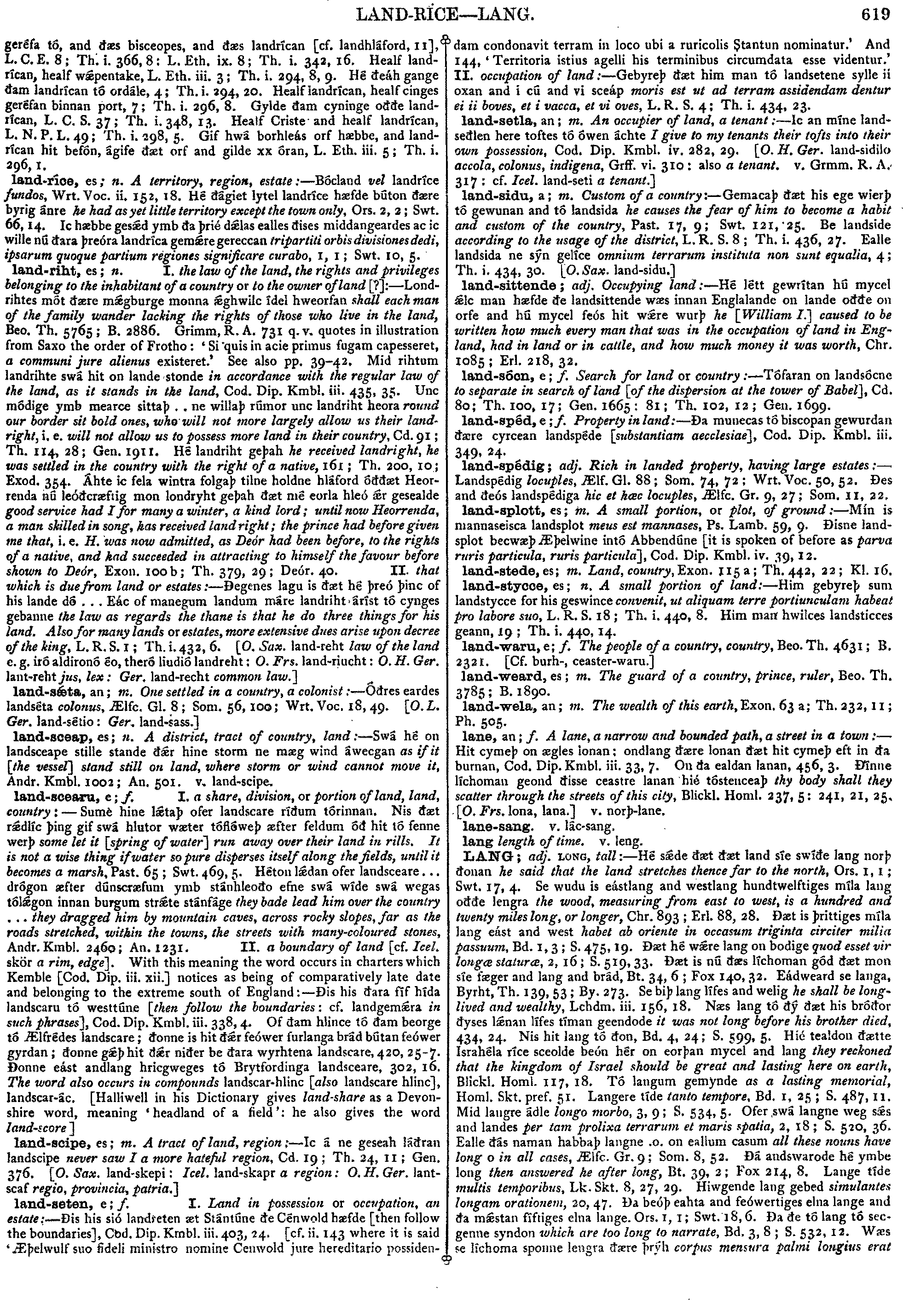
LANG;
adj.
LONG,
tall
:--
Hé
sde
ðæt
ðæt
land
síe
swíðe
lang
norþ
ðonan
he
said
that
the
land
stretches
thence
far
to
the
north,
Ors.
1,
1;
Swt.
17,
4.
Se
wudu
is
eástlang
and
westlang
hundtwelftiges
míla
lang
oððe
lengra
the
wood,
measuring
from
east
to
west,
is
a
hundred
and
twenty
miles
long,
or
longer,
Chr.
893;
Erl.
88,
28.
Ðæt
is
þrittiges
míla
lang
eást
and
west
habet
ab
oriente
in
occasum
triginta
circiter
milia
passuum,
Bd.
1,
3;
S.
475,
19.
Ðæt
hé
wre
lang
on
bodige
quod
esset
vir
longæ
staturæ,
2,
16;
S.
519,
33.
Ðæt
is
nú
ðæs
líchoman
gód
ðæt
man
síe
fæger
and
lang
and
brád,
Bt.
34,
6;
Fox
140,
32.
Eádweard
se
langa,
Byrht,
Th.
139,
53;
By
273.
Se
biþ
lang
lífes
and
welig
he
shall
be
longlived
and
wealthy,
Lchdm.
iii.
156,
18.
Næs
lang
tó
ðý
ðæt
his
bróðor
ðyses
lnan
lífes
tíman
geendode
it
was
not
long
before
his
brother
died,
434,
24.
Nis
hit
lang
tó
ðon,
Bd.
4,
24;
S.
599,
5.
Hié
tealdon
ðætte
Israhéla
ríce
sceolde
beón
hér
on
eorþan
mycel
and
lang
they
reckoned
that
the
kingdom
of
Israel
should
be
great
and
lasting
here
on
earth,
Blickl.
Homl.
117,
18.
Tó
langum
gemynde
as
a
lasting
memorial,
Homl.
Skt.
pref.
51.
Langere
tíde
tanto
tempore,
Bd.
1,
25;
S.
487,
11.
Mid
langre
ádle
longo
morbo,
3,
9;
S.
534,
5.
Ofer
swá
langne
weg
ss
and
landes
per
tam
prolixa
terrarum
et
maris
spatia,
2,
18;
S.
520,
36.
Ealle
ðás
naman
habbaþ
langne
.o.
on
eallum
casum
all
these
nouns
have
long
o
in
all
cases,
Ælfc.
Gr.
9;
Som.
8,
52.
Ðá
andswarode
hé
ymbe
long
then
answered
he
after
long,
Bt.
39,
2;
Fox
214,
8.
Lange
tíde
multis
temporibus,
Lk.
Skt.
8,
27,
29.
Hiwgende
lang
gebed
simulantes
longam
orationem,
20,
47.
Ða
beóþ
eahta
and
feówertiges
elna
lange
and
ða
mstan
fíftiges
elna
lange.
Ors.
1,
1;
Swt.18,
6.
Ða
ðe
tó
lang
tó
secgenne
syndon
which
are
too
long
to
narrate,
Bd.
3,
8;
S.
532,
12.
Wæs
se
líchoma
sponne
lengra
ðære
þrýh
corpus
mensura
palmi
longius
erat
sarcofago,
4,
11;
S.
580,
5.
sarcofago,
4,
11;
S.
580,
5.
Ne
bip
hé
lengra
ðonne
syfan
elna
lang,
Ors.
1,
1;
Swt.
18,
4.
Ðis
eálond
hafaþ
mycele
lengran
dagas
on
sumera
ðonne
ða
súþdlas
middangeardes,
Bd.
1,
1;
S.
473,
32.
Ðá
bebeád
hé
ðæt
him
mon
lengran
cwidas
beforan
cwde
præcepit
eum
sententias
longiores
dicere,
5,
2;
S.
615;
14.
Ða
onfóþ
lengestne
dóm
hi
accipient
prolixius
judicium,
Mk.
12,
40.
[The
word
occurs
in
all
the
Teutonic
dialects.]
DER.
and-,
dæg-,
ealdor-,
ge-,
morgen-,
niht-,
sumor-
lang;
it
also
is
found
in
combination
with
the
words
denoting
the
points
of
the
compass,
eást-lang,
&c.
|
Source: Bosworth/Toller, page b0621, entry 4 View original page image as: [TIFF] [PNG] [View previous entry] [View next entry] |
[Comment on this entry] [View comments] |
The following entry has been hand-corrected once. |
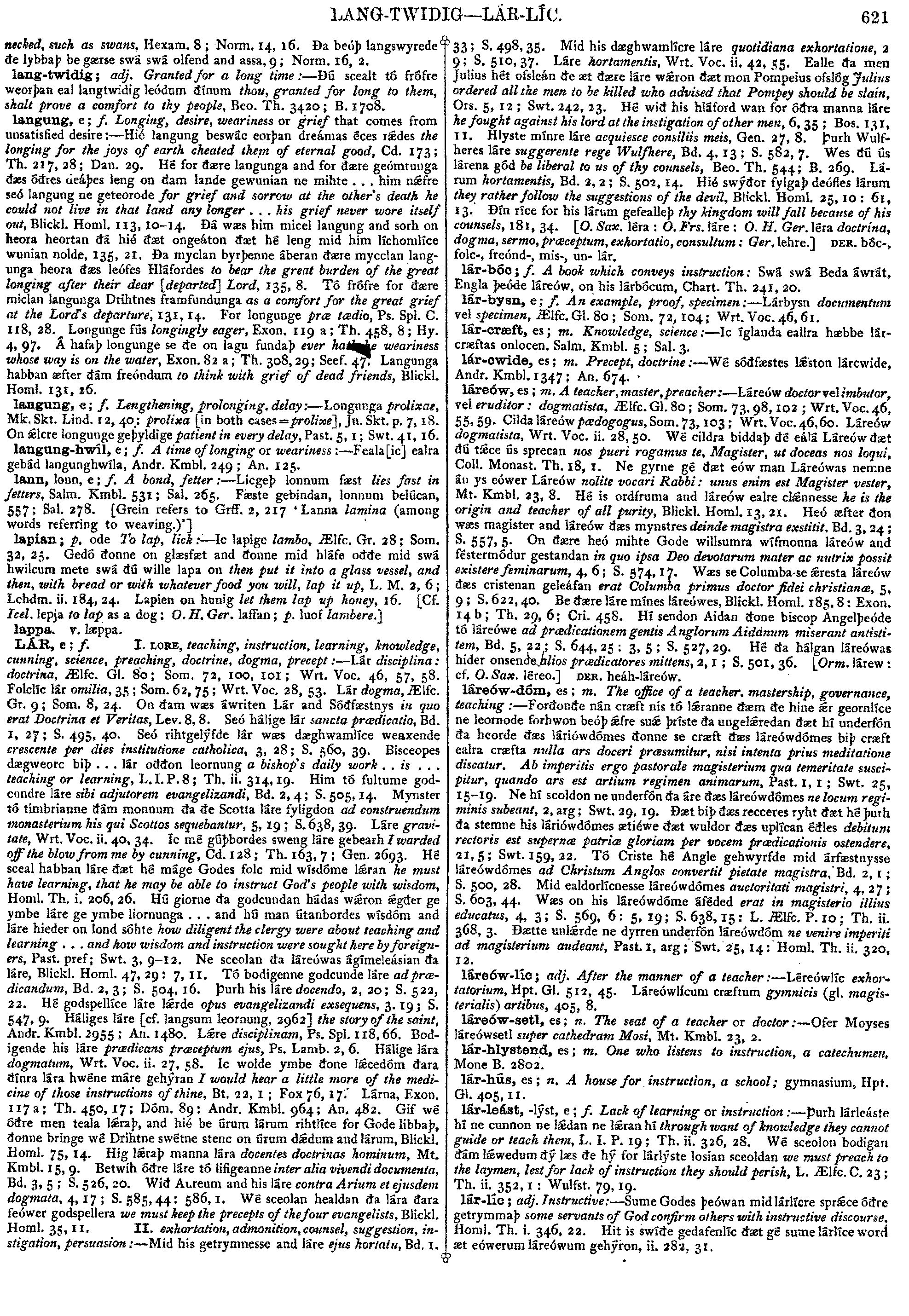
langung,
e;
f.
Lengthening,
prolonging,
delay
:--
Longunga
prolixae,
Mk.
Skt.
Lind.
12,
40:
prolixa
[in
both
cases
=
prolixe],
Jn.
Skt.
p.
7,
18.
On
lcre
longunge
geþyldige
patient
in
every
delay,
Past.
5,
1;
Swt.
41,
16.
|
Source: Bosworth/Toller, page b0634, entry 20 View original page image as: [TIFF] [PNG] [View previous entry] [View next entry] |
[Comment on this entry] [View comments] |
The following entry has been hand-corrected once. |
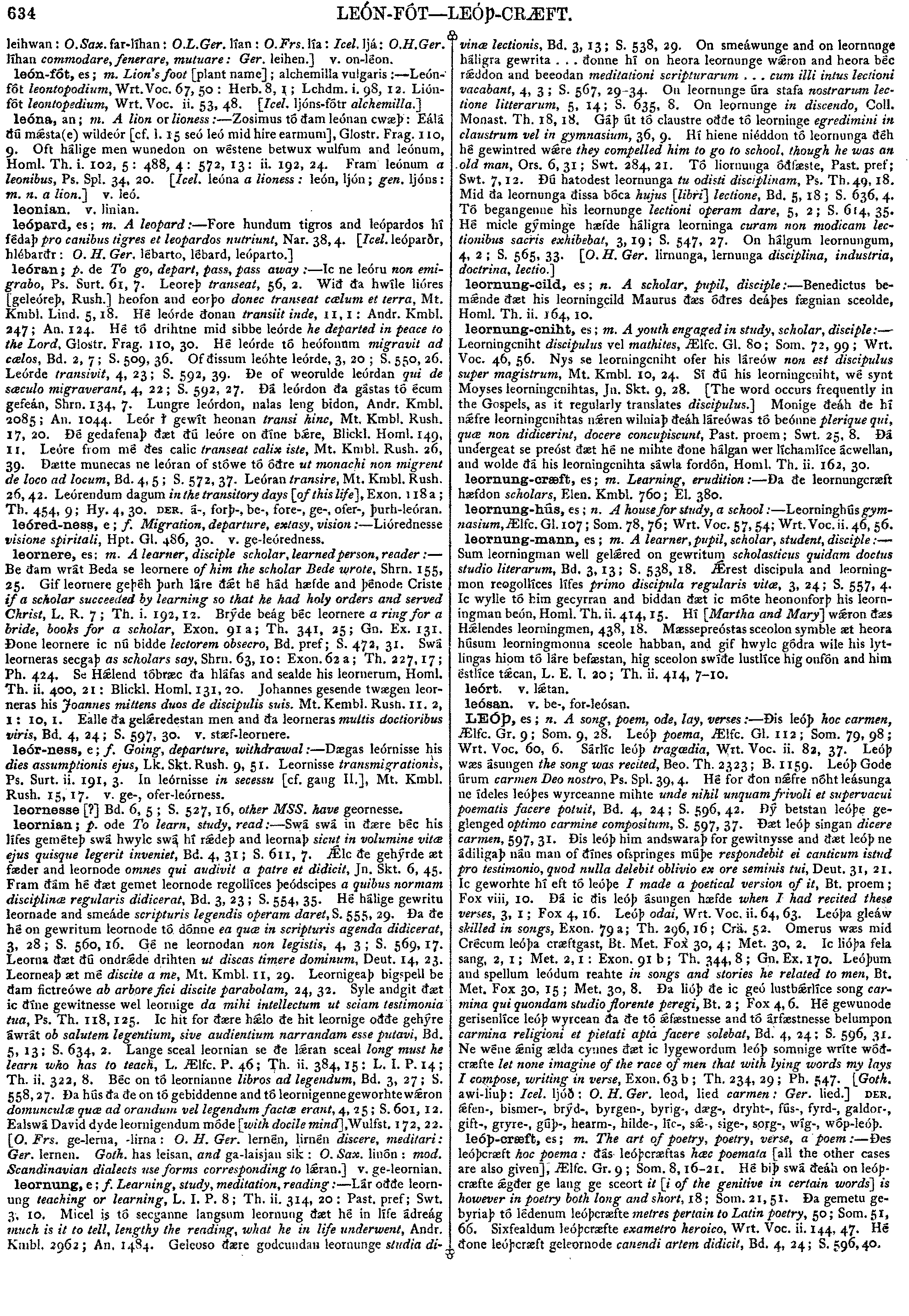
leóþ-cræft,
es;
m.
The
art
of
poetry,
poetry,
verse,
a
poem
:--
Ðes
leóþcræft
hoc
poema:
ðás
leóþcræftas
hæc
poemata
[all
the
other
cases
are
also
given],
Ælfc.
Gr.
9;
Som.
8,
16-21.
Hé
biþ
swá
ðeáh
on
leópcræfte
gðer
ge
lang
ge
sceort
it
[i
of
the
genitive
in
certain
words]
is
however
in
poetry
both
long
and
short,
18;
Som.
21,
51.
Ða
gemetu
gebyriaþ
tó
lédenum
leóþcræfte
metres
pertain
to
Latin
poetry,
50;
Som.
51,
66.
Sixfealdum
leóþcræfte
exametro
heroico,
Wrt.
Voc.
ii.
144,
47.
Hé
ðone
leóþcræft
geleornode
canendi
artem
didicit,
Bd.
4,
24;
S.
596,
40.
|
Source: Bosworth/Toller, page b0649, entry 21 View original page image as: [TIFF] [PNG] [View previous entry] [View next entry] |
[Comment on this entry] [View comments] |
The following entry has been hand-corrected once. |
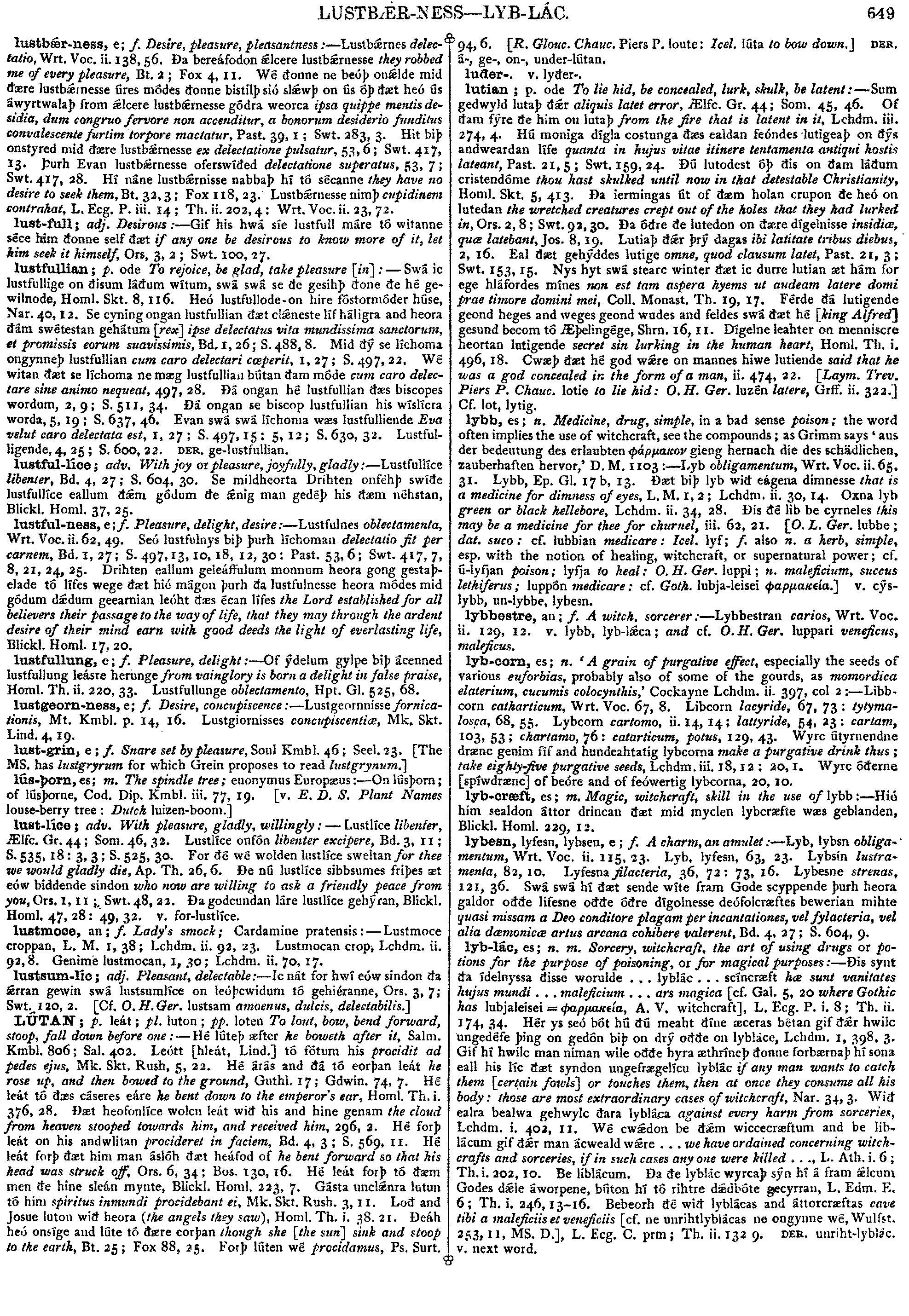
lyb-lác,
es;
n.
m.
Sorcery,
witchcraft,
the
art
of
using
drugs
or
potions
for
the
purpose
of
poisoning,
or
for
magical
purposes
:--
Ðis
synt
ða
ídelnyssa
ðisse
worulde
...
lyblác
...
scíncræft
hæ
sunt
vanitates
hujus
mundi
...
maleficium
...
ars
magica
[cf.
Gal.
5,
20
where
Gothic
has
lubjaleisei
=


 &iota-tonos;,
A.
V.
witchcraft],
L.
Ecg.
P.
i.
8;
Th.
ii.
174,
34.
Hér
ys
seó
bót
hú
ðú
meaht
ðíne
æceras
bétan
gif
ðr
hwilc
ungedéfe
þing
on
gedón
biþ
on
drý
oððe
on
lybláce,
Lchdm.
1,
398,
3.
Gif
hí
hwilc
man
niman
wile
oððe
hyra
æthríneþ
ðonne
forbærnaþ
hí
sona
eall
his
líc
ðæt
syndon
ungefrægelícu
lyblác
if
any
man
wants
to
catch
them
[certain
fowls]
or
touches
them,
then
at
once
they
consume
all
his
body:
those
are
most
extraordinary
cases
of
witchcraft,
Nar.
34,
3.
Wið
ealra
bealwa
gehwylc
ðara
lybláca
against
every
harm
from
sorceries,
Lchdm.
i.
402,
11.
Wé
cwdon
be
ðm
wiccecræftum
and
be
liblácum
gif
ðr
man
ácweald
wre
...
we
have
ordained
concerning
witchcrafts
and
sorceries,
if
in
such
cases
anyone
were
killed...,
L.
Ath.
i.
6;
Th.
i.
202,
10.
Be
liblácum.
Ða
ðe
lyblác
wyrcaþ
sýn
hí
á
fram
lcum
Godes
dle
áworpene,
búton
hí
tó
rihtre
ddbóte
grecyrran,
L.
Edm.
E.
6;
Th.
i.
246,
13-16.
Bebeorh
ðé
wið
lyblácas
and
áttorcræftas
cave
tibi
a
maleftciis
et
veneficiis
[cf.
ne
unrihtlyblácas
ne
ongynne
wé,
Wulfst.
253,
11,
MS.
D.],
L.
Ecg.
C.
prm;
Th.
ii,
132
9.
DER.
unriht-lyblác.
v.
next
word.
&iota-tonos;,
A.
V.
witchcraft],
L.
Ecg.
P.
i.
8;
Th.
ii.
174,
34.
Hér
ys
seó
bót
hú
ðú
meaht
ðíne
æceras
bétan
gif
ðr
hwilc
ungedéfe
þing
on
gedón
biþ
on
drý
oððe
on
lybláce,
Lchdm.
1,
398,
3.
Gif
hí
hwilc
man
niman
wile
oððe
hyra
æthríneþ
ðonne
forbærnaþ
hí
sona
eall
his
líc
ðæt
syndon
ungefrægelícu
lyblác
if
any
man
wants
to
catch
them
[certain
fowls]
or
touches
them,
then
at
once
they
consume
all
his
body:
those
are
most
extraordinary
cases
of
witchcraft,
Nar.
34,
3.
Wið
ealra
bealwa
gehwylc
ðara
lybláca
against
every
harm
from
sorceries,
Lchdm.
i.
402,
11.
Wé
cwdon
be
ðm
wiccecræftum
and
be
liblácum
gif
ðr
man
ácweald
wre
...
we
have
ordained
concerning
witchcrafts
and
sorceries,
if
in
such
cases
anyone
were
killed...,
L.
Ath.
i.
6;
Th.
i.
202,
10.
Be
liblácum.
Ða
ðe
lyblác
wyrcaþ
sýn
hí
á
fram
lcum
Godes
dle
áworpene,
búton
hí
tó
rihtre
ddbóte
grecyrran,
L.
Edm.
E.
6;
Th.
i.
246,
13-16.
Bebeorh
ðé
wið
lyblácas
and
áttorcræftas
cave
tibi
a
maleftciis
et
veneficiis
[cf.
ne
unrihtlyblácas
ne
ongynne
wé,
Wulfst.
253,
11,
MS.
D.],
L.
Ecg.
C.
prm;
Th.
ii,
132
9.
DER.
unriht-lyblác.
v.
next
word.
|
Source: Bosworth/Toller, page b0653, entry 1 View original page image as: [TIFF] [PNG] [View previous entry] [View next entry] |
[Comment on this entry] [View comments] |
The following entry has been hand-corrected once. |
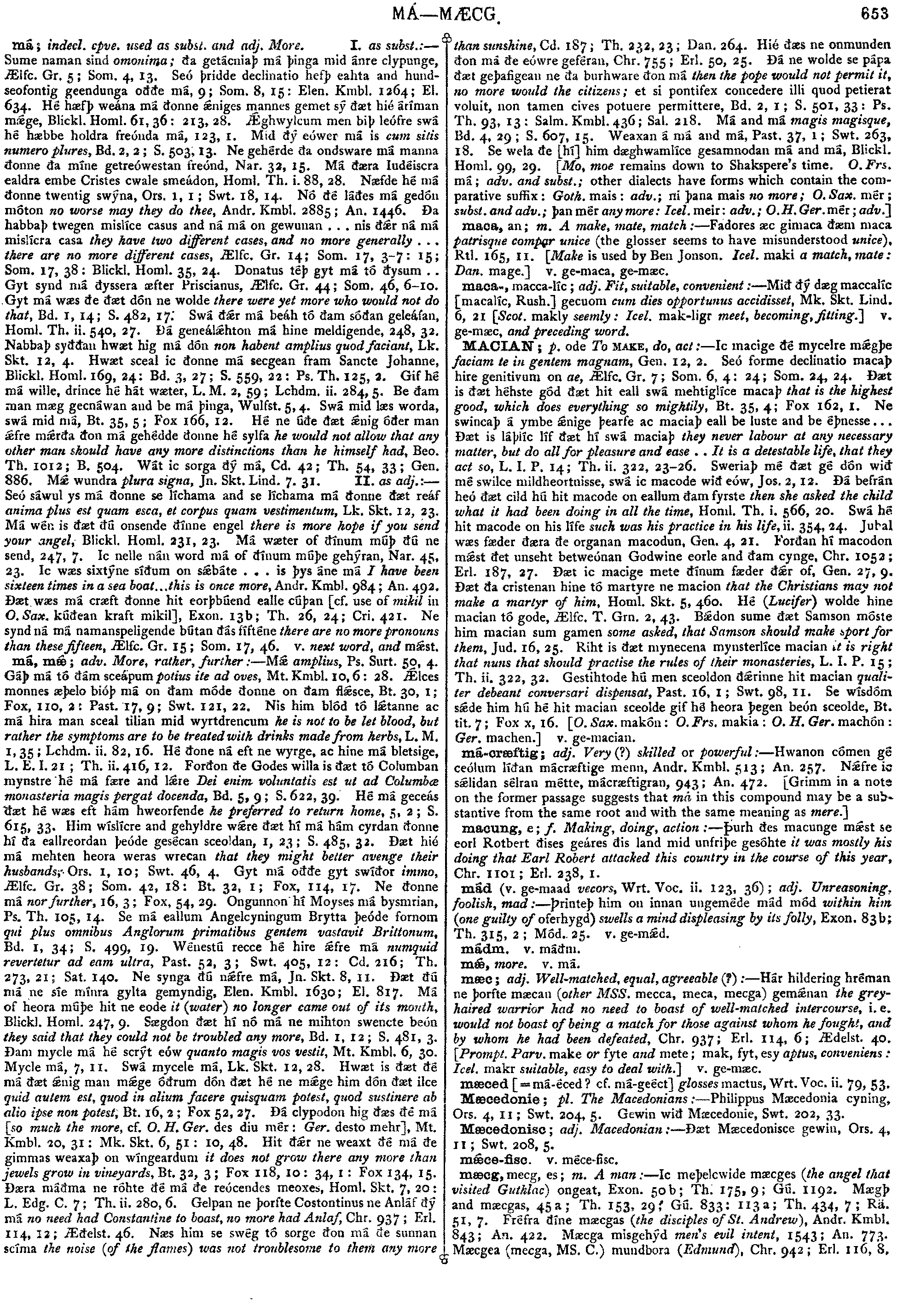
má;
indecl.
cpve.
used
as
subst.
and
adj.
More.
I.
as
subst.
:--
Sume
naman
sind
omonima;
ða
getácniaþ
má
þinga
mid
ánre
clypunge,
Ælfc.
Gr.
5
;
Som.
4,
13.
Seó
þridde
declinatio
hefþ
eahta
and
hundseofontig
geendunga
oððe
má,
9;
Som.
8,
15
:
Elen.
Kmbl.
1264;
El.
634.
Hé
hæfþ
weána
má
ðonne
niges
mannes
gemet
sý
ðæt
hié
áríman
mge,
Blickl.
Homl.
61,
36
:
213,
28.
Æ-acute;ghwylcum
men
biþ
leófre
swá
hé
hæbbe
holdra
freónda
má,
123,
1.
Mid
ðý
eówer
má
is
cum
sitis
numero
plures,
Bd.
2,
2
;
S.
503,
13.
Ne
gehérde
ða
ondsware
má
manna
ðonne
ða
míne
getreówestan
freónd,
Nar.
32,
15.
Má
ðæra
Iudéiscra
ealdra
embe
Cristes
cwale
smeádon,
Homl.
Th.
i.
88,
28.
Næfde
hé
má
ðonne
twentig
swýna,
Ors.
1,
1
;
Swt.
18,
14.
Nó
ðé
láðes
má
gedón
móton
no
worse
may
they
do
thee,
Andr.
Kmbl.
2885;
An.
1446.
Ða
habbaþ
twegen
mislíce
casus
and
ná
má
on
gewunan
...
nis
ðr
ná
má
mislícra
casa
they
have
two
different
cases,
and
no
more
generally
..
.
there
are
no
more
different
cases,
Ælfc.
Gr.
14;
Som.
17,
3-7
:
15;
Som.
17,
38
:
Blickl.
Homl.
35,
24.
Donatus
téþ
gyt
má
tó
ðysum
.
.
Gyt
synd
má
ðyssera
æfter
Priscianus,
Ælfc.
Gr.
44;
Som.
46,
6-10.
Gyt
má
wæs
ðe
ðæt
dón
ne
wolde
there
were
yet
more
who
would
not
do
that,
Bd.
1,
14;
S.
482,
17.
Swá
ðr
má
beáh
tó
ðam
sóðan
geleáfan,
Homl.
Th.
ii.
540,
27.
Ðá
geneálhton
má
hine
meldigende,
248,
32.
Nabbaþ
syððan
hwæt
hig
má
dón
non
habent
amplius
quod
faciant,
Lk.
Skt.
12,
4.
Hwæt
sceal
ic
ðonne
má
secgean
fram
Sancte
Johanne,
Blickl.
Homl.
169,
24
:
Bd.
3,
27;
S.
559,
22
:
Ps.
Th.
125,
2.
Gif
hé
má
wille,
drince
hé
hát
wæter,
L.
M.
2,
59;
Lchdm.
ii.
284,
5.
Be
ðam
man
mæg
gecnáwan
and
be
má
þinga,
Wulfst.
5,
4.
Swá
mid
læs
worda,
swá
mid
má,
Bt.
35.
5;
Fox
166,
12.
Hé
ne
úde
ðæt
nig
óðer
man
fre
mrða
ðon
má
gehédde
ðonne
hé
sylfa
he
would
not
allow
that
any
other
man
should
have
any
more
distinctions
than
he
himself
had,
Beo.
Th.
1012
;
B.
504.
Wát
ic
sorga
ðý
má,
Cd.
42;
Th.
54,
33;
Gen.
886.
M
wundra
plura
signa,
Jn.
Skt.
Lind.
7.
31.
II.
as
adj.
:--
Seó
sáwul
ys
má
ðonne
se
líchama
and
se
líchama
má
ðonne
ðæt
reáf
anima
plus
est
quam
esca,
et
corpus
quam
vestimentum,
Lk.
Skt.
12,
23.
Má
wén
is
ðæt
ðú
onsende
ðínne
engel
there
is
more
hope
if
you
send
your
angel,
Blickl.
Homl.
231,
23.
Má
wæter
of
ðínum
múþ
ðú
ne
send,
247.
7.
Ic
nelle
nán
word
má
of
ðínum
múþe
gehýran,
Nar.
45,
23.
Ic
wæs
sixtýne
síðum
on
sbáte
.
.
.
is
þys
áne
má
I
have
been
sixteen
times
in
a
sea
boat
...
this
is
once
more,
Andr.
Kmbl.
984;
An.
492.
Ðæt
wæs
má
cræft
ðonne
hit
eorþbúend
ealle
cúþan
[cf.
use
of
mikil
in
O.Sax.
kúðean
kraft
mikil],
Exon.
13
b;
Th.
26,
24;
Cri.
421.
Ne
synd
ná
má
namanspeligende
bútan
ðás
fífténe
there
are
no
more
pronouns
than
these
fifteen,
Ælfc.
Gr.
15
;
Som.
17,
46.
v.
next
word,
and
mst.
|
Source: Bosworth/Toller, page b0682, entry 35 View original page image as: [TIFF] [PNG] [View previous entry] [View next entry] |
[Comment on this entry] [View comments] |
The following entry has been hand-corrected once. |
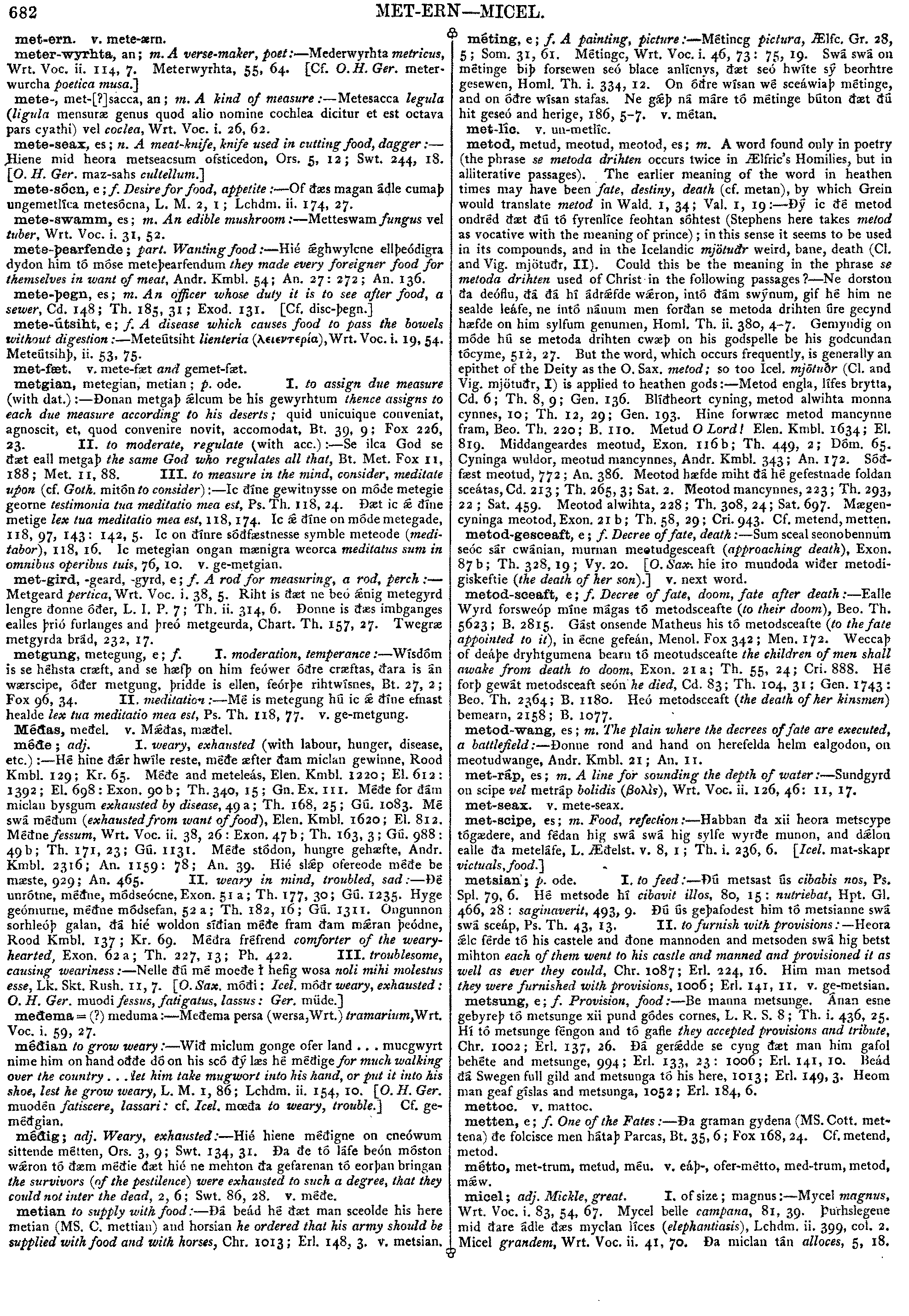
...
Hwæt
máre
dést
ðú?
Gewyslíce
máre
ic
dó,
Coll.
Monast.
Th.
19,
23-35.
Ðonne
hí
mst
tó
yfele
gedón
hæfdon,
ðonne
nam
man
grið
and
frið
wið
hí,
Chr.
1011;
Erl.
145,
2.
V.
oblique
cases
used
adverbially
:--
Se
lce
biþ
micles
tó
beald
(much
too
bold),
Past.
9;
Swt.
61,
2.
Ðara
micles
tó
feala
winþ
wiþ
gecynde,
Bt.
Met.
Fox
13,
32;
Met.
13,
16.
Micles
on
æþelum
wíde
is
geweorðod
háligra
tíd,
Menol.
Fox
236;
Men.
119.
Hié
God
wolde
onmunan
swá
micles,
Andr.
Kmbl.
1789;
An.
897.
Micclum
nimium,
Ælfc.
Gr.
38;
Som.
40,
46.
Ne
cweþe
ic
ná
ðæt
ðeós
bóc
máge
micclum
tó
láre
fremian,
pref.;
Som.
1,
43:
Herb.
17,
2;
Lchdm.
i.
110,
10.
Ealle
micclum
ðæs
wundrodon,
Homl.
Th.
i.
42,
16,
21:
Ps.
Th.
103,
14.
Ne
him
mycelum
ondrdeþ,
111,
6.
Swá
man
æt
méder
biþ
miclum
féded,
130,
4:
Andr.
Kmbl.
244;
An.
122:
Bt.
Met.
Fox
13,
40;
Met.
13,
20.
Micel
ic
gedeorfe
multum
laboro,
Coll.
Monast.
Th.
20,
25.
Oftor
micle
much
oftener,
Bt.
Met.
Fox
19,
37;
Met.
19,
19.
Hé
wæs
micle
ðé
blíðra,
9,
63;
Met.
9,
32.
Swíðe
micle
scyrtran
ymbhwearft,
28,
14;
Met.
28,
7.
Nóht
micle
r,
Bd.
4,
23;
S.
593,
21.
Ðam
mycle
má
(quanta
magis)
hé
scrýt
eów,
Mt.
Kmbl.
6,
30.
Ic
þegnum
ðínum
dyrnde
and
sylfum
ðé
swíðost
micle
I
concealed
it
from
thy
servants,
and
from
thee
much
the
most,
Cd.
129;
Th.
164,
12;
Gen.
2713.
[Laym.
O.
E.
Homl.
A.
R.
Chauc.
Ayenb.
muchel,
mochel:
Orm.
Havel.
mikel;
Gen.
a.
Ex.
mikel,
michel:
Goth.
mikils:
O.
Sax.
O.
L.
Ger.
mikil:
Icel.
mikill:
O.
H.
Ger.
michil.]
v.
efen-,
fr-,
mis-,
ofer-,
wuldor-micel,
and
má.
|
Source: Bosworth/Toller, page b0812, entry 24 View original page image as: [TIFF] [PNG] [View previous entry] [View next entry] |
[Comment on this entry] [View comments] |
The following entry has been hand-corrected once. |
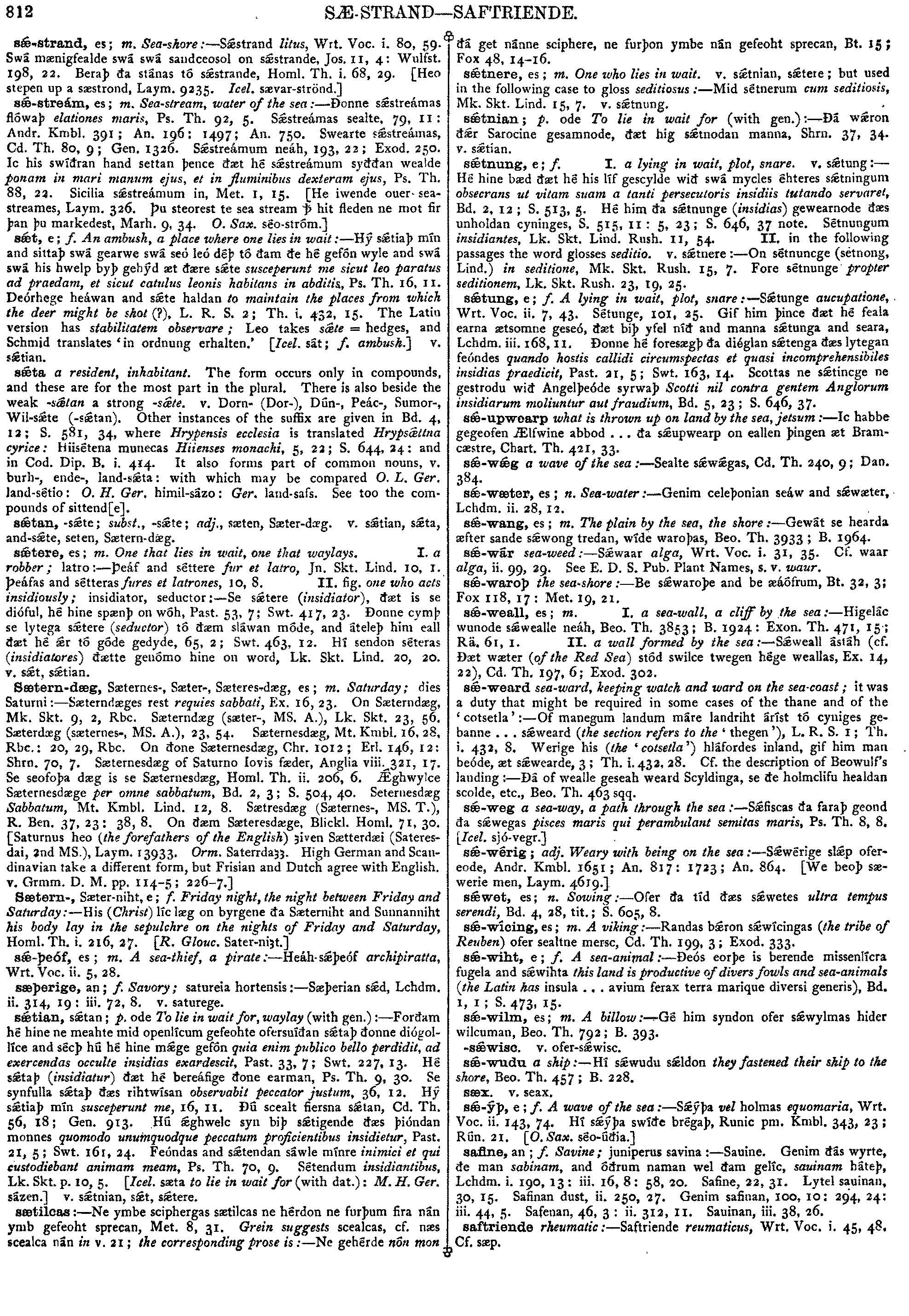
s-weard
sea-ward,
keeping
watch
and
ward
on
the
sea-coast;
it
was
a
duty
that
might
be
required
in
some
cases
of
the
thane
and
of
the
'cotsetla'
:--
Of
manegum
landum
máre
landriht
áríst
tó
cyniges
gebanne
.
.
.
sweard
(the
section
refers
to
the
'thegen'),
L.
R.
S.
1;
Th.
i.
432,
8.
Werige
his
(the
'cotsetla')
hláfordes
inland,
gif
him
man
beóde,
æt
swearde,
3
;
Th.
i.
432,
28.
Cf.
the
description
of
Beowulf's
landing
:--
Ða
of
wealle
geseah
weard
Scyldinga,
se
ðe
holmclifu
healdan
scolde,
etc.
,
Beo.
Th.
463
sqq.
| Result Page: |  |
Previous | 1 2 3 4 5 6 7 8 9 10 11 12 | Next |  |
Germanic Lexicon Project (main page)
This search system was written by
Sean Crist
Please consider
volunteering
to correct the data in these online dictionaries.
No rights reserved. Feel free to use these data in any way you please.