|
|

|
Source: Cleasby/Vigfusson, page b0054, entry 11 View original page image as: [TIFF] [PNG] [View previous entry] [View next entry] |
[Comment on this entry] [View comments] |
The following entry has not been hand-corrected. However, the page is reserved and someone is correcting it. |
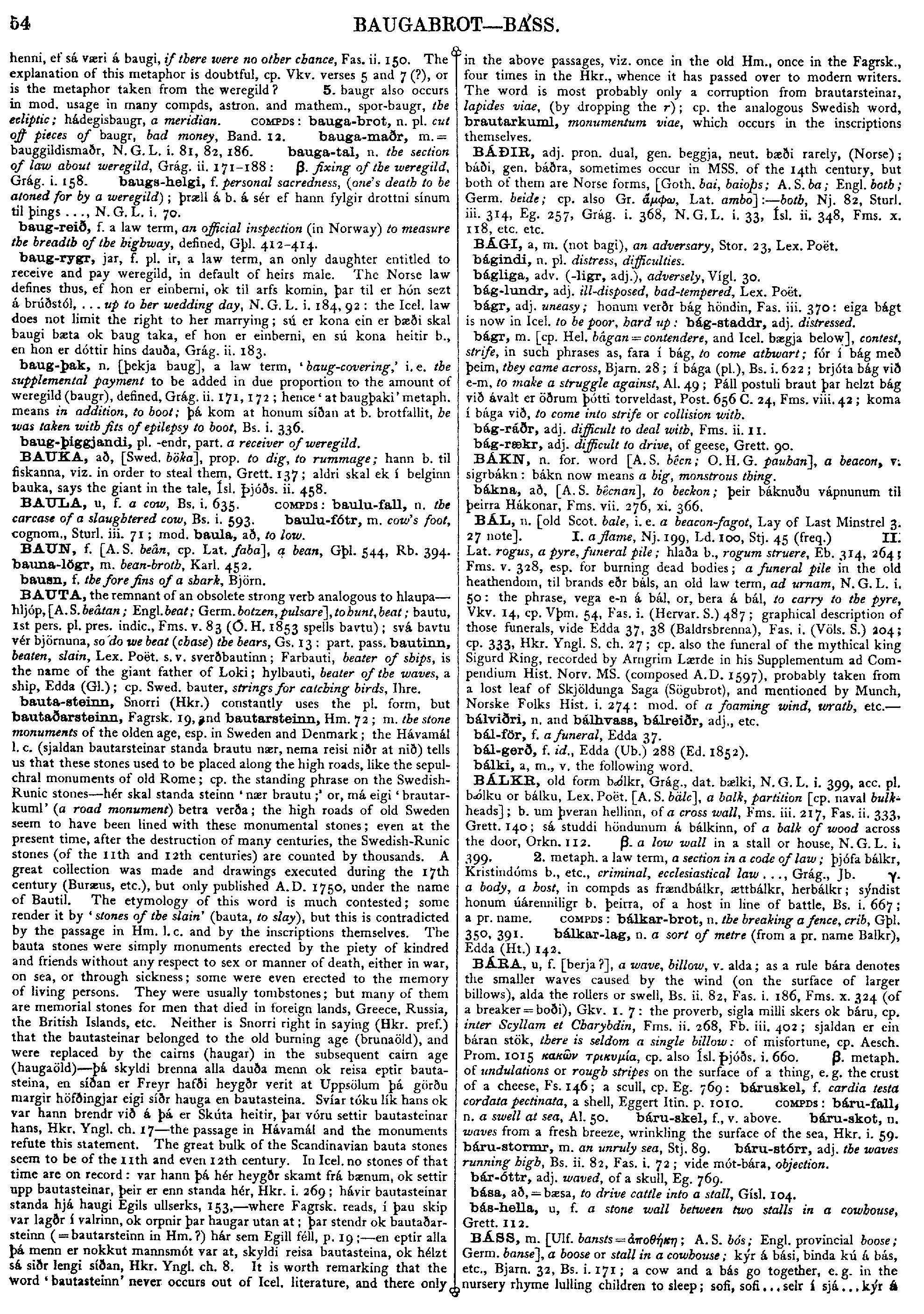
bauta-steinn, Snorri (Hkr.) constantly uses the pl. form, but bautaðarsteinn, Fagrsk. 19, ^nd bautarsteinn, Hm. 72; m. the stone monuments of the olden age, esp. in Sweden and Denmark; the Hávamál 1. c. (sjaldan bautarsteinar standa brautu nær, nema reisi niðr at nið) tells us that these stones used to be placed along the high roads, like the sepul- chral monuments of old Rome; cp. the standing phrase on the Swedish- Runic stones -- her skal standa steinn ' naer brautu;' or, má eigi' brautar- kuml' (a roa d monument) betra verða; the high roads of old Sweden seem to have been lined with these monumental stones; even at the present time, after the destruction of many centuries, the Swedish-Runic stones (of the nth and I2th centuries) are counted by thousands. A great collection was made and drawings executed during the I7*h century (Buræus, etc.), but only published A. D. 1750, under the name of Bautil. The etymology of this word is much contested; some render it by ' s t on e s of the slain' (bauta, to slay), but this is contradicted by the passage in Hm. 1. c. and by the inscriptions themselves. The bauta stones were simply monuments erected by the piety of kindred and friends without any respect to sex or manner of death, either in war, on sea, or through sickness; some were even erected to the memory of living persons. They were usually tombstones; but many of them are memorial stones for men that died in foreign lands, Greece, Russia, the British Islands, etc. Neither is Snorri right in saying (Hkr. pref.) that the bautasteinar belonged to the old burning age (brunaöld), and were replaced by the cairns (haugar) in the subsequent cairn age (haugaöld) -- þá skyldi brenna alla dauða menn ok reisa eptir bauta- steina, en síðan er Freyr hafði heygðr verit at Uppsölum þá görðu margir höfðingjar eigi síðr hauga en bautasteina. Svíar tóku lík hans ok var hann brendr við á þá er Skúta heitir, þar vóru settir bautasteinar hans, Hkr. Yngl. ch. 17 -- the passage in Hávamál and the monuments refute this statement. The great bulk of the Scandinavian bauta stones seem to be of the nth and even 12th century. In Icel. no stones of that time are on record: var hann þá her heygðr skamt frá bsenum, ok settir upp bautasteinar, þeir er enn standa her, Hkr. i. 269; hávir bautasteinar standa hjá haugi Egils ullserks, 153, -- where Fagrsk. reads, í þau skip var lagðr í valrinn, ok orpnir þar haugar utan at; þar stendr ok bautaðar- steinn (= bautarsteinn in Hm. ?) hár sem Egill fell, p. 19; -- en eptir alia þá menn er nokkut mannsmót var at, skyldi reisa bautasteina, ok hélzt sa siðr lengi síðan, Hkr. Yngl. ch. 8. It is worth remarking that the Word ' bautasteinn' never occurs out of Icel. literature, and there only in the above passages, viz. once in the old Hm., once in the Fagrsk., four times in the Hkr., whence it has passed over to modern writers. The word is most probably only a corruption from brautarsteinar, lapides viae, (by dropping the r); cp. the analogous Swedish word, brautarkuml, monumentum viae, which occurs in the inscriptions themselves.
|
Source: Cleasby/Vigfusson, page b0070, entry 33 View original page image as: [TIFF] [PNG] [View previous entry] [View next entry] |
[Comment on this entry] [View comments] |
The following entry has been hand-corrected once. |
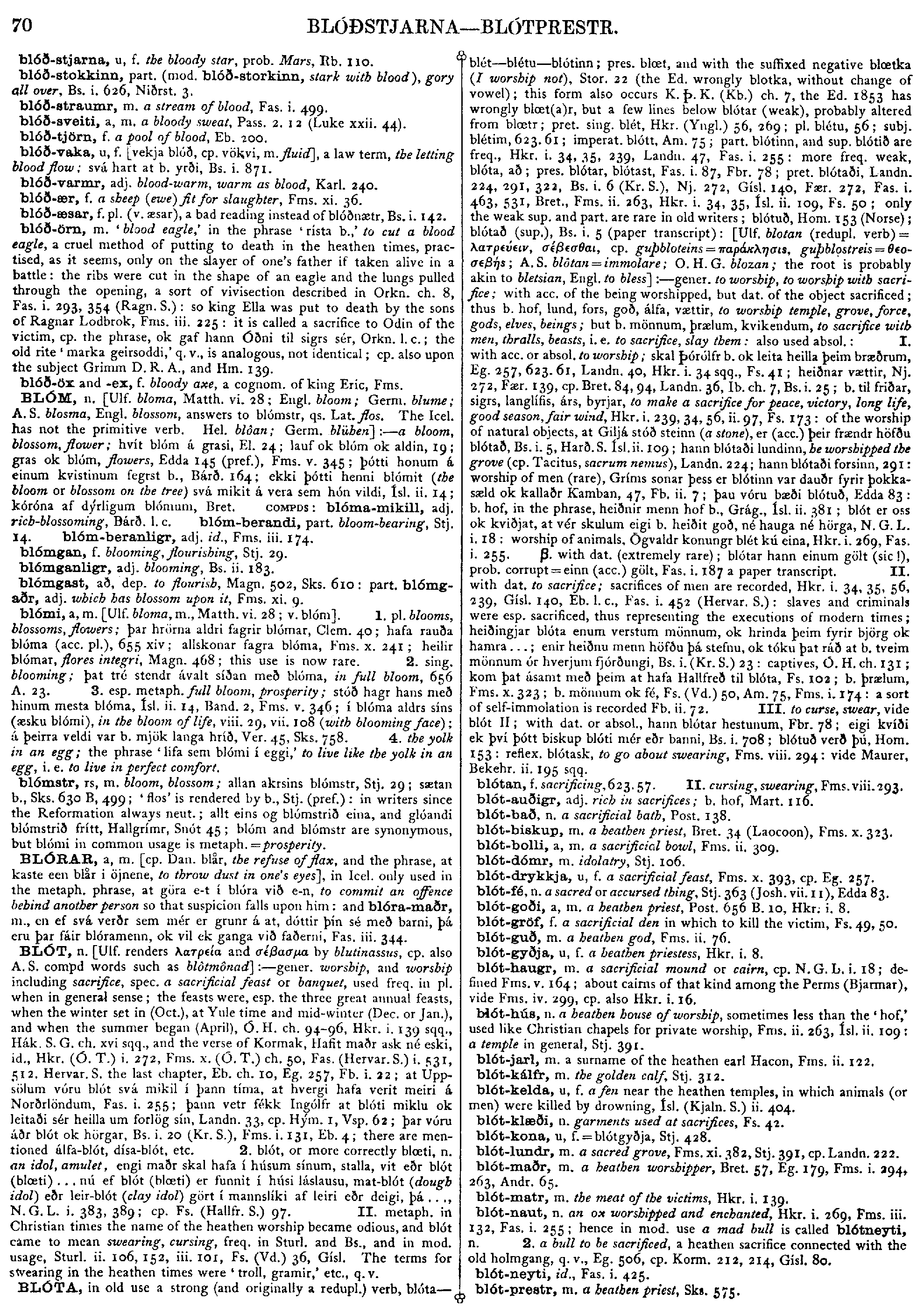
blót-haugr, m. a sacrificial mound or cairn, cp. N. G. L. i. 18; defined Fms. v. 164; about cairns of that kind among the Perms (Bjarmar), vide Fms. iv. 299, cp. also Hkr. i. 16.
|
Source: Cleasby/Vigfusson, page b0088, entry 27 View original page image as: [TIFF] [PNG] [View previous entry] [View next entry] |
[Comment on this entry] [View comments] |
The following entry has been hand-corrected once. |
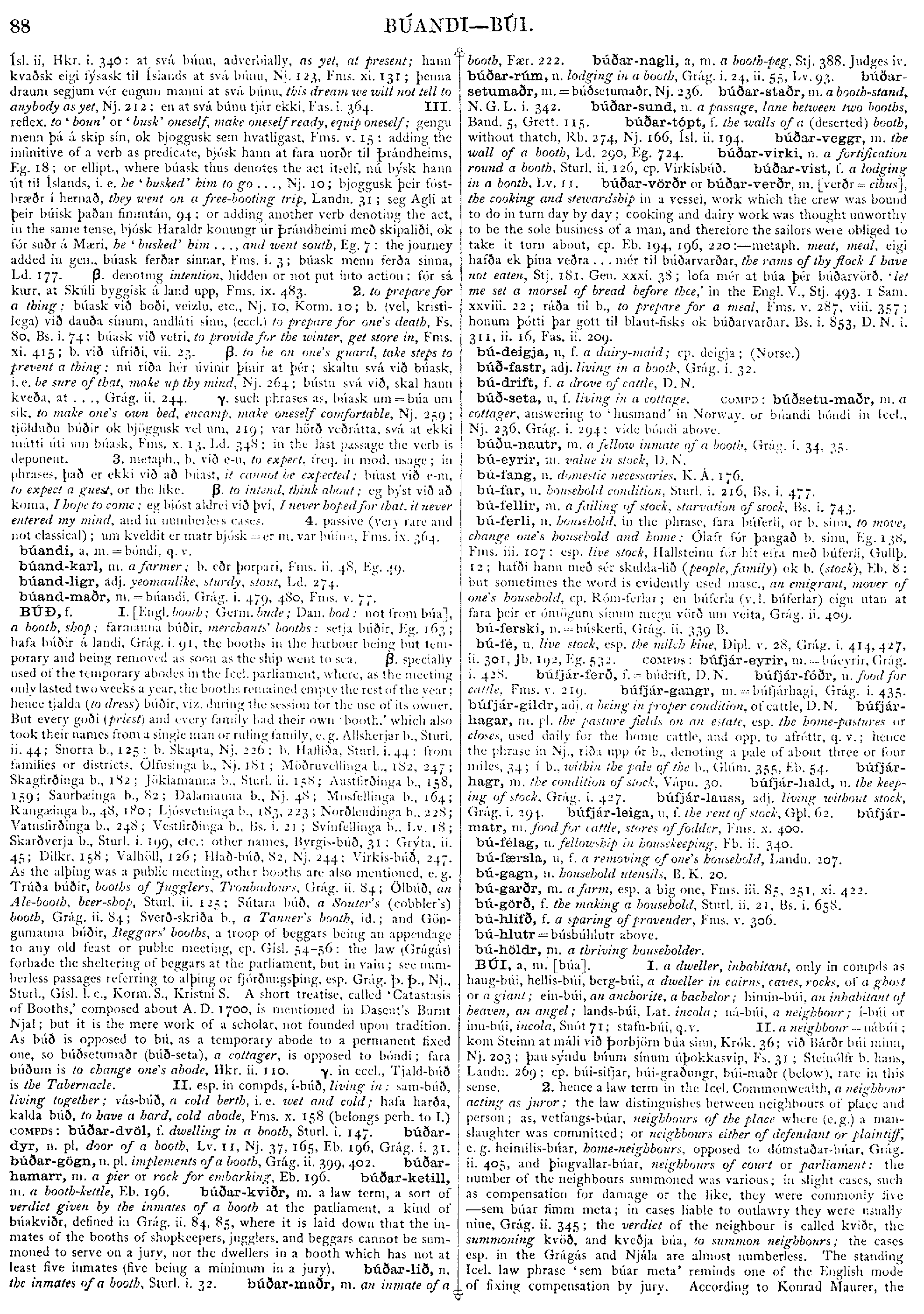
BÚI, a, m. [búa]. I. a dweller, inhabitant, only in compds as haug-búi, hellis-búi, berg-búi, a dweller in cairns, caves, rocks, of a ghost or a giant; ein-búi, an anchorite, a bachelor; himin-búi, an inhabitant of heaven, an angel; lands-búi, Lat. incola; ná-búi, a neighbour; í-búi or inn-búi, incola, Snót 71; stafn-búi, q.v. II. a neighbour = nábúi; kom Steinn at máli við Þorbjörn búa sinn, Krók. 36; við Bárðr búi minn, Nj. 203; þau sýndu búum sínum úþokkasvip, Fs. 31; Steinólfr b. hans, Landn. 269; cp. búi-sifjar, búi-graðungr, búi-maðr (below), rare in this sense. 2. hence a law term in the Icel. Commonwealth, a neighbour acting as juror; the law distinguishes between neighbours of place and person; as, vetfangs-búar, neighbours of the place where (e.g.) a manslaughter was committed; or neighbours either of defendant or plaintiff, e.g. heimilis-búar, home-neighbours, opposed to dómstaðar-búar, Grág. ii. 405, and þingvallar-búar, neighbours of court or parliament: the number of the neighbours summoned was various; in slight cases, such as compensation for damage or the like, they were commonly five--sem búar fimm meta; in cases liable to outlawry they were usually nine, Grág. ii. 345; the verdict of the neighbour is called kviðr, the summoning kvöð, and kveðja búa, to summon neighbours; the cases esp. in the Grágás and Njála are almost numberless. The standing Icel. law phrase 'sem búar meta' reminds one of the English mode of fixing compensation by jury. According to Konrad Maurer,
|
Source: Cleasby/Vigfusson, page b0104, entry 1 View original page image as: [TIFF] [PNG] [View previous entry] [View next entry] |
[Comment on this entry] [View comments] |
The following entry has not been hand-corrected. However, the page is reserved and someone is correcting it. |
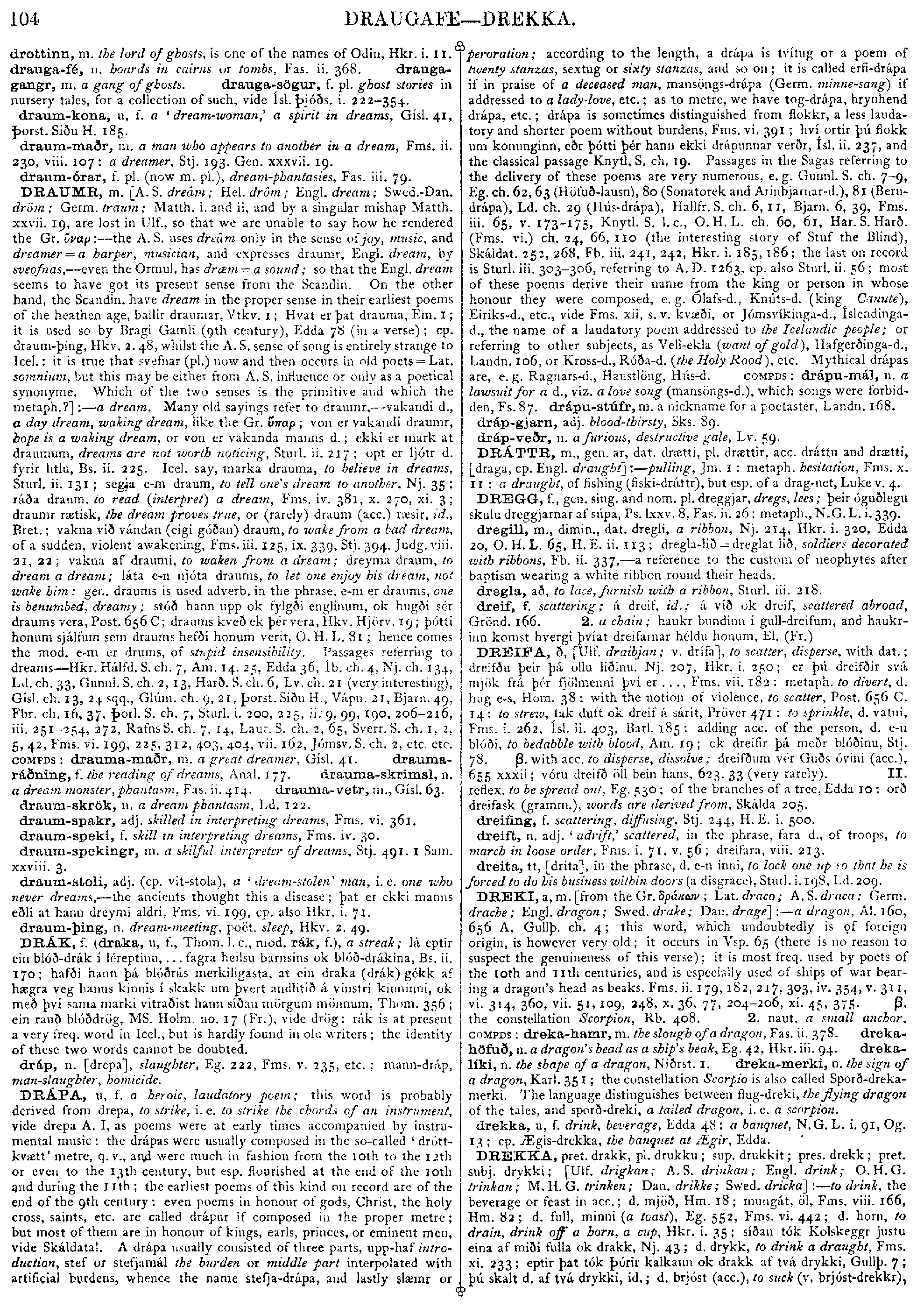
drottinn, m. the lord of ghosts, is one of the names of Odin, Hkr. i. II. drauga-fe, n. boards in cairns or tombs, Fas. ii. 368. drauga- gangr, m. a gang of gbosts. drauga-sögur, f. pl. g h os t stories in nursery tales, for a collection of such, vide Ísl. Jjjóðs. i. 222 -- 354.
|
Source: Cleasby/Vigfusson, page b0126, entry 1 View original page image as: [TIFF] [PNG] [View previous entry] [View next entry] |
[Comment on this entry] [View comments] |
The following entry has not been hand-corrected. However, the page is reserved and someone is correcting it. |
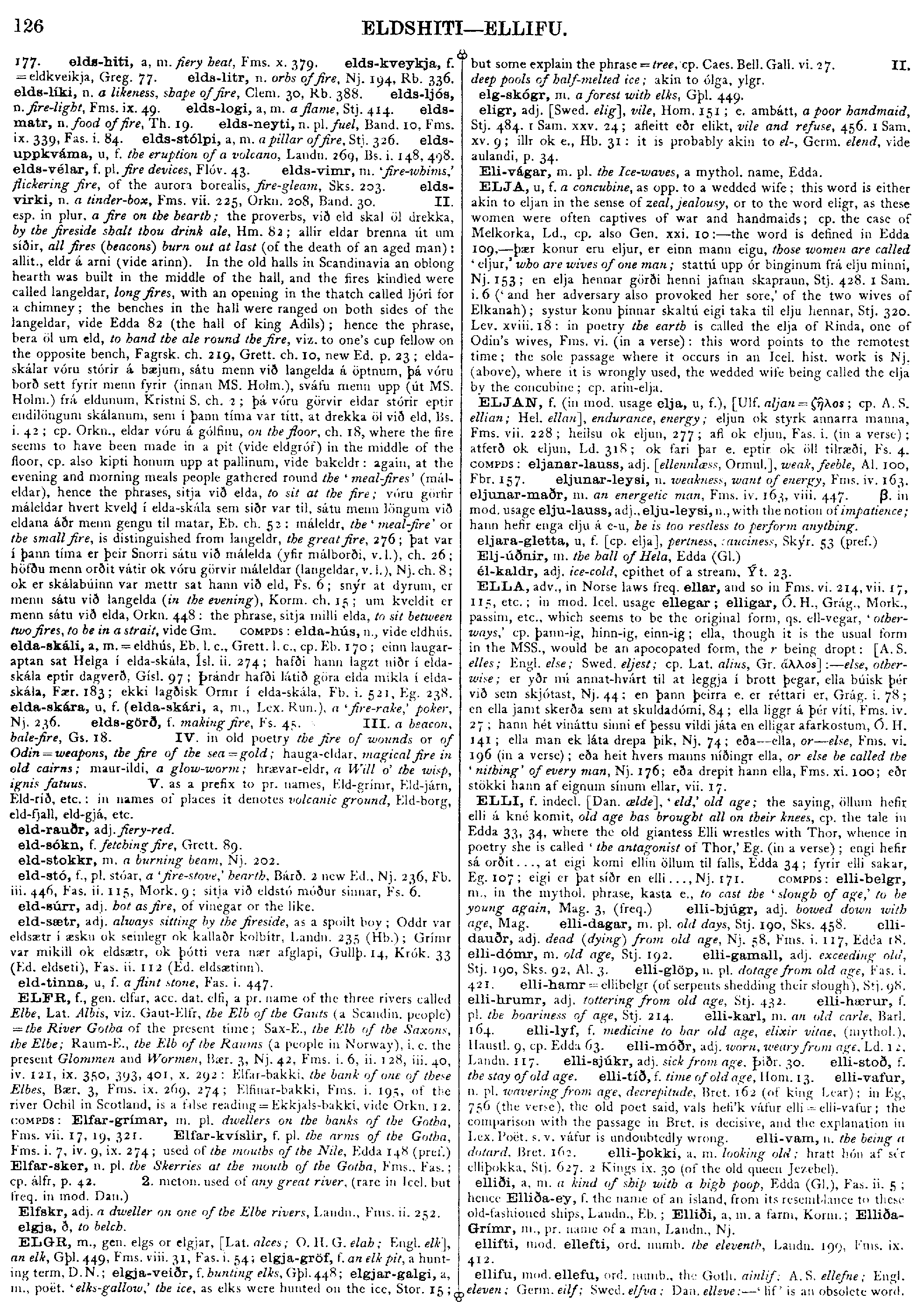
177- elds-hiti, a, m. fiery beat, Fms. x. 379. elds-kveykja, f. = eldkveikja, Greg. 77. elds-litr, n. orbs of fire, Nj. 194, Rb. 336. elds-MM, n. a likeness, shape of fire, Clem. 30, Rb. 388. elds-ljós, n. fire-light, Fms. ix. 49. elds-logi, a, m. aflame, Stj. 414. elds- matr, n. /oo d of fire, Th. 19. elds-neyti, n. pl. fuel, Band. 10, Fms. ix. 339, Fas. i. 84. elds-stólpi, a, m. a pillar of fire, Stj. 326. elds- uppkváma, u, f. the eruption of a volcano, Landn. 269, Bs. i. 148, 498. elds-velar, f. pl. ^î re de-vices, Flóv. 43. elds-vimr, m. 'fire-whims, ' flickering fire, of the aurora borealis, fire-gleam, Sks. 203. elds- virki, n. a tinder-box, Fms. vii. 225, Orkn. 208, Band. 30. II. esp. in plur. a fire on the hearth; the proverbs, við eld skal ol drekka, by the fireside sbalt tbou drink ale, Hm. 82; allir eldar brenna út um síðir, all fires (beacons') burn out at last (of the death of an aged man): allit., eldr á ami (vide arinn). In the old halls in Scandinavia an oblong hearth was built in the middle of the hall, and the fires kindled were called langeldar, long fires, with an opening in the thatch called ljuri for a chimney; the benches in the hall were ranged on both sides of the langeldar, vide Edda 82 (the hall of king Adils); hence the phrase, bera ol um eld, to hand the ale round the fire, viz. to one's cup fellow on the opposite bench, Fagrsk. ch. 219, Grett. ch. 10, new Ed. p. 23; elda- skálar vóru stórir á bæjuni, sátu menu við langelda á öptnuin, þá voru borð sett fyrir menn fyrir (inrian MS. Holm.), sváfu menu upp (ut MS. Holm.) frá eldunurn, Kristni S. ch. 2; þá vóru görvir eldar stórir eptir endilonguni skalanum, sem í þann tínia var titt, at drekka öl við eld, Bs. i. 42; cp. Orkn., eldar vóru á gólfinu, on the floor, ch. 18, where the fire seems to have been made in a pit (vide eldgróf) in the middle of the floor, cp. also kipti honum upp at pallinum, vide bakeldr: again, at the evening and morning meals people gathered round the 'meal-fires' (m;d- eldar), hence the phrases, sitja við elda, t o s it at the fire; vóru görrir máleldar hvert kveli] í elda-skúla sern siðr var til, sátu menn löngum við eldana áðr menn gengu til matar, Eb. ch. 52: maleldr, the' meal-fire' or the small fire, is distinguished from laugeldr, the great fire, 276; þat var í þann tíma er þeir Snorri sátu við málelda (yfir málborði, v. 1.), ch. 26; höfðu menn orðit vátir ok vóru görvir máleldar (langeldar, v. 1.), Nj. ch. 8; ok er skálabúinn var mettr sat hann við eld, Fs. 6; snýr at dyruin, er menn sátu við langelda (i n the evening), Korm. ch. 15; um kveldit er menn sátu við elda, Orkn. 448: the phrase, sitja milli elda, to sit between two fires, to be in a strait, vide Gin. COMPDS: elda-hús, n., vide eldhiis. elda-skali, a, m. = eldhús, Eb. 1. c., Grett. 1. c., cp. Eb. 170; einn laugar- aptan sat Helga í elda-skála, Ísl. ii. 274; hafði hann lagzt uiðr í elcla- skála eptir dagverð. Gísl. 97; þrándr hafði látið gora elda mikla í elda- skála, Fzr. 183; ekki lagðisk Ormr í elda-skála, Fb. i. 521, Eg. 238. elda-skára, u, f. (elda-skári, a, m., Lex. Run.), a 'fire-rake, ' poker, Nj. 236. elds-görð, f. making fire, Fs. 45. III. a beacon, bale-fire, Gs. 18. IV. in old poetry the fire of wounds or of Odin = weapons, the fire of the sea = gold; hauga-eldar, magical fire in old cairns; maur-ildi, a glow-worm; hraevar-eldr, a Will o' the wisp, ignis fatuus. V. as a prefix to pr. names, Kld-grinir, Kld-járn, Kld-ríð, etc.: in names of places it denotes volcanic ground, Kld-borg, eld-fjall, eld-gjá, etc.
|
Source: Cleasby/Vigfusson, page b0203, entry 43 View original page image as: [TIFF] [PNG] [View previous entry] [View next entry] |
[Comment on this entry] [View comments] |
The following entry has been hand-corrected once. |
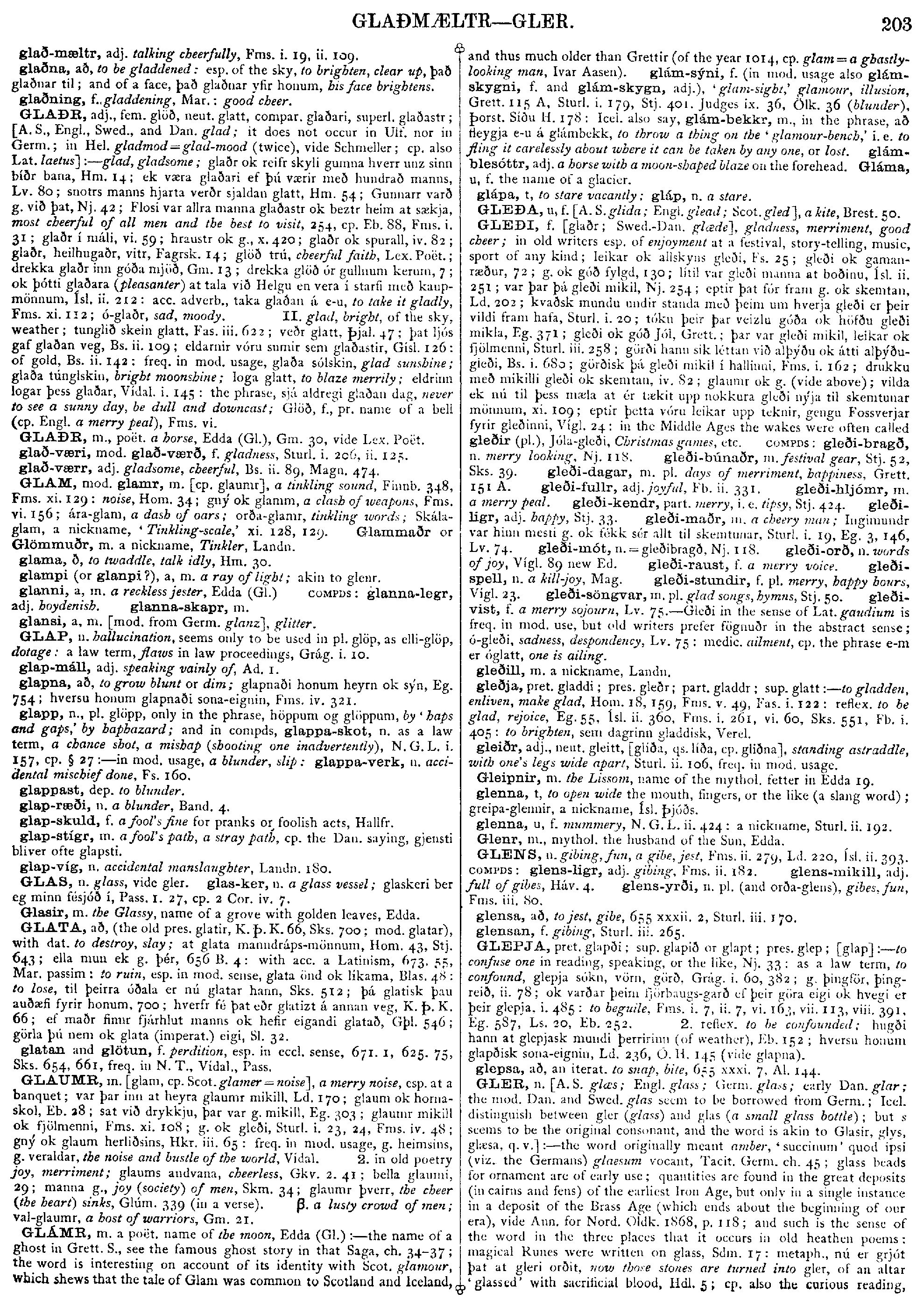
GLER, n. [A. S. glæs; Engl. glass; Germ. glass; early Dan. glar; the mod. Dan. and Swed. glas seem to be borrowed from Germ.; Icel. distinguish between gler (glass) and glas (a small glass bottle); but s seems to be the original consonant, and the word is akin to Glasir, glys, glæsa, q.v.] :-- the word originally meant amber, 'succinum' quod ipsi (viz. the Germans) glaesum vocant, Tacit. Germ. ch. 45; glass beads for ornament are of early use; quantities are found in the great deposits (in cairns and fens) of the earliest Iron Age, but only in a single instance in a deposit of the Brass Age (which ends about the beginning of our era), vide Ann. for Nord. Oldk. 1868, p. 118; and such is the sense of the word in the three places that it occurs in old heathen poems: magical Runes were written on glass, Sdm. 17: metaph., nú er grjót þat at gleri orðit, now those stones are turned into gler, of an altar 'glassed' with sacrificial blood, Hdl, 5; cp. also the curious reading,
|
Source: Cleasby/Vigfusson, page b0241, entry 20 View original page image as: [TIFF] [PNG] [View previous entry] [View next entry] |
[Comment on this entry] [View comments] |
The following entry has been hand-corrected once. |
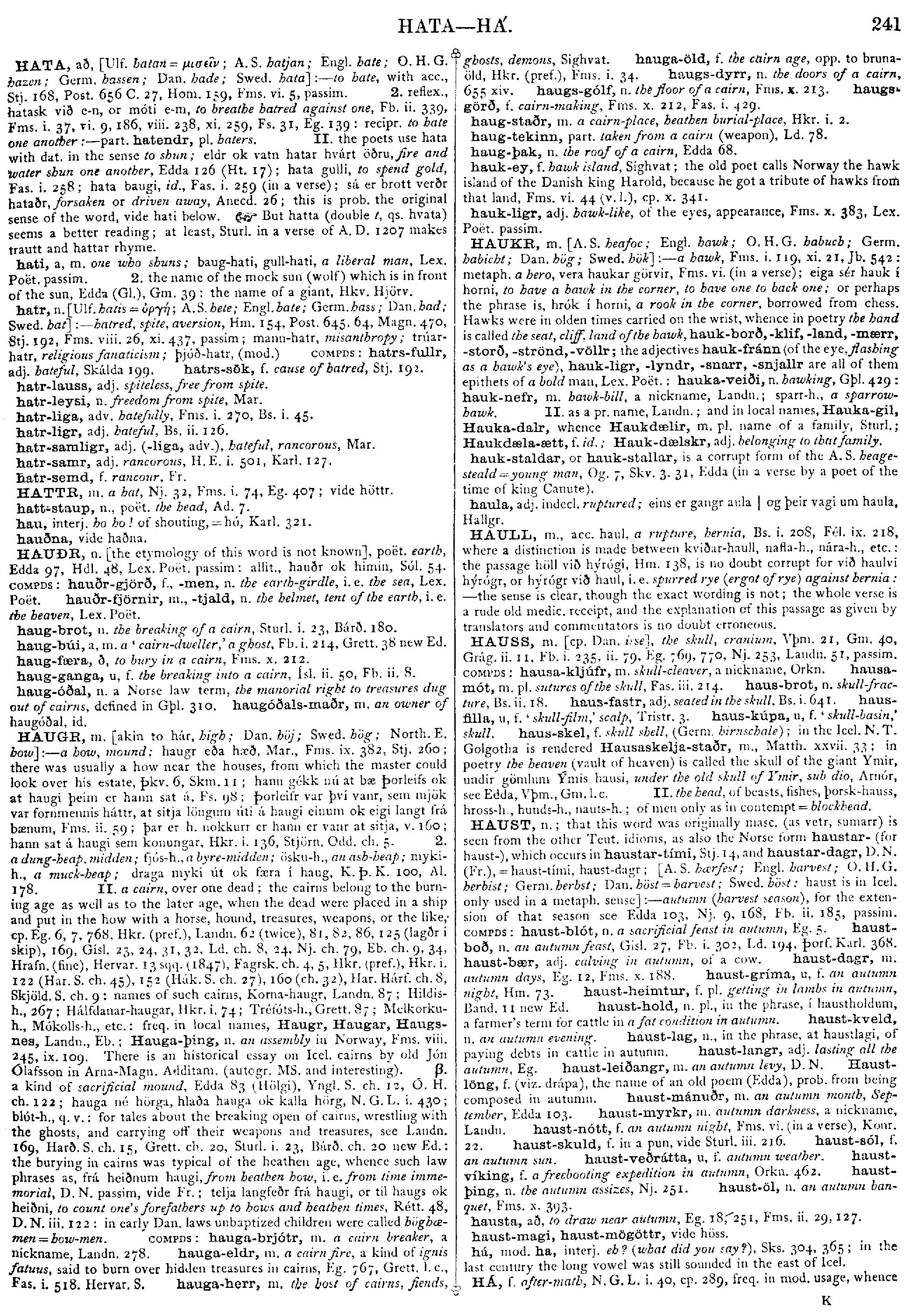
haug-óðal, n. a Norse law term, the manorial right to treasures dug out of cairns, defined in Gþl. 310. haugóðals-maðr, m. an owner of haugóðal, id.
|
Source: Cleasby/Vigfusson, page b0241, entry 21 View original page image as: [TIFF] [PNG] [View previous entry] [View next entry] |
[Comment on this entry] [View comments] |
The following entry has been hand-corrected once. |
HAUGR,
m.
[akin
to
hár,
high;
Dan.
höj;
Swed.
hog;
North.
E.
how]
:--
a
how,
mound;
haugr
eða
hæð,
Mar.,
Fms.
ix.
382,
Stj.
260;
there
was
usually
a
how
near
the
houses,
from
which
the
master
could
look
over
his
estate,
Þkv.
6,
Skm.
11;
hann
gékk
nú
at
bæ
Þorleifs
ok
at
haugi
þeim
er
hann
sat
a.,
Fs.
98;
Þorleifr
var
því
vanr,
sem
mjök
var
fornmennis
háttr,
at
sitja
löngum
úti
á
haugi
einum
ok
eigi
langt
frá
bænum,
Fms.
ii.
59;
þar
er
h.
nokkurr
er
hann
er
vanr
at
sitja,
v.
160;
hann
sat
á
haugi
sem
konungar,
Hkr.
i.
136,
Stjörn.
Odd.
ch.
5.
2.
a
dung-heap.
midden;
fjós-h.,
a
byre-midden;
ösku-h.,
an
ash-heap;
myki-h.,
a
muck-heap;
draga
myki
út
ok
færa
í
haug,
K.
Þ.
K.
100,
Al.
178.
II.
a
cairn,
over
one
dead;
the
cairns
belong
to
the
burning
age
as
well
as
to
the
later
age,
when
the
dead
were
placed
in
a
ship
and
put
in
the
how
with
a
horse,
hound,
treasures,
weapons,
or
the
like,
cp.
Eg.
6,
7,
768.
Hkr.
(pref.),
Landn.
62
(twice),
81,
82,
86,
125
(lagðr
í
skip),
169,
Gísl.
23,
24,
31,
32,
Ld.
ch.
8,
24,
Nj.
ch.
79,
Eb.
ch.
9,
34,
Hrafn.
(fine),
Hervar.
13
sqq.
(1847),
Fagrsk.
ch.
4,
5,
Hkr.
(pref.),
Hkr.
i.
122
(Har.
S.
ch.
45),
152
(Hák.
S.
ch.
27),
160
(ch.
32),
Har.
Hárf.
ch.
8,
Skjöld.
S.
ch.
9:
names
of
such
cairns,
Korna-haugr,
Landn.
87;
Hildis-h.,
267;
Hálfdanar-haugar,
Hkr.
i.
74;
Tréfóts-h.,
Grett.
87;
Melkorku-h.,
Mókolls-h.,
etc.:
freq.
in
local
names,
Haugr,
Haugar,
Haugs-nes,
Landn.,
Eb.;
Hauga-þing,
n.
an
assembly
in
Norway,
Fms.
viii.
245,
ix.
109.
There
is
an
historical
essay
on
Icel.
cairns
by
old
Jón
Ólafsson
in
Arna-Magn.
Additam.
(autogr.
MS.
and
interesting).
 .
a
kind
of
sacrificial
mound,
Edda
83
(Hölgi),
Yngl.
S.
ch.
12,
Ó.
H.
ch.
122;
hauga
né
hörga,
hlaða
hauga
ok
kalla
hörg,
N.
G.
L.
i.
430;
blót-h.,
q.v.:
for
tales
about
the
breaking
open
of
cairns,
wrestling
with
the
ghosts,
and
carrying
off
their
weapons
and
treasures,
see
Landn.
169,
Harð.
S.
ch.
15,
Grett.
ch.
20,
Sturl.
i.
23,
Bárð.
ch.
20
new
Ed.:
the
burying
in
cairns
was
typical
of
the
heathen
age,
whence
such
law
phrases
as,
frá
heiðnum
haugi,
from
heathen
how,
i.e.
from
time
immemorial,
D.
N.
passim,
vide
Fr.;
telja
langfeðr
frá
haugi,
or
til
haugs
ok
heiðni,
to
count
one's
forefathers
up
to
hows
and
heathen
times,
Rétt.
48,
D.
N.
iii.
122:
in
early
Dan.
laws
unbaptized
children
were
called
höghæmen
=
how-men.
COMPDS:
hauga-brjótr,
m.
a
cairn
breaker,
a
nickname,
Landn.
278.
hauga-eldr,
m.
a
cairn
fire,
a
kind
of
ignis
fatuus,
said
to
burn
over
hidden
treasures
in
cairns,
Eg.
767,
Grett.
l.c.,
Fas.
i.
518.
Hervar.
S.
hauga-herr,
m.
the
host
of
cairns,
fiends,
ghosts,
demons,
Sighvat.
hauga-öld,
f.
the
cairn
age,
opp.
to
bruna-öld,
Hkr.
(pref.),
Fms.
i.
34.
haugs-dyrr,
n.
the
doors
of
a
cairn,
655
xiv.
haugs-gólf,
n.
the
floor
of
a
cairn,
Fms.
x.
213.
haugs-görð,
f.
cairn-making,
Fms.
x.
212,
Fas.
i.
429.
.
a
kind
of
sacrificial
mound,
Edda
83
(Hölgi),
Yngl.
S.
ch.
12,
Ó.
H.
ch.
122;
hauga
né
hörga,
hlaða
hauga
ok
kalla
hörg,
N.
G.
L.
i.
430;
blót-h.,
q.v.:
for
tales
about
the
breaking
open
of
cairns,
wrestling
with
the
ghosts,
and
carrying
off
their
weapons
and
treasures,
see
Landn.
169,
Harð.
S.
ch.
15,
Grett.
ch.
20,
Sturl.
i.
23,
Bárð.
ch.
20
new
Ed.:
the
burying
in
cairns
was
typical
of
the
heathen
age,
whence
such
law
phrases
as,
frá
heiðnum
haugi,
from
heathen
how,
i.e.
from
time
immemorial,
D.
N.
passim,
vide
Fr.;
telja
langfeðr
frá
haugi,
or
til
haugs
ok
heiðni,
to
count
one's
forefathers
up
to
hows
and
heathen
times,
Rétt.
48,
D.
N.
iii.
122:
in
early
Dan.
laws
unbaptized
children
were
called
höghæmen
=
how-men.
COMPDS:
hauga-brjótr,
m.
a
cairn
breaker,
a
nickname,
Landn.
278.
hauga-eldr,
m.
a
cairn
fire,
a
kind
of
ignis
fatuus,
said
to
burn
over
hidden
treasures
in
cairns,
Eg.
767,
Grett.
l.c.,
Fas.
i.
518.
Hervar.
S.
hauga-herr,
m.
the
host
of
cairns,
fiends,
ghosts,
demons,
Sighvat.
hauga-öld,
f.
the
cairn
age,
opp.
to
bruna-öld,
Hkr.
(pref.),
Fms.
i.
34.
haugs-dyrr,
n.
the
doors
of
a
cairn,
655
xiv.
haugs-gólf,
n.
the
floor
of
a
cairn,
Fms.
x.
213.
haugs-görð,
f.
cairn-making,
Fms.
x.
212,
Fas.
i.
429.
|
Source: Cleasby/Vigfusson, page b0311, entry 12 View original page image as: [TIFF] [PNG] [View previous entry] [View next entry] |
[Comment on this entry] [View comments] |
The following entry has been hand-corrected once. |
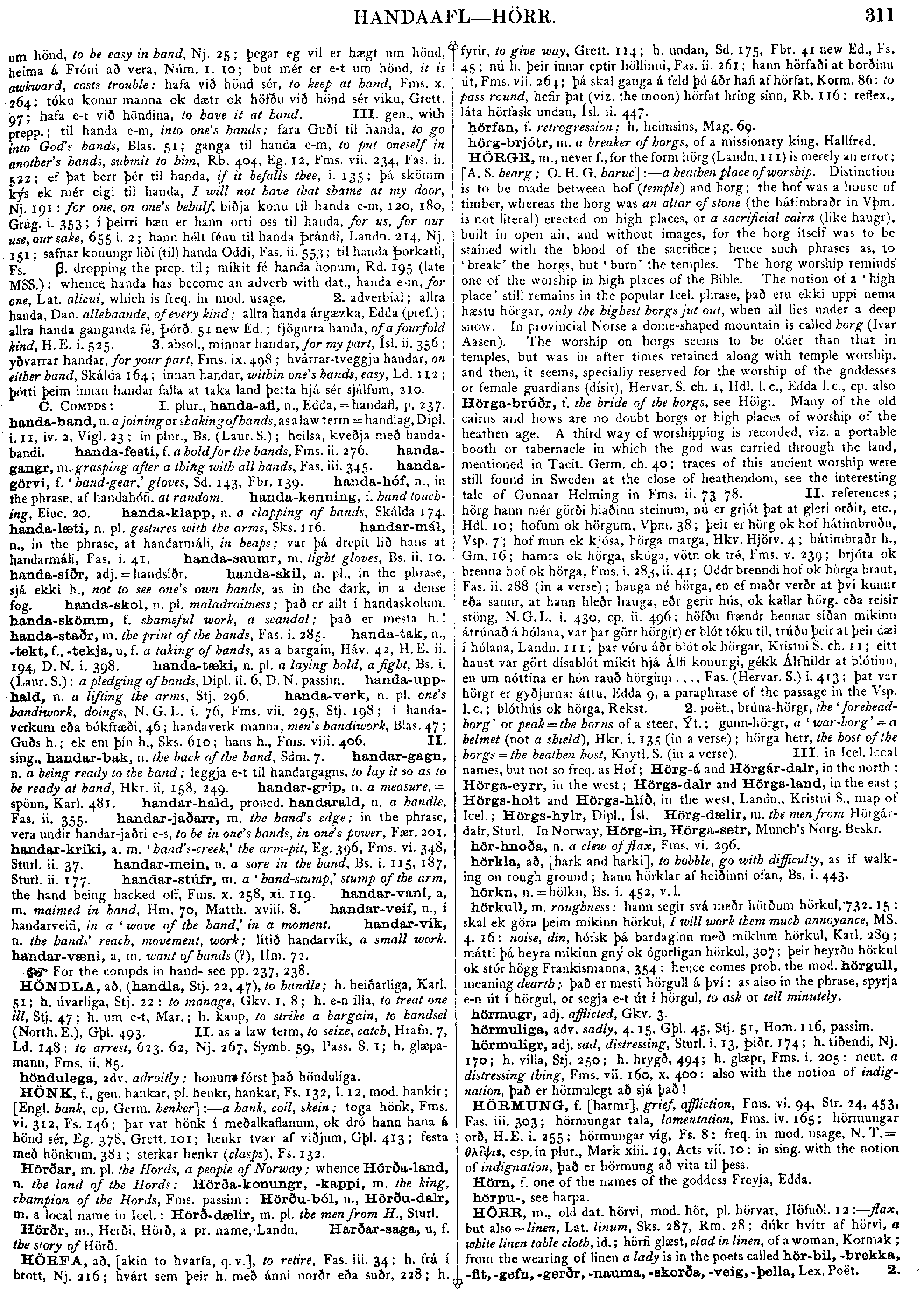
HÖRGR, m., never f., for the form hörg (Landn. 111) is merely an error; [A. S. hearg; O. H. G. haruc] :-- a heathen place of worship. Distinction is to be made between hof (temple) and horg; the hof was a house of timber, whereas the horg was an altar of stone (the hátimbraðr in Vþm. is not literal) erected on high places, or a sacrificial cairn (like haugr), built in open air, and without images, for the horg itself was to be stained with the blood of the sacrifice; hence such phrases as, to 'break' the horgs, but 'burn' the temples. The horg worship reminds one of the worship in high places of the Bible. The notion of a 'high place' still remains in the popular Icel. phrase, það eru ekki uppi nema hæstu hörgar, only the highest horgs jut out, when all lies under a deep snow. In provincial Norse a dome-shaped mountain is called horg (Ivar Aasen). The worship on horgs seems to be older than that in temples, but was in after times retained along with temple worship, and then, it seems, specially reserved for the worship of the goddesses or female guardians (dísir), Hervar. S. ch. 1, Hdl. l.c., Edda l.c., cp. also Hörga-brúðr, f. the bride of the horgs, see Hölgi. Many of the old cairns and hows are no doubt horgs or high places of worship of the heathen age. A third way of worshipping is recorded, viz. a portable booth or tabernacle in which the god was carried through the land, mentioned in Tacit. Germ. ch. 40; traces of this ancient worship were still found in Sweden at the close of heathendom, see the interesting tale of Gunnar Helming in Fms. ii. 73-78. II. references; hörg hann mér görði hlaðinn steinum, nú er grjót þat at gleri orðit, etc., Hdl. 10; hofum ok hörgum, Vþm. 38; þeir er hörg ok hof hátimbruðu, Vsp. 7; hof mun ek kjósa, hörga marga, Hkv. Hjörv. 4; hátimbraðr h., Gm. 16; hamra ok hörga, skóga, vötn ok tré, Fms. v. 239; brjóta ok brenna hof ok hörga, Fms. i. 283, ii. 41; Oddr brenndi hof ok hörga braut, Fas. ii. 288 (in a verse); hauga né hörga, en ef maðr verðr at því kunnr eða sannr, at hann hleðr hauga, eðr gerir hús, ok kallar hörg, eða reisir stöng, N. G. L. i. 430, cp. ii. 496; höfðu frændr hennar síðan mikinn átrúnað á hólana, var þar görr UNCERTAIN hörg(r) er blót tóku til, trúðu þeir at þeir dæi í hólana, Landn. 111; þar vóru áðr blót ok hörgar, Kristni S. ch. 11; eitt haust var gört dísablót mikit hjá Álfi konungi, gékk Álfhildr at blótinu, en um nóttina er hón rauð hörginn ..., Fas. (Hervar. S.) i. 413; þat var hörgr er gyðjurnar áttu, Edda 9, a paraphrase of the passage in the Vsp. l.c.; blóthús ok hörga, Rekst. 2. poët., brúna-hörgr, the 'forehead-horg' or peak = the horns of a steer, Ýt.; gunn-hörgr, a 'war-horg' = a helmet (not a shield), Hkr. i. 135 (in a verse); hörga herr, the host of the horgs = the heathen host, Knytl. S. (in a verse). III. in Icel. local names, but not so freq. as Hof; Hörg-á and Hörgár-dalr, in the north; Hörga-eyrr, in the west; Hörgs-dalr and Hörgs-land, in the east; Hörgs-holt and Hörgs-hlíð, in the west, Landn., Kristni S., map of Icel.; Hörgs-hylr, Dipl., Ísl. Hörg-dælir, m. the men from Hörgárdalr, Sturl. In Norway, Hörg-in, Hörga-setr, Munch's Norg. Beskr.
|
Source: Cleasby/Vigfusson, page b0476, entry 11 View original page image as: [TIFF] [PNG] [View previous entry] [View next entry] |
[Comment on this entry] [View comments] |
The following entry has been hand-corrected once. |
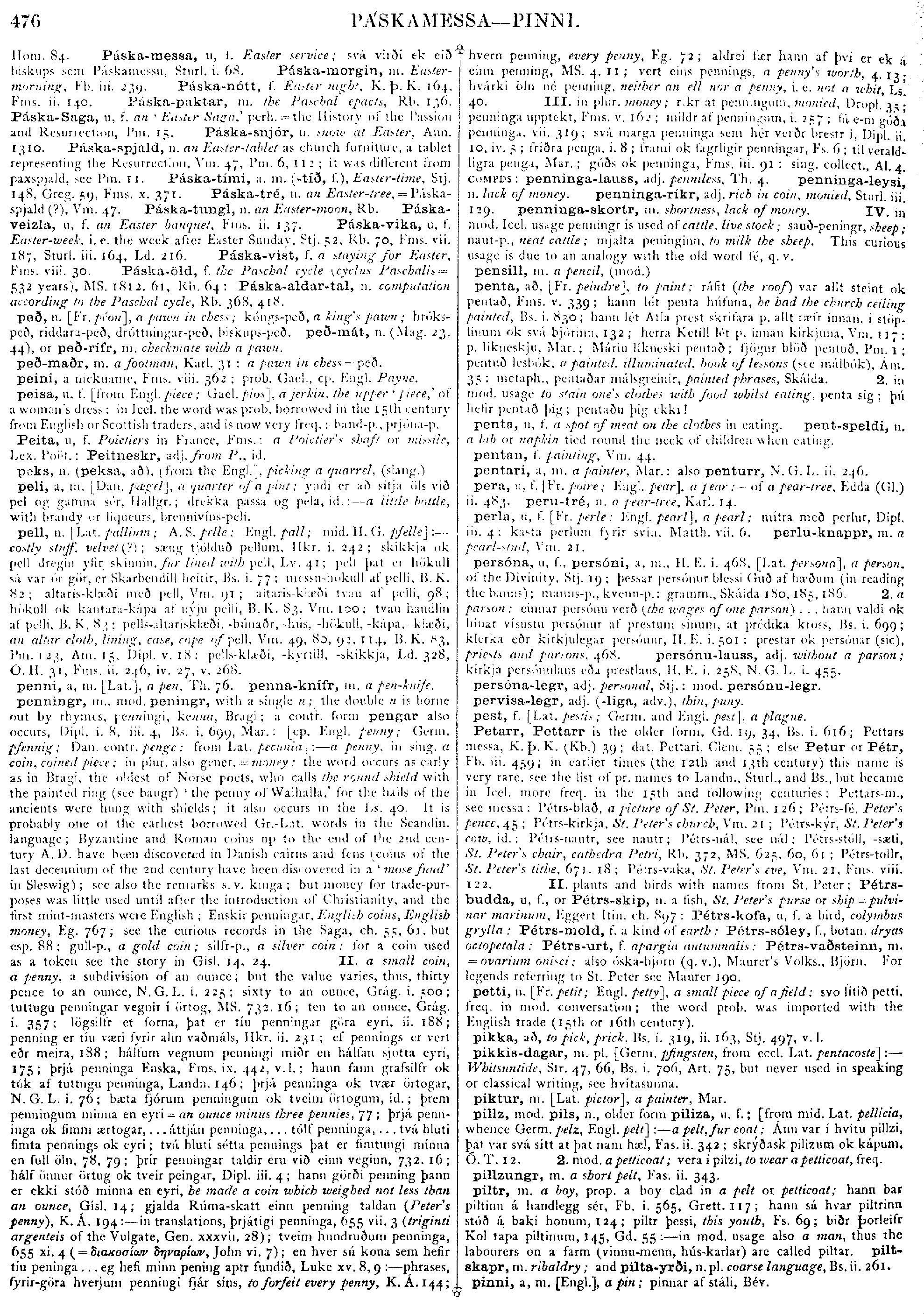
penningr, m., mod. peningr, with a single n; the double n is borne out by rhymes, penningi, kenna, Bragi; a contr. form pengar also occurs, Dipl. i. 8, iii. 4, Bs. i. 699, Mar.: [cp. Engl. penny; Germ. pfennig; Dan. contr. penge; from Lat. pecunia] :-- a penny, in sing. a coin, coined piece; in plur. also gener. = money: the word occurs as early as in Bragi, the oldest of Norse poets, who calls the round shield with the painted ring (see baugr) 'the penny of Walhalla,' for the halls of the ancients were hung with shields; it also occurs in the Ls. 40. It is probably one of the earliest borrowed Gr.-Lat. words in the Scandin. language; Byzantine and Roman coins up to the end of the 2nd century A.D. have been discovered in Danish cairns and fens (coins of the last decennium of the 2nd century have been discovered in a 'mose fund' in Sleswig); see also the remarks s.v. kinga; but money for trade-purposes was little used until after the introduction of Christianity, and the first mint-masters were English; Enskir penningar, English coins, English money, Eg. 767; see the curious records in the Saga, ch. 55, 61, but esp. 88; gull-p., a gold coin; silfr-p., a silver coin: for a coin used as a token see the story in Gísl. 14, 24. II. a small coin, a penny, a subdivision of an ounce; but the value varies, thus, thirty pence to an ounce, N.G.L. i. 225; sixty to an ounce, Grág. i. 500; tuttugu penningar vegnir í örtog, MS. 732. 16; ten to an ounce, Grág. i. 357; lögsilfr et forna, þat er tíu penningar göra eyri, ii. 188; penning er tíu væri fyrir alin vaðmáls, Hkr. ii. 231; ef pennings er vert eðr meira, 188; hálfum vegnum penningi miðr en hálfan sjótta eyri, 175; þrjá penninga Enska, Fms. ix. 442, v.l.; hann fann grafsilfr ok tók af tuttugu penninga, Landn. 146; þrjá penninga ok tvær örtogar, N.G.L. i. 76; bæta fjórum penningum ok tveim örtogum, id.; þrem penningum minna en eyri = an ounce minus three pennies, 77; þrjá penninga ok fimm ærtogar, ... áttján penninga, ... tólf penninga, ... tvá hluti fimta pennings ok eyri; tvá hluti sétta pennings þat er fimtungi minna en full öln, 78, 79; þrír penningar taldir eru við einn veginn, 732. 16; hálf önnur örtug ok tveir peningar, Dipl. iii. 4; hann görði penning þann er ekki stóð minna en eyri, he made a coin which weighed not less than an ounce, Gísl. 14; gjalda Rúma-skatt einn penning taldan (Peter's penny), K.Á. 194 :-- in translations, þrjátigi penninga, 655 vii. 3 (triginti argenteis of the Vulgate, Gen. xxxvii. 28); tveim hundruðum penninga, 655 xi. 4 (= GREEK, John vi. 7); en hver sú kona sem hefir tíu peninga ... eg hefi minn pening aptr fundið, Luke xv. 8, 9 :-- phrases, fyrir-göra hverjum penningi fjár síns, to forfeit every penny, K.Á. 144; hvern penning, every penny, Eg. 72; aldrei fær hann af því er ek á einn penning, MS. 4. 11; vert eins pennings, a penny's worth, 4. 13; hvárki öln né penning, neither an ell nor a penny, i.e. not a whit, Ls 40. III. in plur. money; ríkr at penningum, monied, Dropl. 35; penninga upptekt, Fms. v. 162; mildr af penningum, i. 257; fá e-m góða penninga, vii. 319; svá marga penninga sem hér verðr brestr í, Dipl. ii. 10, iv. 3; fríðra penga, i. 8; frami ok fagrligir penningar, Fs. 6; til veraldligra pengi, Mar.; góðs ok penninga, Fms. iii. 91: sing. collect., Al. 4. COMPDS: penninga-lauss, adj. penniless, Th. 4. penninga-leysi n. lack of money. penninga-ríkr, adj. rich in coin, monied, Sturl. iii. 129. penninga-skortr, m. shortness, lack of money. IV. in mod. Icel. usage penningr is used of cattle, live stock; sauð-peningr, sheep; naut-p., neat cattle; mjalta peninginn, to milk the sheep. This curious usage is due to an analogy with the old word fé, q.v.
| Result Page: | 1 2 | Next |  |
Germanic Lexicon Project (main page)
This search system was written by
Sean Crist
Please consider
volunteering
to correct the data in these online dictionaries.
No rights reserved. Feel free to use these data in any way you please.