|
|

Tip: In the search results, you can click on any word or abbreviation for more information.
|
Source: Bosworth/Toller, page b0110, entry 20 View original page image as: [TIFF] [PNG] [View previous entry] [View next entry] |
[Comment on this entry] [View comments] |
The following entry has been hand-corrected once. |
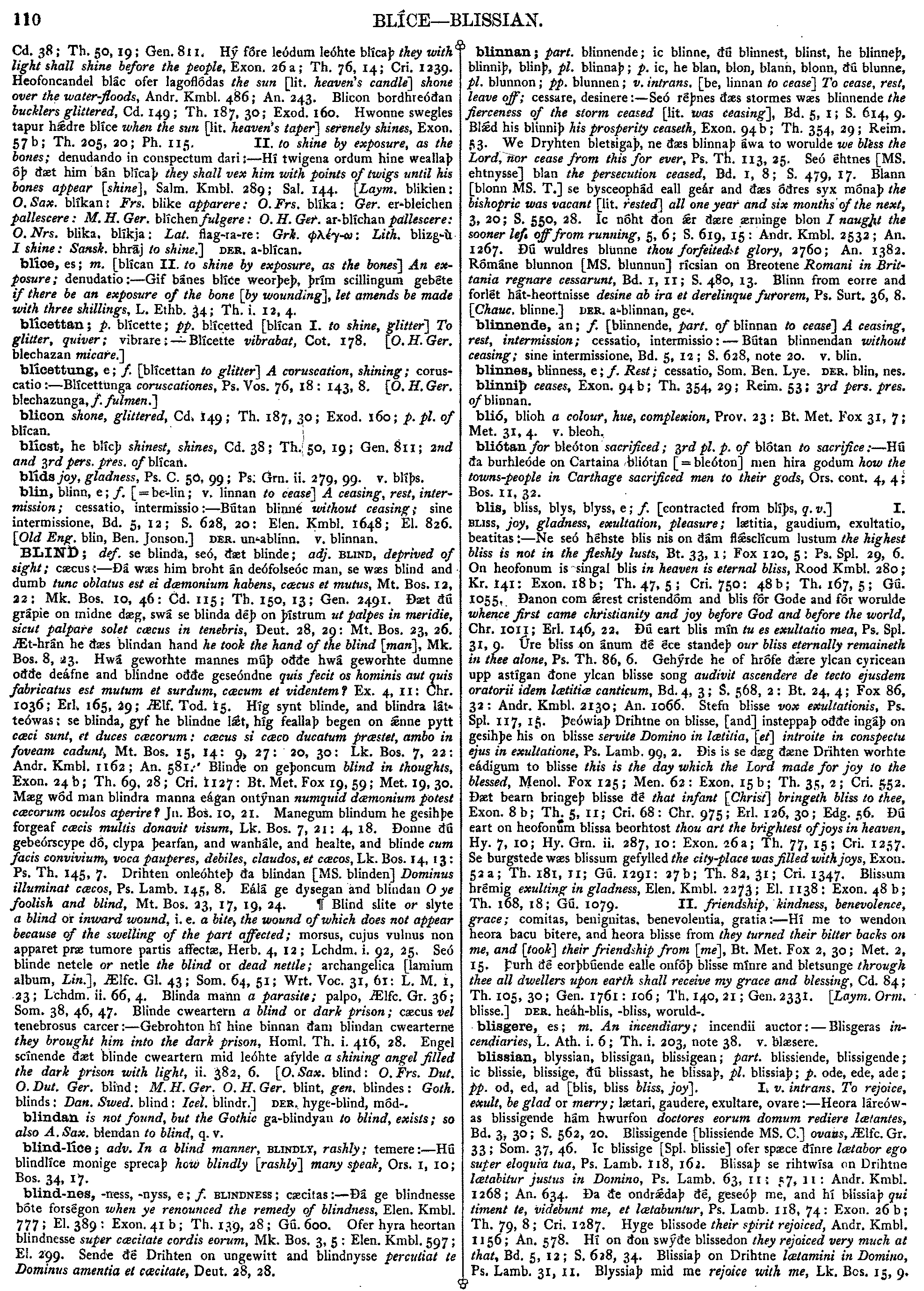
blissian,
blyssian,
blissigan,
blissigean;
part.
blissiende,
blissigende;
ic
blissie,
blissige,
ðú
blissast,
he
blissaþ,
pl.
blissiaþ;
p.
ode,
ede,
ade;
pp.
od,
ed,
ad
[blis,
bliss
bliss,
joy].
I.
v.
intrans.
To
rejoice,
exult,
be
glad
or
merry;
lætari,
gaudere,
exultare,
ovare
:--
Heora
láreówas
blissigende
hám
hwurfon
doctores
eorum
domum
rediere
lætantes,
Bd.
3,
30;
S.
562,
20.
Blissigende
[blissiende
MS.
C.]
ovans,
Ælfc.
Gr.
33;
Som.
37,
46.
Ic
blissige
[Spl.
blissie]
ofer
spæce
ðínre
lætabor
ego
super
eloquia
tua,
Ps.
Lamb.
118,
162.
Blissaþ
se
rihtwísa
on
Drihtne
lætabitur
justus
in
Domino,
Ps.
Lamb.
63,
11:
57,
11:
Andr.
Kmbl.
1268;
An.
634.
Ða
ðe
ondr daþ
ðé,
geseóþ
me,
and
hí
blissiaþ
qui
timent
te,
videbunt
me,
et
lætabuntur,
Ps.
Lamb.
118,
74:
Exon.
26
b;
Th.
79,
8;
Cri.
1287.
Hyge
blissode
their
spirit
rejoiced,
Andr.
Kmbl.
1156;
An.
578.
Hí
on
ðon
swýðe
blissedon
they
rejoiced
very
much
at
that,
Bd.
5,
12;
S.
628,
34.
Blissiaþ
on
Drihtne
lætamini
in
Dominio,
Ps.
Lamb.
31,
11.
Blyssiaþ
mid
me
rejoice
with
me,
Lk.
Bos.
15,
9.
Blissie
[Lamb.
blissige]
heorte
sécendra
Drihten
lætetur
cor
quærentium
Dominum,
Ps.
Spl.
104,
3.
Blissian
[blissien,
Th.
66,
4]
and
fægnian
híg
þeóda
lætentur
et
exultent
gentes,
Ps.
Lamb.
66,
5.
Ðæt
hí
blission
mid
Criste
that
they
rejoice
with
Christ,
Chr.
1036;
Erl.
165,
17;
Ælf.
Tod.
9.
II.
v.
trans.
dat.
or
acc.
To
make
to
rejoice,
to
gladden,
delight,
exhilarate;
lætificare
:--
Sum
sceal
on
heápe
blissian
æt
beór
bencsittendum
one
shall
in
company
delight
the
bench-sitters
at
beer,
Exon.
88
a;
Th.
331,
34;
Vy.
78.
Ðá
se
hálga
ongann
hæleþ
blissigean
then
the
saint
began
to
gladden
the
man,
Andr.
Kmbl.
3213;
An.
1609.
Ðú,
God,
eallum
blissast
thou,
O
God,
makest
all
to
rejoice,
Hy.
7.
34;
Hy.
Grn.
ii.
287,
34.
Heortan
manna
wíndrinc
blissaþ
vinum
lætificet
cor
hominis,
Ps.
Th.
103,
14.
He
sárig
folc
blissade
he
gladdened
the
sorrowful
people,
Ps.
Th.
l06,
32.
Hyge
wearþ
mongum
blissad
the
mind
of
many
was
made
to
rejoice,
Exon.
24
b;
Th.
71,
71,
30;
Cri.
1163.
[Laym.
blissien:
Orm.
blissen.]
DER.
ge-blissian:
mód-blissiende.
daþ
ðé,
geseóþ
me,
and
hí
blissiaþ
qui
timent
te,
videbunt
me,
et
lætabuntur,
Ps.
Lamb.
118,
74:
Exon.
26
b;
Th.
79,
8;
Cri.
1287.
Hyge
blissode
their
spirit
rejoiced,
Andr.
Kmbl.
1156;
An.
578.
Hí
on
ðon
swýðe
blissedon
they
rejoiced
very
much
at
that,
Bd.
5,
12;
S.
628,
34.
Blissiaþ
on
Drihtne
lætamini
in
Dominio,
Ps.
Lamb.
31,
11.
Blyssiaþ
mid
me
rejoice
with
me,
Lk.
Bos.
15,
9.
Blissie
[Lamb.
blissige]
heorte
sécendra
Drihten
lætetur
cor
quærentium
Dominum,
Ps.
Spl.
104,
3.
Blissian
[blissien,
Th.
66,
4]
and
fægnian
híg
þeóda
lætentur
et
exultent
gentes,
Ps.
Lamb.
66,
5.
Ðæt
hí
blission
mid
Criste
that
they
rejoice
with
Christ,
Chr.
1036;
Erl.
165,
17;
Ælf.
Tod.
9.
II.
v.
trans.
dat.
or
acc.
To
make
to
rejoice,
to
gladden,
delight,
exhilarate;
lætificare
:--
Sum
sceal
on
heápe
blissian
æt
beór
bencsittendum
one
shall
in
company
delight
the
bench-sitters
at
beer,
Exon.
88
a;
Th.
331,
34;
Vy.
78.
Ðá
se
hálga
ongann
hæleþ
blissigean
then
the
saint
began
to
gladden
the
man,
Andr.
Kmbl.
3213;
An.
1609.
Ðú,
God,
eallum
blissast
thou,
O
God,
makest
all
to
rejoice,
Hy.
7.
34;
Hy.
Grn.
ii.
287,
34.
Heortan
manna
wíndrinc
blissaþ
vinum
lætificet
cor
hominis,
Ps.
Th.
103,
14.
He
sárig
folc
blissade
he
gladdened
the
sorrowful
people,
Ps.
Th.
l06,
32.
Hyge
wearþ
mongum
blissad
the
mind
of
many
was
made
to
rejoice,
Exon.
24
b;
Th.
71,
71,
30;
Cri.
1163.
[Laym.
blissien:
Orm.
blissen.]
DER.
ge-blissian:
mód-blissiende.
|
Source: Bosworth/Toller, page b0111, entry 5 View original page image as: [TIFF] [PNG] [View previous entry] [View next entry] |
[Comment on this entry] [View comments] |
The following entry has been hand-corrected once. |
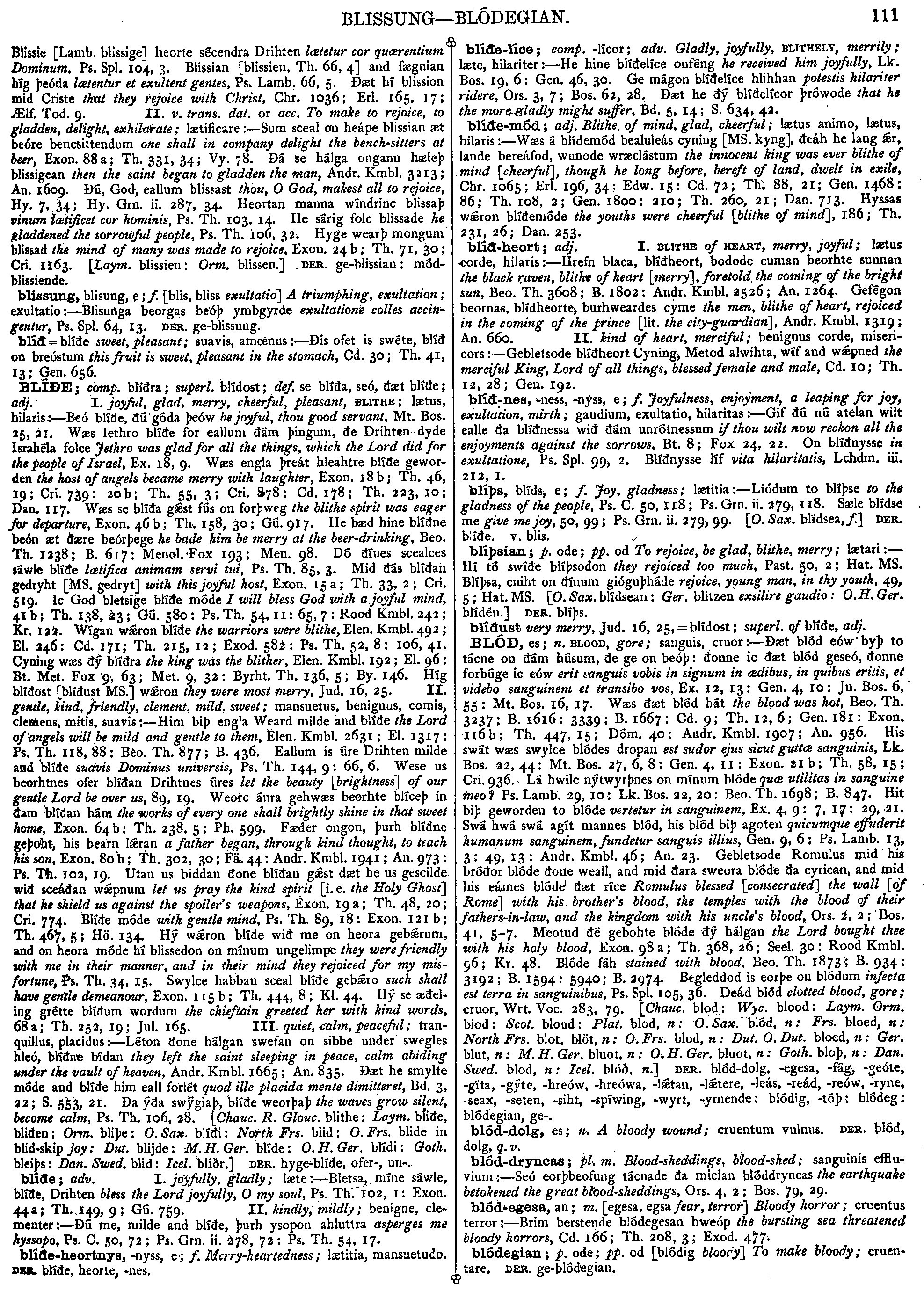
sáwle
bríðe
lætifica
animam
servi
tui,
Ps.
Th.
85,
3.
Mid
ðás
blíðan
gedryht
[MS.
gedryt]
with
this
joyful
host,
Exon.
15
a;
Th.
33,
2;
Cri.
519.
Ic
God
bletsige
blíðe
móde
I
will
bless
God
with
a
joyful
mind,
41
b;
Th.
138,
23;
Gú.
580:
Ps.
Th.
54,
11:
65,
7:
Rood
Kmbl.
242;
Kr.
122.
Wígan
wron
blíðe
the
warriors
were
blithe,
Elen.
Kmbl.
492;
El.
246:
Cd.
171;
Th.
215,
12;
Exod.
582:
Ps.
Th.
52,
8:
106,
41.
Cyning
wæs
ðý
blíðra
the
king
was
the
blither,
Elen.
Kmbl.
192;
El.
96:
Bt.
Met.
Fox
9,
63;
Met.
9,
32:
Byrht.
Th.
136,
5;
By.
146.
Híg
blíðost
[blíðust
MS.]
wron
they
were
most
merry,
Jud.
16,
25.
II.
gentle,
kind,
friendly,
clement,
mild,
sweet;
mansuetus,
benignus,
comis,
clemens,
mitis,
suavis
:--
Him
biþ
engla
Weard
milde
and
blíðe
the
Lord
of
angels
will
be
mild
and
gentle
to
them,
Elen.
Kmbl.
2631;
El.
1317:
Ps.
Th.
118,
98:
Beo.
Th.
877;
B.
436.
Eallum
is
úre
Drihten
milde
and
blíðe
suavis
Dominus
universis,
Ps.
Th.
144,
9:
66,
6.
Wese
us
beorhtnes
ofer
blíðan
Drihtnes
úres
let
the
beauty
[brightness]
of
our
gentle
Lord
be
over
us,
89,
19.
Weorc
ánra
gehwæs
beorhte
blíceþ
in
ðam
blíðan
hám
the
works
of
every
one
shall
brightly
shine
in
that
sweet
home,
Exon.
64
b;
Th.
238,
5;
Ph.
599.
Fæder
ongon,
þurh
blíðne
geþoht,
his
bearn
lran
a
father
began,
through
kind
thought,
to
teach
his
son,
Exon.
80
b;
Th.
302,
30;
Fä.
44:
Andr.
Kmbl.
1941;
An.
973:
Ps.
Th.
102,
19.
Utan
us
biddan
ðone
blíðan
gst
ðæt
he
us
gescilde,
wið
sceáðan
wpnum
let
us
pray
the
kind
spirit
[i.e.
the
Holy
Ghost]
that
he
shield
us
against
the
spoiler's
weapons,
Exon.
19
a;
Th.
48,
20;
Cri.
774.
Blíðe
móde
with
gentle
mind,
Ps.
Th.
89,
18:
Exon.
121
b;
Th.
467,
5;
Hö.
134.
Hý
wron
blíðe
wið
me
on
heora
gebrum,
and
on
heora
móde
hí
blissedon
on
mínum
ungelimpe
they
were
friendly
with
me
in
their
manner,
and
in
their
mind
they
rejoiced
for
my
misfortune,
Ps.
Th.
34,
15.
Swylce
habban
sceal
blíðe
gebro
such
shall
have
gentle
demeanour,
Exon.
115
b;
Th.
444,
8;
Kl.
44.
Hý
se
æðeling
grétte
blíðum
wordum
the
chieftain
greeted
her
with
kind
words,
68
a;
Th.
252,
19;
Jul.
165.
III.
quiet,
calm,
peaceful;
tranquillus,
placidus
:--
Léton
ðone
hálgan
swefan
on
sibbe
under
swegles
hleó,
blíðne
bídan
they
left
the
saint
sleeping
in
peace,
calm
abiding
under
the
vault
of
heaven,
Andr.
Kmbl.
1665;
An.
835.
Ðæt
he
smylte
móde
and
blíðe
him
eall
forlét
quod
ille
placida
mente
dimitteret,
Bd.
3,
22;
S.
553,
21.
Ða
ýða
swýgiaþ,
blíðe
weorþaþ
the
waves
grow
silent,
become
calm,
Ps.
Th.
106,
28.
[Chauc.
R.
Glouc.
blithe:
Laym.
blíðe,
bliðen:
Orm.
bliþe:
O.
Sax.
blíði:
North
Frs.
blid:
O.
Frs.
blide
in
blid-skip
joy:
Dut.
blijde:
M.
H.
Ger.
blíde:
O.
H.
Ger.
blídi:
Goth.
bleiþs:
Dan.
Swed.
blid:
Icel.
blíðr.]
DER.
hyge-blíðe,
ofer-,
un-.
|
Source: Bosworth/Toller, page b0832, entry 21 View original page image as: [TIFF] [PNG] [View previous entry] [View next entry] |
[Comment on this entry] [View comments] |
The following entry has been hand-corrected once. |
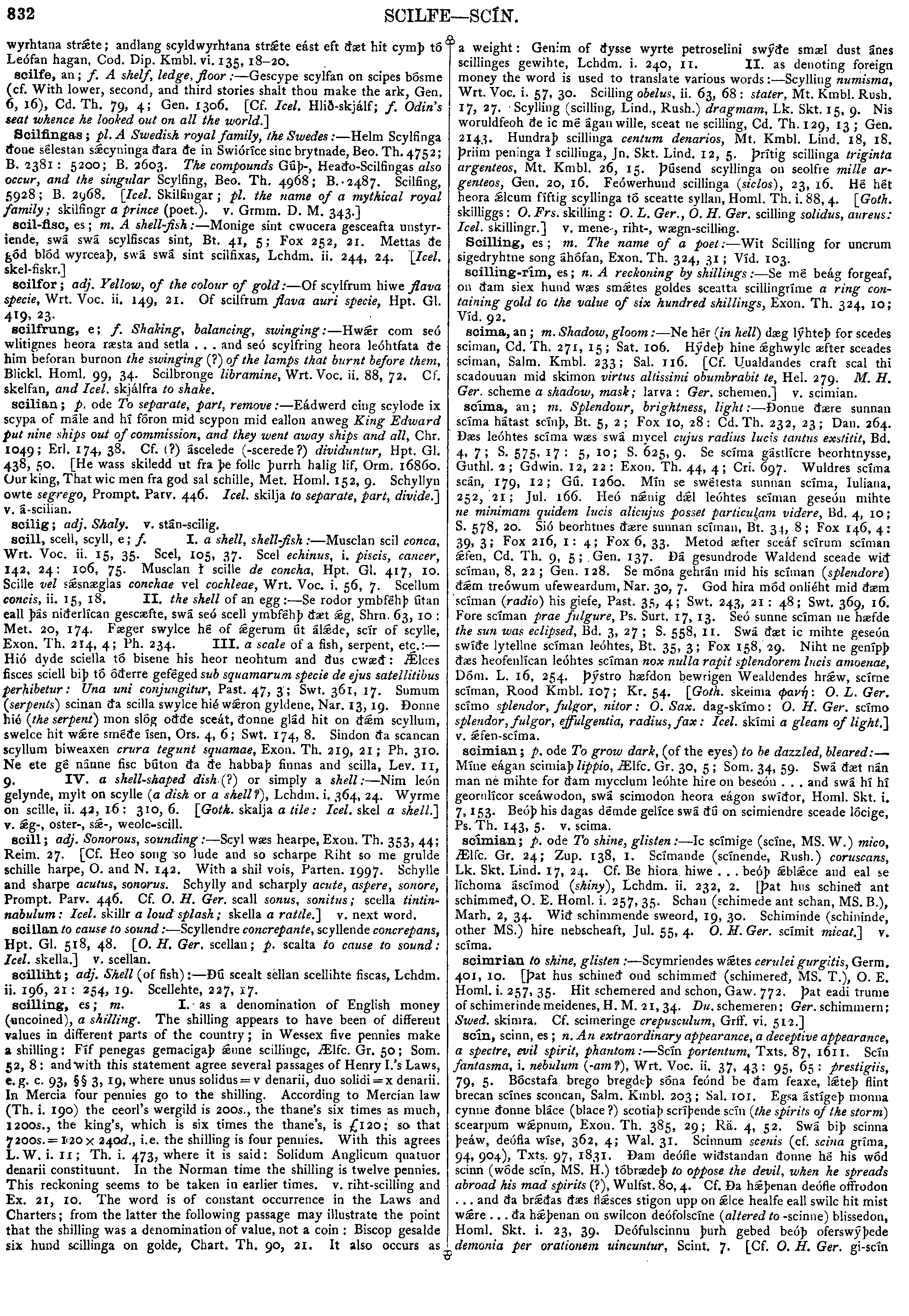
scín,
scinn,
es;
n.
An
extraordinary
appearance,
a
deceptive
appearance,
a
spectre,
evil
spirit,
phantom:?-Scín
portentum,
Txts.
87,
1611.
Scín
fantasma,
i.
nebulum
(-am?),
Wrt.
Voc.
ii.
37,
43:
95,
65:
prestigiis,
79,
5.
Bócstafa
brego
bregdeþ
sóna
feónd
be
ðam
feaxe,
lteþ
flint
brecan
scínes
sconcan,
Salm.
Kmbl.
203;
Sal.
101.
Egsa
ástígeþ
monna
cynne
ðonne
bláce
(blace?)
scotiaþ
scríþende
scín
(the
spirits
of
the
storm)
scearpum
wpnum,
Exon.
Th.
385,
29;
Rä.
4,
52.
Swá
biþ
scinna
þeáw,
deófla
wíse,
362,
4;
Wal.
31.
Scinnum
scenis
(cf.
scina
gríma,
94,
904),
Txts.
97,
1831.
Ðam
deófle
wiðstandan
ðonne
hé
his
wód
scinn
(wóde
scín,
MS.
H.)
tóbrædeþ
to
oppose
the
devil,
when
he
spreads
abroad
his
mad
spirits
(?),
Wulfst.
80,
4.
Cf.
Ða
hþenan
deófle
offrodon
.
.
.
and
ða
brðas
ðæs
flsces
stigon
upp
on
lce
healfe
eall
swilc
hit
mist
wre
.
.
.
ða
hþenan
on
swilcon
deófolscíne
(altered
to
-scinne)
blissedon,
Homl.
Skt.
i.
23,
39.
Deófulscinnu
þurh
gebed
beóþ
oferswýþede
demonia
per
orationem
uincuntur,
Scint.
7.
[Cf.
O.
H.
Ger.
gi-scín
|
Source: Bosworth/Toller, page b1109, entry 15 View original page image as: [TIFF] [PNG] [View previous entry] [View next entry] |
[Comment on this entry] [View comments] |
The following entry has been hand-corrected once. |
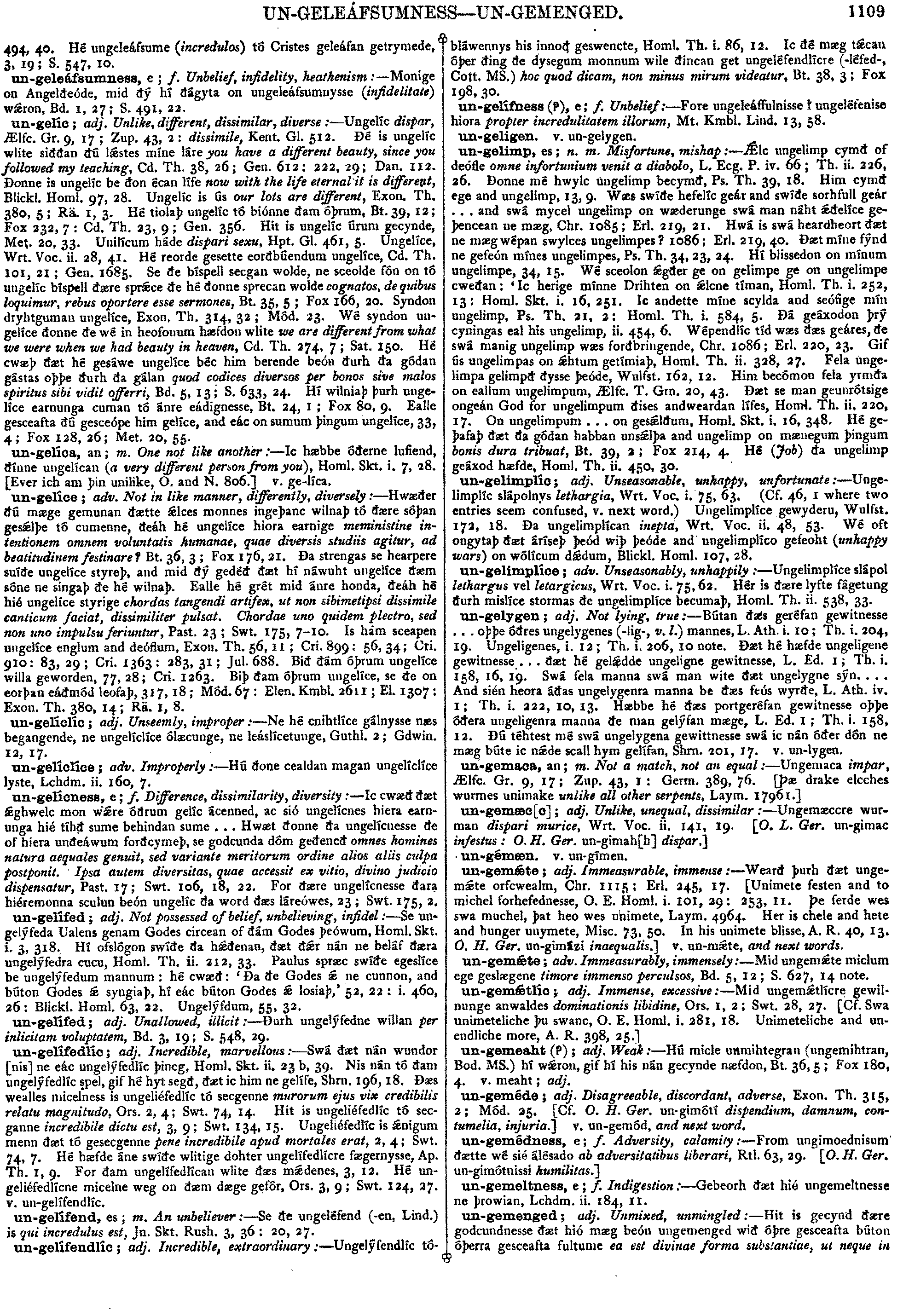
un-gelimp,
es;
n.
m.
Misfortune,
mishap
:--
Æ-acute;lc
ungelimp
cymð
of
deófle
omne
infortunium
venit
a
diabolo,
L.
Ecg.
P.
iv.
66;
Th.
ii.
226,
26.
Ðonne
mé
hwylc
ungelimp
becymð,
Ps.
Th.
39,
18.
Him
cymð
ege
and
ungelimp,
13,
9.
Wæs
swíðe
hefelíc
geár
and
swíðe
sorhfull
geár
...
and
swá
mycel
ungelimp
on
wæderunge
swá
man
náht
ðelíce
geþencean
ne
mæg,
Chr.
1085;
Erl.
219,
21.
Hwá
is
swá
heardheort
ðæt
ne
mæg
wépan
swylces
ungelimpes?
1086;
Erl.
219,
40.
Ðæt
míne
fýnd
ne
gefeón
mínes
ungelimpes,
Ps.
Th.
34,
23,
24.
Hí
blissedon
on
mínum
ungelimpe,
34,
15.
Wé
sceolon
gðer
ge
on
gelimpe
ge
on
ungelimpe
cweðan:
'Ic
herige
mínne
Drihten
on
lcne
tíman,
Homl.
Th.
i.
252,
13:
Homl.
Skt.
i.
16,
251.
Ic
andette
míne
scylda
and
seófige
mín
ungelimp,
Ps.
Th.
21,
2:
Homl.
Th.
i.
584,
5.
Ðá
geáxodon
þrý
cyningas
eal
his
ungelimp,
ii.
454,
6.
Wépendlíc
tíd
wæs
ðæs
geáres,
ðe
swá
manig
ungelimp
wæs
forðbringende,
Chr.
1086;
Erl.
220,
23.
Gif
ús
ungelimpas
on
htum
getímiaþ,
Homl.
Th.
ii.
328,
27.
Fela
ungelimpa
gelimpð
ðysse
þeóde,
Wulfst.
562,
12.
Him
becómon
fela
yrmða
on
eallum
ungelimpum,
Ælfc.
T.
Grn.
20,
43.
Ðæt
se
man
geunrótsige
ongeán
God
for
ungelimpum
ðises
andweardan
lífes,
Homl.
Th.
ii.
220,
57.
On
ungelimpum
...
on
geslðum,
Homl.
Skt.
i.
16,
348.
Hé
geþafaþ
ðæt
ða
gódan
habban
unslþa
and
ungelimp
on
mænegum
þingum
bonis
dura
tribuat,
Bt.
39,
2;
Fox
214,
4.
Hé
(Job)
ða
ungelimp
geáxod
hæfde,
Homl.
Th.
ii.
450,
30.
|
Source: Bosworth/Toller, page b1167, entry 2 View original page image as: [TIFF] [PNG] [View previous entry] [View next entry] |
[Comment on this entry] [View comments (1)] |
The following entry has been hand-corrected once. |
wánian
p.
ode
To
lament,
deplore,
(I)
absolute
:--
Ðæt
synfulle
mancynn
wépaþ
and
wániaþ,
Wulfst.
183,
2.
Ðonne
grániaþ
and
wániaþ
ða
ðe
hér
blissedon
and
fægnedon,
245,
3
:
Anglia
viii.
336,
41.
Beornas
grétaþ,
wépaþ
wánende,
Exon.
Th.
61,
31
;
Cri.
993.
Ða
wánigendran
welras
(wániendan,
Wulfst.
139,
8)
os
lugens,
Dóm.
L.
208.
(2)
with
reflexive
dative
:--
Hé
wánode
him
sylfum:
'
Wá
is
mé
earmum
.
.
.
,
'
Homl.
Skt.
i.
II.
223.
(3)
with
acc.
:--
Sár
wánigean,
Beo.
Th.
1579;
B.
787.
Wánian,
Exon.
Th.
166,
22;
Gú.
1046.
Ongan
hé
sár
cwánian,
wyrd
wánian,
wordum
mlde
.
.
.
,
274,
24;
Jul.
538.
(4)
with
reflex
dat.
and
(a)
acc.
:--
Hé
him
wæs
wániende
gðer
ge
his
ágene
heardslþa
ge
ealles
ðæs
folces
ipse
nunc
suam,
nune
publicam
infelicitatem
deflet,
Ors.
4,
5
;
Swt.
166,
20.
(b)
a
clause
:--
Hé
him
wæs
swíþe
wániende
ðæt
hé
to
him
cucan
ne
com,
Ors.
5,
12;
Swt.
244,
4.
[Heo
weop
for
hire
weisið,
wanede
hire
siðes.
Laym.
25847.
Weape
and
wony
(weinen,
1st
MS.
),
25827.
Wepenn
and
wanenn
for
hiss
sinne.
Orm.
5653.
Hit
cumeþ
weopinde
and
woniende
iwiteþ
.
.
.
Þeo
moder
greoneþ
and
 bearn
woaneþ,
Fragm.
Phlps.
5,
32-41.
Heo
woneþ
and
groneþ
day
and
nyht,
Misc.
152,
187.
Scholde
euch
mon
woni
and
grede,
O.
and
N.
975.
O.
H.
Ger.
weinón
flere,
lacrymare,
ejulare,
vagire:
Icel.
veina
to
wail.
Cf.
Goth.
wainags
unhappy.]
bearn
woaneþ,
Fragm.
Phlps.
5,
32-41.
Heo
woneþ
and
groneþ
day
and
nyht,
Misc.
152,
187.
Scholde
euch
mon
woni
and
grede,
O.
and
N.
975.
O.
H.
Ger.
weinón
flere,
lacrymare,
ejulare,
vagire:
Icel.
veina
to
wail.
Cf.
Goth.
wainags
unhappy.]
|
Source: Bosworth/Toller, page d0118, entry 38 View original page image as: [TIFF] [PNG] [View previous entry] [View next entry] |
[Comment on this entry] [View comments] |
The following entry has been hand-corrected once. |
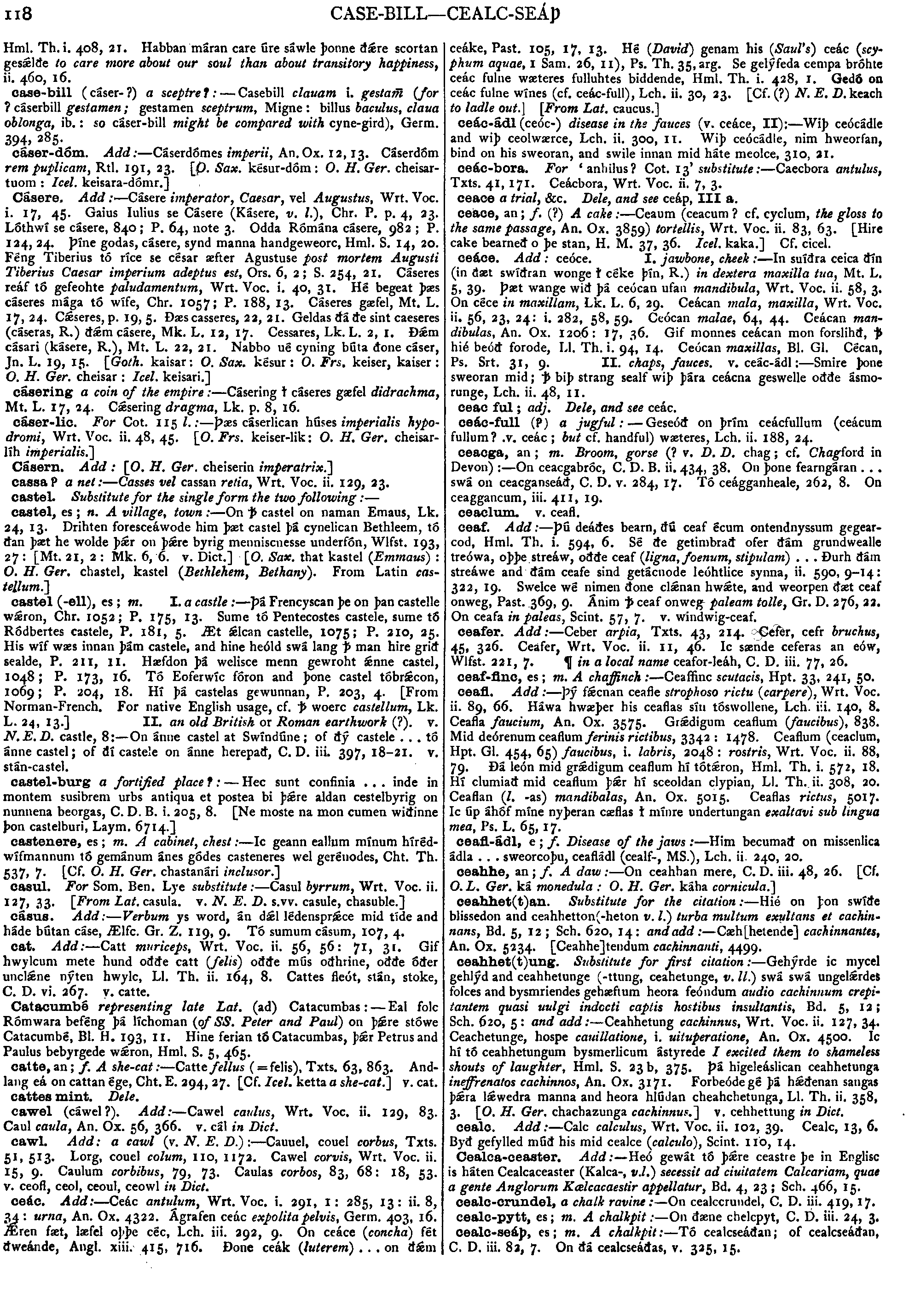
ceahhet(t)an. Substitute for the citation :-- Hié on þon swíðe blissedon and ceahhetton(-heton v. l.) turba multum exultans et cachinnans, Bd. 5, 12; Sch. 620, 14: and add :-- Cæh[hetende] cachinnantes, An. Ox. 5234. [Ceahhe]tendum cachinnanti, 4499.
|
Source: Bosworth/Toller, page d0484, entry 29 View original page image as: [TIFF] [PNG] [View previous entry] [View next entry] |
[Comment on this entry] [View comments] |
The following entry has been hand-corrected once. |
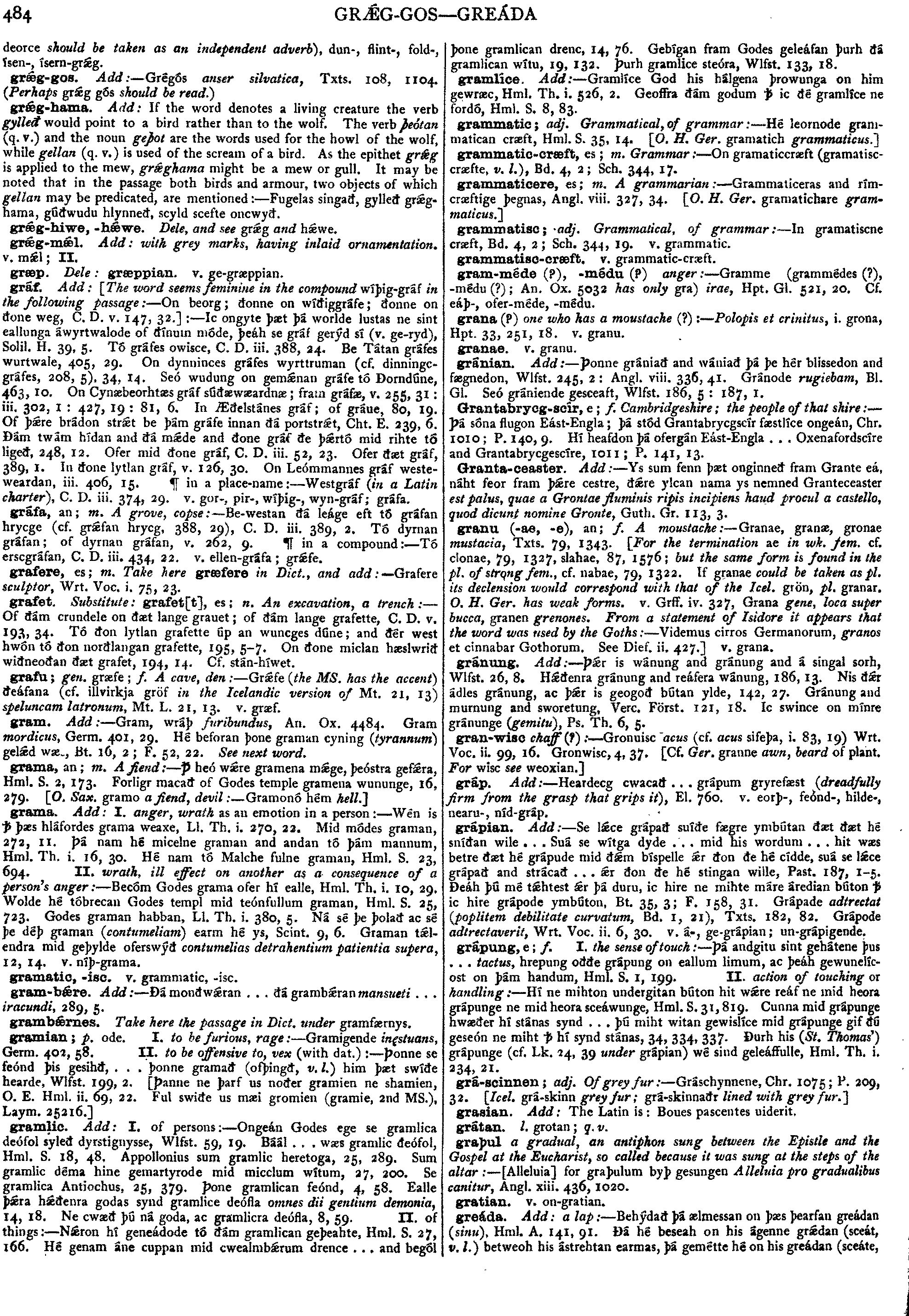
gránian. Add :-- Þonne grániað and wániað þá þe hér blissedon and fægnedon, Wlfst. 245, 2: Angl. viii. 336, 41. Gránode rugiebam, Bl. Gl. Seó grániende gesceaft, Wlfst. 186, 5: 187, 1.
Germanic Lexicon Project (main page)
This search system was written by
Sean Crist
Please consider
volunteering
to correct the data in these online dictionaries.
No rights reserved. Feel free to use these data in any way you please.