|
|

Tip: In the search results, you can click on any word or abbreviation for more information.
|
Source: Cleasby/Vigfusson, page b0236, entry 1 View original page image as: [TIFF] [PNG] [View previous entry] [View next entry] |
[Comment on this entry] [View comments] |
The following entry has been hand-corrected once. |
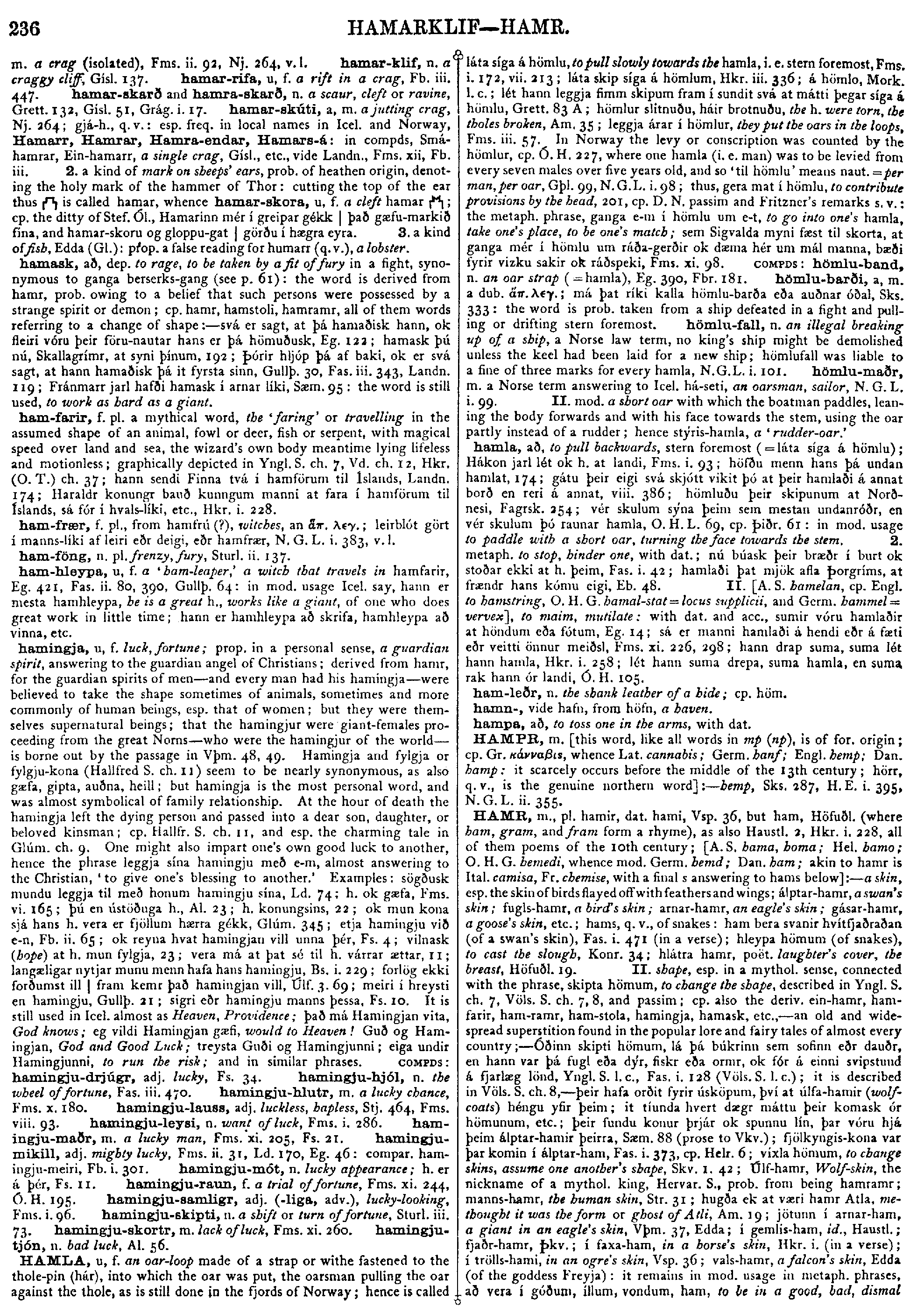
m. a crag (isolated), Fms. ii. 92, Nj. 264, v.l. hamar-klif, n. a craggy cliff, Gísl. 137. hamar-rifa, u, f. a rift in a crag, Fb. iii. 447. hamar-skarð and hamra-skarð, n. a scaur, cleft or ravine, Grett. 132, Gísl. 51, Grág. i. 17. hamar-skúti, a, m. a jutting crag, Nj. 264; gjá-h., q.v.: esp. freq. in local names in Icel. and Norway, Hamarr, Hamrar, Hamra-endar, Hamars-á: in compds, Smá-hamrar, Ein-hamarr, a single crag, Gísl., etc., vide Landn., Fms. xii, Fb. iii. 2. a kind of mark on sheeps' ears, prob. of heathen origin, denoting the holy mark of the hammer of Thor: cutting the top of the ear thus UNCERTAIN is called hamar, whence hamar-skora, u, f. a cleft hamar UNCERTAIN; cp. the ditty of Stef. Ól., Hamarinn mér í greipar gékk | það gæfu-markið fína, and hamar-skoru og gloppu-gat | görðu í hægra eyra. 3. a kind of fish, Edda (Gl.): prop. a false reading for humarr (q.v.), a lobster.
|
Source: Cleasby/Vigfusson, page b0237, entry 5 View original page image as: [TIFF] [PNG] [View previous entry] [View next entry] |
[Comment on this entry] [View comments] |
The following entry has been hand-corrected once. |
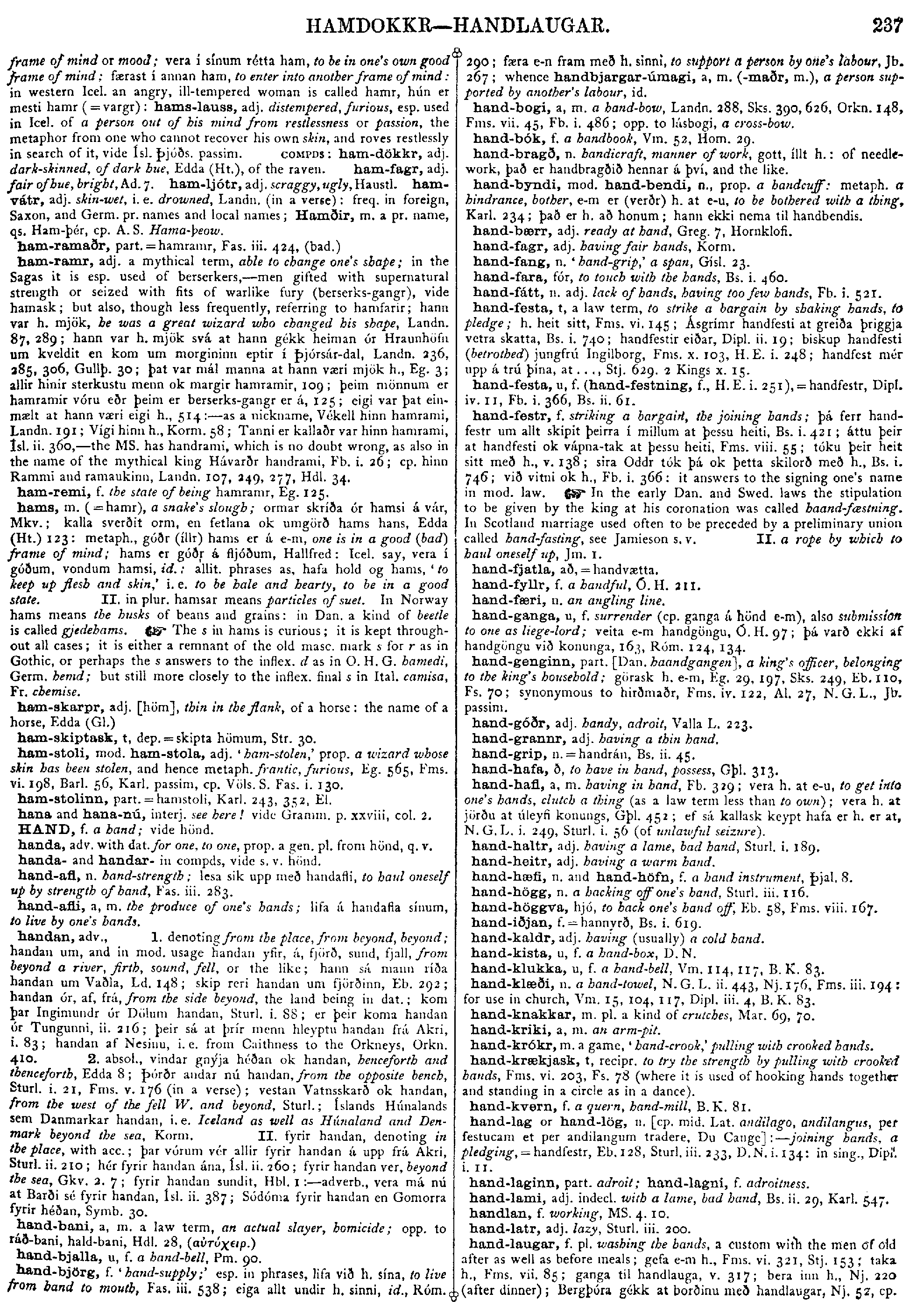
hams, m. ( = hamr), a snake's slough; ormar skríða ór hamsi á vár, Mkv.; kalla sverðit orm, en fetlana ok umgörð hams hans, Edda (Ht.) 123: metaph., góðr (íllr) hams er á e-m, one is in a good (bad) frame of mind; hams er góðr á fljóðum, Hallfred: Icel. say, vera í góðum, vondum hamsi, id.: allit. phrases as, hafa hold og hams, 'to keep up flesh and skin,' i.e. to be hale and hearty, to be in a good state. II. in plur. hamsar means particles of suet. In Norway hams means the husks of beans and grains: in Dan. a kind of beetle is called gjedehams. UNCERTAIN The s in hams is curious; it is kept throughout all cases; it is either a remnant of the old masc. mark s for r as in Gothic, or perhaps the s answers to the inflex. d as in O. H. G. hamedi, Germ. hemd; but still more closely to the inflex. final s in Ital. camisa, Fr. chemise.
|
Source: Cleasby/Vigfusson, page b0237, entry 31 View original page image as: [TIFF] [PNG] [View previous entry] [View next entry] |
[Comment on this entry] [View comments] |
The following entry has been hand-corrected once. |
hand-festr, f. striking a bargain, the joining hands; þá ferr handfestr um allt skipit þeirra í millum at þessu heiti, Bs. i. 421; áttu þeir at handfesti ok vápna-tak at þessu heiti, Fms. viii. 55; tóku þeir heit sitt með h., v. 138; sira Oddr tók þá ok þetta skilorð með h., Bs. i. 746; við vitni ok h., Fb. i. 366: it answers to the signing one's name in mod. law. UNCERTAIN In the early Dan. and Swed. laws the stipulation to be given by the king at his coronation was called haand-fæstning. In Scotland marriage used often to be preceded by a preliminary union called hand-fasting, see Jamieson s.v. II. a rope by which to haul oneself up, Jm. 1.
|
Source: Cleasby/Vigfusson, page b0239, entry 9 View original page image as: [TIFF] [PNG] [View previous entry] [View next entry] |
[Comment on this entry] [View comments] |
The following entry has been hand-corrected once. |
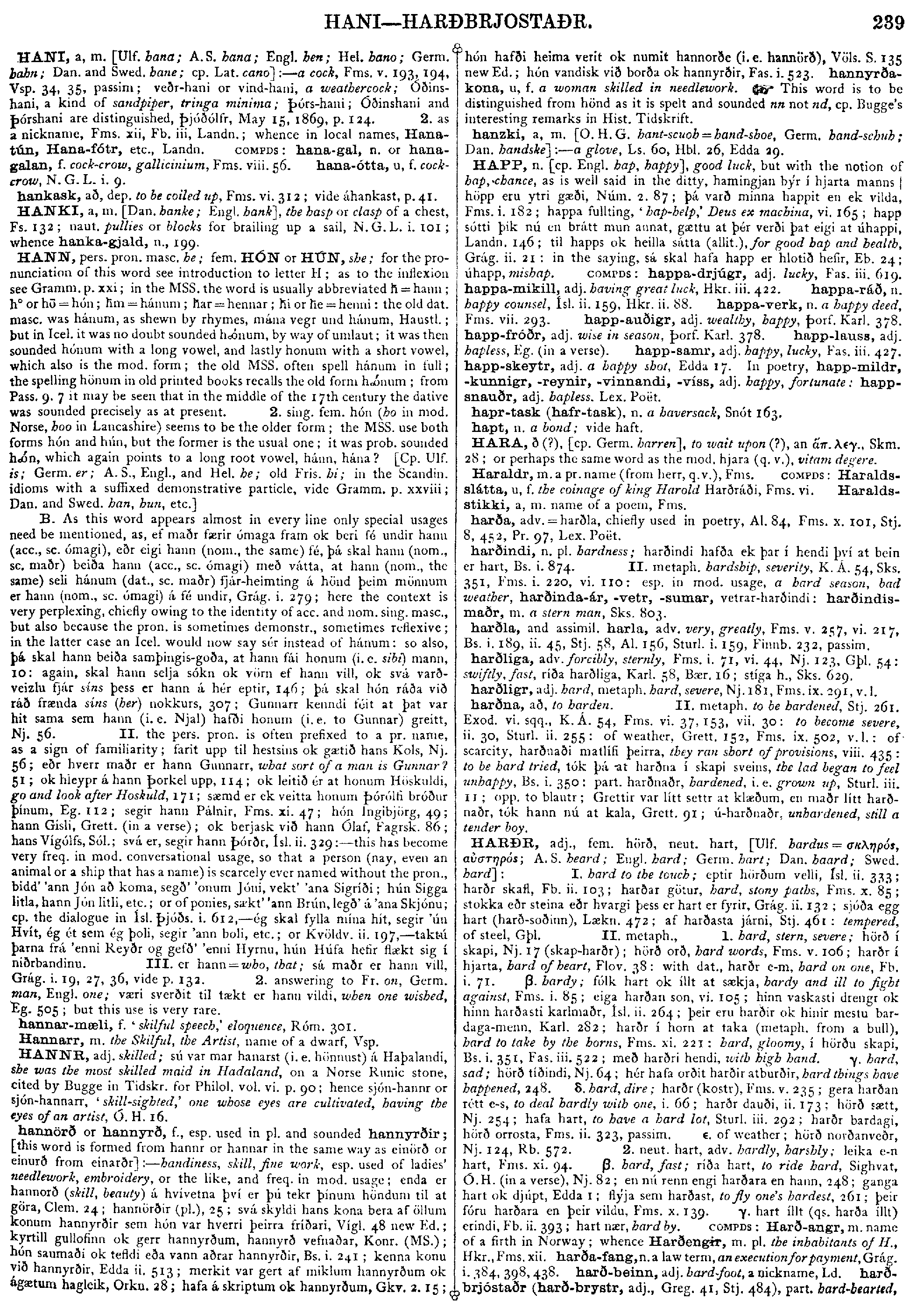
hannörð or hannyrð, f., esp. used in pl. and sounded hannyrðir; [this word is formed from hannr or hannar in the same way as einörð or einurð from einarðr] :-- handiness, skill, fine work, esp. used of ladies' needlework, embroidery, or the like, and freq. in mod. usage; enda er hannorð (skill, beauty) á hvívetna því er þú tekr þínum höndum til at göra, Clem. 24; hannörðir (pl.), 25; svá skyldi hans kona bera af öllum konum hannyrðir sem hón var hverri þeirra fríðari, Vígl. 48 new Ed.; kyrtill gullofinn ok gerr hannyrðum, hannyrð vefnaðar, Konr. (MS.); hón saumaði ok tefldi eða vann aðrar hannyrðir, Bs. i. 241; kenna konu við hannyrðir, Edda ii. 513; merkit var gert af miklum hannyrðum ok ágætum hagleik, Orkn. 28; hafa á skriptum ok hannyrðum, Gkv. 2. 15; hón hafði heima verit ok numit hannorðe (i.e. hannörð), Völs. S. 135 new Ed.; hón vandisk við borða ok hannyrðir, Fas. i. 523. hannyrða-kona, u, f. a woman skilled in needlework. UNCERTAIN This word is to be distinguished from hönd as it is spelt and sounded nn not nd, cp. Bugge's interesting remarks in Hist. Tidskrift.
|
Source: Cleasby/Vigfusson, page b0241, entry 1 View original page image as: [TIFF] [PNG] [View previous entry] [View next entry] |
[Comment on this entry] [View comments] |
The following entry has been hand-corrected once. |
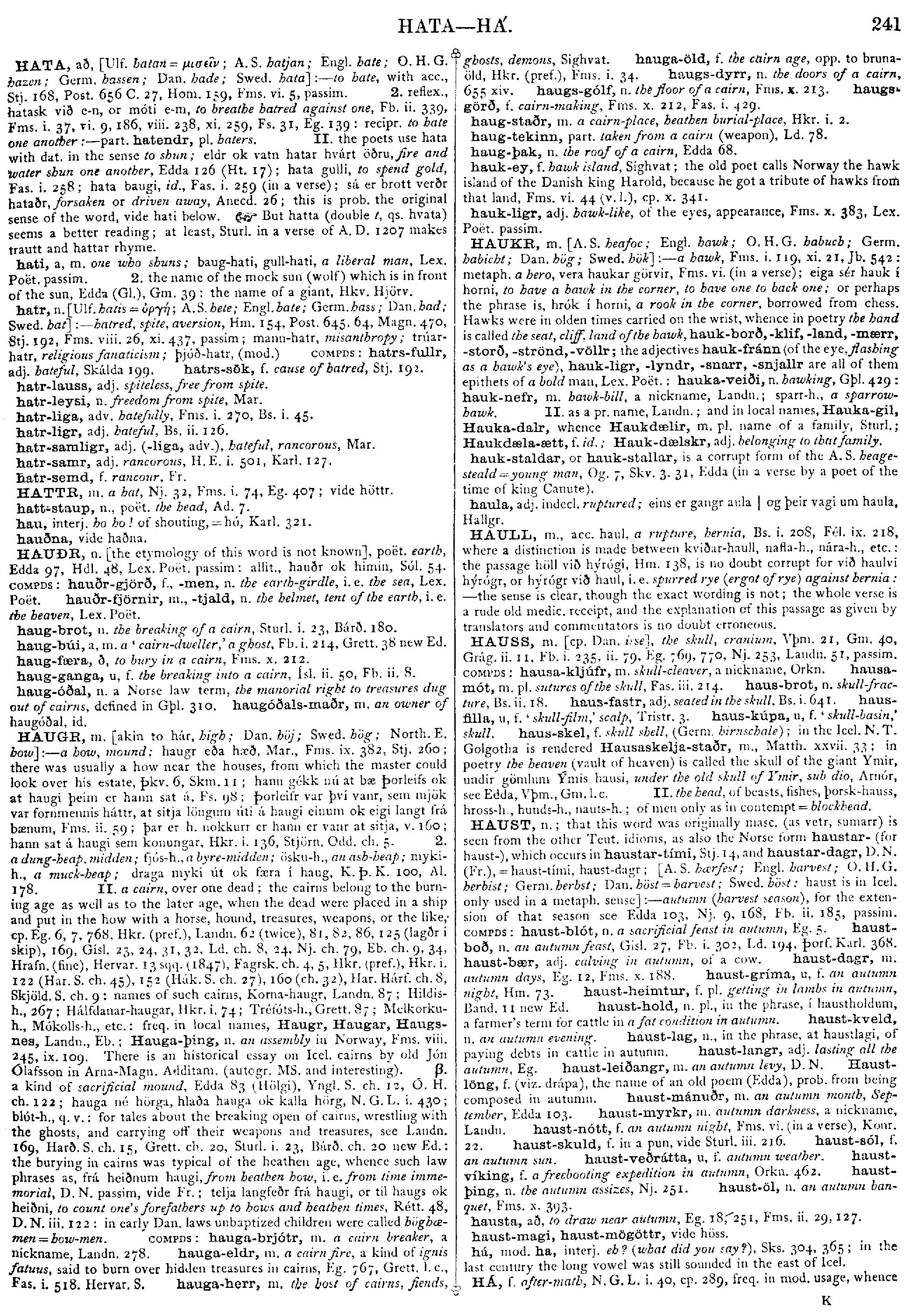
HATA, að, [Ulf. hatan = GREEK; A. S. hatjan; Engl. hate; O. H. G. hazen; Germ. hassen; Dan. hade; Swed. hata] :-- to hate, with acc., Stj. 168, Post. 656 C. 27, Hom. 159, Fms. vi. 5, passim. 2. reflex., hatask við e-n, or móti e-m, to breathe hatred against one, Fb. ii. 339, Fms. i. 37, vi. 9, 186, viii. 238, xi. 259, Fs. 31, Eg. 139: recipr. to hate one another :-- part. hatendr, pl. haters. II. the poets use hata with dat. in the sense to shun; eldr ok vatn hatar hvárt öðru, fire and water shun one another, Edda 126 (Ht. 17); hata gulli, to spend gold, Fas. i. 258; hata baugi, id., Fas. i. 259 (in a verse); sá er brott verðr hataðr, forsaken or driven away, Anecd. 26; this is prob. the original sense of the word, vide hati below. UNCERTAIN But hatta (double t, qs. hvata) seems a better reading; at least, Sturl. in a verse of A.D. 1207 makes trautt and hattar rhyme.
|
Source: Cleasby/Vigfusson, page b0250, entry 5 View original page image as: [TIFF] [PNG] [View previous entry] [View next entry] |
[Comment on this entry] [View comments] |
The following entry has been hand-corrected once. |
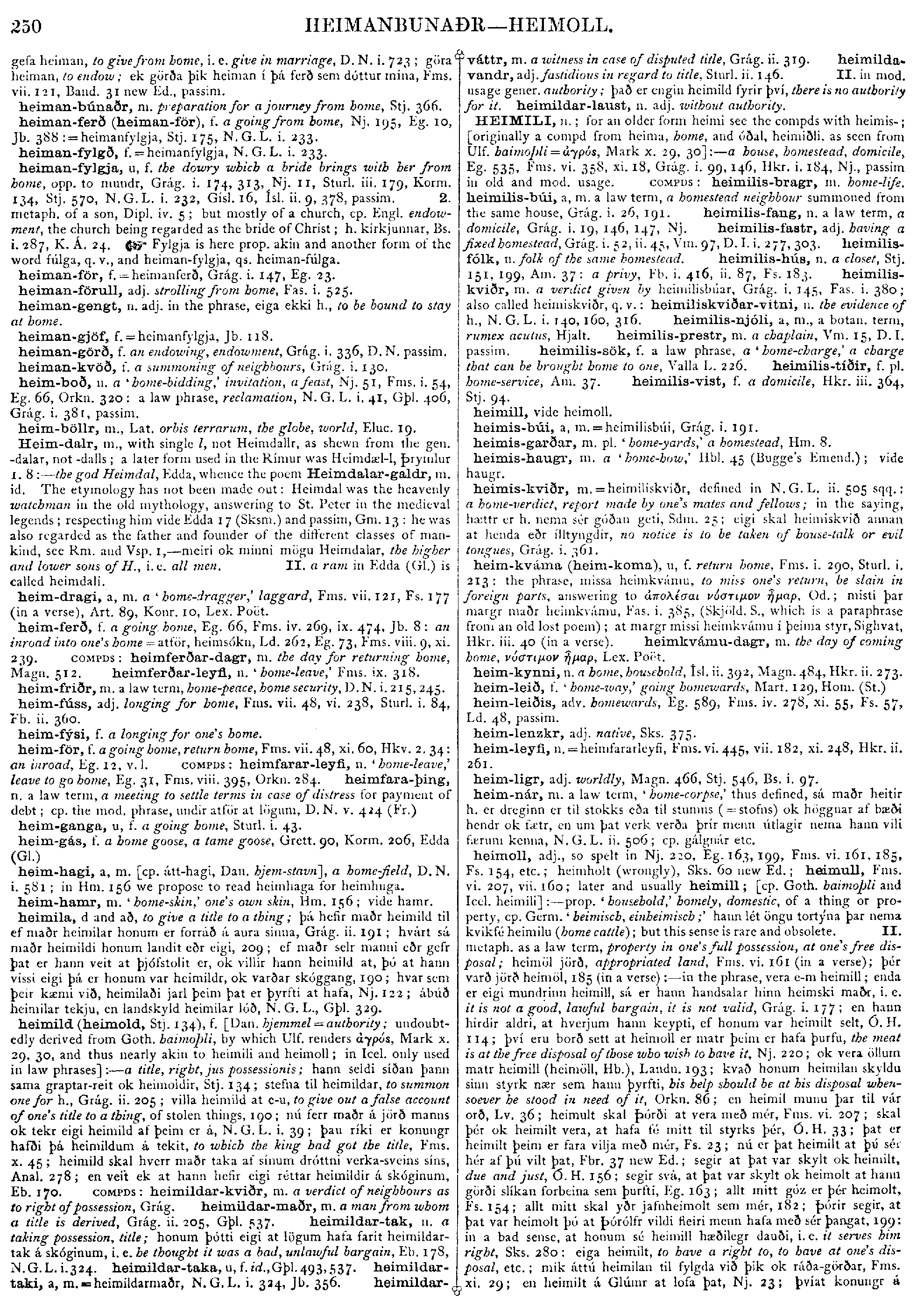
heiman-fylgja, u, f. the dowry which a bride brings with her from home, opp. to mundr, Grág. i. 174. 313, Nj. 11, Sturl. iii. 179, Korm. 134, Stj. 570, N. G. L. i. 232, Gísl. 16, Ísl. ii. 9, 378, passim. 2. metaph. of a son, Dipl. iv. 5; but mostly of a church, cp. Engl. endowment, the church being regarded as the bride of Christ; h. kirkjunnar, Bs. i. 287, K. Á. 24. UNCERTAIN Fylgja is here prop. akin and another form of the word fúlga, q.v., and heiman-fylgja, qs. heiman-fúlga.
|
Source: Cleasby/Vigfusson, page b0253, entry 28 View original page image as: [TIFF] [PNG] [View previous entry] [View next entry] |
[Comment on this entry] [View comments] |
The following entry has been hand-corrected once. |
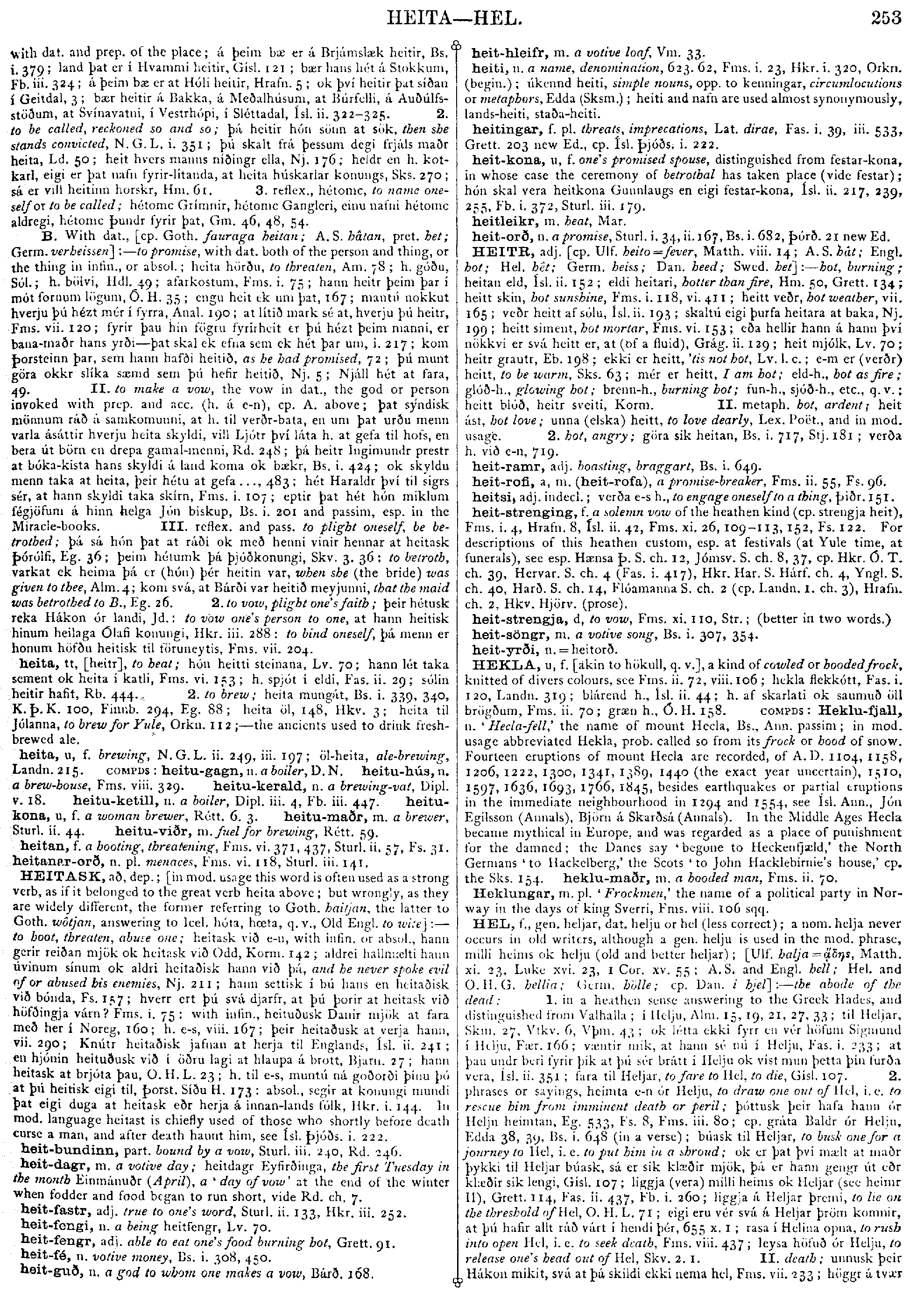
HEKLA, u, f. [akin to hökull, q.v.], a kind of cowled or hooded frock, knitted of divers colours, see Fms. ii. 72, viii. 106; hekla flekkótt, Fas. i. 120, Landn. 319; blárend h., Ísl. ii. 44; h. af skarlati ok saumuð öll brögðum, Fms. ii. 70; græn h., Ó. H. 158. COMPDS: Heklu-fjall, n. 'Hecla-fell' the name of mount Hecla, Bs., Ann. passim; in mod. usage abbreviated Hekla, prob. called so from its frock or hood of snow. Fourteen eruptions of mount Hecla are recorded, of A.D. 1104, 1158, 1206, 1222, 1300, 1341, 1389, 1440 (the exact year uncertain), 1510, 1597, 1636, 1693, 1766, 1845, besides earthquakes or partial eruptions in the immediate neighbourhood in 1294 and 1554, see Ísl. Ann., Jón Egilsson (Annals), Björn á Skarðsá (Annals). In the Middle Ages Hecla became mythical in Europe, and was regarded as a place of punishment for the damned; the Danes say 'begone to Heckenfjæld,' the North Germans 'to Hackelberg,' the Scots 'to John Hacklebirnie's house,' cp. the Sks. 154. heklu-maðr, m. a hooded man, Fms. ii. 70.
|
Source: Cleasby/Vigfusson, page b0255, entry 23 View original page image as: [TIFF] [PNG] [View previous entry] [View next entry] |
[Comment on this entry] [View comments (2)] |
The following entry has been hand-corrected once. |
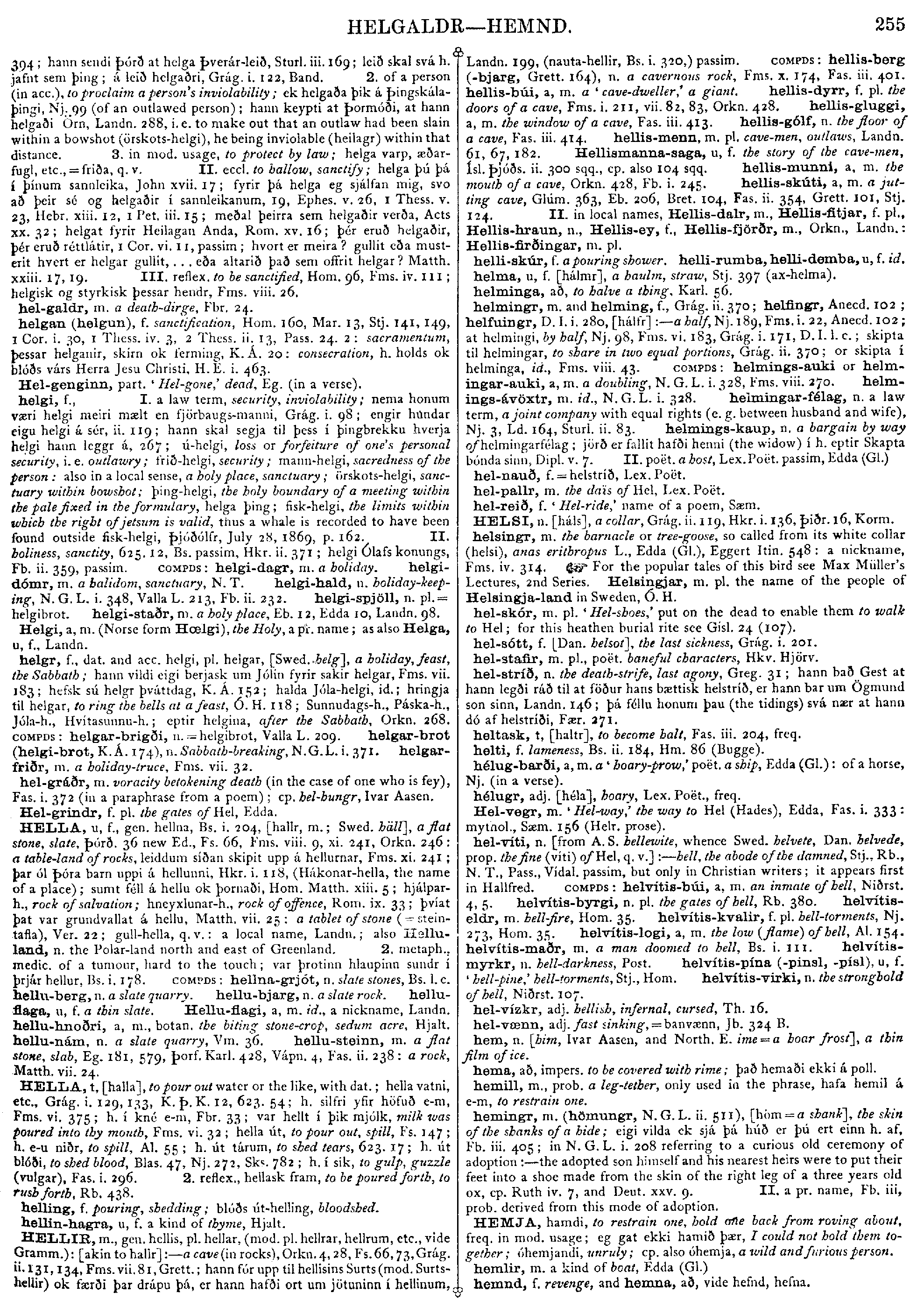
helsingr, m. the barnacle or tree-goose, so called from its white collar (helsi), anas erithropus L., Edda (Gl.), Eggert Itin. 548: a nickname, Fms. iv. 314. UNCERTAIN For the popular tales of this bird see Max Müller's Lectures, 2nd Series. Helsingjar, m. pl. the name of the people of Helsingja-land in Sweden, Ó. H.
|
Source: Cleasby/Vigfusson, page b0258, entry 14 View original page image as: [TIFF] [PNG] [View previous entry] [View next entry] |
[Comment on this entry] [View comments] |
The following entry has been hand-corrected once. |
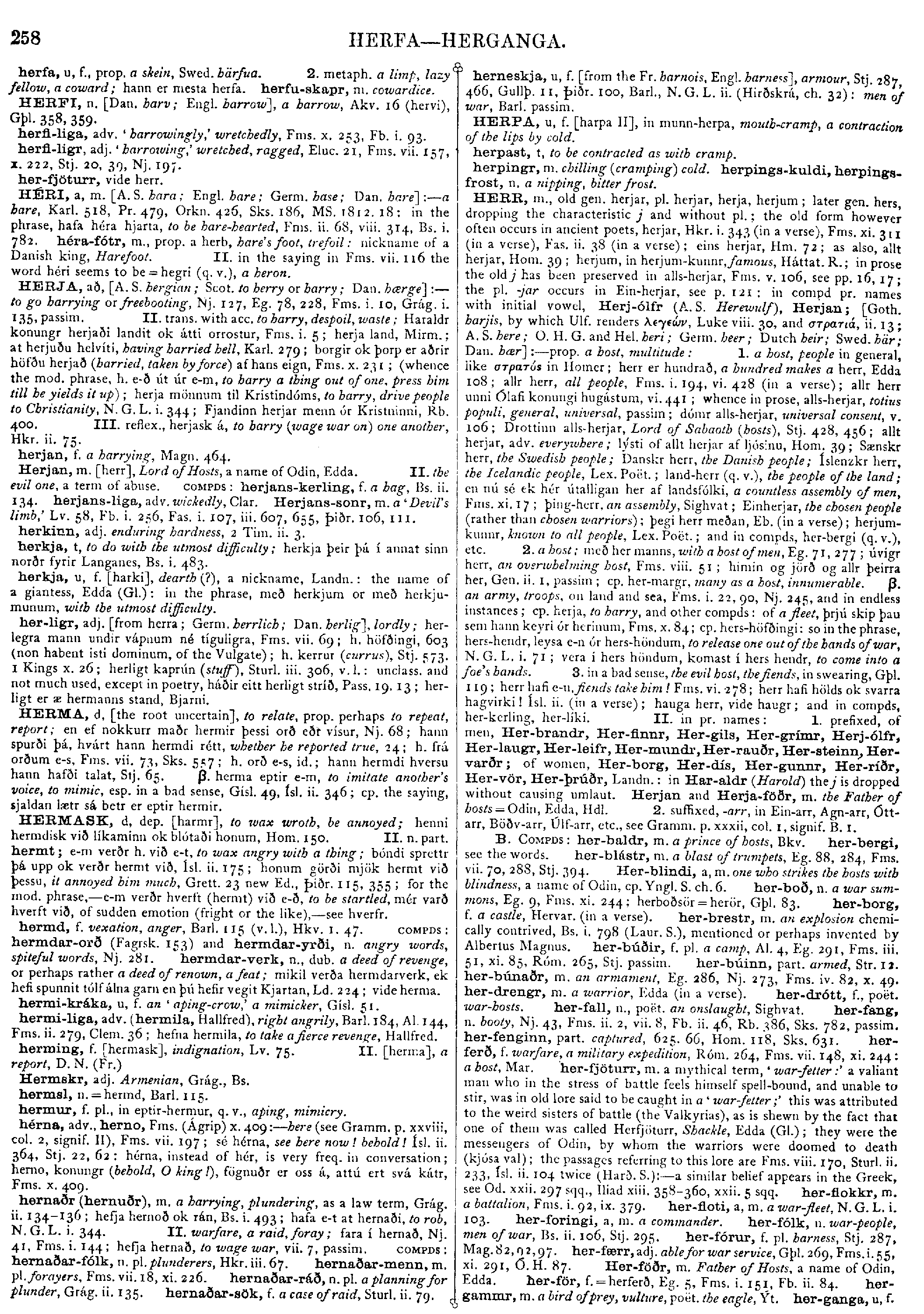
HERMA,
d,
[the
root
uncertain],
to
relate,
prop.
perhaps
to
repeat,
report;
en
ef
nokkurr
maðr
hermir
þessi
orð
eðr
vísur,
Nj.
68;
hann
spurði
þá,
hvárt
hann
hermdi
rétt,
whether
he
reported
true,
24;
h.
frá
orðum
e-s,
Fms.
vii.
73,
Sks.
557;
h.
orð
e-s,
id.;
hann
hermdi
hversu
hann
hafði
talat,
Stj.
65.
 .
herma
eptir
e-m,
to
imitate
another's
voice,
to
mimic,
esp.
in
a
bad
sense,
Gísl.
49,
Ísl.
ii.
346;
cp.
the
saying,
sjaldan
lætr
sá
betr
er
eptir
hermir.
.
herma
eptir
e-m,
to
imitate
another's
voice,
to
mimic,
esp.
in
a
bad
sense,
Gísl.
49,
Ísl.
ii.
346;
cp.
the
saying,
sjaldan
lætr
sá
betr
er
eptir
hermir.
|
Source: Cleasby/Vigfusson, page b0260, entry 28 View original page image as: [TIFF] [PNG] [View previous entry] [View next entry] |
[Comment on this entry] [View comments] |
The following entry has been hand-corrected once. |
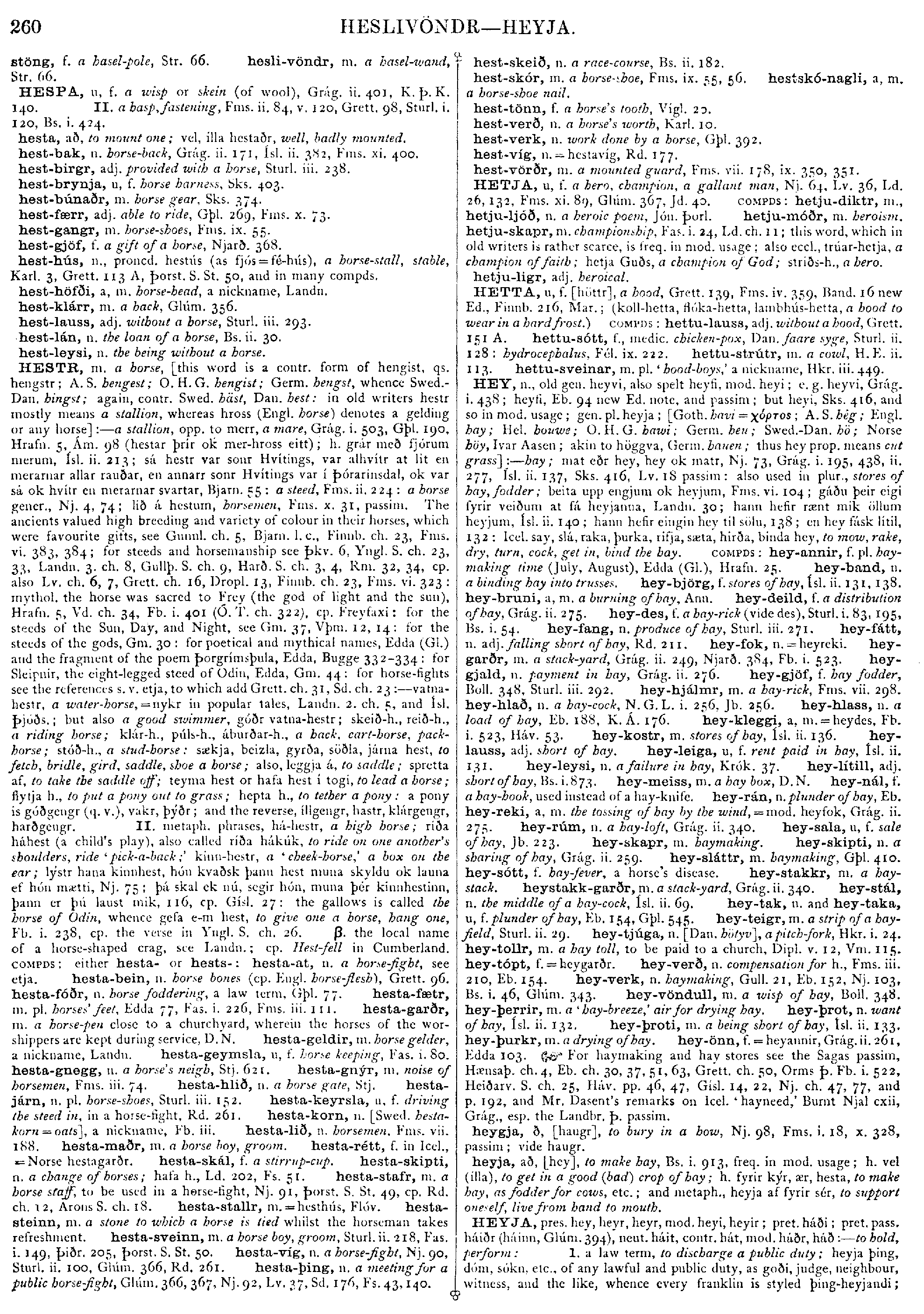
HEY, n., old gen. heyvi, also spelt heyfi, mod. heyi; e.g. heyvi, Grág. i. 438; heyfi, Eb. 94 new Ed. note, and passim; but heyi, Sks. 416, and so in mod. usage; gen. pl. heyja; [Goth. havi = GREEK; A.S. hêg; Engl. hay; Hel. houwe; O. H. G. hawi; Germ. heu; Swed.-Dan. hö; Norse höy, Ivar Aasen; akin to höggva, Germ. hauen; thus hey prop. means cut grass] :-- hay; mat eðr hey, hey ok matr, Nj. 73, Grág. i. 195, 438, ii. 277, Ísl. ii. 137, Sks. 416, Lv. 18 passim: also used in plur., stores of hay, fodder; beita upp engjum ok heyjum, Fms. vi. 104; gáðu þeir eigi fyrir veiðum at fá heyjanna, Landn. 30; hann hefir rænt mik öllum heyjum, Ísl. ii. 140; hann hefir eingin hey til sölu, 138; en hey fásk lítil, 132: Icel. say, slá, raka, þurka, rifja, sæta, hirða, binda hey, to mow, rake, dry, turn, cock, get in, bind the hay. COMPDS: hey-annir, f. pl. haymaking time (July, August), Edda (Gl.), Hrafn. 25. hey-band, n. a binding hay into trusses. hey-björg, f. stores of hay, Ísl. ii. 131, 138. hey-bruni, a, m. a burning of hay, Ann. hey-deild, f. a distribution of hay, Grág. ii. 275. hey-des, f. a hay-rick (vide des), Sturl. i. 83, 195, Bs. i. 54. hey-fang, n. produce of hay, Sturl. iii. 271. hey-fátt, n. adj. falling short of hay, Rd. 211. hey-fok, n. = heyreki. hey-garðr, m. a stack-yard, Grág. ii. 249, Njarð. 384, Fb. i. 523. hey-gjald, n. payment in hay, Grág. ii. 276. hey-gjöf, f. hay fodder, Boll. 348, Sturl. iii. 292. hey-hjálmr, m. a hay-rick, Fms. vii. 298. hey-hlað, n. a hay-cock, N. G. L. i. 256, Jb. 256. hey-hlass, n. a load of hay, Eb. 188, K. Á. 176. hey-kleggi, a, m. = heydes, Fb. i. 523, Háv. 53. hey-kostr, m. stores of hay, Ísl. ii. 136. hey-lauss, adj. short of hay. hey-leiga, u, f. rent paid in hay, Ísl. ii. 131. hey-leysi, n. a failure in hay, Krók. 37. hey-lítill, adj. short of hay, Bs. i. 873. hey-meiss, m. a hay box, D. N. hey-nál, f. a hay-hook, used instead of a hay-knife. hey-rán, n. plunder of hay, Eb. hey-reki, a, m. the tossing of hay by the wind, = mod. heyfok, Grág. ii. 275. hey-rúm, n. a hay-loft, Grág. ii. 340. hey-sala, u, f. sale of hay, Jb. 223. hey-skapr, m. haymaking. hey-skipti, n. a sharing of hay, Grág. ii. 259. hey-sláttr, m. haymaking, Gþl. 410. hey-sótt, f. hay-fever, a horse's disease. hey-stakkr, m. a haystack, heystakk-garðr, m. a stack-yard, Grág. ii. 340. hey-stál, n. the middle of a hay-cock, Ísl. ii. 69. hey-tak, n. and hey-taka, u, f. plunder of hay, Eb. 154, Gþl. 545. hey-teigr, m. a strip of a hay-field, Sturl. ii. 29. hey-tjúga, n. [Dan. hötyv], a pitch-fork, Hkr. i. 24. hey-tollr, m. a hay toll, to be paid to a church, Dipl. v. 12, Vm. 115. hey-tópt, f. = heygarðr. hey-verð, n. compensation for h., Fms. iii. 210, Eb. 154. hey-verk, n. haymaking, Gull. 21, Eb. 152, Nj. 103, Bs. i. 46, Glúm. 343. hey-vöndull, m. a wisp of hay, Boll. 348. hey-þerrir, m. a 'hay-breeze,' air for drying hay. hey-þrot, n. want of hay, Ísl. ii. 132. hey-þroti, m. a being short of hay, Ísl. ii. 133. hey-þurkr, m. a drying of hay. hey-önn, f. = heyannir, Grág. ii. 261, Edda 103. UNCERTAIN For haymaking and hay stores see the Sagas passim, Hænsaþ. ch. 4, Eb. ch. 30, 37, 51, 63, Grett. ch. 50, Orms Þ. Fb. i. 522, Heiðarv. S. ch. 25, Háv. pp. 46, 47, Gísl. 14, 22, Nj. ch. 47, 77, and p. 192, and Mr. Dasent's remarks on Icel. 'hayneed,' Burnt Njal cxii, Grág., esp. the Landbr. Þ. passim.
| Result Page: |  |
Previous | 71 72 73 74 75 76 77 78 79 80 81 82 83 84 85 86 87 88 89 | Next |  |
Germanic Lexicon Project (main page)
This search system was written by
Sean Crist
Please consider
volunteering
to correct the data in these online dictionaries.
No rights reserved. Feel free to use these data in any way you please.