|
|

|
Source: Cleasby/Vigfusson, page b0090, entry 8 View original page image as: [TIFF] [PNG] [View previous entry] [View next entry] |
[Comment on this entry] [View comments] |
The following entry has been hand-corrected once. |
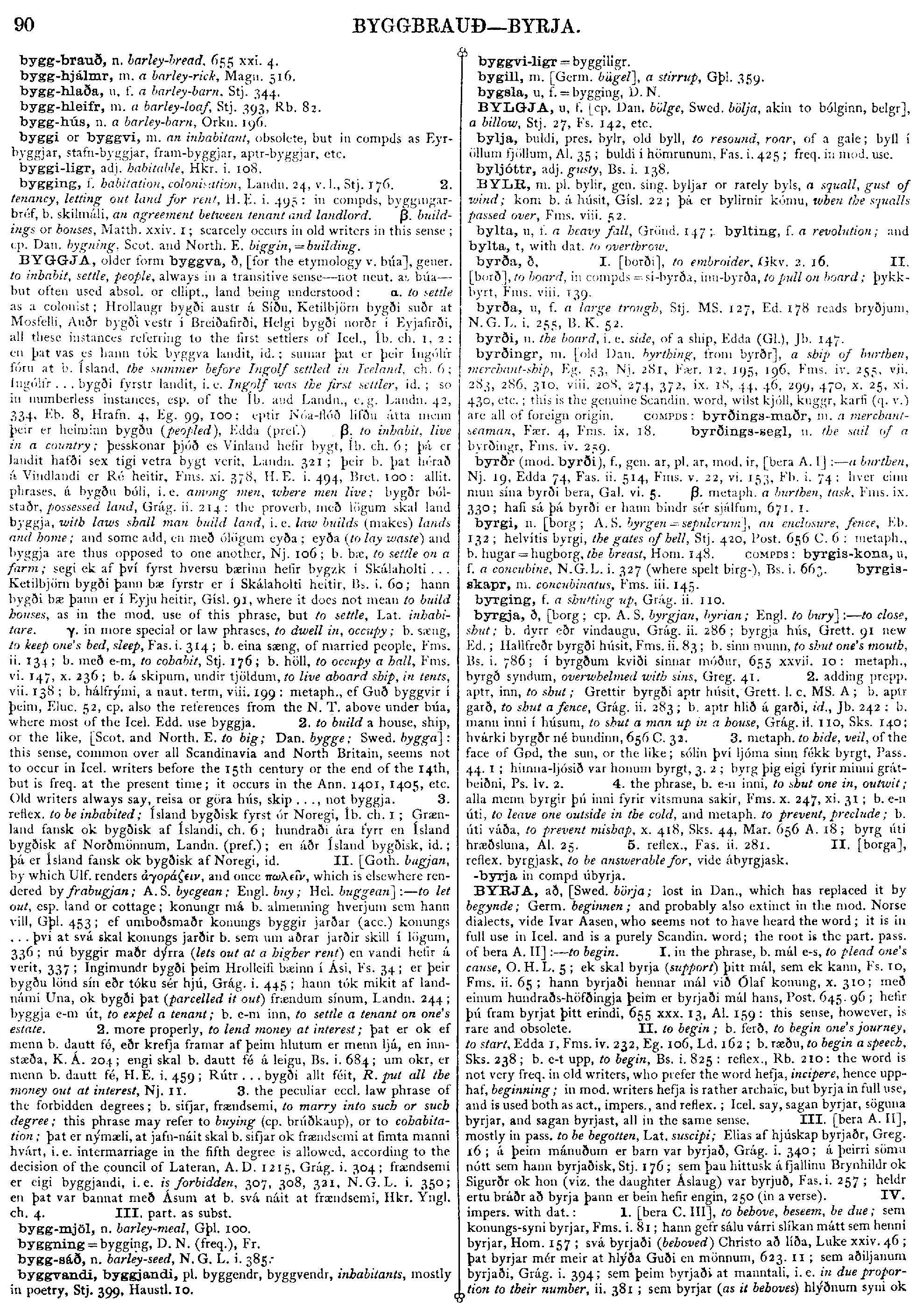
bygging,
f.
habitation,
colonisation,
Landn.
24,
v.l.,
Stj.
176.
2.
tenancy,
letting
out
land
for
rent,
H.
E.
i.
495:
in
compds,
byggingarbréf,
b.
skilmáli,
an
agreement
between
tenant
and
landlord.
 .
buildings
or
houses,
Matth.
xxiv.
1;
scarcely
occurs
in
old
writers
in
this
sense;
cp.
Dan.
bygning,
Scot.
and
North.
E.
biggin,
=
building.
.
buildings
or
houses,
Matth.
xxiv.
1;
scarcely
occurs
in
old
writers
in
this
sense;
cp.
Dan.
bygning,
Scot.
and
North.
E.
biggin,
=
building.
|
Source: Cleasby/Vigfusson, page b0090, entry 9 View original page image as: [TIFF] [PNG] [View previous entry] [View next entry] |
[Comment on this entry] [View comments] |
The following entry has been hand-corrected once. |
BYGGJA,
older
form
byggva,
ð,
[for
the
etymology
v.
búa],
gener.
to
inhabit,
settle,
people,
always
in
a
transitive
sense--not
neut.
as.
búa--but
often
used
absol.
or
ellipt.,
land
being
understood:
 .
to
settle
as
a
colonist;
Hrollaugr
bygði
austr
á
Síðu,
Ketilbjörn
bygði
suðr
at
Mosfelli,
Auðr
bygði
vestr
í
Breiðafirði,
Helgi
bygði
norðr
í
Eyjafirði,
all
these
instances
referring
to
the
first
settlers
of
Icel.,
Íb.
ch.
1.
2;
en
þat
vas
es
hann
tók
byggva
landit,
id.;
sumar
þat
er
þeir
Ingólfr
fóru
at
b.
Ísland,
the
summer
before
Ingolf
settled
in
Iceland,
ch.
6;
Íngólfr
...
bygði
fyrstr
landit,
i.e.
Ingolf
was
the
first
settler,
id.;
so
in
numberless
instances,
esp.
of
the
Íb.
and
Landn.,
e.g.
Landn.
42,
334,
Eb.
8,
Hrafn.
4,
Eg.
99,
100;
eptir
Nóa-flóð
lifðu
átta
menn
þeir
er
heiminn
bygðu
(peopled),
Edda
(pref.)
.
to
inhabit,
live
in
a
country;
þesskonar
þjóð
es
Vínland
hefir
bygt,
Íb.
ch.
6;
þá
er
landit
hafði
sex
tigi
vetra
bygt
verit,
Landn.
321;
þeir
b.
þat
hérað
á
Vindlandi
er
Ré
heitir,
Fms.
xi.
378,
H.
E.
i.
494,
Bret.
100:
allit.
phrases,
á
bygðu
bóli,
i.e.
among
men,
where
men
live;
bygðr
bólstaðr,
possessed
land,
Grág.
ii.
214:
the
proverb,
með
lögum
skal
land
byggja,
with
laws
shall
man
build
land,
i.e.
law
builds
(makes)
lands
and
home;
and
some
add,
en
með
ólögum
eyða;
eyða
(to
lay
waste)
and
byggja
are
thus
opposed
to
one
another,
Nj.
106;
b.
bæ,
to
settle
on
a
farm;
segi
ek
af
því
fyrst
hversu
bærinn
hefir
bygzk
í
Skálaholti
...
Ketilbjörn
bygði
þann
bæ
fyrstr
er
í
Skálaholti
heitir,
Bs.
i.
60;
hann
bygði
bæ
þann
er
í
Eyju
heitir,
Gísl.
91,
where
it
does
not
mean
to
build
houses,
as
in
the
mod.
use
of
this
phrase,
but
to
settle,
Lat.
inhabitare.
.
to
settle
as
a
colonist;
Hrollaugr
bygði
austr
á
Síðu,
Ketilbjörn
bygði
suðr
at
Mosfelli,
Auðr
bygði
vestr
í
Breiðafirði,
Helgi
bygði
norðr
í
Eyjafirði,
all
these
instances
referring
to
the
first
settlers
of
Icel.,
Íb.
ch.
1.
2;
en
þat
vas
es
hann
tók
byggva
landit,
id.;
sumar
þat
er
þeir
Ingólfr
fóru
at
b.
Ísland,
the
summer
before
Ingolf
settled
in
Iceland,
ch.
6;
Íngólfr
...
bygði
fyrstr
landit,
i.e.
Ingolf
was
the
first
settler,
id.;
so
in
numberless
instances,
esp.
of
the
Íb.
and
Landn.,
e.g.
Landn.
42,
334,
Eb.
8,
Hrafn.
4,
Eg.
99,
100;
eptir
Nóa-flóð
lifðu
átta
menn
þeir
er
heiminn
bygðu
(peopled),
Edda
(pref.)
.
to
inhabit,
live
in
a
country;
þesskonar
þjóð
es
Vínland
hefir
bygt,
Íb.
ch.
6;
þá
er
landit
hafði
sex
tigi
vetra
bygt
verit,
Landn.
321;
þeir
b.
þat
hérað
á
Vindlandi
er
Ré
heitir,
Fms.
xi.
378,
H.
E.
i.
494,
Bret.
100:
allit.
phrases,
á
bygðu
bóli,
i.e.
among
men,
where
men
live;
bygðr
bólstaðr,
possessed
land,
Grág.
ii.
214:
the
proverb,
með
lögum
skal
land
byggja,
with
laws
shall
man
build
land,
i.e.
law
builds
(makes)
lands
and
home;
and
some
add,
en
með
ólögum
eyða;
eyða
(to
lay
waste)
and
byggja
are
thus
opposed
to
one
another,
Nj.
106;
b.
bæ,
to
settle
on
a
farm;
segi
ek
af
því
fyrst
hversu
bærinn
hefir
bygzk
í
Skálaholti
...
Ketilbjörn
bygði
þann
bæ
fyrstr
er
í
Skálaholti
heitir,
Bs.
i.
60;
hann
bygði
bæ
þann
er
í
Eyju
heitir,
Gísl.
91,
where
it
does
not
mean
to
build
houses,
as
in
the
mod.
use
of
this
phrase,
but
to
settle,
Lat.
inhabitare.
 .
in
more
special
or
law
phrases,
to
dwell
in,
occupy;
b.
sæng,
to
keep
one's
bed,
sleep,
Fas.
i.
314;
b.
eina
sæng,
of
married
people,
Fms.
ii.
134;
b.
með
e-m,
to
cohabit,
Stj.
176;
b.
höll,
to
occupy
a
hall,
Fms.
vi.
147,
x.
236;
b.
á
skipum,
undir
tjöldum,
to
live
aboard
ship,
in
tents,
vii.
138;
b.
hálfrými,
a
naut.
term,
viii.
199:
metaph.,
cf
Guð
byggvir
í
þeim,
Eluc.
52,
cp.
also
the
references
from
the
N.
T.
above
under
búa,
where
most
of
the
Icel.
Edd.
use
byggja.
2.
to
build
a
house,
ship,
or
the
like,
[Scot.
and
North.
E.
to
big;
Dan.
bygge;
Swed.
bygga]:
this
sense,
common
over
all
Scandinavia
and
North
Britain,
seems
not
to
occur
in
Icel.
writers
before
the
15th
century
or
the
end
of
the
14th,
but
is
freq.
at
the
present
time;
it
occurs
in
the
Ann.
1401,
1405,
etc.
Old
writers
always
say,
reisa
or
göra
hús,
skip
...,
not
byggja.
3.
reflex.
to
be
inhabited;
Ísland
bygðisk
fyrst
ór
Noregi,
Íb.
ch.
1;
Grænland
fansk
ok
bygðisk
af
Íslandi,
ch.
6;
hundraði
ára
fyrr
en
Ísland
bygðisk
af
Norðmönnum,
Landn.
(pref.);
en
áðr
Ísland
bygðisk,
id.;
þá
er
Ísland
fansk
ok
bygðisk
af
Noregi,
id.
II.
[Goth.
bugjan,
by
which
Ulf.
renders
GREEK,
and
once
GREEK,
which
is
elsewhere
rendered
by
frabugjan;
A.
S.
bycgean;
Engl.
buy;
Hel.
buggean]
:--
to
let
out,
esp.
land
or
cottage;
konungr
má
b.
almenning
hverjum
sem
hann
vill,
Gþl.
453;
ef
umboðsmaðr
konungs
byggir
jarðar
(acc.)
konungs
...
því
at
svá
skal
konungs
jarðir
b.
sem
um
aðrar
jarðir
skill
í
lögum,
336;
nú
byggir
maðr
dýrra
(lets
out
at
a
higher
rent)
en
vandi
hefir
á
verit,
337;
Ingimundr
bygði
þeim
Hrolleifi
bæinn
í
Ási,
Fs.
34;
er
þeir
bygðu
lönd
sín
eðr
tóku
sér
hjú,
Grág.
i.
445;
hann
tók
mikit
af
landnámi
Una,
ok
bygði
þat
(parcelled
it
out)
frændum
sínum,
Landn.
244;
byggja
e-m
út,
to
expel
a
tenant;
b.
e-m
inn,
to
settle
a
tenant
on
one's
estate.
2.
more
properly,
to
lend
money
at
interest;
þat
er
ok
ef
menn
b.
dautt
fé,
eðr
krefja
framar
af
þeim
hlutum
er
menn
ljá,
en
innstæða,
K.
Á.
204;
engi
skal
b.
dautt
fé
á
leigu,
Bs.
i.
684;
um
okr,
er
menn
b.
dautt
fé,
H.
E.
i.
459;
Rútr
...
bygði
allt
féit,
R.
put
all
the
money
out
at
interest,
Nj.
11.
3.
the
peculiar
eccl.
law
phrase
of
the
forbidden
degrees;
b.
sifjar,
frændsemi,
to
marry
into
such
or
such
degree;
this
phrase
may
refer
to
buying
(cp.
brúðkaup),
or
to
cohabitation;
þat
er
nýmæli,
at
jafn-náit
skal
b.
sifjar
ok
frændsemi
at
fimta
manni
hvárt,
i.e.
intermarriage
in
the
fifth
degree
is
allowed,
according
to
the
decision
of
the
council
of
Lateran,
A.D.
1215,
Grág.
i.
304;
frændsemi
er
eigi
byggjandi,
i.e.
is
forbidden,
307,
308,
321,
N.
G.
L.
i.
350;
en
þat
var
bannat
með
Ásum
at
b.
svá
náit
at
frændsemi,
Hkr.
Yngl.
ch.
4.
III.
part.
as
subst.
.
in
more
special
or
law
phrases,
to
dwell
in,
occupy;
b.
sæng,
to
keep
one's
bed,
sleep,
Fas.
i.
314;
b.
eina
sæng,
of
married
people,
Fms.
ii.
134;
b.
með
e-m,
to
cohabit,
Stj.
176;
b.
höll,
to
occupy
a
hall,
Fms.
vi.
147,
x.
236;
b.
á
skipum,
undir
tjöldum,
to
live
aboard
ship,
in
tents,
vii.
138;
b.
hálfrými,
a
naut.
term,
viii.
199:
metaph.,
cf
Guð
byggvir
í
þeim,
Eluc.
52,
cp.
also
the
references
from
the
N.
T.
above
under
búa,
where
most
of
the
Icel.
Edd.
use
byggja.
2.
to
build
a
house,
ship,
or
the
like,
[Scot.
and
North.
E.
to
big;
Dan.
bygge;
Swed.
bygga]:
this
sense,
common
over
all
Scandinavia
and
North
Britain,
seems
not
to
occur
in
Icel.
writers
before
the
15th
century
or
the
end
of
the
14th,
but
is
freq.
at
the
present
time;
it
occurs
in
the
Ann.
1401,
1405,
etc.
Old
writers
always
say,
reisa
or
göra
hús,
skip
...,
not
byggja.
3.
reflex.
to
be
inhabited;
Ísland
bygðisk
fyrst
ór
Noregi,
Íb.
ch.
1;
Grænland
fansk
ok
bygðisk
af
Íslandi,
ch.
6;
hundraði
ára
fyrr
en
Ísland
bygðisk
af
Norðmönnum,
Landn.
(pref.);
en
áðr
Ísland
bygðisk,
id.;
þá
er
Ísland
fansk
ok
bygðisk
af
Noregi,
id.
II.
[Goth.
bugjan,
by
which
Ulf.
renders
GREEK,
and
once
GREEK,
which
is
elsewhere
rendered
by
frabugjan;
A.
S.
bycgean;
Engl.
buy;
Hel.
buggean]
:--
to
let
out,
esp.
land
or
cottage;
konungr
má
b.
almenning
hverjum
sem
hann
vill,
Gþl.
453;
ef
umboðsmaðr
konungs
byggir
jarðar
(acc.)
konungs
...
því
at
svá
skal
konungs
jarðir
b.
sem
um
aðrar
jarðir
skill
í
lögum,
336;
nú
byggir
maðr
dýrra
(lets
out
at
a
higher
rent)
en
vandi
hefir
á
verit,
337;
Ingimundr
bygði
þeim
Hrolleifi
bæinn
í
Ási,
Fs.
34;
er
þeir
bygðu
lönd
sín
eðr
tóku
sér
hjú,
Grág.
i.
445;
hann
tók
mikit
af
landnámi
Una,
ok
bygði
þat
(parcelled
it
out)
frændum
sínum,
Landn.
244;
byggja
e-m
út,
to
expel
a
tenant;
b.
e-m
inn,
to
settle
a
tenant
on
one's
estate.
2.
more
properly,
to
lend
money
at
interest;
þat
er
ok
ef
menn
b.
dautt
fé,
eðr
krefja
framar
af
þeim
hlutum
er
menn
ljá,
en
innstæða,
K.
Á.
204;
engi
skal
b.
dautt
fé
á
leigu,
Bs.
i.
684;
um
okr,
er
menn
b.
dautt
fé,
H.
E.
i.
459;
Rútr
...
bygði
allt
féit,
R.
put
all
the
money
out
at
interest,
Nj.
11.
3.
the
peculiar
eccl.
law
phrase
of
the
forbidden
degrees;
b.
sifjar,
frændsemi,
to
marry
into
such
or
such
degree;
this
phrase
may
refer
to
buying
(cp.
brúðkaup),
or
to
cohabitation;
þat
er
nýmæli,
at
jafn-náit
skal
b.
sifjar
ok
frændsemi
at
fimta
manni
hvárt,
i.e.
intermarriage
in
the
fifth
degree
is
allowed,
according
to
the
decision
of
the
council
of
Lateran,
A.D.
1215,
Grág.
i.
304;
frændsemi
er
eigi
byggjandi,
i.e.
is
forbidden,
307,
308,
321,
N.
G.
L.
i.
350;
en
þat
var
bannat
með
Ásum
at
b.
svá
náit
at
frændsemi,
Hkr.
Yngl.
ch.
4.
III.
part.
as
subst.
|
Source: Cleasby/Vigfusson, page b0091, entry 22 View original page image as: [TIFF] [PNG] [View previous entry] [View next entry] |
[Comment on this entry] [View comments] |
The following entry has been hand-corrected once. |
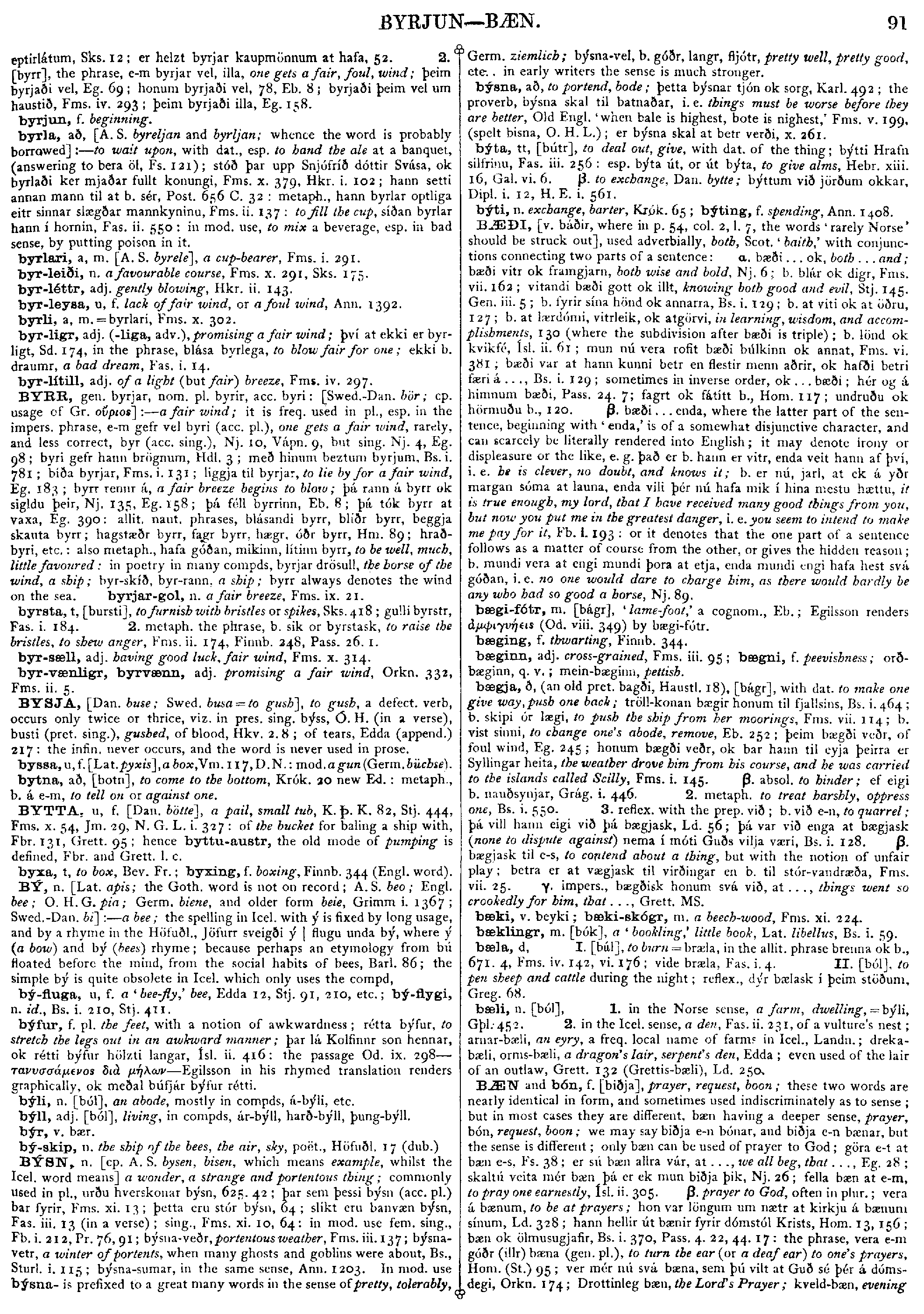
býfur, f. pl. the feet, with a notion of awkwardness; retta býfur, to stretch the legs out in an awkward manner; þar lá Kolfinnr son hennar, ok rétti býfur hölzti langar, Ísl. ii. 416: the passage Od. ix. 298 -- GREEK -- Egilsson in his rhymed translation renders graphically, ok meðal búfjár býfur rétti.
|
Source: Cleasby/Vigfusson, page b0091, entry 29 View original page image as: [TIFF] [PNG] [View previous entry] [View next entry] |
[Comment on this entry] [View comments] |
The following entry has been hand-corrected once. |
býta,
tt,
[bútr],
to
deal
out,
give,
with
dat.
of
the
thing;
býtti
Hrafn
silfrinu,
Fas.
iii.
256:
esp.
býta
út,
or
út
býta,
to
give
alms,
Hebr.
xiii.
16,
Gal.
vi.
6.
.
to
exchange,
Dan.
bytte;
býttum
við
jörðum
okkar,
Dipl.
i.
12,
H.
E.
i.
561.
|
Source: Cleasby/Vigfusson, page b0091, entry 31 View original page image as: [TIFF] [PNG] [View previous entry] [View next entry] |
[Comment on this entry] [View comments] |
The following entry has been hand-corrected once. |
BÆÐI,
[v.
báðir,
where
in
p.
54,
col.
2,
1.
7,
the
words
'rarely
Norse'
should
be
struck
out],
used
adverbially,
both,
Scot.
'
baithh,
'with
conjunctions
connecting
two
parts
of
a
sentence:
a.
bæði,
...
ok,
both
...
and;
bæði
vitr
ok
framgjarn,
both
wise
and
bold,
Nj.
6;
b.
blár
ok
digr,
Fms.
vii.
162;
vitandi
bœði
gott
ok
illt,
knowing
both
good
and
evil,
Stj.
145.
Gen.
iii.
5;
b.
fyrir
sína
hönd
ok
annarra,
Bs.
i.
129;
b.
at
viti
ok
at
öðru,
127;
b.
at
lærdómi,
vitrleik,
ok
atgörvi,
in
learning,
wisdom,
and
accom-
plishments,
130
(where
the
subdivision
after
bæði
is
triple);
b.
lönd
ok
kvikfé,
Ísl.
ii.
61;
mun
nú
vera
rofit
bæði
búlkinn
ok
annat,
Fms.
vi.
381;
bæði
var
at
hann
kunni
betr
en
flestir
menn
aðrir,
ok
hafði
betri
færi
á
...,
Bs.
i.
129;
sometimes
in
inverse
order,
ok
...
bæði;
hér
og
á
himnum
bæði,
Pass.
24.
7;
fagrt
ok
fátítt
b.,
Hom.
117;
undruðu
ok
hörmuðu
b.,
120.
.
bæði...
enda,
where
the
latter
part
of
the
sen-
tence,
beginning
with
'enda,'
is
of
a
somewhat
disjunctive
character,
and
can
scarcely
be
literally
rendered
into
English;
it
may
denote
irony
or
displeasure
or
the
like,
e.
g.
það
er
b.
hann
er
vitr,
enda
veit
hann
af
því,
i.e.
he
is
clever,
no
doubt,
and
knows
it;
b.
er
nú,
jarl,
at
ek
á
yðr
margan
sóma
at
launa,
enda
vili
þér
nú
hafa
mik
í
hina
mestu
hættu,
it
is
true
enough,
my
lord,
that
I
have
received
many
good
things
from
you,
but
now
you
put
me
in
the
greatest
danger,
i.
e.
you
seem
to
intend
to
make
me
pay
for
it,
Fb.
i.
193:
or
it
denotes
that
the
one
part
of
a
sentence
follows
as
a
matter
of
course
from
the
other,
or
gives
the
hidden
reason;
b.
mundi
vera
at
engi
mundi
þora
at
etja,
enda
mundi
engi
hafa
hest
svá
góðan,
i.
e.
no
one
would
dare
to
charge
him,
as
there
would
hardly
be
any
who
had
so
good
a
horse,
Nj.
89.
|
Source: Cleasby/Vigfusson, page b0091, entry 46 View original page image as: [TIFF] [PNG] [View previous entry] [View next entry] |
[Comment on this entry] [View comments] |
The following entry has been hand-corrected once. |
BÆR, bœr, or býr, gen. baejar or býjar; gen. biar also occurs, esp. in Norse MSS. of the 14th century, Fb., but is rare and unclassical; pl. -ir, gen. -ja, dat. -jum. In Icel. people say bær; in Norway bö in Swed. and Dan. (always with y) by; the root word being búa, bú: this word is very freq. in local names of towns and villages throughout the whole of Scandinavia; and wherever the Scandinavian tribes settled the name by or bö went along with them. In the map of Northern England the use of this word marks out the limits and extent of the Norse immigration, e.g. the name Kirkby or Kirby; about twenty or thirty such are found in English maps of the Northern and Midland Counties, denot- ing churches built by the Norse or Danish settlers, as Whitby, Grimsby, etc., cp. Kirkjubær in Icel. In Denmark and Sweden local names ending in -by are almost numberless. I. a town, village, this is the Norse, Swed., and Dan. notion; þeir brenna býi at köldum kolum, Fms. xi. 122; til bæjarins (of Niðarós), vii. 30; of Bergen, viii. 360, 438; Tunsberg, ix. 361; of the town residence of the earl of Orkney, Nj. 267: allit., borgir ok bæi, castles and towns, Ann. 1349, etc. etc.; baejar-biskup, a town-bishop, Fms. vii. 32; bæjar-prestr, a town- priest, D.N.; bæjar-lögmaðr, a town-justice, id.; bæjar-lýðr, bæjar-lið, bæjar-menn, town's-people, Fms. viii. 38, 160, 210, Eg. 240, Bs. i. 78; baejar-brenna, the burning of a town, Fms. x. 30; bæjar-bygð, a town-district, viii. 247; bæjar-gjald, a town-rate, N.G.L. i. 328; bæjar-sýsla, a town-office, Fms. vi. 109; bæjar-starf, id., Hkr. iii. 441; bæjar-seta, dwelling in town, Ld. 73, Ísl. ii. 392. II. a farm, landed estate, this is the Icel. notion, as that country has no towns; bær in Icel. answers to the Germ, 'hof,' Norweg. 'ból,' Dan. 'gaard,' denoting a farm, or farmyard and buildings, or both together; hence the phrase, reisa, göra, setja bæ, efna til bæjar, to build the farmstead, Eb. 10, 26, 254, Ld. 96, 98, Fs. 26, Landn. 126, 127, Eg. 131, Gísl. 8, 28, Bs. i. 26, Þorst. hv. 35; byggja bæ, Bs. i. 60; the phrase, bær heitir..., a farm is called so and so, Ísl. ii. 322, 323, 325, Ann. 1300, Hrafn. 22, Dropl. 5; the allit. phrase, búa á bæ..., Þorst. hv. 37; the passages are numberless, and 'bær' has almost become synonymous with 'house and home;' and as it specially means 'the farm-buildings,' Icel. also say innan-bæjar, in-doors; utan-bæjar, out-of-doors; í bæ, within doors; milii baejar ok stöðuls, K.Þ.K. 78; milli bæja; bæ frá bæ, from house to house; á bæ og af bæ, at home and abroad: things belonging to a bær, bæjar-dyr, the doors of the houses, the chief entrance; bæjar-hurð (janua); bæjar-veggr, the wall of the houses; bæjar-bust, the gable of the houses; bæjar-lækr, the home-spring, well; bæjar-hlað, the premises; bæjar-stétt, the pavement in the front of the houses; bæjar-leið, a furlong, a short distance as between two 'bæir;' bæjar-sund, passage between the houses; bæjar-hús, the home-stead, opp. to fjár-hús, etc., where cattle is kept, or barns and the like; fram-bær, the front part of the houses; torf-bær, timbr-bær, a 'bær' built of turf or timber: phrases denoting the 'bær' as hearth and home, hér sú Guð í bæ, God be in this house, a form of greeting, cp. Luke x. 5; bæjar-bragr, the customs or life in a house; nema börn hvað á bæ er títt (a proverb).
|
Source: Cleasby/Vigfusson, page b0091, entry 52 View original page image as: [TIFF] [PNG] [View previous entry] [View next entry] |
[Comment on this entry] [View comments] |
The following entry has been hand-corrected once. |
BÆTA,
tt,
[bót;
Ulf.
bôtjan
=
GREEK;
Hel.
bôtian;
A.
S.
bêtan;
O.H.G.
bôzau;
Germ.
büssen]
:--
to
better,
improve,
amend,
also
t
o
restore,
repair,
Nj.
163,
Gþl.
411;
b.
aptr,
to
restore,
Grág.
ii.
336;
b.
upp,
to
restore,
atone
for,
Fms.
ix.
43;
b.
at
e-u,
to
repair,
367;
bæta
ráð
sitt,
to
better
one's
condition,
to
marry,
Nj.
2:
theol.
to
better
one's
life:
Guð
bætti
honum
af
þessi
sótt,
God
restored
him
to
health,
Fms.
ix.
391;
with
gen.
of
the
sickness,
O.H.L.
84.
.
to
mend,
put
a
patch
on
a
garment.
2.
reflex.,
e-m
bætisk,
one
gets
better,
is
restored
to
health;
at
föður
hans
bættisk
helstríð,
Landn.
146:
absol.,
bættisk
honum
þegar,
he
got
better
at
once,
Bs.
i.
318,
319,
325:
with
gen.,
baettisk
Búa
augna-verkjarins,
Ísl.
ii.
428
(rare);
cp.
heilsu-bót,
recovery
of
health.
II.
a
law
term,
to
pay
weregild,
the
person
slain
in
acc.,
the
money
in
dat.;
Hrafnkell
bætti
engan
mann
fé,
i.e.
H.
paid
no
weregild
whomsoever
he
slew,
Hrafn.
4;
ek
vil
engan
mann
fé
b.,
9;
Styrr
vá
mörg
víg,
en
bætti
engin
(viz.
víg),
S.
slew
many
men,
but
paid
for
none,
Eb.
54;
bæta
þá
menn
alla
er
þar
létusk
eðr
fyrir
sárum
urðu,
98;
b.
sakir
(acc.)
fé
(dat.),
Grág.
ii.
169:
the
allit.
law
term,
b.
baugum,
to
pay
weregild,
174:
the
amount
of
money
in
acc.
to
pay
out,
bæt
heldr
fé
þat
er
þú
ert
sakaðr
við
hann,
Fms.
iii.
22;
ok
á
hann
eigi
þat
at
b.,
he
has
not
to
pay
that,
Grág.
ii.
168;
b.
öfandar
bót,
Gþl.
358:
part.
bættr,
Eb.
98,
246.
2.
metaph.
to
redress,
adjust;
b.
við
e-n,
or
b.
yfir
við
e-n,
to
give
one
redress,
make
good
a
wrong
inflicted;
hefir
þú
yfir
bætt
við
mik
um
þetta
bráðræði,
Fms.
ii.
25,
xi.
434:
also
used
in
a
religious
sense,
skaltu
b.
við
Guð,
er
þú
hefir
svá
mjök
gengit
af
trú
þinni,
ii.
213
(yfír-bót,
repentance);
b.
sál,
or
b.
fyrir
sál
sinni,
to
do
for
the
health
of
the
soul,
iv.
63,
Fb.
i.
345
Bs.
i.
642
(in
a
verse);
b.
um
e-t,
to
make
a
thing
better
(um-bot,
bettering,
improvement),
Orkn.
442:
reflex.,
ekki
bætisk
um,
matters
grow
worse,
Fms.
ii.
53;
b.
við,
to
add
to
(við-bót,
addition),
Húv.
45.
3.
part.
pass,
used
as
adj.
in
compar.;
ok
er
eigi
at
bættra,
þótt
...,
things
are
no
better,
though
...,
Fms.
vii.
36;
þykir
mér
Ólafr
ekki
at
bættari,
þótt...,
i.e.
it
is
no
redress
for
Olave's
death,
though
...,
Fas.
ii.
410;
er
mér
ekki
sour
minn
at
bættari
þótt
Bolli
sé
drepinn,
my
son's
death
is
none
the
more
atoned
for
though
B.
is
slain,
Ld.
226.
4.
part.
act.
as
noun;
bætandi,
pl.
-endr,
a
law
term,
one
who
has
to
pay
weregild,
Grág.
ii.
174,
etc.
|
Source: Cleasby/Vigfusson, page b0093, entry 6 View original page image as: [TIFF] [PNG] [View previous entry] [View next entry] |
[Comment on this entry] [View comments (1)] |
The following entry has been hand-corrected once. |
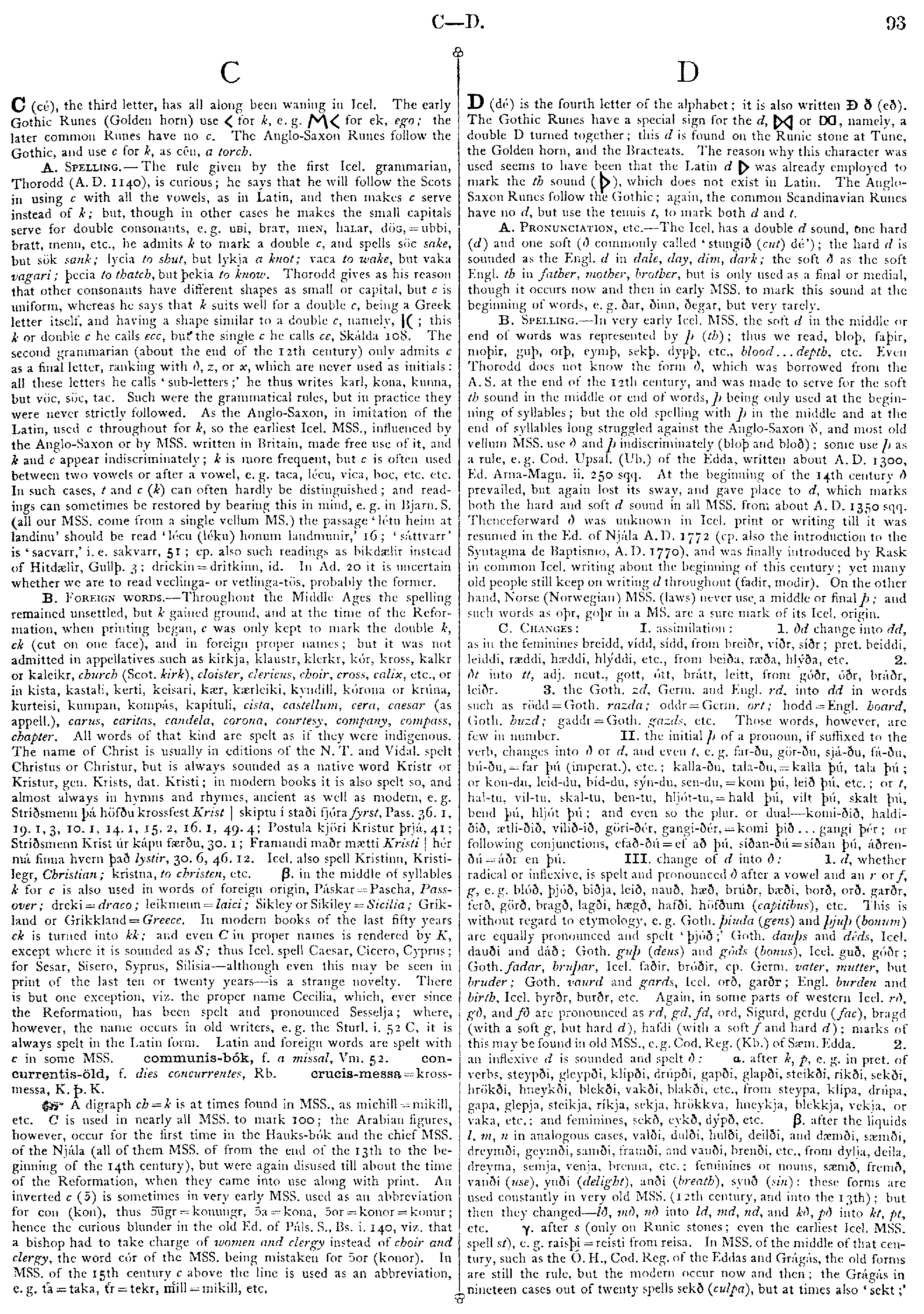
C.
CHANGES:
I.
assimilation:
1.
ðd
change
into
dd,
as
in
the
feminines
breidd,
vídd,
sídd,
from
breiðr,
víðr,
síðr;
pret.
beiddi,
leiddi,
ræddi,
hæddi,
hlýddi,
etc.,
from
beiða,
ræða,
hlýða,
etc.
2.
ðt
into
tt,
adj.
neut.,
gott,
ótt,
brátt,
leitt,
from
góðr,
óðr,
bráðr,
leiðr.
3.
the
Goth,
zd,
Germ,
and
Engl.
rd
into
dd
in
words
such
as
rödd
=
Goth.
razda;
oddr
=
Germ,
ort;
hodd
=
Engl.
hoard,
Goth.
huzd;
gaddr
=
Goth.
gazds,
etc.
Those
words,
however,
are
few
in
number.
II.
the
initial
þ
of
a
pronoun,
if
suffixed
to
the
verb,
changes
into
ð
or
d,
and
even
t,
e.g.
far-ðu,
gör-ðu,
sjá-ðu,
fá-ðu,
bú-ðu,
=
far
þú
(imperat.),
etc.;
kalla-ðu,
tala-ðu,
=
kalla
þú,
tala
þú;
or
kon-du,
leid-du,
bíd-du,
sýn-du,
sen-du,
=
kom
þú,
leið
þú,
etc.;
or
t,
hal-tu,
vil-tu,
skal-tu,
ben-tu,
hljót-tu,
=
hald
þú,
vilt
þú,
skalt
þú,
bend
þú,
hljót
þu;
and
even
so
the
plur.
or
dual
--
komi-ðið,
haldi-ðið,
ætli-ðið,
vilið-ið,
göri-ðér,
gangi-ðér,
=
komi
þið
...
gangi
þér;
or
following
conjunctions,
efað-ðú
=
ef
að
þú,
síðan-ðú
=
síðan
þú,
áðren-ððí
=
áðr
en
þú.
III.
change
of
d
into
ð:
1.
d,
whether
radical
or
inflexive,
is
spelt
and
pronounced
ð
after
a
vowel
and
an
r
or
f,
g,
e.g.
blóð,
þjóð,
biðja,
leið,
nauð,
hæð,
brúðr,
bæði,
borð,
orð,
garðr,
ferð,
görð,
bragð,
lagði,
hægð,
hafði,
höfðum
(capitibus),
etc.
This
is
without
regard
to
etymology,
e.g.
Goth,
þiuda
(gens)
and
þjuþ
(bonum)
are
equally
pronounced
and
spelt
'þjóð;'
Goth.
dauþs
and
dêds,
Icel.
dauði
and
dáð;
Goth,
guþ
(deus)
and
gôds
(bonus),
Icel.
guð,
góðr;
Goth.
fadar,
bruþar,
Icel.
faðir,
bróðir,
cp.
Germ,
vater,
mutter,
but
bruder;
Goth,
vaurd
and
gards,
Icel.
orð,
garðr;
Engl.
burden
and
birth,
Icel.
byrðr,
burðr,
etc.
Again,
in
some
parts
of
western
Icel.
rð,
gð,
and
fd
are
pronounced
as
rd,
gd,
fd,
ord,
Sigurd,
gerdu
(fac),
bragd
(with
a
soft
g,
but
hard
d),
hafdi
(with
a
soft
f
and
hard
d);
marks
of
this
may
be
found
in
old
MSS.,
e.g.
Cod.
Reg.
(Kb.)
of
Stem.
Edda.
2.
an
inflexive
d
is
sounded
and
spelt
ð:
.
after
k,
p,
e.g.
in
pret.
of
verbs,
steypði,
gleypði,
klípði,
drúpði,
gapði,
glapði,
steikði,
ríkði,
sekði,
hrökði,
hneykði,
blekði,
vakði,
blakði,
etc.,
from
steypa,
klípa,
drúpa,
gapa,
glepja,
steikja,
ríkja,
sekja,
hrökkva,
hneykja,
blekkja,
vekja,
or
vaka,
etc.;
and
feminines,
sekð,
eykð,
dýpð,
etc.
.
after
the
liquids
l,
m,
n
in
analogous
cases,
valði,
dulði,
hulði,
deilði,
and
dæmði,
sæmði,
dreymði,
geymði,
samði,
framði,
and
vanði,
brenði,
etc.,
from
dylja,
deila,
dreyma,
semja,
venja,
brenna,
etc.;
feminines
or
nouns,
sæmð,
fremð,
vanði
(use),
ynði
(delight),
anði
(breath),
synð
(sin):
these
forms
are
used
constantly
in
very
old
MSS.
(12th
century,
and
into
the
13th);
but
then
they
changed
--
lð,
mð,
nð
into
ld,
md,
nd,
and
kð,
pð
into
kt,
pt,
etc.
.
after
s
(only
on
Runic
stones;
even
the
earliest
Icel.
MSS.
spell
st),
e.g.
raisþi
=
reisti
from
reisa.
In
MSS.
of
the
middle
of
that
century,
such
as
the
Ó.H.,
Cod.
Reg.
of
the
Eddas
and
Grágás,
the
old
forms
are
still
the
rule,
but
the
modern
occur
now
and
then;
the
Grágás
in
nineteen
cases
out
of
twenty
spells
sekð
(culpa),
but
at
times
also
'sekt;'
|
Source: Cleasby/Vigfusson, page b0093, entry 30 View original page image as: [TIFF] [PNG] [View previous entry] [View next entry] |
[Comment on this entry] [View comments] |
The following entry has been hand-corrected once. |
DAGR,
m.,
irreg.
dat.
degi,
pl.
dagar:
[the
kindred
word
dœgr
with
a
vowel
change
from
ó
(dóg)
indicates
a
lost
root
verb
analogous
to
ala,
ól,
cp.
dalr
and
dælir;
this
word
is
common
to
all
Teutonic
dialects;
Goth.
dags;
A.S.
dag;
Engl.
day;
Swed.-Dan.
dag;
Germ,
tag;
the
Lat.
dies
seems
to
be
identical,
although
no
interchange
has
taken
place]
:--
a
day;
in
different
senses:
1.
the
natural
day
:--
sayings
referring
to
the
day,
at
kveldi
skal
dag
leyfa,
at
eventide
shall
the
day
be
praised,
Hm.
80
;
allir
dagar
eiga
kveld
um
síðir;
mörg
eru
dags
augu,
vide
auga;
enginn
dagr
til
enda
tryggr,
no
day
can
be
trusted
till
its
end;
allr
dagr
til
stefnu,
Grág.
i.
395,
443,
is
a
law
phrase,
--
for
summoning
was
lawful
only
if
performed
during
the
day;
this
phrase
is
also
used
metaph.
=
'plenty
of
time'
or
the
like:
popular
phrases
as
to
the
daylight
are
many
--
dagr
rennr,
or
rennr
upp,
and
kemr
upp,
the
day
rises,
Bm.
1;
dagr
í
austri,
day
in
the
east,
where
the
daylight
first
appears;
dagsbrún,
'day's
brow,'
is
the
first
streak
of
daylight,
the
metaphor
taken
from
the
human
face;
lysir
af
degi,
it
brightens
from
the
day,
i.e.
daylight
is
appearing;
dagr
ljómar,
the
day
gleams;
fyrir
dag,
before
day;
móti
degi,
undir
dag,
about
daybreak;
komið
at
degi,
id.,
Fms.
viii.
398;
dagr
á
lopti,
day
in
the
sky;
árla,
snemma
dags,
early
in
the
morning,
Pass.
15.
17;
dagr
um
allt
lopt,
etc.;
albjartr
dagr,
hábjartr
d.,
full
day,
broad
daylight;
hæstr
dagr,
high
day;
önd-verðr
d.,
the
early
day
=
forenoon,
Am.
50;
miðr
dagr,
midday,
Grág.
i.
413,
446,
Sks.
217,
219;
áliðinn
dagr,
late
in
the
day,
Fas.
i.
313;
hallandi
dagr,
declining
day;
at
kveldi
dags,
síð
dags,
late
in
the
day,
Fms.
i.
69.
In
the
evening
the
day
is
said
to
set,
hence
dag-sett,
dag-setr,
and
dagr
setzt;
in
tales,
ghosts
and
spirits
come
out
with
nightfall,
but
dare
not
face
the
day;
singing
merry
songs
after
nightfall
is
not
safe,
það
kallast
ekki
Kristnum
leyft
að
kveða
þegar
dagsett
er,
a
ditty;
Syrpuvers
er
mestr
galdr
er
í
fólginn,
ok
eigi
er
lofat
at
kveða
eptir
dagsetr,
Fas.
iii.
206,
Ísl.
Þjóðs.
ii.
7,
8:
the
daylight
is
symbolical
of
what
is
true
or
clear
as
day,
hence
the
word
dagsanna,
or
satt
sem
dagr,
q.v.
2.
of
different
days;
í
dag,
to-day,
Grág.
i.
16,
18,
Nj.
36,
Ld.
76,
Fms.
vi.
151;
í
gær-dag,
yesterday;
í
fyrra
dag,
the
day
before
yesterday,
Háv.
50;
í
hinni-fyrra
dag,
the
third
day;
annars
dags,
Vígl.
23,
Pass.
50.
I;
hindra
dags,
the
hinder
day,
the
day
after
to-mor-
row,
Hm.
109;
dag
eptir
dag,
day
after
day,
Hkr.
ii.
313;
dag
frá
degi,
from
day
to
day,
Fms.
ii.
230;
hvern
dag
frá
öðrum,
id.,
Fms.
viii.
182;
annan
dag
frá
öðrum.
id.,
Eg.
277;
um
daginn,
during
the
day;
á
dögunum.
the
other
day;
nótt
ok
dag,
night
and
day;
liðlangan
dag,
the
'life-long'
day;
dögunum
optar,
more
times
than
there
are
days,
i.e.
over
and
over
again,
Fms.
x.
433;
á
deyjanda
degi,
on
one's
day
of
death,
Grág.
i.
402.
.
regu-dagr,
a
rainy
day:
sólskins-dagr,
a
sunny
day;
sumar-
dagr,
a
summer
day;
vetrar-dagr,
a
winter
day;
hátíðis-dagr,
a
feast
day;
fegins-dagr,
a
day
of
joy;
dóms-dagr,
the
day
of
doom,
judgment
day,
Gl.
82,
Fms.
viii.
98;
hamingju-dagr,
heilla-dagr,
a
day
of
happiness;
gleði-
dagr,
id.;
brúðkaups-dagr,
bridal-day;
burðar-dagr,
a
birthday.
3.
in
pl.
days
in
the
sense
of
times;
aðrir
dagar,
Fms.
i.
216;
ek
ætlaða
ekki
at
þessir
dagar
mundu
verða,
sem
nú
eru
orðnir,
Nj.
171;
góðir
dagar,
happy
days,
Fms.
xi.
286,
270;
sjá
aldrei
glaðan
dag
(sing.),
never
to
see
glad
days.
.
á
e-s
dögum,
um
e-s
daga
eptir
e-s
daga,
esp.
of
the
lifetime
or
reign
of
kings,
Fms.;
but
in
Icel.
also
used
of
the
lög-
sögumaðr,
Jb.
repeatedly;
vera
á
dögum,
to
be
alive;
eptir
minn
dag,
'after
my
day,'
i.e.
when
I
am
dead.
.
calendar
days,
e.g.
Hvita-
dagar,
the
White
days,
i.e.
Whitsuntide;
Hunda-dagar,
the
Dog
days;
Banda-dagr,
Vincula
Petri;
Höfuð-dagr,
Decap.
Johannis;
Geisla-dagr,
Epiphany;
Imbru-dagar,
Ember
days;
Gang-dagar,
'Ganging
days,'
Ro-
gation
days;
Dýri-dagr,
Corpus
Christi;
etc.
4.
of
the
week-
days;
the
old
names
being
Sunnu-d.
or
Drottins-d.,
Mána-d.,
Týs-d.,
Öðins-d.,
Þórs-d.,
Frjá-d.,
Laugar-d.
or
Þvátt-d.
It
is
hard
to
understand
how
the
Icel.
should
be
the
one
Teut.
people
that
have
disused
the
old
names
of
the
week-days;
but
so
it
was,
vide
Jóns
S.
ch.
24;
fyrir
bauð
hann
at
eigna
daga
vitrum
mönnum
heiðnum,
svá
sem
at
kalla
Týrsdag
|
Source: Cleasby/Vigfusson, page b0096, entry 1 View original page image as: [TIFF] [PNG] [View previous entry] [View next entry] |
[Comment on this entry] [View comments] |
The following entry has been hand-corrected once. |
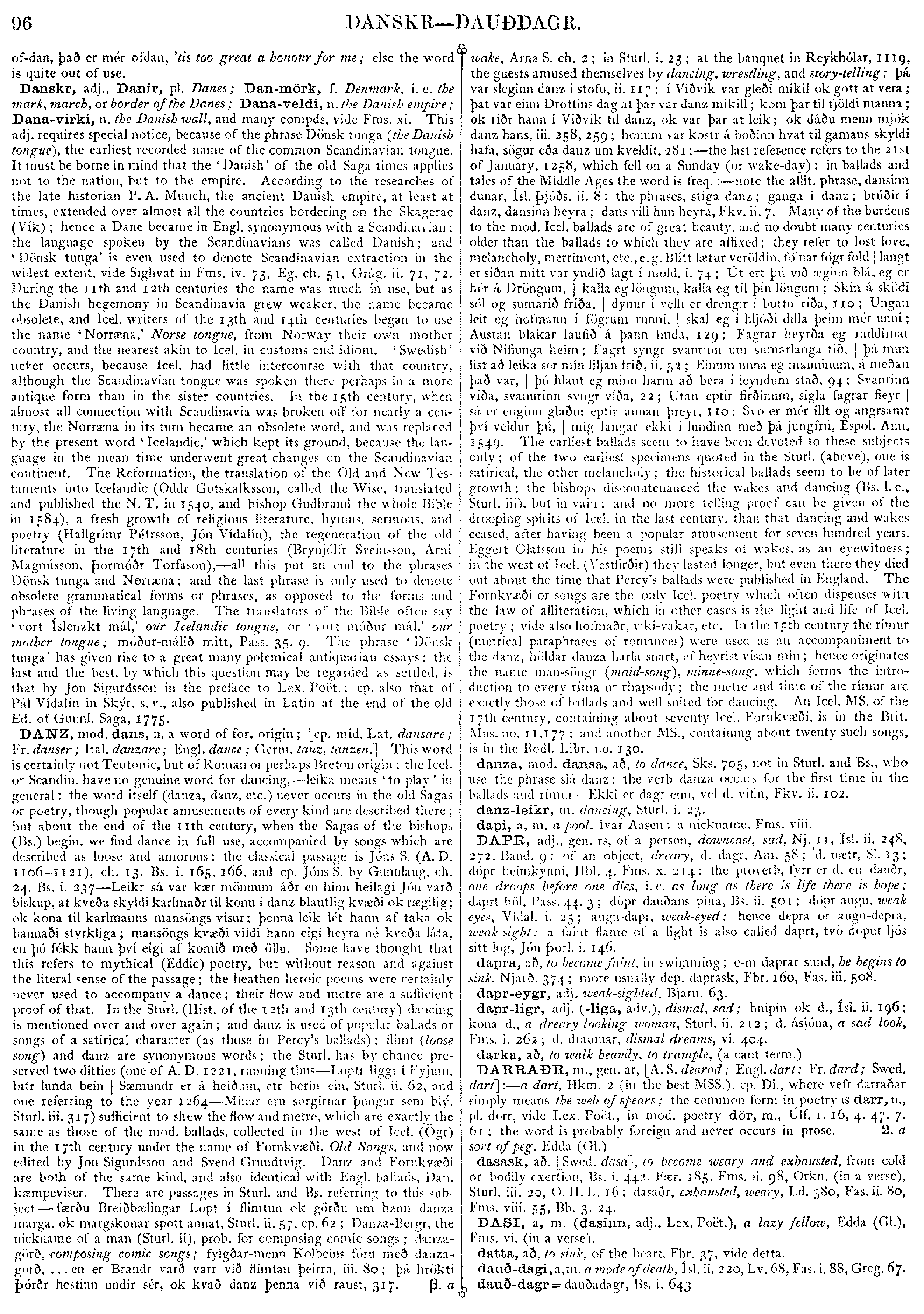
of-dan, það er mér ofdan, 'tis too great a honour for me; else the word is quite out of use.
| Result Page: |  |
Previous | 100 101 102 103 104 105 106 107 108 109 110 111 112 113 114 115 116 117 118 | Next |  |
Germanic Lexicon Project (main page)
This search system was written by
Sean Crist
Please consider
volunteering
to correct the data in these online dictionaries.
No rights reserved. Feel free to use these data in any way you please.