|
|

Tip: In the search results, you can click on any word or abbreviation for more information.
|
Source: Cleasby/Vigfusson, page b0161, entry 24 View original page image as: [TIFF] [PNG] [View previous entry] [View next entry] |
[Comment on this entry] [View comments] |
The following entry has been hand-corrected once. |
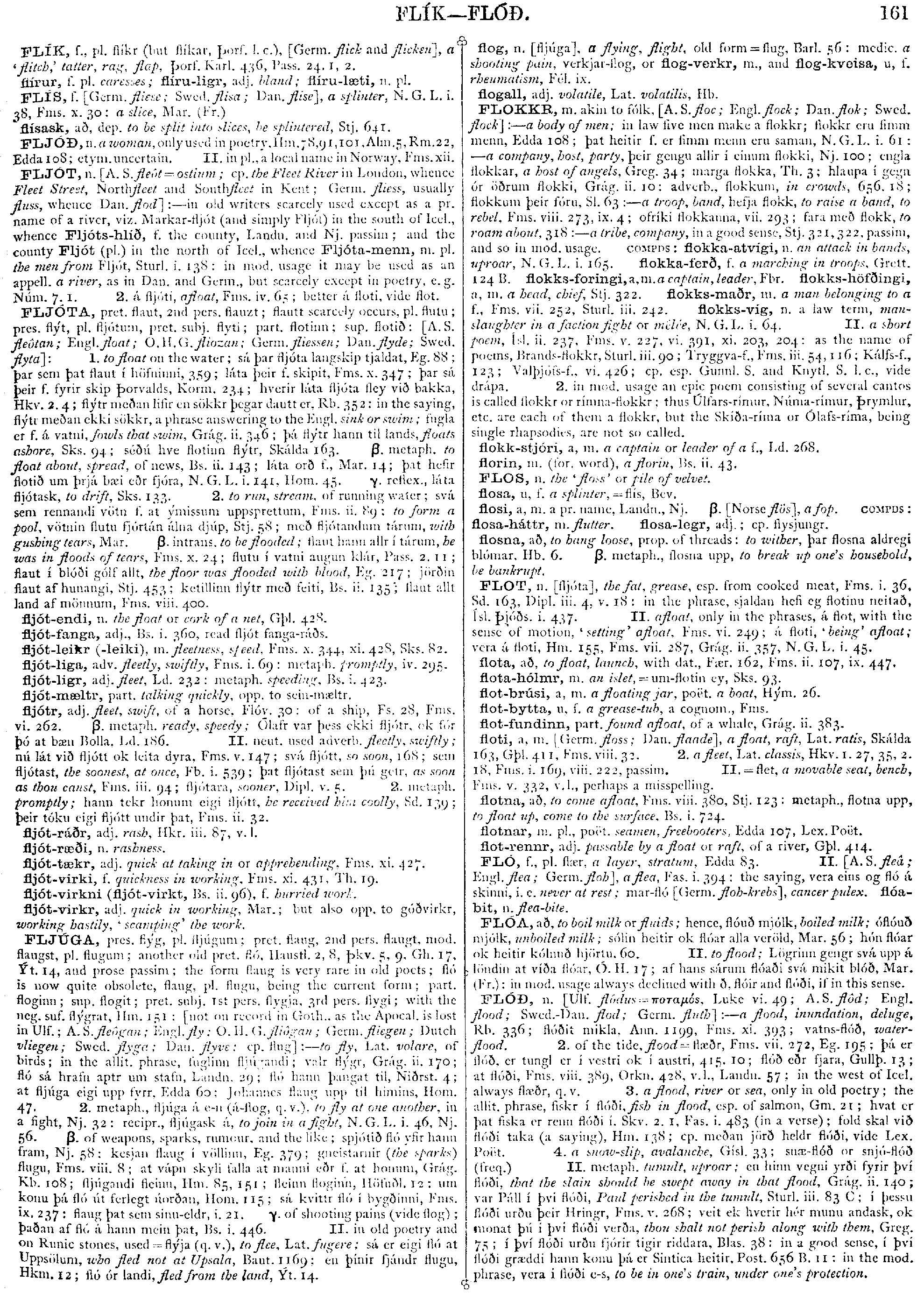
FLOKKR, m. akin to fólk, [A. S. floc; Engl. flock; Dan. flok; Swed. flock] :-- a body of men; in law five men make a flokkr; flokkr eru fimm menn, Edda 108; þat heitir f. er fimm menn eru saman, N. G. L. i. 61: -- a company, host, party, þeir gengu allir í einum flokki, Nj. 100; engla flokkar, a host of angels, Greg. 34; marga flokka, Th. 3; hlaupa í gegn ór öðrum flokki, Grág. ii. 10: adverb., flokkum, in crowds, 656. 18; flokkum þeir fóru, Sl. 63 :-- a troop, band, hefja flokk, to raise a band, to rebel, Fms. viii. 273, ix. 4; ofríki flokkanna, vii. 293; fara með flokk, to roam about, 318 :-- a tribe, company, in a good sense, Stj. 321, 322, passim, and so in mod. usage. COMPDS: flokka-atvígi, n. an attack in bands, uproar, N. G. L. i. 165. flokka-ferð, f. a marching in troops, Grett. 124 B. flokks-foringi, a, m. a captain, leader, Fbr. flokks-höfðingi, a, m. a head, chief, Stj. 322. flokks-maðr, m. a man belonging to a f. Fms. vii. 252, Sturl. iii. 242. flokks-víg, n. a law term, manslaughter in a faction fight or mêlée, N. G. L. i. 64. II. a short poem, Ísl. ii. 237, Fms. v. 227, vi. 391, xi. 203, 204: as the name of poems, Brands-flokkr, Sturl. iii. 90; Tryggva-f., Fms. iii. 54, 116; Kálfs-f., 123; Valþjófs-f., vi. 426; cp. esp. Gunnl. S. and Knytl. S. l.c., vide drápa. 2. in mod. usage an epic poem consisting of several cantos is called flokkr or rímna-flokkr; thus Úlfars-rímur, Núma-rímur, Þrymlur, etc. are each of them a flokkr, but the Skíða-ríma or Ólafs-ríma, being single rhapsodies, are not so called.
|
Source: Cleasby/Vigfusson, page b0175, entry 21 View original page image as: [TIFF] [PNG] [View previous entry] [View next entry] |
[Comment on this entry] [View comments] |
The following entry has been hand-corrected once. |
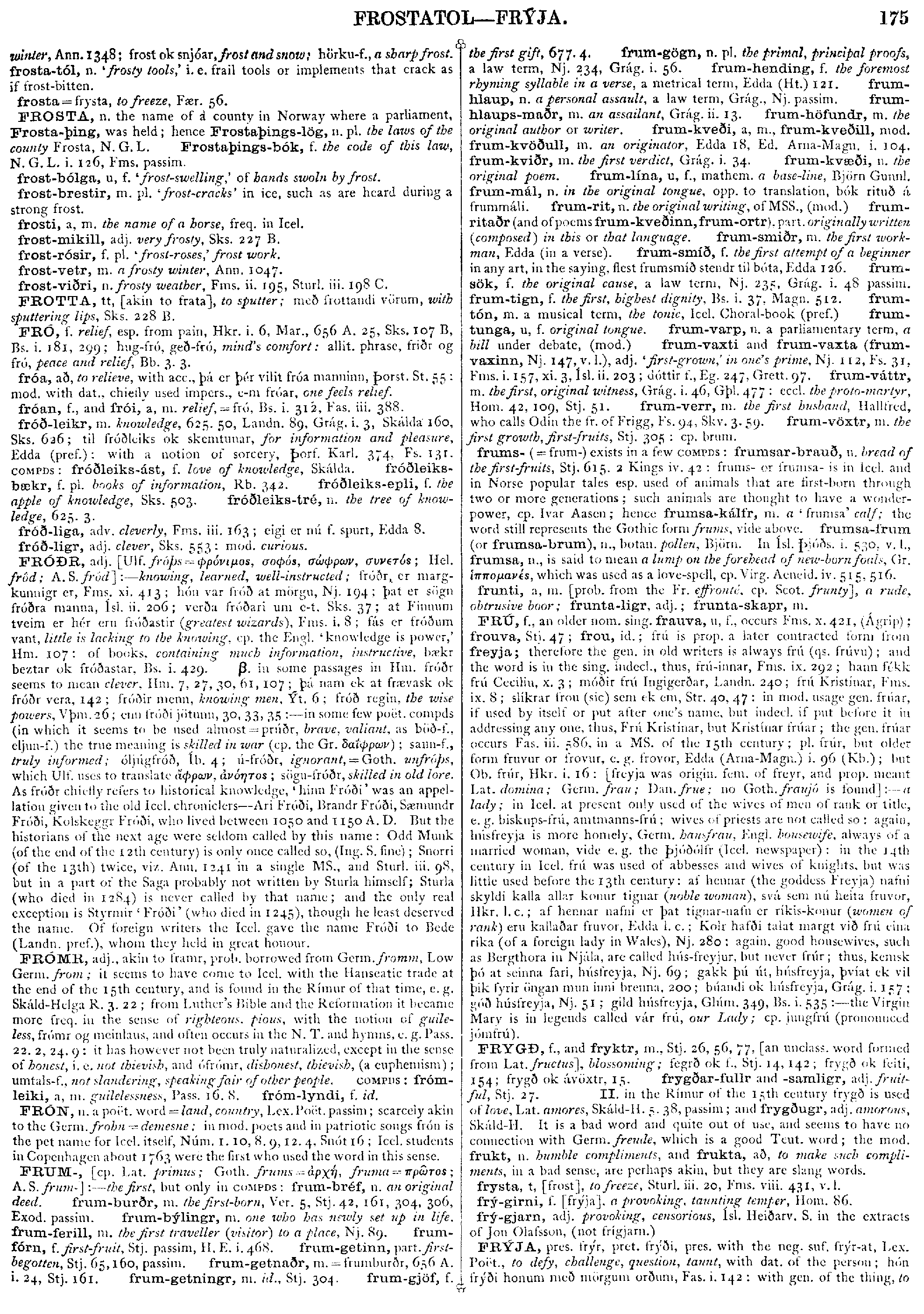
FRUM- [cp. Lat. primus; Goth. frums = GREEK, fruma = GREEK; A. S. frum-] :-- the first, but only in COMPDS: frum-bréf, n. an original deed. frum-burðr, m. the first-born, Ver. 5, Stj. 42, 161, 304, 306, Exod. passim. frum-býlingr, m. one who has newly set up in life. frum-ferill, m. the first traveller (visitor) to a place, Nj. 89. frum-fórn, f. first-fruit, Stj. passim, H. E. i. 468. frum-getinn, part. first-begotten, Stj. 65, 160, passim. frum-getnaðr, m. = frumburðr, 656 A. i. 24, Stj. 161. frum-getningr, m. id., Stj. 304. frum-gjöf, f. the first gift, 677. 4. frum-gögn, n. pl. the primal, principal proofs, a law term, Nj. 234, Grág. i. 56. frum-hending, f. the foremost rhyming syllable in a verse, a metrical term, Edda (Ht.) 121. frum-hlaup, n. a personal assault, a law term, Grág., Nj. passim. frumhlaups-maðr, m. an assailant, Grág. ii. 13. frum-höfundr, m. the original author or writer. frum-kveði, a, m., frum-kveðill, mod. frum-kvöðull, m. an originator, Edda 18, Ed. Arna-Magn. i. 104. frum-kviðr, m. the first verdict, Grág. i. 34. frum-kvæði, n. the original poem. frum-lína, u, f., mathem. a base-line, Björn Gunnl. frum-mál, n. in the original tongue, opp. to translation, bók rituð á frummáli. frum-rit, n. the original writing, of MSS., (mod.) frum-ritaðr (and of poems frum-kveðinn, frum-ortr), part. originally written (composed) in this or that language. frum-smiðr, m. the first workman, Edda (in a verse). frum-smíð, f. the first attempt of a beginner in any art, in the saying, flest frumsmíð stendr til bóta, Edda 126. frum-sök, f. the original cause, a law term, Nj. 235, Grág. i. 48 passim. frum-tign, f. the first, highest dignity, Bs. i. 37, Magn. 512. frum-tón, m. a musical term, the tonic, Icel. Choral-book (pref.) frum-tunga, u, f. original tongue. frum-varp, n. a parliamentary term, a bill under debate, (mod.) frum-vaxti and frum-vaxta (frum-vaxinn, Nj. 147, v.l.), adj. 'first-grown,' in one's prime, Nj. 112, Fs. 31, Fms. i. 157, xi. 3, Ísl. ii. 203; dóttir f., Eg. 247, Grett. 97. frum-váttr, m. the first, original witness, Grág. i. 46, Gþl. 477: eccl. the proto-martyr, Hom. 42, 109, Stj. 51. frum-verr, m. the first husband, Hallfred, who calls Odin the fr. of Frigg, Fs. 94, Skv. 3. 59. frum-vöxtr, m. the first growth, first-fruits, Stj. 305: cp. brum.
|
Source: Cleasby/Vigfusson, page b0205, entry 2 View original page image as: [TIFF] [PNG] [View previous entry] [View next entry] |
[Comment on this entry] [View comments] |
The following entry has been hand-corrected once. |
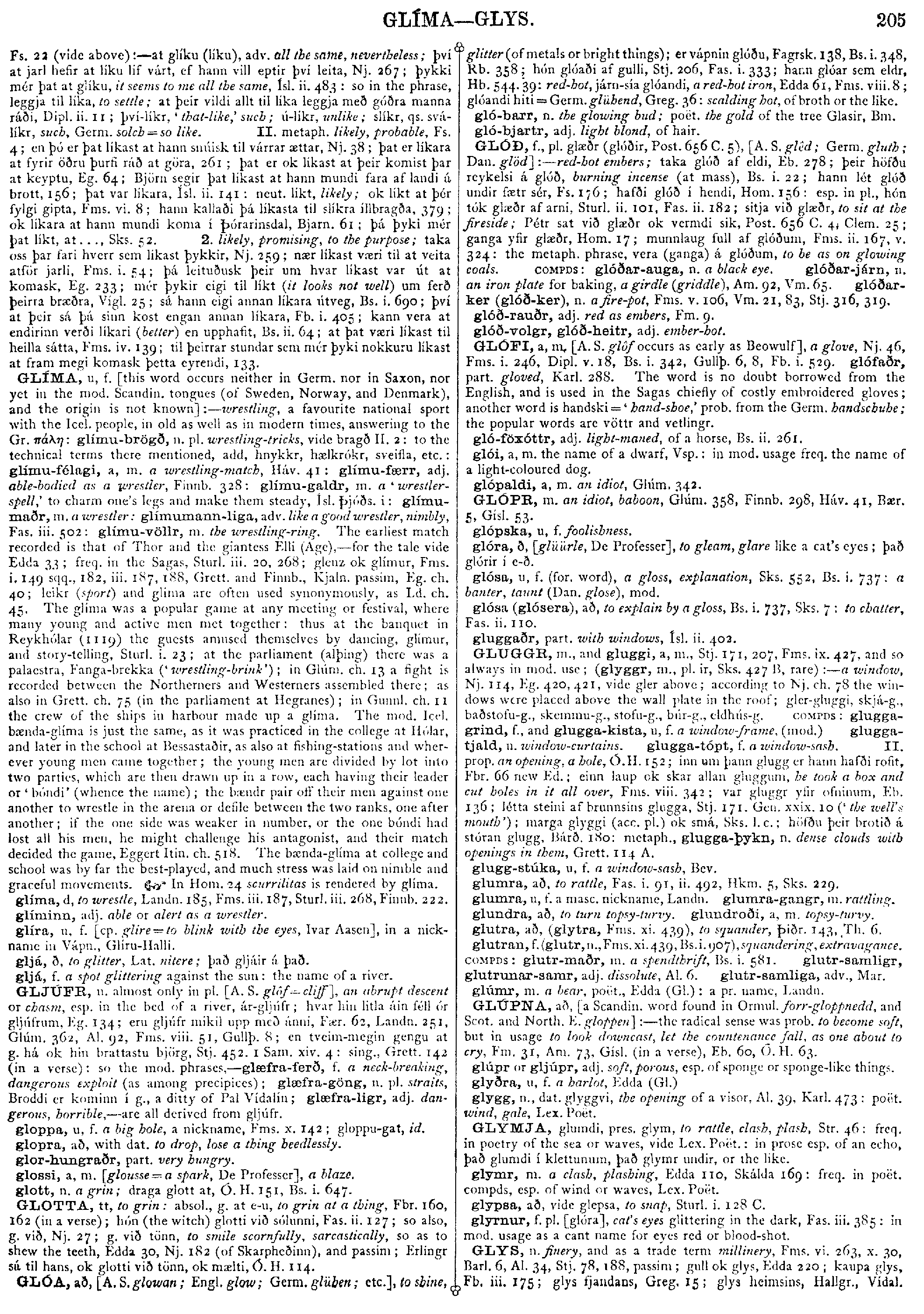
GLÍMA, u, f. [this word occurs neither in Germ. nor in Saxon, nor yet in the mod. Scandin. tongues (of Sweden, Norway, and Denmark), and the origin is not known] :-- wrestling, a favourite national sport with the Icel. people, in old as well as in modern times, answering to the Gr. GREEK: glímu-brögð, n. pl. wrestling-tricks, vide bragð II. 2: to the technical terms there mentioned, add, hnykkr, hælkrókr, sveifla, etc.: glímu-félagi, a, m. a wrestling-match, Háv. 41: glímu-færr, adj. able-bodied as a wrestler, Finnb. 328: glímu-galdr, m. a 'wrestler-spell,' to charm one's legs and make them steady, Ísl. Þjóðs. i: glímu-maðr, m. a wrestler: glímumann-liga, adv. like a good wrestler, nimbly, Fas. iii. 502: glímu-völlr, m. the wrestling-ring. The earliest match recorded is that of Thor and the giantess Elli (Age), -- for the tale vide Edda 33; freq. in the Sagas, Sturl. iii. 20, 268; glenz ok glímur, Fms. i. 149 sqq., 182, iii. 187, 188, Grett. and Finnb., Kjaln. passim, Eg. ch. 40; leikr (sport) and glíma are often used synonymously, as Ld. ch. 45. The glíma was a popular game at any meeting or festival, where many young and active men met together: thus at the banquet in Reykhólar (1119) the guests amused themselves by dancing, glímur, and story-telling, Sturl. i. 23; at the parliament (alþing) there was a palaestra, Fanga-brekka ('wrestling-brink'); in Glúm. ch. 13 a fight is recorded between the Northerners and Westerners assembled there; as also in Grett. ch. 75 (in the parliament at Hegranes); in Gunnl. ch. 11 the crew of the ships in harbour made up a glíma. The mod. Icel. bænda-glíma is just the same, as it was practiced in the college at Hólar, and later in the school at Bessastaðir, as also at fishing-stations and wherever young men came together; the young men are divided by lot into two parties, which are then drawn up in a row, each having their leader or 'bóndi' (whence the name); the bændr pair off their men against one another to wrestle in the arena or defile between the two ranks, one after another; if the one side was weaker in number, or the one bóndi had lost all his men, he might challenge his antagonist, and their match decided the game, Eggert Itin. ch. 518. The bænda-glíma at college and school was by far the best-played, and much stress was laid on nimble and graceful movements. UNCERTAIN In Hom. 24 scurrilitas is rendered by glíma.
|
Source: Cleasby/Vigfusson, page b0260, entry 17 View original page image as: [TIFF] [PNG] [View previous entry] [View next entry] |
[Comment on this entry] [View comments] |
The following entry has been hand-corrected once. |
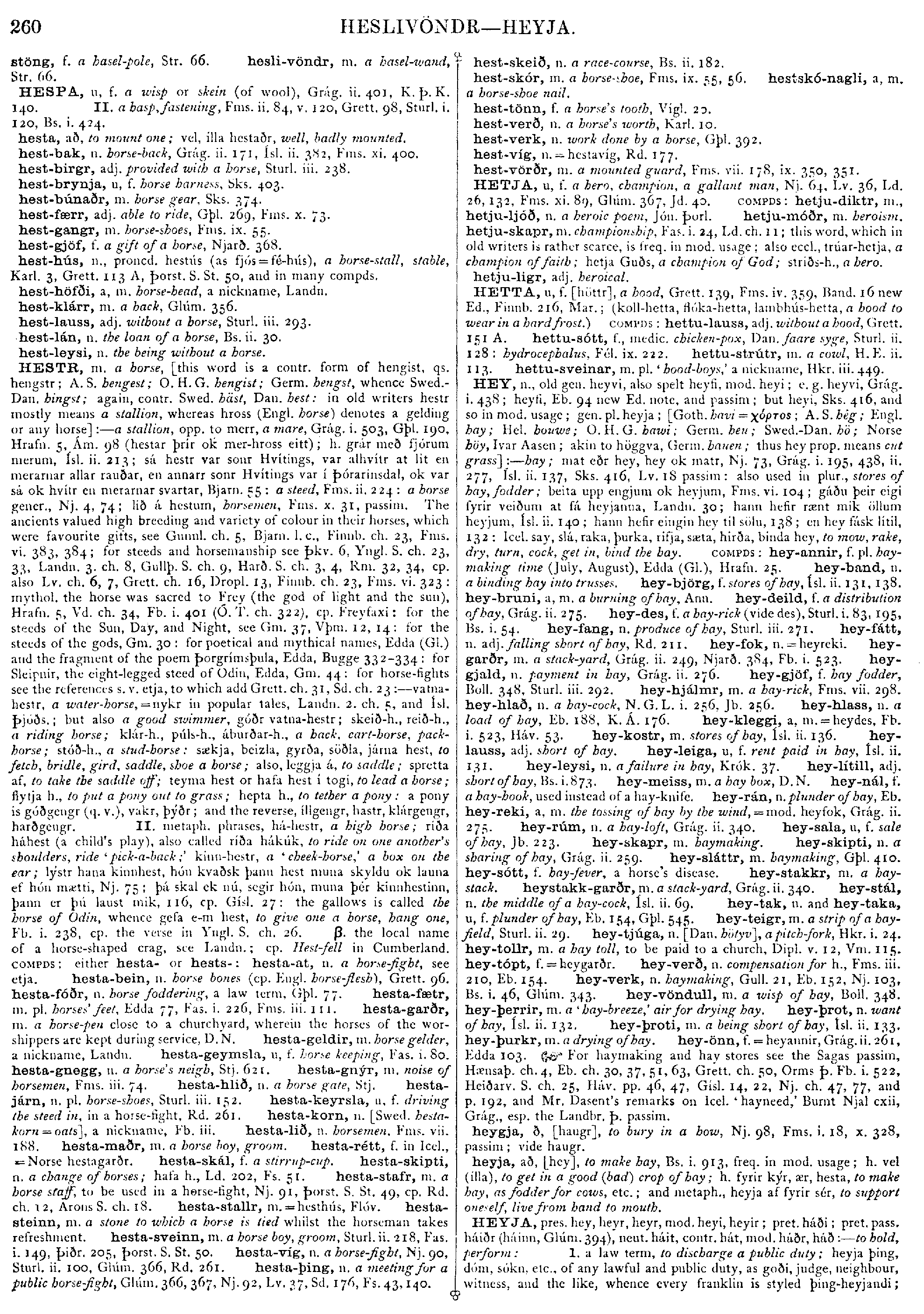
HESTR,
m.
a
horse,
[this
word
is
a
contr.
form
of
hengist,
qs.
hengstr;
A.
S.
hengest;
O.
H.
G.
hengist;
Germ.
hengst,
whence
Swed.-Dan.
hingst;
again,
contr.
Swed.
häst,
Dan.
hest:
in
old
writers
hestr
mostly
means
a
stallion,
whereas
hross
(Engl.
horse)
denotes
a
gelding
or
any
horse]
:--
a
stallion,
opp.
to
merr,
a
mare,
Grág.
i.
503,
Gþl.
190,
Hrafn.
5,
Ám.
98
(hestar
þrír
ok
mer-hross
eitt);
h.
grár
með
fjórum
merum,
Ísl.
ii.
213;
sá
hestr
var
sonr
Hvítings,
var
alhvítr
at
lit
en
merarnar
allar
rauðar,
en
annarr
sonr
Hvítings
var
í
Þórarínsdal,
ok
var
sá
ok
hvítr
en
merarnar
svartar,
Bjarn.
55:
a
steed,
Fms.
ii.
224:
a
horse
gener.,
Nj.
4,
74;
lið
á
hestum,
horsemen,
Fms.
x.
31,
passim.
The
ancients
valued
high
breeding
and
variety
of
colour
in
their
horses,
which
were
favourite
gifts,
see
Gunnl.
ch.
5,
Bjarn.
l.c.,
Finnb.
ch.
23,
Fms.
vi.
383,
384;
for
steeds
and
horsemanship
see
Þkv.
6,
Yngl.
S.
ch.
23,
33,
Landn.
3.
ch.
8,
Gullþ.
S.
ch.
9,
Harð.
S.
ch.
3,
4,
Rm.
32,
34,
cp.
also
Lv.
ch.
6,
7,
Grett.
ch.
16,
Dropl.
13,
Finnb.
ch.
23,
Fms.
vi.
323:
mythol.
the
horse
was
sacred
to
Frey
(the
god
of
light
and
the
sun),
Hrafn.
5,
Vd.
ch.
34,
Fb.
i.
401
(Ó.
T.
ch.
322),
cp.
Freyfaxi:
for
the
steeds
of
the
Sun,
Day,
and
Night,
see
Gm.
37,
Vþm.
12,
14:
for
the
steeds
of
the
gods,
Gm.
30:
for
poetical
and
mythical
names,
Edda
(Gl.)
and
the
fragment
of
the
poem
Þorgrímsþula,
Edda,
Bugge
332-334:
for
Sleipnir,
the
eight-legged
steed
of
Odin,
Edda,
Gm.
44:
for
horse-fights
see
the
references
s.v.
etja,
to
which
add
Grett.
ch.
31,
Sd.
ch.
23
:--
vatna-hestr,
a
water-horse,
=
nykr
in
popular
tales,
Landn.
2.
ch.
5,
and
Ísl.
Þjóðs.;
but
also
a
good
swimmer,
góðr
vatna-hestr;
skeið-h.,
reið-h.,
a
riding
horse;
klár-h.,
púls-h.,
áburðar-h.,
a
hack,
cart-horse,
pack-horse;
stóð-h.,
a
stud-horse:
sækja,
beizla,
gyrða,
söðla,
járna
hest,
to
fetch,
bridle,
gird,
saddle,
shoe
a
horse;
also,
leggja
á,
to
saddle;
spretta
af,
to
take
the
saddle
off;
teyma
hest
or
hafa
hest
í
togi,
to
lead
a
horse;
flytja
h.,
to
put
a
pony
out
to
grass;
hepla
h.,
to
tether
a
pony:
a
pony
is
gúðgengr
(q.v.),
vakr,
þýðr;
and
the
reverse,
íllgengr,
hastr,
klárgengr,
harðgengr.
II.
metaph.
phrases,
há-hestr,
a
high
horse;
ríða
háhest
(a
child's
play),
also
called
ríða
hákúk,
to
ride
on
one
another's
shoulders,
ride
'pick-a-back;'
kinn-hestr,
a
'cheek-horse,'
a
box
on
the
ear;
lýstr
hana
kinnhest,
hón
kvaðsk
þann
hest
muna
skyldu
ok
launa
ef
hón
mætti,
Nj.
75;
þá
skal
ek
nú,
segir
hón,
muna
þér
kinnhestinn,
þann
er
þú
laust
mik,
116,
cp.
Gísl.
27:
the
gallows
is
called
the
horse
of
Odin,
whence
gefa
e-m
hest,
to
give
one
a
horse,
hang
one,
Fb.
i.
238,
cp.
the
verse
in
Yngl.
S.
ch.
26.
 .
the
local
name
of
a
horse-shaped
crag,
see
Landn.;
cp.
Hest-fell
in
Cumberland.
COMPDS:
either
hesta-
or
hests-:
hesta-at,
n.
a
horse-fight,
see
etja.
hesta-bein,
n.
horse
bones
(cp.
Engl.
horse-flesh),
Grett.
96.
hesta-fóðr,
n.
horse
foddering,
a
law
term,
Gþl.
77.
hesta-fætr,
m.
pl.
horses'
feet,
Edda
77,
Fas.
i.
226,
Fms.
iii.
111.
hesta-garðr,
m.
a
horse-pen
close
to
a
churchyard,
wherein
the
horses
of
the
worshippers
are
kept
during
service,
D.
N.
hesta-geldir,
m.
horse
gelder,
a
nickname,
Landn.
hesta-geymsla,
u,
f.
horse
keeping,
Fas.
i.
80.
hesta-gnegg,
n.
a
horse's
neigh,
Stj.
621.
hesta-gnýr,
m,
noise
of
horsemen,
Fms.
iii.
74.
hesta-hlið,
n.
a
horse
gate,
Stj.
hesta-járn,
n.
pl.
horse-shoes,
Sturl.
iii.
152.
hesta-keyrsla,
u,
f.
driving
the
steed
in,
in
a
horse-fight,
Rd.
261.
hesta-korn,
n.
[Swed.
hestakorn
=
oats],
a
nickname,
Fb.
iii.
hesta-lið,
n.
horsemen,
Fms.
vii.
188.
hesta-maðr,
m.
a
horse
boy,
groom.
hesta-rétt,
f.
in
Icel.,
=
Norse
hestagarðr.
hesta-skál,
f.
a
stirrup-cup.
hesta-skipti,
n.
a
change
of
horses;
hafa
h.,
Ld.
202,
Fs.
51.
hesta-stafr,
m.
a
horse
staff,
to
be
used
in
a
horse-fight,
Nj.
91,
Þorst.
S.
St.
49,
cp.
Rd.
ch.
12,
Arons
S.
ch.
18.
hesta-stallr,
m.
=
hesthús,
Flóv.
hesta-steinn,
m.
a
stone
to
whicb
a
horse
is
tied
whilst
the
horseman
takes
refreshment.
hesta-sveinn,
m.
a
horse
boy,
groom,
Sturl.
ii.
218,
Fas.
i.
149,
Þiðr.
205,
Þorst.
S.
St.
50.
hesta-víg,
n.
a
horse-fight,
Nj.
90,
Sturl.
ii.
100,
Glúm.
366,
Rd.
261.
hesta-þing,
n.
a
meeting
for
a
public
horse-fight,
Glúm.
366,
367,
Nj.
92,
Lv.
37,
Sd.
176,
Fs.
43,
140.
.
the
local
name
of
a
horse-shaped
crag,
see
Landn.;
cp.
Hest-fell
in
Cumberland.
COMPDS:
either
hesta-
or
hests-:
hesta-at,
n.
a
horse-fight,
see
etja.
hesta-bein,
n.
horse
bones
(cp.
Engl.
horse-flesh),
Grett.
96.
hesta-fóðr,
n.
horse
foddering,
a
law
term,
Gþl.
77.
hesta-fætr,
m.
pl.
horses'
feet,
Edda
77,
Fas.
i.
226,
Fms.
iii.
111.
hesta-garðr,
m.
a
horse-pen
close
to
a
churchyard,
wherein
the
horses
of
the
worshippers
are
kept
during
service,
D.
N.
hesta-geldir,
m.
horse
gelder,
a
nickname,
Landn.
hesta-geymsla,
u,
f.
horse
keeping,
Fas.
i.
80.
hesta-gnegg,
n.
a
horse's
neigh,
Stj.
621.
hesta-gnýr,
m,
noise
of
horsemen,
Fms.
iii.
74.
hesta-hlið,
n.
a
horse
gate,
Stj.
hesta-járn,
n.
pl.
horse-shoes,
Sturl.
iii.
152.
hesta-keyrsla,
u,
f.
driving
the
steed
in,
in
a
horse-fight,
Rd.
261.
hesta-korn,
n.
[Swed.
hestakorn
=
oats],
a
nickname,
Fb.
iii.
hesta-lið,
n.
horsemen,
Fms.
vii.
188.
hesta-maðr,
m.
a
horse
boy,
groom.
hesta-rétt,
f.
in
Icel.,
=
Norse
hestagarðr.
hesta-skál,
f.
a
stirrup-cup.
hesta-skipti,
n.
a
change
of
horses;
hafa
h.,
Ld.
202,
Fs.
51.
hesta-stafr,
m.
a
horse
staff,
to
be
used
in
a
horse-fight,
Nj.
91,
Þorst.
S.
St.
49,
cp.
Rd.
ch.
12,
Arons
S.
ch.
18.
hesta-stallr,
m.
=
hesthús,
Flóv.
hesta-steinn,
m.
a
stone
to
whicb
a
horse
is
tied
whilst
the
horseman
takes
refreshment.
hesta-sveinn,
m.
a
horse
boy,
groom,
Sturl.
ii.
218,
Fas.
i.
149,
Þiðr.
205,
Þorst.
S.
St.
50.
hesta-víg,
n.
a
horse-fight,
Nj.
90,
Sturl.
ii.
100,
Glúm.
366,
Rd.
261.
hesta-þing,
n.
a
meeting
for
a
public
horse-fight,
Glúm.
366,
367,
Nj.
92,
Lv.
37,
Sd.
176,
Fs.
43,
140.
|
Source: Cleasby/Vigfusson, page b0280, entry 40 View original page image as: [TIFF] [PNG] [View previous entry] [View next entry] |
[Comment on this entry] [View comments] |
The following entry has been hand-corrected once. |
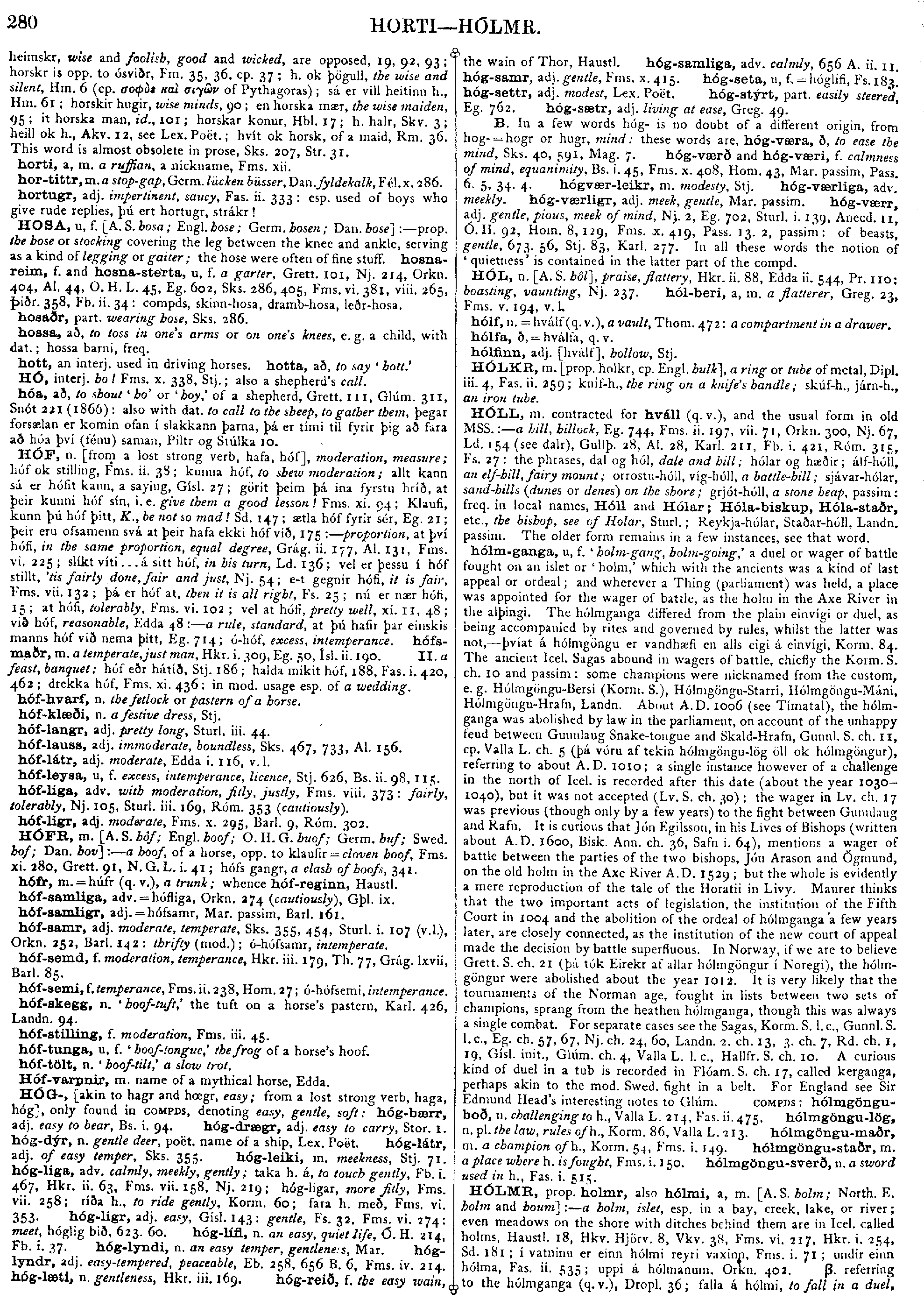
hólm-ganga, u, f. 'holm-gang, holm-going,' a duel or wager of battle fought on an islet or 'holm,' which with the ancients was a kind of last appeal or ordeal; and wherever a Thing (parliament) was held, a place was appointed for the wager of battle, as the holm in the Axe River in the alþingi. The hólmganga differed from the plain einvígi or duel, as being accompanied by rites and governed by rules, whilst the latter was not, -- þvíat á hólmgöngu er vandhæfi en alls eigi á einvígi, Korm. 84. The ancient Icel. Sagas abound in wagers of battle, chiefly the Korm. S. ch. 10 and passim: some champions were nicknamed from the custom, e.g. Hólmgöngu-Bersi (Korm. S.), Hólmgöngu-Starri, Hólmgöngu-Máni, Hólmgöngu-Hrafn, Landn. About A.D. 1006 (see Tímatal), the hólmganga was abolished by law in the parliament, on account of the unhappy feud between Gunnlaug Snake-tongue and Skald-Hrafn, Gunnl. S. ch. 11, cp. Valla L. ch. 5 (þá vóru af tekin hólmgöngu-lög öll ok hólmgöngur), referring to about A.D. 1010; a single instance however of a challenge in the north of Icel. is recorded after this date (about the year 1030-1040), but it was not accepted (Lv. S. ch. 30); the wager in Lv. ch. 17 was previous (though only by a few years) to the fight between Gunnlaug and Rafn. It is curious that Jón Egilsson, in his Lives of Bishops (written about A.D. 1600, Bisk. Ann. ch. 36, Safn i. 64), mentions a wager of battle between the parties of the two bishops, Jón Arason and Ögmund, on the old holm in the Axe River A.D. 1529; but the whole is evidently a mere reproduction of the tale of the Horatii in Livy. Maurer thinks that the two important acts of legislation, the institution of the Fifth Court in 1004 and the abolition of the ordeal of hólmganga a few years later, are closely connected, as the institution of the new court of appeal made the decision by battle superfluous. In Norway, if we are to believe Grett. S. ch. 21 (þá tók Eirekr af allar hólmgöngur í Noregi), the hólmgöngur were abolished about the year 1012. It is very likely that the tournaments of the Norman age, fought in lists between two sets of champions, sprang from the heathen hólmganga, though this was always a single combat. For separate cases see the Sagas, Korm. S. l.c., Gunnl. S. l.c., Eg. ch. 57, 67, Nj. ch. 24, 60, Landn. 2. ch. 13, 3. ch. 7, Rd. ch. 1, 19, Gísl. init., Glúm. ch. 4, Valla L. l.c., Hallfr. S. ch. 10. A curious kind of duel in a tub is recorded in Flóam. S. ch. 17, called kerganga, perhaps akin to the mod. Swed. fight in a belt. For England see Sir Edmund Head's interesting notes to Glúm. COMPDS: hólmgöngu-boð, n. challenging to h., Valla L. 214, Fas. ii. 475. hólmgöngu-lög, n. pl. the law, rules of h., Korm. 86, Valla L. 213. hólmgöngu-maðr, m. a champion of h., Korm. 54, Fms. i. 149. hólmgöngu-staðr, m. a place where h. is fought, Fms. i. 150. hólmgöngu-sverð, n. a sword used in h., Fas. i. 515.
|
Source: Cleasby/Vigfusson, page b0404, entry 100 View original page image as: [TIFF] [PNG] [View previous entry] [View next entry] |
[Comment on this entry] [View comments] |
The following entry has been hand-corrected once. |
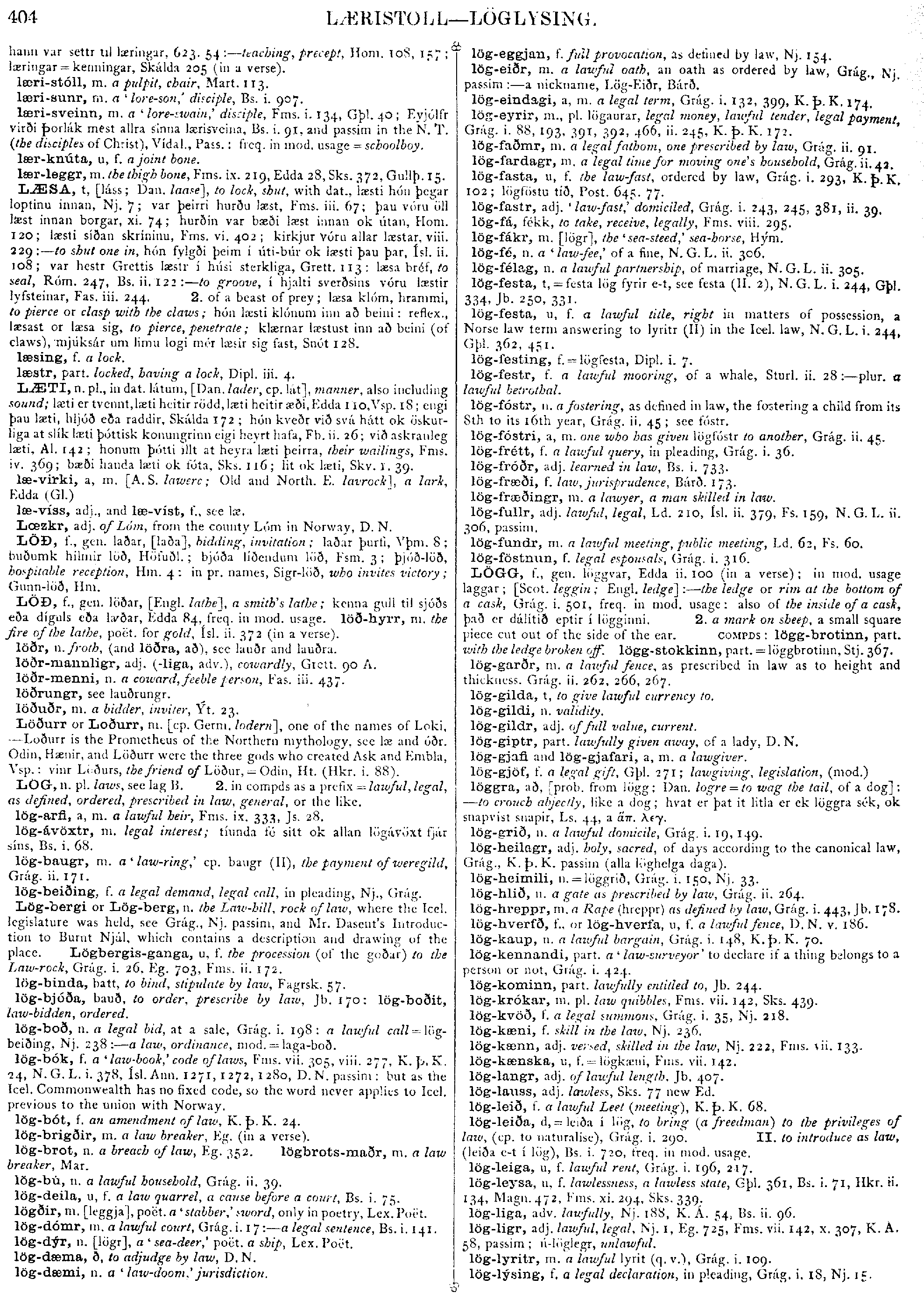
lög-maðr, m. [old Swed. lagman; the president of the supreme court formerly held in Orkney was called the lagman] :-- ' law-man. ' In the ancient Scandinavian kingdoms each legal community or state (log) had its own laws, its own parliament (lögþing), and its own 'law-man' (lagh- mann, logmaðr); the lagman was the first commoner and the spokesman of the people against the king and court at public assemblies or else- where; he was also the guardian of the law, and the president of the legis- lative body and of the law courts. As in the heathen time laws were not written, the lagman had to sry what was the law of the laud in any case of doubt; in the general assemblies, at least in Iceland, he had to ' say the law (from memory) to the assembled people from the Law-hill (LogbergiJ; hence in the Icelandic Commonwealth he was called lög-sögu- jnaðr (q. v.), the ' law-speaker, ' ' law-sayer, ' ' speaker of the law, ' and his office log-saga or lög-sögn =' law-speaking:' 1. Sweden and Gothland in olden times were the classical lands of lagmen, for the whole kingdom was a confederation of commonwealths, each with its parliament, law- speaker, and laws, who were all of them united under one king; see the Various records in the old Swedish laws, Sveriges Gamla Lagar, as edited by Schlyter, as also the classical account given of lagman Thorgny in O. H. ch. 60 sqq. -- í hverri þessi deild landsins er sitt lögþing, ok sin log, yfir hverjum lögum er lögmaðr, ... þat skulu log vera sem hann réð upp at kveða; en ef konungr, eða jarl, eða byskupar fara yfir land ok eigu þing við búendr, þá svarar lögmaðr af hendi búenda ...; aðrir lögmenn allir skulu vera undir-menn þess lögmanns er á Tíunda-landi er, Ö. H. 65. 2. in Norway the political institutions of the old patriarchal ages were greatly disturbed through the wars and conquest of Harald Fairhair; the ancient laws of Norway too have been preserved in a much more fragmentary state than those of Sweden; of some of the most interest- ing laws only the eccl. section has been preserved, often in Icelandic transcripts or abridged. The most interesting records of the lagmen are therefore not to be found in the Norse laws, but in the Sagas, e. g. the debates in the Hák. S. Gamla, ch. 71-80, 85-97 (in the Flatey book), as also in the þinga-þáttr in Fms. vii. 123-150, and in stray passages in the Icelandic Sagas, in such phrases as lögmenn ok konungr, logmenn ok dómendr, lenda menn ok logmenn ok alla aiþyðu, Eg. 352. 3. in the later Middle Age in Norway, and in Icel. after 1280, the lagman was a justice, who presided in the court lögrétta, at the lögþing (II), cp. jb. passim. 4. in the Icelandic Commonwealth, the officer whose duties have been described above was specially called lögsögu- maðr, and lögmaðr is only used = lagamaðr = a lawyer, -- þat er ok, at lögsögumaðí skal svá görla þáttu alla upp segja, at engi viti einna miclogi görr, en ef honum vinsk eigi fróðleikr til þess, þá skal hann eiga stefnu via fimm logmenn (lawyers, men skilled in law), en næstu dægr áðr, eðr fleiri, Grág. i. 2, 3; þat skal allt hafa er finnsk á skrdO þeirri er Hafiiði lét göra ... en þat eitt af annarra lögmajma fyrirsögn (of other lawyers) er eigi mæli því í gegn, 7; Njáll var lögmaðr svá mikill (so ^ reat a lawyer), at eingi fannsk hans jafningi, Nj. 30. At the union with Nor- way (A. D. 1272) the lögsögu-maðr of the Commonwealth was replaced by two lagmen of the Norse kind, so that in the Sagas composed after that date (e. g. the Grettla) or in Sagas preserved in later transcripts, the terms were now and then confounded, and 'lögmaðr' was, by way of anachronism, used of the lögsögu-maðr of the old Commonwealth, cp. Grett. 64, 115, 173, 191 new Ed., Nj. 24, 164, 237 (v. 1.), Eg. 597, Ísl. (Gunnl. S.) ii. 208, 238, 256, Bs. i. (Hungrv.) 62, Fms. iv. 115, 176, where the 0. H. edition has the true reading, being made from a vel- lum of the Commonwealth time. P. two instances are recorded referring to the loth century in Iceland, where a lögmaðr occurs as a kind of county- sheriff" or officer, viz. in the Háv. S. (begin.) and the Svarfdæla S. ch. 10; but both records seem to be spurious and adapted to the state of things in Norway, for neither Saga is preserved in its pure original state, but remoulded after the union; see Maurqr's Entstehung des Ísl. Staates, Beitrage, 136 sqq. In Scandinavia during the Middle Ages, as the power of the king increased, so that of the old lagman sank, and at last died away. In England it is preserved in the Speaker of the House of Commons, whose very name recalls to mind the law- speaker of the old Scandinavian communities. II. a pr. name, Lög-maðr, Orkn. COMPDS: lögmanns-dæmi, n. the jurisdiction of a lagman, Fms. v. 266. lögmanns-eiðr, m. an oath of homage to the king, Gþl. 66. logmarms-lauss, adj. without a lagman, Ann. I39O- lögmanns-úrskurðr, m. a logman's decree, Jb. 170.
|
Source: Cleasby/Vigfusson, page b0534, entry 11 View original page image as: [TIFF] [PNG] [View previous entry] [View next entry] |
[Comment on this entry] [View comments] |
The following entry has been hand-corrected once. |
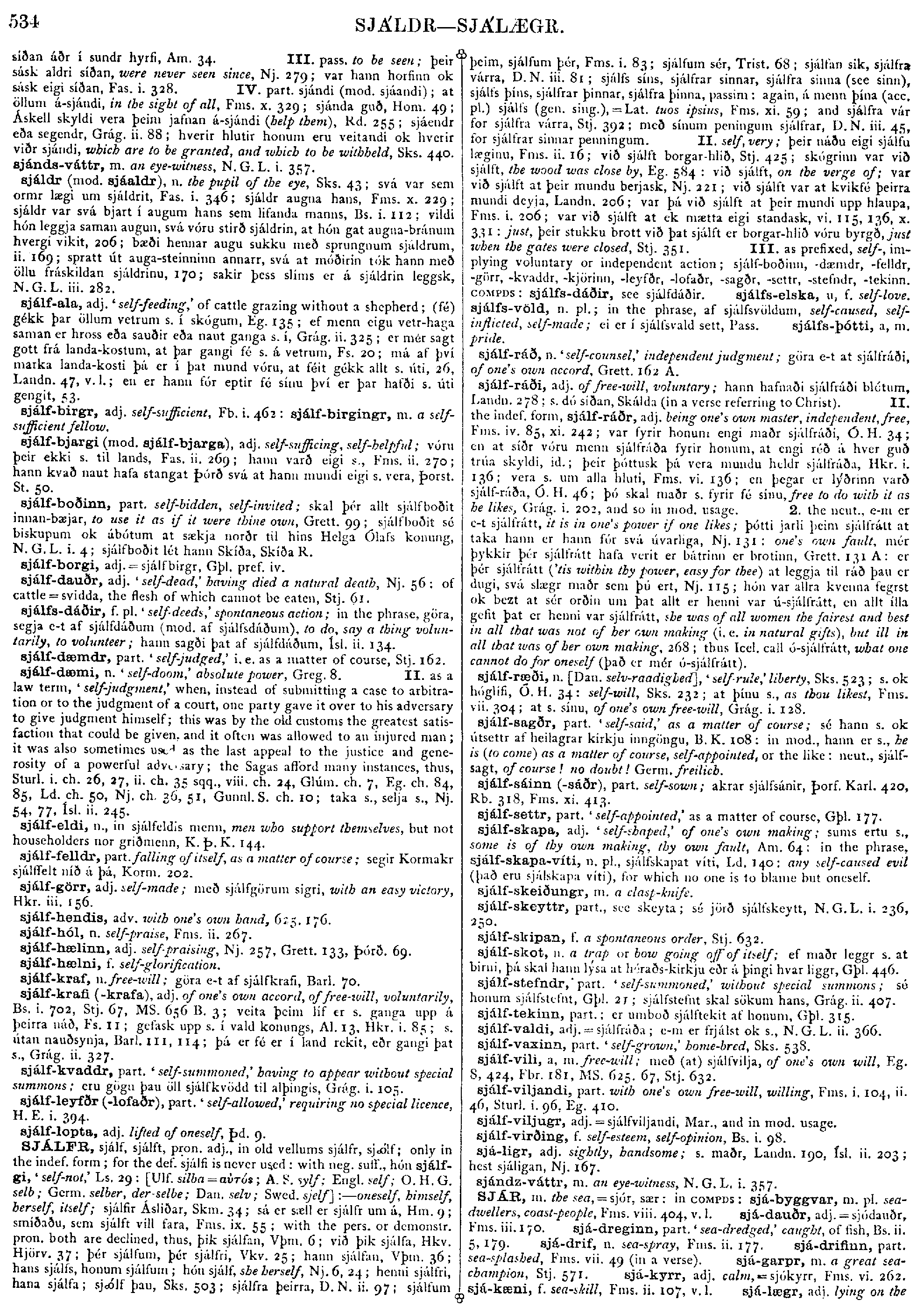
sjálf-dæmi, n. 'self-doom,' absolute power, Greg. 8. II. as a law term, 'self-judgment,' when, instead of submitting a case to arbitration or to the judgment of a court, one party gave it over to his adversary to give judgment himself; this was by the old customs the greatest satisfaction that could be given, and it often was allowed to an injured man; it was also sometimes used as the last appeal to the justice and generosity of a powerful adversary; the Sagas afford many instances, thus, Sturl. i. ch. 26, 27, ii. ch. 35 sqq., viii. ch. 24, Glúm. ch. 7, Eg. ch. 84, 85, Ld. ch. 50, Nj. ch. 36, 51, Gunnl. S. ch. 10; taka s., selja s., Nj. 54, 77, Ísl. ii. 245.
|
Source: Cleasby/Vigfusson, page b0541, entry 13 View original page image as: [TIFF] [PNG] [View previous entry] [View next entry] |
[Comment on this entry] [View comments] |
The following entry has been hand-corrected once. |
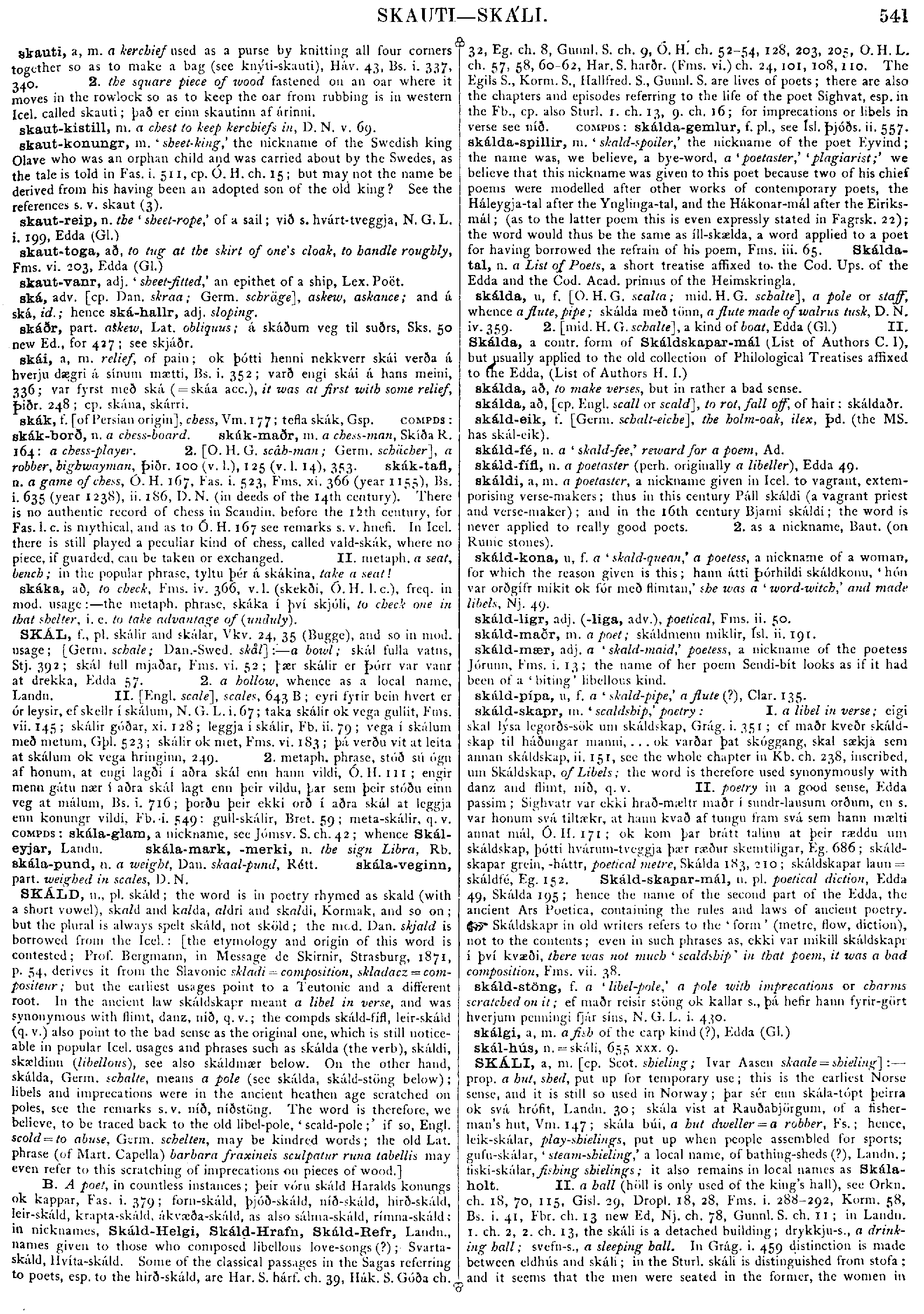
SKÁLD, n., pl. skáld; the word is in poetry rhymed as skald (with a short vowel), skald and kalda, aldri and skaldi, Kormak, and so on; but the plural is always spelt skáld, not sköld; the mod. Dan. skjald is borrowed from the Icel.: [the etymology and origin of this word is contested; Prof. Bergmann, in Message de Skirnir, Strasburg, 1871, p. 54, derives it from the Slavonic skladi = composition, skladacz = compositeur; but the earliest usages point to a Teutonic and a different root. In the ancient law skáldskapr meant a libel in verse, and was synonymous with flimt, danz, níð, q.v.; the compds skáld-fífl, leir-skáld (q.v.) also point to the bad sense as the original one, which is still noticeable in popular Icel. usages and phrases such as skálda (the verb), skáldi, skældinn (libellous), see also skáldmær below. On the other hand, skálda, Germ. schalte, means a pole (sec skálda, skáld-stöng below); libels and imprecations were in the ancient heathen age scratched on poles, see the remarks s.v. níð, níðstöng. The word is therefore, we believe, to be traced back to the old libel-pole, 'scald-pole;' if so, Engl. scold = to abuse, Germ. schelten, may be kindred words; the old Lat. phrase (of Mart. Capella) barbara fraxineis sculpatur runa tabellis may even refer to this scratching of imprecations on pieces of wood.] B. A poet, in countless instances; þeir vóru skáld Haralds komings ok kappar, Fas. i. 379; forn-skáld, þjóð-skáld, níð-skáld, hirð-skáld, leir-skáld, krapta-skáld, ákvæða-skáld, as also sálma-skáld, rímna-skáld; in nicknames, Skáld-Helgi, Skáld-Hrafn, Skáld-Refr, Landn., names given to those who composed libellous love-songs(?); Svarta-skáld, Hvíta-skúld. Some of the classical passages in the Sagas referring to poets, esp. to the hirð-skáld, are Har. S. hárf. ch. 39, Hák. S. Góða ch. 32, Eg. ch. 8, Gunnl. S. ch. 9, Ó.H. ch. 52-54, 128, 203, 205, O.H.L. ch. 57, 58, 60-62, Har. S. harðr. (Fms. vi.) ch. 24, 101, 108, 110. The Egils S., Korm. S., Hallfred. S., Gunnl. S. are lives of poets; there are also the chapters and episodes referring to the life of the poet Sighvat, esp. in the Fb., cp. also Sturl. 1. ch. 13, 9. ch. 16; for imprecations or libels in verse see níð. COMPDS: skálda-gemlur, f. pl., see Ísl. Þjóðs. ii. 557. skálda-spillir, m. 'skald-spoiler,' the nickname of the poet Eyvind; the name was, we believe, a bye-word, a 'poetaster,' 'plagiarist;' we believe that this nickname was given to this poet because two of his chief poems were modelled after other works of contemporary poets, the Háleygja-tal after the Ynglinga-tal, and the Hákonar-mál after the Eiriks-mál; (as to the latter poem this is even expressly stated in Fagrsk. 22); the word would thus be the same as íll-skælda, a word applied to a poet for having borrowed the refrain of his poem, Fms. iii. 65. Skálda-tal, n. a List of Poets, a short treatise affixed to. the Cod. Ups. of the Edda and the Cod. Acad. primus of the Heimskringla.
|
Source: Cleasby/Vigfusson, page b0541, entry 30 View original page image as: [TIFF] [PNG] [View previous entry] [View next entry] |
[Comment on this entry] [View comments] |
The following entry has been hand-corrected once. |
SKÁLI, a, m. [cp. Scot. shieling; Ivar Aasen skaale = shieling] :-- prop. a hut, shed, put up for temporary use; this is the earliest Norse sense, and it is still so used in Norway; þar sér enn skála-tópt þeirra ok svá hrófit, Landn. 30; skála vist at Rauðabjörgum, of a fisherman's hut, Vm. 147; skála búi, a hut dweller = a robber, Fs.; hence, leik-skálar, play-shielings, put up when people assembled for sports; gufu-skálar, 'steam-shieling' a local name, of bathing-sheds(?), Landn.; fiski-skálar, fishing shielings; it also remains in local names as Skála-holt. II. a hall (höll is only used of the king's hall), see Orkn. ch. 18, 70, 115, Gísl. 29, Dropl. 18, 28, Fms. i. 288-292, Korm. 58, Bs. i. 41, Fbr. ch. 13 new Ed, Nj. ch. 78, Gunnl. S. ch. 11; in Landn. 1. ch. 2, 2. ch. 13, the skáli is a detached building; drykkju-s., a drinking hall; svefn-s., a sleeping hall. In Grág. i. 459 distinction is made between eldhús and skáli; in the Sturl. skáli is distinguished from stofa; and it seems that the men were seated in the former, the women in
|
Source: Cleasby/Vigfusson, page b0773, entry 42 View original page image as: [TIFF] [PNG] [View previous entry] [View next entry] |
[Comment on this entry] [View comments] |
The following entry has been hand-corrected once. |
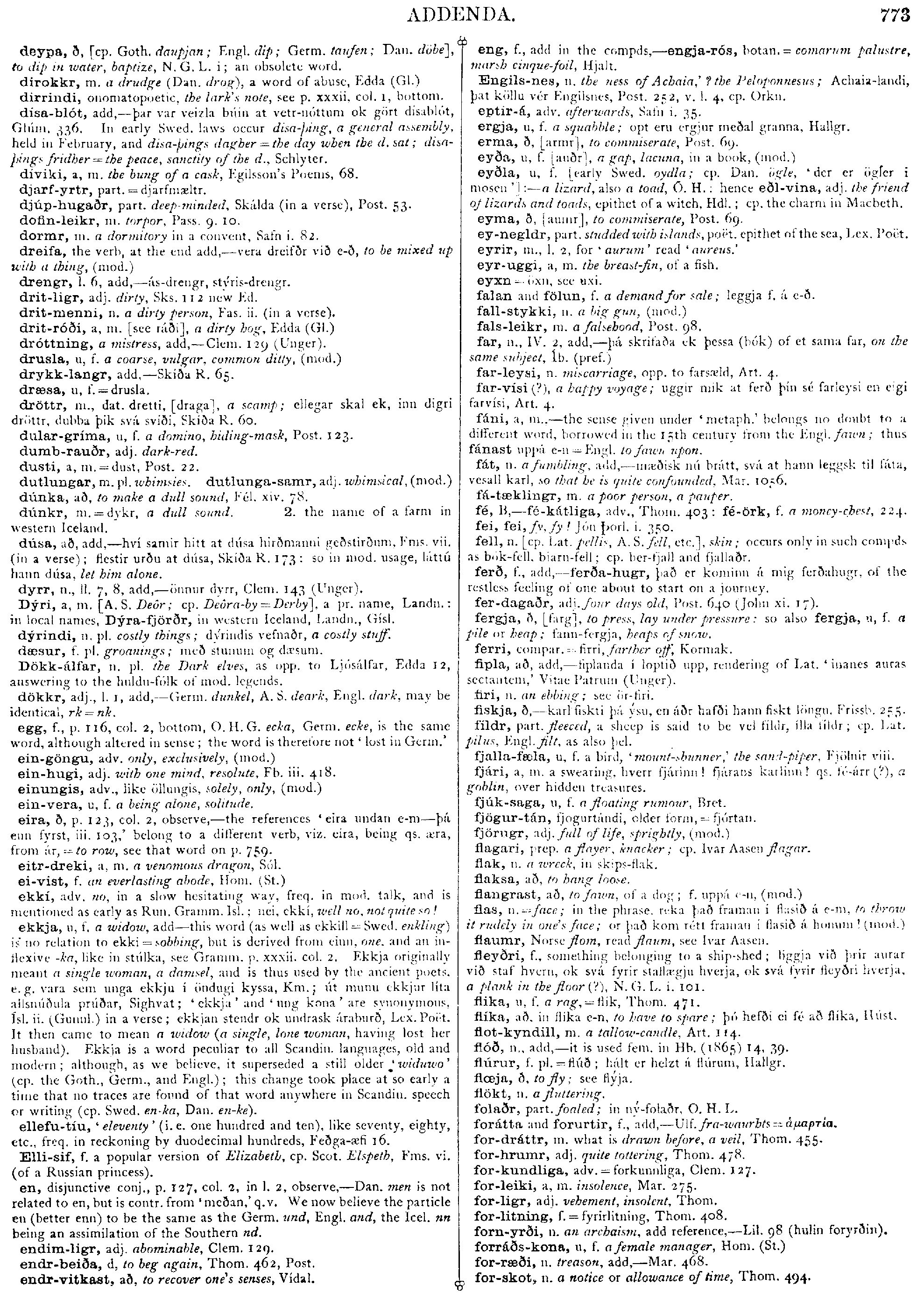
ekkja, u, f. a widow, add -- this word (as well as ekkill = Swed. enkling) is no relation to ekki = sobbing, but is derived from einn, one, and an inflexive -ka, like in stúlka, see Gramm. p. xxxii. col. 2. Ekkja originally meant a single woman, a damsel, and is thus used by the ancient poets, e.g. vara sem unga ekkju í öndugi kyssa, Km.; út munu ekkjur líta allsnúðula prúðar, Sighvat; 'ekkja' and 'ung kona' are synonymous, Ísl. ii. (Gunnl.) in a verse; ekkjan stendr ok undrask áraburð, Lex. Poët. It then came to mean a widow (a single, lone woman, having lost her husband). Ekkja is a word peculiar to all Scandin. languages, old and modern; although, as we believe, it superseded a still older 'widuwo' (cp. the Goth., Germ., and Engl.); this change took place at so early a time that no traces are found of that word anywhere in Scandin. speech or writing (cp. Swed. en-ka, Dan. en-ke).
| Result Page: |  |
Previous | 1 2 |
Germanic Lexicon Project (main page)
This search system was written by
Sean Crist
Please consider
volunteering
to correct the data in these online dictionaries.
No rights reserved. Feel free to use these data in any way you please.