|
|

|
Source: Cleasby/Vigfusson, page b0602, entry 26 View original page image as: [TIFF] [PNG] [View previous entry] [View next entry] |
[Comment on this entry] [View comments] |
The following entry has been hand-corrected once. |
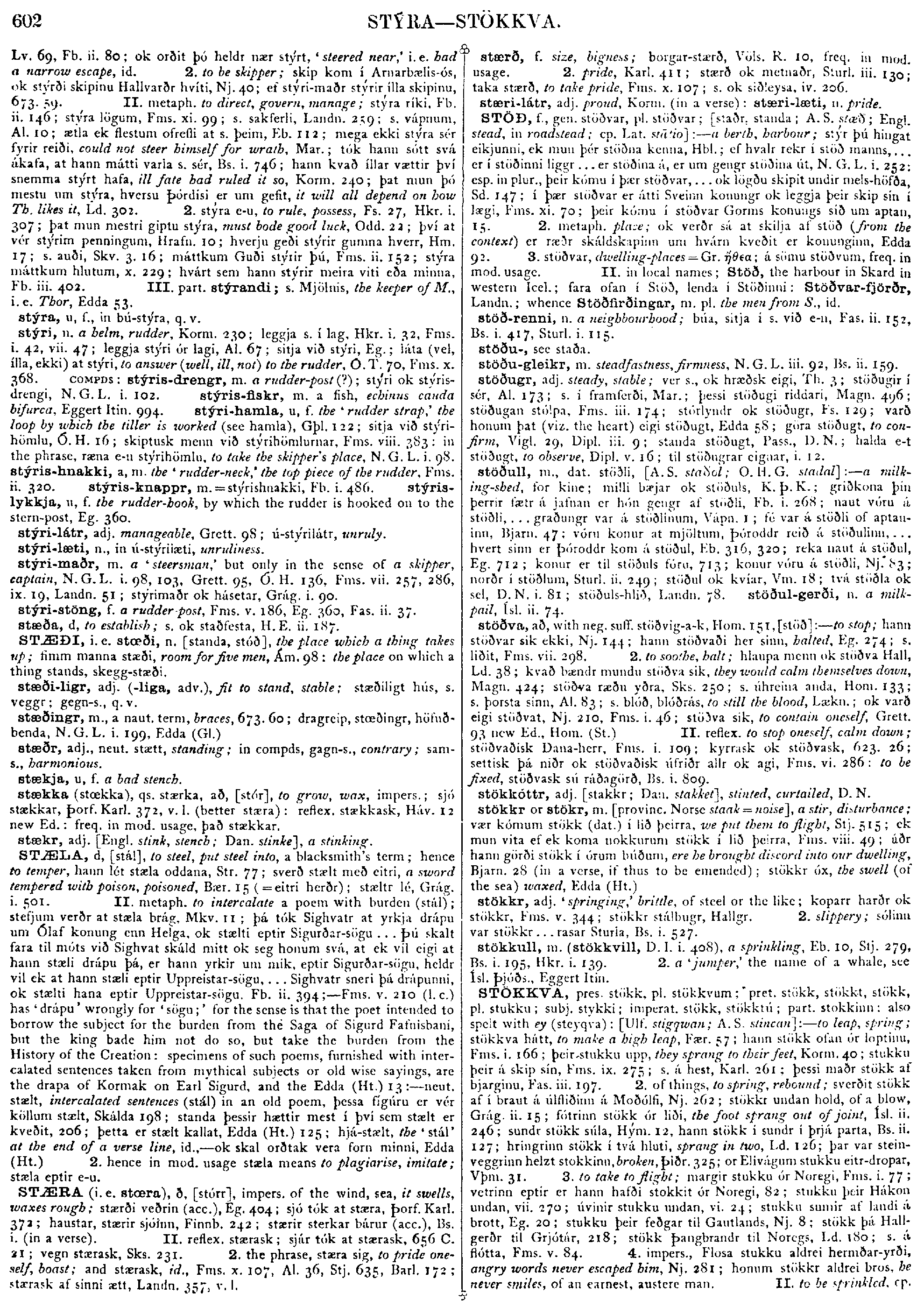
stöðva, að, with neg. suff. stöðvig-a-k, Hom, 151, [stöð] :-- to stop; hann stöðvar sik ekki, Nj. 144; hann stöðvaði her sinn, halted, Eg. 274; s. liðit, Fms. vii. 298. 2. to soothe, halt; hlaupa menn ok stöðva Hall, Ld. 38; kvað bændr mundu stöðva sik, they would calm themselves down, Magn. 424; stöðva ræðu yðra, Sks. 250; s. úhreina anda, Hom. 133; s. þorsta sinn, Al. 83; s. blóð, blóðrás, to still the blood, Lækn.; ok varð eigi stöðvat, Nj. 210, Fms. i. 46; stöðva sik, to contain oneself, Grett. 93 new Ed., Hom. (St.) II. reflex. to stop oneself, calm down; stöðvaðisk Dana-herr, Fms. i. 109; kyrrask ok stöðvask, 623. 26; settisk þá niðr ok stöðvaðisk úfriðr allr ok agi, Fms. vi. 286: to be fixed, stöðvask sú ráðagörð, Bs. i. 809.
|
Source: Cleasby/Vigfusson, page b0722, entry 1 View original page image as: [TIFF] [PNG] [View previous entry] [View next entry] |
[Comment on this entry] [View comments] |
The following entry has been hand-corrected once. |
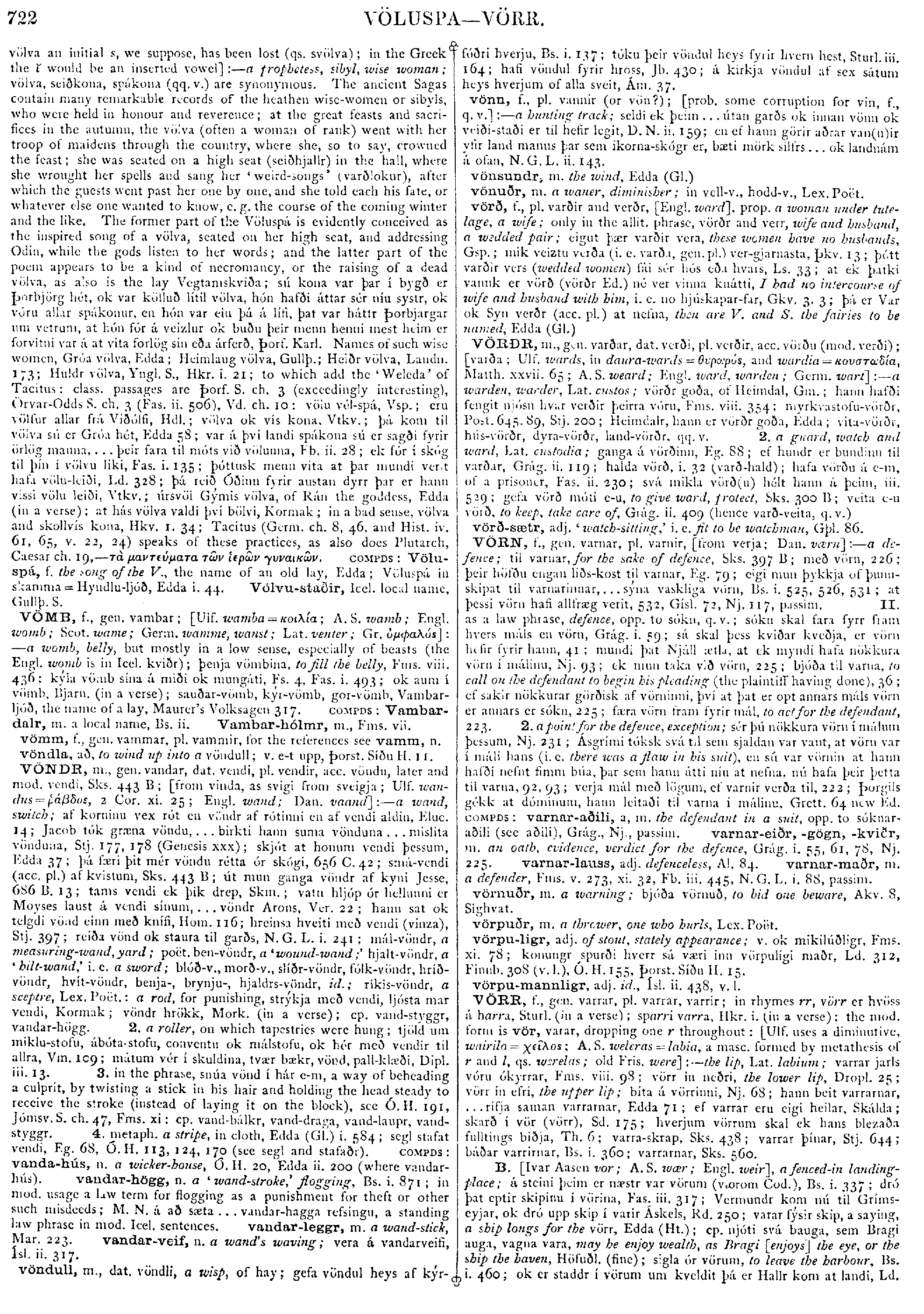
völva
an
initial
s,
we
suppose,
has
been
lost
(qs.
svölva);
in
the
Greek
the
 would
be
an
inserted
vowel]
:--
a
prophetess,
sibyl,
wise
woman;
vöa,
seiðkona,
spákona
(qq.v.)
are
synonymous.
The
ancient
Sagas
contain
many
remarkable
records
of
the
heathen
wise-women
or
sibyls,
who
were
held
in
honour
and
reverence;
at
the
great
feasts
and
sacrifices
in
the
autumn,
the
völva
(often
a
woman
of
rank)
went
with
her
troop
of
maidens
through
the
country,
where
she,
so
to
say,
crowned
the
feast;
she
was
seated
on
a
high
seat
(seiðhjallr)
in
the
hall,
where
she
wrought
her
spells
and
sang
her
'weird-songs'
(varðlokur),
after
which
the
guests
went
past
her
one
by
one,
and
she
told
each
his
fate,
or
whatever
else
one
wanted
to
know,
e.g.
the
course
of
the
coming
winter
and
the
like.
The
former
part
of
the
Völuspá
is
evidently
conceived
as
the
inspired
song
of
a
völva,
seated
on
her
high
seat,
and
addressing
Odin,
while
the
gods
listen
to
her
words;
and
the
latter
part
of
the
poem
appears
to
be
a
kind
of
necromancy,
or
the
raising
of
a
dead
völva,
as
also
is
the
lay
Vegtamskviða;
sú
kona
var
þar
í
bygð
er
Þorbjörg
hét,
ok
var
kölluð
lítil
völva,
hón
hafði
áttar
sér
níu
systr,
ok
vóru
allar
spákonur,
en
hón
var
ein
þá
á
lífi,
þat
var
háttr
Þorbjargar
um
vetrum,
at
hón
fór
á
veizlur
ok
buðu
þeir
menn
henni
mest
heim
er
forvitni
var
á
at
vita
forlög
sín
eða
árferð,
Þorf.
Karl.
Names
of
such
wise
women,
Gróa
völva,
Edda;
Heimlaug
völva,
Gullþ.;
Heiðr
völva,
Landn.
173;
Huldr
völva,
Yngl.
S.,
Hkr.
i.
21;
to
which
add
the
'Weleda'
of
Tacitus:
class.
passages
are
Þorf.
S.
ch.
3
(exceedingly
interesting),
Örvar-Odds
S.
ch.
3
(Fas.
ii.
506),
Vd.
ch.
10:
völu
vél-spá,
Vsp.;
eru
völfur
allar
frá
Víðólfi,
Hdl.;
völva
ok
vís
kona.
Vtkv.;
þá
kom
til
völva
sú
er
Gróa
hét,
Edda
58;
var
á
því
landi
spákona
sú
er
sagði
fyrir
örlög
manna,
...
þeir
fara
til
móts
við
völunna,
Fb.
ii.
28;
ek
fór
í
skóg
til
þín
í
völvu
líki,
Fas.
i.
135;
þóttusk
menn
vita
at
þar
mundi
verst
hafa
völu-leiði,
Ld.
328;
þá
reið
Óðinn
fyrir
austan
dyrr
þar
er
hann
vissi
völu
leiði,
Vtkv.;
úrsvöl
Gýmis
völva,
of
Rán
the
goddess,
Edda
(in
a
verse);
at
hás
völva
valdi
því
bölvi,
Kormak;
in
a
bad
sense,
völva
and
skollvis
kona,
Hkv.
1.
34;
Tacitus
(Germ.
ch.
8,
46,
and
Hist.
iv.
61,
65,
v.
22,
24)
speaks
of
these
practices,
as
also
does
Plutarch,
Caesar
ch.
19,
--
GREEK.
COMPDS:
Völu-spá,
f.
the
song
of
the
V.,
the
name
of
an
old
lay,
Edda;
Völuspá
in
skamma
=
Hyndlu-ljóð,
Edda
i.
44.
Völvu-staðir,
Icel.
local
name,
Gullþ.
S.
would
be
an
inserted
vowel]
:--
a
prophetess,
sibyl,
wise
woman;
vöa,
seiðkona,
spákona
(qq.v.)
are
synonymous.
The
ancient
Sagas
contain
many
remarkable
records
of
the
heathen
wise-women
or
sibyls,
who
were
held
in
honour
and
reverence;
at
the
great
feasts
and
sacrifices
in
the
autumn,
the
völva
(often
a
woman
of
rank)
went
with
her
troop
of
maidens
through
the
country,
where
she,
so
to
say,
crowned
the
feast;
she
was
seated
on
a
high
seat
(seiðhjallr)
in
the
hall,
where
she
wrought
her
spells
and
sang
her
'weird-songs'
(varðlokur),
after
which
the
guests
went
past
her
one
by
one,
and
she
told
each
his
fate,
or
whatever
else
one
wanted
to
know,
e.g.
the
course
of
the
coming
winter
and
the
like.
The
former
part
of
the
Völuspá
is
evidently
conceived
as
the
inspired
song
of
a
völva,
seated
on
her
high
seat,
and
addressing
Odin,
while
the
gods
listen
to
her
words;
and
the
latter
part
of
the
poem
appears
to
be
a
kind
of
necromancy,
or
the
raising
of
a
dead
völva,
as
also
is
the
lay
Vegtamskviða;
sú
kona
var
þar
í
bygð
er
Þorbjörg
hét,
ok
var
kölluð
lítil
völva,
hón
hafði
áttar
sér
níu
systr,
ok
vóru
allar
spákonur,
en
hón
var
ein
þá
á
lífi,
þat
var
háttr
Þorbjargar
um
vetrum,
at
hón
fór
á
veizlur
ok
buðu
þeir
menn
henni
mest
heim
er
forvitni
var
á
at
vita
forlög
sín
eða
árferð,
Þorf.
Karl.
Names
of
such
wise
women,
Gróa
völva,
Edda;
Heimlaug
völva,
Gullþ.;
Heiðr
völva,
Landn.
173;
Huldr
völva,
Yngl.
S.,
Hkr.
i.
21;
to
which
add
the
'Weleda'
of
Tacitus:
class.
passages
are
Þorf.
S.
ch.
3
(exceedingly
interesting),
Örvar-Odds
S.
ch.
3
(Fas.
ii.
506),
Vd.
ch.
10:
völu
vél-spá,
Vsp.;
eru
völfur
allar
frá
Víðólfi,
Hdl.;
völva
ok
vís
kona.
Vtkv.;
þá
kom
til
völva
sú
er
Gróa
hét,
Edda
58;
var
á
því
landi
spákona
sú
er
sagði
fyrir
örlög
manna,
...
þeir
fara
til
móts
við
völunna,
Fb.
ii.
28;
ek
fór
í
skóg
til
þín
í
völvu
líki,
Fas.
i.
135;
þóttusk
menn
vita
at
þar
mundi
verst
hafa
völu-leiði,
Ld.
328;
þá
reið
Óðinn
fyrir
austan
dyrr
þar
er
hann
vissi
völu
leiði,
Vtkv.;
úrsvöl
Gýmis
völva,
of
Rán
the
goddess,
Edda
(in
a
verse);
at
hás
völva
valdi
því
bölvi,
Kormak;
in
a
bad
sense,
völva
and
skollvis
kona,
Hkv.
1.
34;
Tacitus
(Germ.
ch.
8,
46,
and
Hist.
iv.
61,
65,
v.
22,
24)
speaks
of
these
practices,
as
also
does
Plutarch,
Caesar
ch.
19,
--
GREEK.
COMPDS:
Völu-spá,
f.
the
song
of
the
V.,
the
name
of
an
old
lay,
Edda;
Völuspá
in
skamma
=
Hyndlu-ljóð,
Edda
i.
44.
Völvu-staðir,
Icel.
local
name,
Gullþ.
S.
|
Source: Cleasby/Vigfusson, page b0775, entry 32 View original page image as: [TIFF] [PNG] [View previous entry] [View next entry] |
[Comment on this entry] [View comments] |
The following entry has been hand-corrected once. |
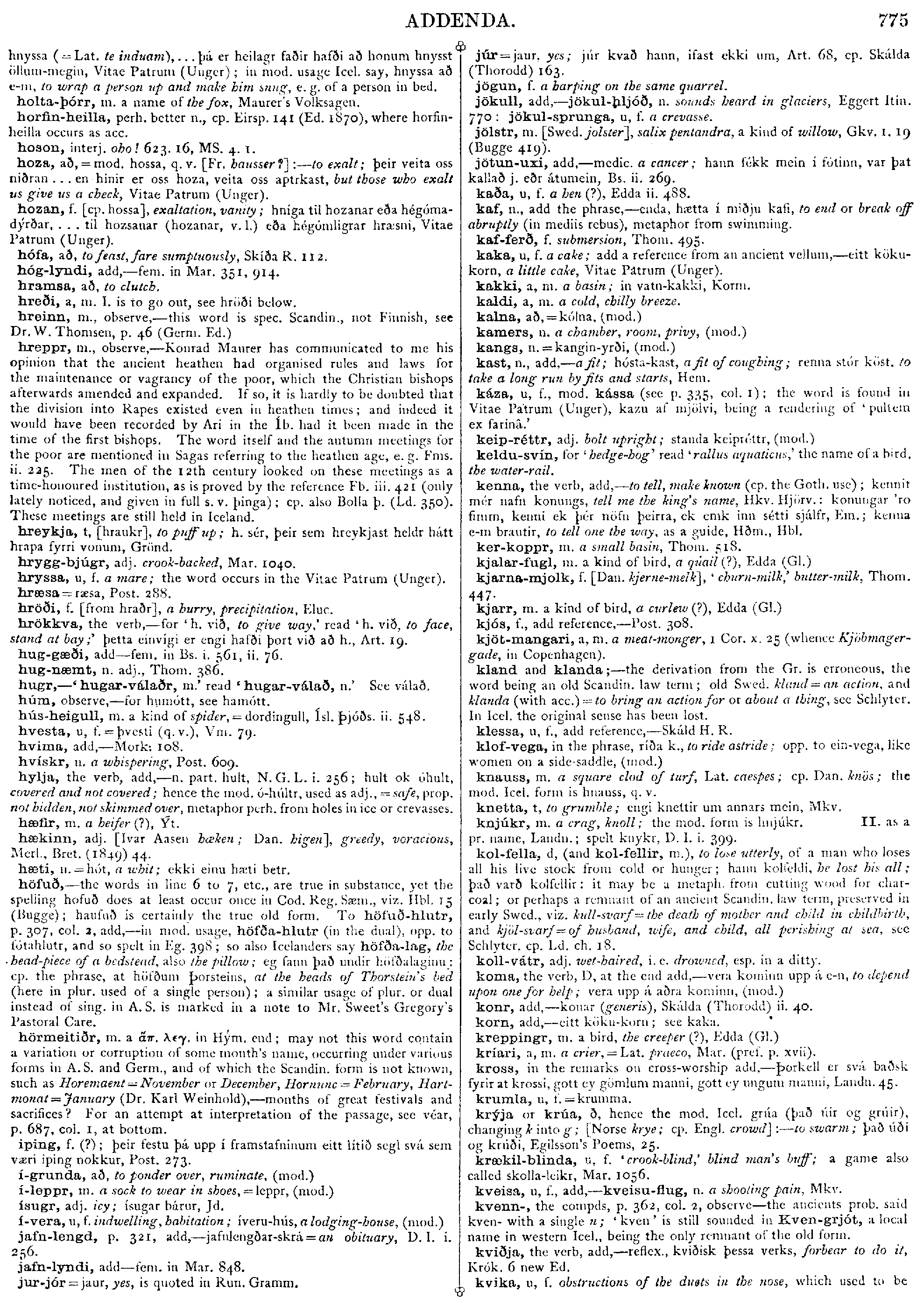
hörmeitiðr, m. a GREEK. in Hým. end; may not this word contain a variation or corruption of some month's name, occurring under various forms in A.S. and Germ., and of which the Scandin. form is not known, such as Horemaent = November or December, Hornunc = February, Hartmonat = January (Dr. Karl Weinhold), -- months of great festivals and sacrifices? For an attempt at interpretation of the passage, see véar, p. 687, col. 1, at bottom.
| Result Page: |  |
Previous | 1 2 3 4 |
Germanic Lexicon Project (main page)
This search system was written by
Sean Crist
Please consider
volunteering
to correct the data in these online dictionaries.
No rights reserved. Feel free to use these data in any way you please.